Finding the best rangefinders for bow hunting is not the same exercise as picking one for rifle season. Bowhunters operate inside 80 yards. Every single yard matters. A two-yard error at 45 yards can mean the difference between a double-lung pass-through and a gut shot — or a clean miss entirely. We spent the better part of last fall running three top-tier rangefinders through real treestand sits, spot-and-stalk scenarios, and 3D course sessions to find out which ones actually deliver when it counts.
Below you will find our quick picks, a deep dive into each unit, a buying guide tailored specifically to archery, and answers to the questions bowhunters ask most. If you want to understand how we evaluate gear, check out our Benchmark Score system. For more optics content, visit the hunting optics hub.
Quick Picks
- Best Overall: Sig Sauer KILO 3000BDX — Unmatched Bluetooth ballistic integration and razor-sharp angle compensation. The rangefinder we reach for first.
- Best Value: Leupold RX-2800 TBR/W — Proven TBR/W engine, rock-solid reliability, and a price that won’t destroy your gear budget. Hard to beat for dedicated bowhunters.
- Best for Long-Range Versatility: Vortex Fury HD 5000 AB — Binocular-rangefinder hybrid that handles everything from 10-yard bow shots to 1,000-yard rifle work. Overkill for archery alone, perfect if you hunt multiple seasons.
Why Rangefinders Matter More for Bow Hunters
Rifle hunters can get away with a rough distance estimate. A 300-yard shot versus a 310-yard shot with a modern bolt gun is functionally identical in terms of bullet drop. Archery is a completely different animal.
Arrow trajectories are dramatically parabolic. At 40 yards, most compounds are dropping the arrow roughly 20-25 inches below the line of sight. Move that to 45 yards and the drop jumps to 30+ inches. That five-yard difference — the kind of error a mediocre rangefinder or a hasty guess produces — translates to a hit location shift that can turn an ethical shot into a wounded animal.
Then factor in angle. Bowhunters shoot from elevated treestands, downhill slopes, and steep canyon edges far more often than rifle hunters do at archery distances. A target 30 yards away on a flat range becomes a very different shot when you are 25 feet up in a tree. Without true horizontal distance (what your arrow actually experiences in terms of gravity’s pull), your pin selection will be wrong. Period.
This is why angle-compensated rangefinders are not optional for serious bowhunters. They are mandatory equipment. Every unit on this list includes robust angle compensation, but the way each model handles it — and how fast it delivers that number — varies significantly.
We also want to be blunt about something: the rangefinder market is flooded with cheap units that claim one-yard accuracy but deliver two-to-three-yard variance in real conditions. We tested these three because they consistently returned accurate, repeatable readings under field conditions — fog, rain, low light, cold fingers, fast-moving scenarios where you have seconds to range and shoot.
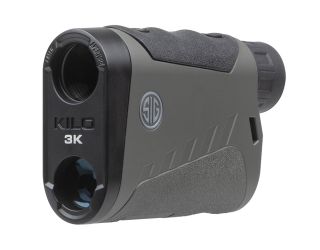
Sig Sauer KILO 3000BDX
Best for: Bowhunters who want the most technologically advanced rangefinding system available and are willing to pay for it.
The Sig Sauer KILO 3000BDX is the rangefinder we kept reaching for all season, and it was not because of brand loyalty. The BDX (Ballistic Data Xchange) ecosystem sets this unit apart from everything else on the market. Pair it with the free Sig BDX app, input your exact arrow speed, arrow weight, and broadhead configuration, and the KILO delivers a precise holdover value — not just a yardage number. For bowhunters running a multi-pin sight, it tells you which pin to use. For single-pin shooters, it gives you the exact dial-to yardage corrected for angle, temperature, and pressure.
In our field testing, the KILO 3000BDX returned readings in under half a second on reflective targets and roughly 0.7 seconds on deer-sized animals in timber. That speed matters when a buck is crossing a shooting lane and you have a three-second window to range, confirm the distance, and draw. The HyperScan mode, which updates four times per second as you pan across a scene, is genuinely useful for spot-and-stalk situations where you need to range multiple landmarks quickly to plan a stalk route.
Accuracy was outstanding. We tested it against a laser-verified 3D course and the KILO was within half a yard at every station from 10 to 80 yards. Angle compensation was dead-on from a 22-foot treestand across dozens of readings at varying distances and angles. The AMR (Angle Modified Range) display is clean and easy to read in the small OLED viewfinder, and the red display illumination works well in both bright daylight and the low-light conditions of early morning sits. Build quality is excellent — the magnesium housing feels durable without being heavy, and the unit survived several accidental drops onto frozen ground without issue. Battery life lasted the entire archery season on a single CR2 cell with moderate use, which is better than we expected given the Bluetooth radio.
The downside is price. The KILO 3000BDX sits at the top of the rangefinder market, and some bowhunters will understandably balk at spending this much on a ranging device. If you do not plan to use the BDX app integration, a significant portion of what makes this unit special goes unused, and you may be better served by the Leupold below.
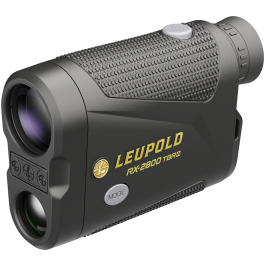
Leupold RX-2800 TBR/W
Best for: Bowhunters who want proven, no-nonsense angle compensation and legendary Leupold reliability without paying flagship prices.
Leupold’s True Ballistic Range with Wind (TBR/W) technology has been the gold standard for angle-compensated rangefinding for over a decade, and the RX-2800 is its best implementation yet. Where the Sig leans into app integration and connected ecosystems, the Leupold takes the opposite approach: everything you need is built into the unit itself, no phone required.
We appreciate that philosophy for bowhunting specifically. Archery season often means early-season warmth with sweaty hands, late-season cold with gloved fingers, and the general reality that fumbling with a phone in a treestand at dawn is not ideal. The RX-2800 lets you set your bow’s ballistic profile directly on the unit using Leupold’s archery mode. Once configured, every reading you take is automatically corrected for angle and displays the true horizontal equivalent distance. The interface is straightforward — press the button, read the number, pick your pin. Done.
In terms of raw performance, the RX-2800 was marginally slower than the Sig in our testing — roughly 0.8 to 1.0 seconds for a reliable reading on non-reflective targets in timber. Still fast enough for virtually any bowhunting scenario, but if you are the type who obsesses over tenths of a second, the Sig has an edge. Accuracy was functionally identical: within one yard at every distance we tested from 10 to 80 yards, and the TBR/W angle compensation matched the Sig’s AMR reading-for-reading from our treestand testing stations.
The OLED display is bright, crisp, and easy to read. The rubber-armored housing is waterproof and feels like it could handle years of hard use — which tracks with Leupold’s reputation. We also like that it runs on a single CR2 battery and sips power conservatively. One small complaint: the eyecup design is adequate but not as comfortable as the Sig’s for extended glassing sessions. For quick-range-and-done bowhunting use, this is irrelevant. For someone who also uses their rangefinder to scan and observe, it is worth noting.
At roughly two-thirds the price of the KILO 3000BDX, the RX-2800 TBR/W is the smart money pick for dedicated bowhunters who want elite-tier accuracy without the premium of a connected ecosystem they may never use. This is the unit we recommend most often to hunters who ask us what to buy.
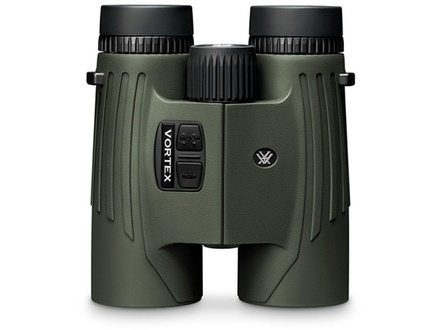
Vortex Fury HD 5000 AB
Best for: Hunters who split their year between archery and rifle seasons and want a single optic that does both jobs at a high level.
The Vortex Fury HD 5000 AB is a fundamentally different product than the other two on this list. It is a full-size 10x42 binocular with an integrated laser rangefinder — not a compact monocular you clip to your harness. That distinction matters enormously for how you use it and who it is for.
For a pure bowhunter who never picks up a rifle, the Fury is probably overkill. It is heavier, bulkier, and more expensive than a dedicated compact rangefinder. But if you are like a lot of us — chasing elk with a bow in September, sitting a rifle stand for whitetail in November, and calling coyotes in January — the Fury eliminates the need to carry separate binoculars and a rangefinder. That is real weight savings and real simplification of your kit.
The optical quality is genuinely impressive for a rangefinder-bino hybrid. The HD glass delivers sharp, bright images with minimal chromatic aberration. We used the Fury for extended glassing sessions during early-season elk hunts and never felt like we were compromising on glass quality for the sake of the integrated rangefinder. Low-light performance is strong — not quite at the level of dedicated premium binos like the Razor HD, but well ahead of most mid-tier options.
The rangefinder engine itself maxes out at 5,000 yards on reflective targets, which is absurd for archery but speaks to its rifle-season capability. On deer-sized targets, we reliably got readings out to 1,800 yards. For bow work, the Applied Ballistics (AB) integration with angle compensation performed well inside 100 yards — consistently within one yard of our control measurements. The AB system lets you load a full ballistic profile, and Vortex’s archery mode simplifies this for bow setups.
Ranging speed was the slowest of the three units in our testing at roughly 1.0 to 1.3 seconds for a confirmed reading in timber, though the difference is academic for most bowhunting situations. The bigger practical consideration is the form factor: ranging from a binocular requires a slightly different workflow than grabbing a compact unit off your chest. You glass, you range, you set down the binos, you draw. Some hunters prefer this; others find it slower than having a dedicated compact rangefinder clipped within instant reach.
Build quality is outstanding, as expected from Vortex. The ArmorTek coating handles abuse, the unit is fully waterproof, and the VIP warranty means you are covered for life. Battery life is good but not exceptional — the larger display and more powerful laser draw more current than the compact units, so carrying a spare CR2 is advisable for extended backcountry trips.
We recommend the Fury HD 5000 AB specifically for multi-season hunters who want to consolidate their kit. If archery is your only game, the Sig or Leupold will serve you better at a lower price and weight.
What to Look for in a Bow Hunting Rangefinder
Choosing a rangefinder for archery is not as simple as picking the one with the longest max range or the lowest price. Here is what actually matters, ranked by importance for bowhunters specifically.
Angle Compensation Is Non-Negotiable
We said it above and we will say it again: if a rangefinder does not offer angle-compensated distance, do not buy it for bow hunting. The line-of-sight distance to a target below your treestand is always longer than the true horizontal distance your arrow will travel under gravity. Shooting the line-of-sight yardage will cause you to shoot high — sometimes dramatically so. Every serious bowhunting rangefinder on the market includes this feature, but the quality and speed of the calculation varies. Look for units that display the compensated distance as the primary reading, not a secondary number you have to toggle to find.
Speed of Reading
When a mature buck steps into a shooting lane, you may have two to four seconds to range him before he is gone. A rangefinder that takes 1.5 seconds to return a reading is too slow for fast-developing bowhunting situations. We look for sub-one-second acquisition on non-reflective targets at typical archery distances. All three units on this list meet that standard, but cheaper models often do not.
Accuracy Inside 100 Yards
Most rangefinder marketing focuses on maximum range — 2,800 yards, 5,000 yards, and so on. Bowhunters do not care about max range. We care about precision at 15 to 80 yards. A unit that is accurate to one yard at 1,000 yards might still show two-to-three-yard variance at 40 yards if it is optimized for long-range rifle use. Always look for reviews (like ours) that specifically test close-range accuracy, because that is the only range band that matters for archery.
Display Readability
You will be using your rangefinder in pre-dawn darkness, in bright midday sun, and in the dappled light of thick timber. The display needs to be readable in all conditions without fiddling with brightness settings. OLED displays with automatic brightness adjustment are the current gold standard. Red illumination tends to be easier to read in low light than black LCD displays.
Size, Weight, and Ergonomics
A bow hunter’s hands are often gloved, cold, sweaty, or shaking with adrenaline. The rangefinder needs to be operable with one hand, quickly, under imperfect conditions. Compact monocular designs that clip to a chest harness or tether to your treestand are the most practical form factor for archery. Rubber armor, a textured grip surface, and a button that is easy to find by feel without looking down are all important details that separate good designs from frustrating ones.
Battery Life
Archery seasons are long. Early-season whitetail through late-season can span four months in some states. A rangefinder that eats batteries means you are either carrying spares or risking a dead unit when it matters most. CR2 batteries are the industry standard. We expect a minimum of several hundred actuations per battery, and the better units deliver a full season of moderate use on a single cell.
Weatherproofing
You will hunt in rain, snow, fog, and condensation-heavy mornings. Your rangefinder needs to be at minimum IPX4 water-resistant, and ideally fully waterproof with nitrogen purging to prevent internal fogging. Every unit on this list meets this standard, but budget models often cut corners here.
Frequently Asked Questions
Do I really need a rangefinder for bow hunting?
Yes. We consider a quality rangefinder the single most important accessory a bowhunter can own after the bow itself. Even experienced archers who are skilled at estimating distance make errors under the pressure of a live hunting situation. A two-to-three-yard estimation mistake that would be inconsequential with a rifle can result in a wounded animal with a bow. The investment in a reliable rangefinder is an investment in ethical hunting.
What is angle compensation and why does it matter?
Angle compensation (sometimes called True Ballistic Range, Angle Modified Range, or similar brand-specific terms) calculates the true horizontal distance to your target rather than the line-of-sight distance. When you shoot at a steep downward angle from a treestand, the straight-line distance to the deer is longer than the horizontal distance your arrow actually needs to travel. If you use the uncorrected distance, you will aim too high. Angle compensation gives you the correct number to use for pin selection.
Can I use a golf rangefinder for bow hunting?
Technically, yes — some golf rangefinders will give you a yardage reading on a deer. But we strongly advise against it. Most golf rangefinders lack angle compensation, which is critical for treestand hunting. They are also optimized for ranging flags and pins (highly reflective) rather than animals (non-reflective), so performance on game tends to be significantly worse. Additionally, golf rangefinders are rarely waterproof or built to handle the abuse of field use. Spend the money on a purpose-built hunting unit.
How far should a bow hunting rangefinder work?
For archery, you need reliable, accurate readings from 10 to 100 yards. Most quality hunting rangefinders will range reflective targets out to 1,000+ yards and non-reflective targets to several hundred yards, which is far more than you need for bow work. Do not get caught up in max-range spec wars. Focus on accuracy and speed at close range instead.
Is the Sig Sauer BDX system worth the extra cost?
If you are a tech-forward hunter who enjoys optimizing your setup and wants precise holdover data rather than just a distance number, the BDX system is genuinely impressive and worth the premium. If you are a traditional-minded hunter who just wants a fast, accurate yardage reading to pick a pin, the Leupold RX-2800 gives you 95% of the practical benefit at a meaningfully lower price. Neither answer is wrong — it depends on how you hunt.
How often should I range landmarks while sitting in a treestand?
We range key landmarks immediately after settling into the stand — the base of specific trees, trail intersections, scrapes, and the edges of our shooting lanes. We note or memorize these distances so that when an animal appears, we already know the approximate distance and only need a quick confirmation range. This practice dramatically reduces the time between spotting an animal and being ready to shoot, and it serves as a backup if your rangefinder fails or you cannot get to it in time.
Can I use one rangefinder for both bow and rifle hunting?
Absolutely, and two of our three picks — the Sig KILO 3000BDX and the Vortex Fury HD 5000 AB — excel at this dual role. Both allow you to store separate ballistic profiles for your bow and rifle setups and switch between them. The Leupold RX-2800 TBR/W also supports both archery and rifle modes. If you only hunt with a bow, the Leupold’s simplicity and price make it the strongest pick. If you hunt multiple seasons with different weapons, the Sig or Vortex offer more flexibility.
Quick Buy — Products in This Article