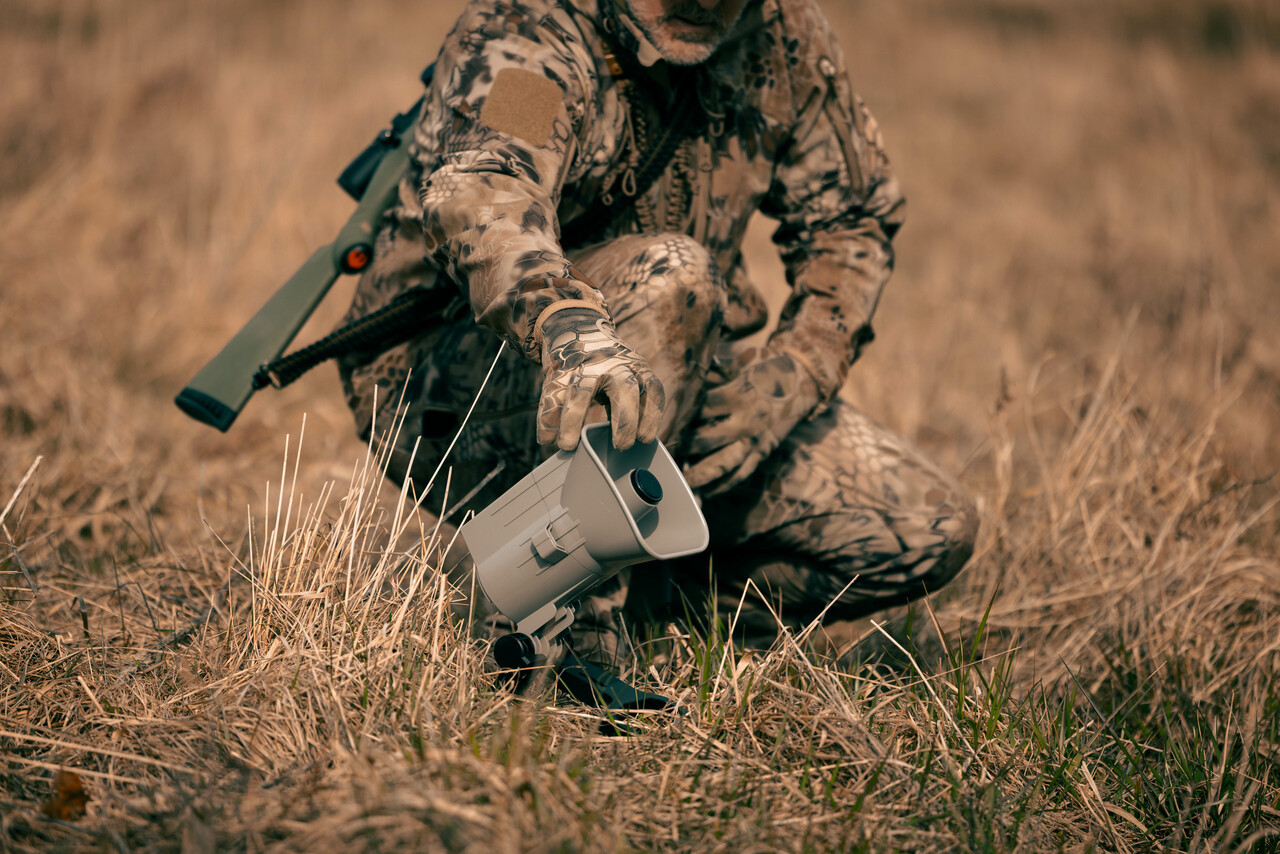
Picking the best electronic predator call for coyote hunting is one of the highest-leverage gear decisions you can make. A quality e-caller does something no mouth call ever will — it puts convincing sound 100+ yards away from your position, pulling incoming coyotes away from you and into a clean shooting lane. We spent the better part of a season running four of the most popular electronic callers through real stands across the Midwest and Southern Plains, testing them in everything from dead-calm mornings to 25 mph crosswinds. Every caller on this list earned its spot through our Benchmark Score system, which evaluates sound quality, remote range, sound library, durability, and battery life under actual hunting conditions.
Whether you are running a trapline, managing livestock predation, or just love the chess match of calling coyotes, this roundup covers every price point and use case worth considering in 2026. For more coverage on predator hunting gear and tactics, visit our predator hunting hub.
Quick Picks: Our Top 4 Electronic Predator Calls
Here is the short version for hunters who already know what they need:
- FOXPRO Shockwave — Best overall e-caller. Unmatched sound quality, absurd remote range, and the deepest sound library in the business.
- FOXPRO X2S — Best compact option. Surprisingly powerful speaker output in a small, packable frame built for hunters who cover ground.
- ICOtec GC500 — Best value. Programmable, loud, and reliable at a price point that makes sense for hunters who call hard and call often.
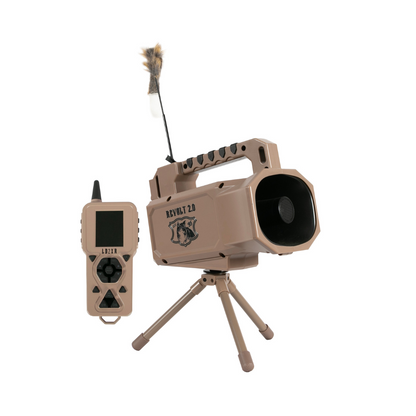
- Lucky Duck Revolt — Best for beginners. Simple operation, solid sound library, and a remote system that just works without a learning curve.
Why an Electronic Caller Changes the Game
If you have only called coyotes with a mouth call, switching to an electronic caller will fundamentally change how you set up and how many dogs you put on the ground. The advantage is not about being lazy — it is about separation, versatility, and consistency.
Separation is everything. When you blow a mouth call, the sound originates from your exact position. Every coyote responding is walking straight toward you, which means they are looking directly at your setup and more likely to hang up or bust you before you get a shot. An e-caller lets you place the sound source 50 to 200 yards away from your position. Incoming coyotes focus on the caller, not on you. This creates better shot angles, reduces the chance of getting winded, and gives you more time to make a clean, ethical shot. On open ground where cover is limited, this single advantage is worth the price of admission.
Sound variety keeps coyotes honest. A skilled mouth caller can produce a handful of convincing sounds. A quality e-caller gives you hundreds. You can run a cottontail distress sequence for ten minutes, transition to pup distress, layer in a coyote howl, and finish with a woodpecker distress — all without moving, all with seamless transitions. Coyotes in pressured areas learn to associate certain sounds with danger. Having a deep, varied sound library means you always have something they have not heard before. We have called in coyotes on sounds we never would have tried with a mouth call simply because we had the option loaded and nothing else was working.
Consistency matters on cold mornings. Mouth calling in single-digit temperatures is miserable. Your lips go numb, reeds freeze, and your calling quality degrades over a long stand. An electronic caller sounds exactly the same whether it is 80 degrees or minus 10. It never gets tired, never gets sloppy, and never coughs at the wrong moment. On those brutal January morning stands where coyote fur is prime and your face is frozen, a reliable e-caller keeps producing while you focus on spotting and shooting.
Hands-free operation lets you stay on the gun. With a remote-controlled caller, you can adjust volume, switch sounds, and trigger sequences without taking your hands off your rifle or your eyes off the landscape. When a coyote appears at 300 yards and is closing fast, the last thing you want to do is put down a mouth call and scramble for your gun. A remote in your pocket or clipped to your vest means you are always ready.
None of this means mouth calls are obsolete. We still carry a howler and a distress call as backups on every stand, and there are situations where a subtle mouth call finishes a hung-up coyote that an e-caller cannot. But for the primary calling tool on a serious coyote setup, an electronic caller is a force multiplier that makes you more effective on every single stand.
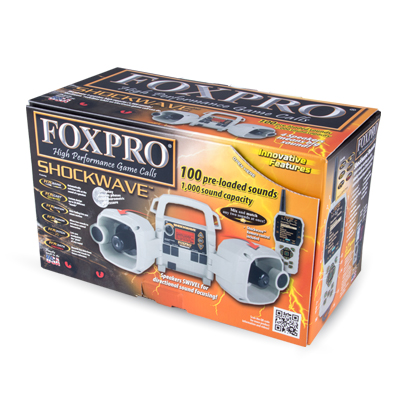
FOXPRO Shockwave
Best for: Experienced coyote hunters who want the absolute best sound quality, remote range, and sound library — no compromises.
The FOXPRO Shockwave is the caller we kept reaching for when conditions were tough, stands were competitive, and we needed everything working at the highest level. It is the flagship of the FOXPRO lineup, and it earns that status with performance that no other caller on this list matches across the board.
Sound quality on the Shockwave is in a class of its own. The dual-speaker system pumps out rich, full-frequency audio that sounds convincingly natural at distances where other callers start to sound tinny or distorted. We A/B tested the Shockwave against every caller in this roundup by playing the same cottontail distress sound at matched volume levels, and the difference was immediately apparent. The low-end warmth and midrange clarity that the Shockwave produces make distress calls sound like an actual animal in pain, not a recording being played through a speaker. At high volume settings, the sound carries without the harsh clipping that plagues single-speaker units. We had coyotes responding from over 600 yards on calm mornings — not just acknowledging the sound, but committing and closing the distance at a run.
Remote range is outstanding. FOXPRO rates the Shockwave’s TX-1000 remote at over 300 yards, and in our testing across open terrain, we consistently got reliable signal transmission well beyond that. In rolling prairie with moderate terrain interference, we maintained solid control at 200+ yards with no signal drops or lag. The remote itself is intuitive once you spend thirty minutes learning the menu system. You can scroll through sounds, adjust volume independently on each speaker, and program sequences on the fly. The backlit display is easy to read in low light without giving away your position.
The Shockwave ships with over 350 FOXPRO sounds, and their library is the industry standard for a reason. Every sound is recorded from real animals in real situations, and the quality of the source recordings shows in the field. You can also load custom sounds via USB, which is a feature serious callers will use. We loaded several coyote vocalizations recorded from local packs and found they outperformed generic howls in our area — educated coyotes responded to familiar voices more aggressively.
Battery life exceeded expectations. Running on eight AA lithium batteries, we got consistent performance through multi-stand days without a battery change. On a particularly productive day where we ran eleven stands in a row, the Shockwave was still going strong at full volume on stand eleven. The built-in battery meter on the remote gives you reliable readings so you are never caught off guard.
The trade-off is price and size. The Shockwave is the most expensive caller in this roundup and the largest unit to carry. If you are hiking miles into public land, the added weight and bulk matter. But for hunters who drive to their stands or do not mind packing a bit more gear for a lot more performance, the Shockwave is the benchmark that every other caller is measured against.
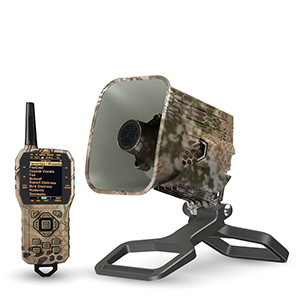
FOXPRO X2S
Best for: Mobile hunters who cover a lot of ground and need a compact, lightweight caller that still delivers serious speaker output.
The FOXPRO X2S is proof that you do not need a full-size caller to bring quality sound to the field. This compact unit weighs roughly a pound and fits easily in a cargo pocket or the side pouch of a hunting pack, which makes it the go-to caller for hunters who walk into their stands, run-and-gun public land, or simply do not want to haul a large speaker box across rough terrain.
Do not let the size fool you — the X2S pushes an impressive amount of volume through its single high-performance speaker. On calm mornings, we had coyotes responding from 400+ yards with no trouble. The sound profile is slightly thinner than the dual-speaker Shockwave, which is expected from a single-driver unit, but FOXPRO has tuned the frequency response to prioritize the midrange tones that matter most for distress calls and coyote vocalizations. Cottontail distress, jackrabbit distress, and pup sounds all come through clean and convincing. At maximum volume there is some compression on the lowest frequencies, but it is subtle enough that coyotes do not seem to care.
The X2S ships with 75 preloaded FOXPRO sounds and supports expansion to over 400 sounds via their free programming utility. The remote is a simplified version of the TX-1000, offering reliable range out to about 150 yards in open terrain. That is shorter than the Shockwave, but for the run-and-gun style of hunting where this caller excels, 150 yards of remote range is more than adequate — you are placing the caller 50 to 100 yards out and setting up tight anyway.
Battery life is solid for the form factor. Running on four AA batteries, we consistently got 4 to 5 hours of active calling, which covers a full morning or evening of stand-hopping with room to spare. We recommend lithium batteries for cold-weather hunts, as alkalines drop off noticeably below 20 degrees.
The X2S is the caller we grabbed most often when plans involved hitting public land walk-in areas, scouting new permission spots, or calling from horseback on large ranches. It is not going to out-blast the Shockwave on a wide-open section of pasture, but it brings 80% of the performance in a package that is half the size and considerably easier on the wallet. For hunters who prioritize mobility without sacrificing sound quality, the X2S is the best compact e-caller we have tested.
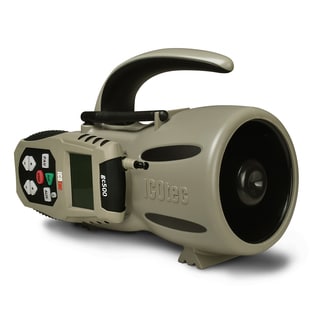
ICOtec GC500
Best for: High-volume callers who want a programmable, capable unit at a price that does not sting when it takes a beating in the field.
The ICOtec GC500 has earned a massive following among serious predator callers, and after running it through a full season alongside the FOXPRO units, we understand why. This caller hits an aggressive sweet spot between performance and price that makes it easy to recommend to anyone who calls regularly and does not want to baby their equipment.
Sound quality on the GC500 is genuinely good. The dual speakers produce loud, clear audio with solid projection across open terrain. It does not match the Shockwave’s nuanced frequency response, but the gap is smaller than the price difference suggests. Distress calls carry well and sound convincing at the volumes that matter for field use. We called in multiple coyotes on stands where the GC500 was the only caller in play, and at no point did we feel like we were leaving dogs in the field because of the sound quality.
The GC500’s standout feature is its programmability. You can load up to 200 sounds and build custom calling sequences that play automatically — transitioning between sounds, adjusting volume ramps, and cycling through a stand’s worth of calling without touching the remote. For hunters who run methodical, timed stand sequences, this is a powerful capability. We programmed a 20-minute stand sequence that started with low-volume locator howls, ramped into cottontail distress at medium volume, and finished with aggressive coyote pup distress at full blast. Running that sequence identically on every stand eliminated a variable and let us focus entirely on scanning and shooting.
Remote range is reliable to about 200 yards in open conditions. The remote handset is large but straightforward — big buttons that work with gloves, a clear display, and a logical menu structure. There is no steep learning curve here. You will be running stands confidently after your first outing.
Battery life is a strong point. The GC500 runs on eight AA batteries and delivered consistent 6+ hour performance in our testing, including in cold conditions where other callers lost steam. The rugged housing has survived being dropped in frozen creek beds, bounced around in truck beds, and knocked over by curious cattle without complaint.
At its price point — significantly under the FOXPRO flagship models — the GC500 is the caller we recommend to hunters who call 50+ stands a season and need a unit that is tough, reliable, programmable, and loud enough to reach out across big country. It is not the most refined caller on this list, but it might be the most practical.
Lucky Duck Revolt
Best for: Hunters new to electronic calling who want a reliable, simple unit that produces results without a steep learning curve.
The Lucky Duck Revolt is the caller we hand to friends who are getting into predator hunting for the first time, and it is the caller that consistently surprises us with how well it performs for the money. Lucky Duck (a subsidiary of Expedite International) built the Revolt around simplicity and reliability, and those priorities show in every aspect of the design.
Sound quality is respectable and effective. The single speaker puts out clear, adequately loud audio that covers the distances most new predator hunters are working — inside 300 yards. It does not have the volume ceiling or the frequency richness of the FOXPRO Shockwave, and on windy days you will notice the sound does not carry as far. But on typical morning and evening stands in moderate conditions, the Revolt produces sounds that bring coyotes running. We called in dogs on the Revolt on stands where seasoned coyotes had been pressured all season.
The sound library includes approximately 100 preloaded sounds covering the essentials: rabbit distress, rodent distress, coyote vocalizations, bird distress, and fawn distress. It is not the deepest library on this list, but it covers the sounds you will actually use on 90% of stands. The Revolt also accepts additional sounds loaded via a standard SD card slot, which means you can expand the library over time as your calling strategy evolves.
Where the Revolt truly shines is the remote system. It is dead simple. Clear display, responsive buttons, and a menu that makes sense the first time you pick it up. No digging through nested submenus, no confusing programming modes. Select a sound, press play, adjust volume. That is it. Remote range is solid at about 150 yards in open terrain, which is sufficient for standard setups. The remote fits comfortably in a gloved hand and the buttons are large enough to operate without looking down.
Battery life on the Revolt runs about 5 hours on four AA batteries, which comfortably covers a morning hunt of three to four stands. The compact size and light weight make it easy to pack, and the unit itself is built well enough to handle the bumps and knocks of regular field use.
The Revolt is not going to outperform a Shockwave or a fully programmed GC500 in a head-to-head comparison. That is not the point. It is a caller that works right out of the box, does not intimidate new hunters with complexity, and produces enough sound quality and volume to call coyotes effectively. If you are building your first predator hunting setup or buying a gift for someone getting into the sport, the Lucky Duck Revolt is a smart starting point that will put fur on the ground.
What to Look for in an Electronic Predator Call
Sound Quality Over Volume
Volume matters, but clarity matters more. A caller that blasts distorted sound at maximum output will spook as many coyotes as it attracts. Listen for clean reproduction of the midrange frequencies where most distress calls live. The best callers sound like an animal in distress, not a speaker playing a recording. If you can, listen to callers side by side before buying — the difference between good and great audio quality is immediately obvious.
Remote Range and Reliability
Your remote is your lifeline. A remote that drops signal, has laggy response, or requires line-of-sight to function will cost you coyotes. For open country hunting, you want at least 150 yards of reliable range. For big Western landscapes, 200+ yards is ideal. Pay attention to terrain performance — a remote that works at 300 yards on flat ground but fails at 100 yards in rolling hills is not actually a 300-yard remote.
Sound Library Depth and Expandability
A big preloaded sound library gives you more options when coyotes in your area get educated to common sounds. Even more important than the starting library is the ability to add custom sounds. USB or SD card expandability lets you load area-specific vocalizations, regional prey distress sounds, and recordings from calling competitions. The hunters who consistently call the most coyotes are the ones who are always experimenting with new sounds.
Battery Life and Power Options
Count on needing at least 4 to 5 hours of battery life for a productive morning or evening of calling. Cold weather saps batteries faster than you expect — budget for lithium batteries during winter hunts or choose a caller that supports external rechargeable battery packs. Always carry spare batteries. A dead caller in the middle of a hot stand is a frustrating way to learn this lesson.
Durability and Weather Resistance
Electronic predator calls live hard lives. They get dropped in snow, rained on, kicked over by wind, and left on frozen ground for hours. Look for sealed speaker housings, rugged remote construction, and a track record of reliability from the manufacturer. Read forums and talk to other callers about long-term durability — first-season performance is easy, third-season performance reveals the truth.
Stand Setup Tips for Electronic Callers
Getting the most out of your e-caller comes down to placement and positioning. Here are the principles that produce the best results for us on every stand.
Place the caller downwind of your position. Coyotes almost always approach from downwind to get a scent confirmation before committing. Putting the caller downwind means approaching coyotes are moving away from you, not toward you.
Keep the caller 75 to 150 yards from your shooting position. Close enough that you maintain solid remote signal, far enough that incoming coyotes fixate on the speaker rather than scanning the broader area. In open country, push that distance to 150 to 200 yards. In tighter terrain with brush and trees, 50 to 100 yards works better.
Elevate the caller slightly when possible. Sound travels farther when the speaker is even a foot or two off the ground. A low tripod, a fencepost, or a small mound of dirt all help project sound over terrain features that would otherwise absorb it. Many callers come with standard tripod mounts for this reason.
Point the speaker toward the direction you expect coyotes to approach from. Sound is directional. Orienting the speaker toward likely travel corridors, known bedding areas, or terrain funnels maximizes the effective calling range where it matters most.
Start quiet and build. Begin each stand at low to medium volume for the first few minutes. A nearby coyote that hears a distress call at full blast from 50 yards will spook. One that hears it at natural volume will commit. After the first five minutes, gradually increase volume to reach farther. This mimics the natural behavior of a prey animal — initial distress is often quieter, escalating as the situation worsens.
Commit to your stands. Give each setup a full 15 to 20 minutes before moving. Coyotes often take 10 to 15 minutes to close the distance, especially in areas with thick cover or broken terrain. Hunters who bail after 8 minutes are leaving dogs that were already on their way.
Frequently Asked Questions
Are electronic predator calls legal in every state?
No. Regulations on electronic game calls vary by state and sometimes by species. Most states allow electronic calls for coyote hunting since coyotes are classified as predators or furbearers with liberal or year-round seasons. However, a few states restrict or prohibit electronic calls for certain game animals. Always check your state’s current hunting regulations before using an e-caller. If you hunt across multiple states, verify the rules in each one — what is legal in Texas may not be legal in Oregon.
How far away can coyotes hear an electronic caller?
In calm conditions, a quality electronic caller at full volume can reach coyotes at 600 to 800+ yards. Wind, terrain, and vegetation all reduce effective range. As a practical guideline, plan on your caller being effective at drawing responses from 400 to 600 yards under typical hunting conditions. Coyotes that are farther out may hear the call but often will not commit to a full approach unless they are hungry, curious, or less pressured. Early season coyotes in areas with light hunting pressure tend to respond from farther distances than late-season dogs that have been educated.
Should I use a decoy with my electronic caller?
Adding a motion decoy near your e-caller is one of the most effective upgrades you can make to your setup. A decoy gives incoming coyotes a visual target that confirms what they are hearing, which reduces hang-ups and pulls their attention even further away from your position. Fur-strip style decoys that flutter in the wind or motorized decoys with erratic movement patterns both work. We run a decoy on the majority of our stands and have seen a noticeable increase in committed responses — coyotes that lock onto the decoy and come in on a string rather than circling and scent-checking. Place the decoy within a few feet of the caller speaker so the visual and audio are coming from the same spot.
How often should I change calling sounds on a stand?
We typically run a primary sound for 3 to 5 minutes before switching or layering in something different. Repetition can work — some coyotes need to hear a sound for ten straight minutes before they commit — but varying your sounds mimics a more natural scenario and can trigger responses from coyotes that ignored the first sound. A common sequence we run: start with a locator howl to provoke a response, transition to distress (rabbit, bird, or rodent) as the primary attractor, and finish with aggressive coyote vocalizations (pup distress, challenge howls) to pull in dominant dogs that might not respond to prey sounds. Do not change sounds constantly, though. Give each sound time to work before moving on.
Can I use an electronic caller for other predators besides coyotes?
Absolutely. Electronic callers are effective for foxes, bobcats, raccoons, and feral hogs, among other species. The key is matching your sound selection to the target species. Fox respond exceptionally well to rodent distress and bird distress at lower volumes. Bobcats prefer subtle sounds — cottontail distress, fawn distress, and bird sounds played quietly tend to outperform loud, aggressive calling. Feral hogs respond to piglet distress and sow vocalizations, though hog calling with electronics is a different discipline entirely. The versatility of a good electronic caller across multiple species is one of the strongest arguments for investing in a quality unit with an expandable sound library.
Quick Buy — Products in This Article