Coyote hunting is one of the most accessible and rewarding forms of hunting you can pick up, and we genuinely believe it is the best starting point for anyone interested in predator hunting. The seasons are long or year-round in most states, tags are cheap or nonexistent, landowner permission is usually easy to get, and the learning curve — while real — rewards effort faster than almost any other type of hunting. You do not need expensive leases, specialized dogs, or years of scouting. You need a rifle, a call, some basic knowledge, and the willingness to sit still in the cold.
We have been calling coyotes across the Midwest and Southern Plains for years, and we still get the same adrenaline dump when a dog materializes out of the brush at a dead sprint toward the call. That moment never gets old. This guide covers everything you need to go from zero experience to making your first successful stand. For more predator hunting content — gear reviews, advanced tactics, and thermal optic breakdowns — visit our predator hunting hub.
Regulations and Licensing
Before you buy a single piece of gear, understand your state’s coyote hunting regulations. This is not optional, and it is the first thing every responsible hunter does.
Most states classify coyotes as furbearers or predators with generous seasons. Many states allow year-round coyote hunting with no bag limit. Others have defined seasons that typically run from fall through early spring, coinciding with prime fur. A handful of states require a specific predator or furbearer license in addition to your general hunting license. Some require you to report harvests.
Here is what you need to verify for your state before your first hunt:
- Season dates. Is coyote hunting open year-round or restricted to specific months?
- Licensing requirements. Do you need a general hunting license, a furbearer stamp, or a separate predator permit?
- Legal shooting hours. Some states restrict hunting to daylight hours. Others allow night hunting with specific equipment or a separate permit.
- Legal equipment. Most states allow centerfire rifles, but some restrict caliber minimums or maximums. Night vision and thermal regulations vary significantly — some states fully allow them, others prohibit them, and some allow thermal but not night vision or vice versa.
- Use of electronic calls. Legal in most states, but a few restrict electronic callers on certain public lands or during specific seasons.
- Use of artificial light. If you plan to hunt at night, know your state’s rules on spotlights, weapon-mounted lights, and infrared illuminators.
- Reporting and tagging. Some states require you to tag or report harvested coyotes, especially during furbearer season.
Your state’s Department of Natural Resources or Game and Fish website will have all of this in the current regulations digest. Read it completely. Call them if anything is unclear. Game wardens do not accept ignorance as an excuse, and a violation can cost you your hunting privileges.
Essential Gear for Coyote Hunting
You do not need a truckload of gear to start calling coyotes. You need the right fundamentals, and you can add specialized equipment as you develop your skills and preferences.
Rifle and Ammunition
The most popular coyote cartridges are the .223 Remington and .22-250 Remington, and for good reason. Both are flat-shooting, low-recoil, and effective on coyotes at typical engagement distances of 50 to 300 yards. The .223 is our top recommendation for beginners because ammunition is affordable, available everywhere, and produces minimal pelt damage. If you already own a .243 Winchester, 6.5 Creedmoor, or even a .308 Winchester, those will absolutely work — you do not need to buy a dedicated coyote rifle to get started.
Pair your rifle with a quality scope. A variable-power optic in the 3-9x or 4-12x range is ideal for daytime coyote hunting. You need enough magnification to identify and place shots on a coyote-sized target at 200+ yards, but enough low-end field of view to pick up a dog running in at close range. If you want guidance on choosing the right glass, our guide to choosing a rifle scope walks through the entire process.
Electronic Caller
An electronic predator call is the single highest-leverage piece of gear you can buy as a beginner coyote hunter. It places sound away from your position, runs realistic calling sequences hands-free, and gives you access to a library of sounds that would take years to master on a mouth call.
We recommend starting with a quality e-caller rather than learning mouth calls first. This is contrary to what some old-school hunters advise, but the reasoning is practical: an e-caller lets you focus on the other skills — setup, wind management, spotting, shooting — without also trying to learn a difficult physical technique simultaneously. You can always add mouth calls to your toolkit later.
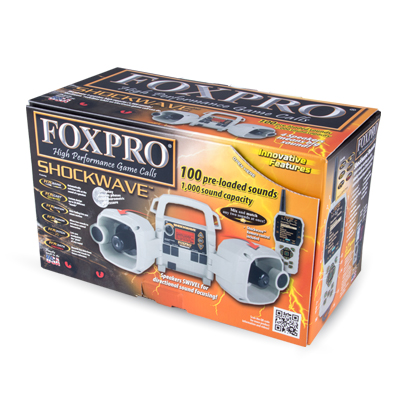
The FOXPRO Shockwave is our top-rated electronic caller and the one we use on most of our own stands. For a deeper comparison of the best options at every price point, check our full electronic predator call roundup.
Decoy
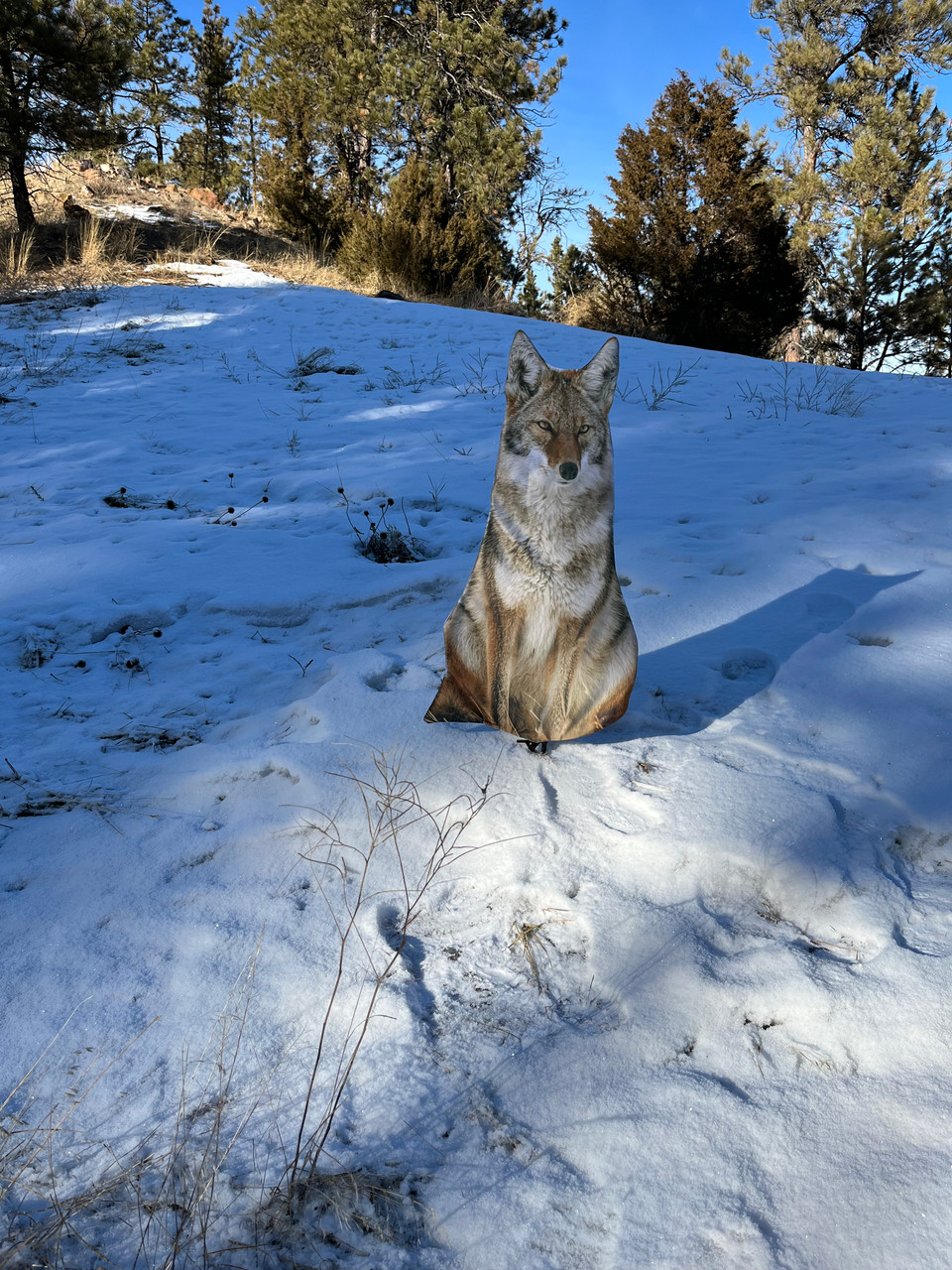
A motion decoy is not strictly required, but it dramatically increases your effectiveness. When a coyote responds to a call, it is trying to locate the source with both its ears and its eyes. A decoy gives the approaching coyote a visual target to focus on, which means it is looking at the decoy instead of scanning for you.
A simple battery-powered topper decoy with an erratic spinning motion is all you need. Place it near your e-caller, about 50 to 150 yards from your shooting position. The combination of sound and movement is extremely convincing to incoming coyotes and will hold their attention long enough for you to make a shot.
Camouflage and Concealment
Coyotes have excellent eyesight. They will pick out an improperly concealed hunter at distances that feel unfair. Full camouflage from head to toe is not a suggestion — it is a requirement.
- Face mask or face paint. Your bare face is the first thing a coyote sees. Cover it.
- Gloves. Hands are the second giveaway. Camo or dark-colored gloves that still allow you to work your trigger and safety.
- Full camo clothing. Match your pattern to your terrain. Open grassland calls for tan and brown patterns. Brush and timber call for woodland patterns. Do not overthink this — just avoid standing out.
- A low-profile seat or pad. Sitting on the ground against a tree, brush pile, or terrain feature breaks your outline far better than any camo pattern.
Thermal Optic (Optional but Game-Changing)
If your state allows night hunting and you want to extend your opportunities, a handheld thermal monocular transforms what is possible. Thermal lets you spot coyotes at distances and in conditions where the naked eye is useless — responding dogs at 500+ yards, coyotes working through cover, and animals moving in complete darkness.
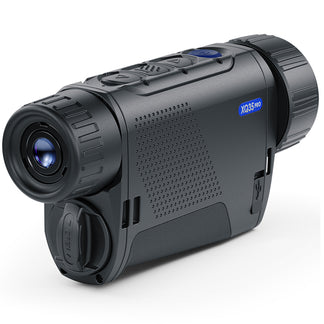
The Pulsar Axion 2 XQ35 Pro is our top pick for a dedicated scanning thermal. It is compact, produces a clear image, and runs long enough to last a full night of hunting. We break down the full category in our best thermal monoculars for predator hunting roundup. If you are trying to decide between thermal and night vision technology, our thermal vs. night vision comparison covers the strengths and trade-offs of each.
Thermal is genuinely optional for beginners — plenty of coyotes are killed during daylight hours. But if night hunting is legal where you are, thermal will put more coyotes in front of you than any other single equipment upgrade.
Choosing a Stand Location
Where you set up matters more than what you call with. A perfect calling sequence from a terrible location produces nothing. A mediocre sequence from a well-chosen stand will put coyotes in shooting range.
Wind Is Everything
This is the single most important factor in choosing a stand, and the one beginners most often underestimate. A coyote’s nose is its primary survival tool. If a responding coyote gets downwind of you and catches your scent, it is gone — instantly, silently, and with no second chance. You will never know it was there.
Set up with the wind in your face or crossing from the direction you expect coyotes to approach. If you are calling into a draw or field edge where you believe coyotes are bedded, the wind should be blowing from them toward you, not the other way around. Check wind direction constantly. It shifts, and when it shifts, your stand may be compromised.
Terrain and Visibility
Choose locations that give you a visual advantage while keeping you concealed. Ideal beginner stand locations include:
- Elevated terrain overlooking open ground. A hilltop, ridge, or elevated fence line lets you see incoming coyotes at distance and gives you time to prepare for the shot.
- Field edges adjacent to thick cover. Coyotes bed in thick brush, CRP grass, creek bottoms, and timber during the day. Calling from a field edge adjacent to these bedding areas puts you between their cover and the sound.
- Fence line intersections and ranch road junctions. Coyotes use linear features to travel. Setting up where two fence lines converge or where a draw meets open pasture puts you on a travel corridor.
Avoid setting up in wide-open terrain with no cover behind you. You need something to break up your outline — a tree, a round bale, a bush, a terrain lip. A coyote approaching from 400 yards will spot a silhouetted figure on a bald hilltop long before it reaches shooting range.
Access
How you get to your stand matters. Walk in quietly, avoid skylining yourself, and do not slam truck doors within earshot of your calling area. We park at least 300 to 400 yards from our stand locations and approach using terrain features that keep us below the line of sight from likely bedding areas. The five minutes you spend on a careful approach can make the difference between calling in a coyote and educating one.
Calling Sequences for Beginners
Calling is the heart of coyote hunting, and it is simpler than most beginners think. You do not need to master twenty different sounds or run complex sequences. A basic, disciplined approach will call in coyotes consistently.
Start with Distress Sounds
Cottontail rabbit distress is the most effective starting sound for beginners. It works everywhere coyotes live, in every season, and coyotes respond to it with aggression because it represents an easy meal. Load a cottontail distress sound on your e-caller and build your first dozen stands around this single sound.
Other effective beginner distress sounds include jackrabbit distress (louder and more aggressive, better for reaching out in open country), rodent distress (subtle and effective in close-cover situations), and bird distress like woodpecker or baby bird (a change-of-pace sound that works well on pressured coyotes that have heard rabbit distress a thousand times).
Timing and Duration
A standard beginner calling sequence looks like this:
- Minutes 0-2: Start calling at moderate volume. You want to reach coyotes within a few hundred yards without blasting out any dogs that are already close. If a coyote is bedded 100 yards away and you open at full volume, you may scare it rather than attract it.
- Minutes 2-5: Increase volume gradually to reach out further. Let the sound carry across the landscape and give coyotes time to hear it, locate it, and decide to respond.
- Minutes 5-8: Maintain volume. Add brief pauses of 15 to 30 seconds between calling bursts. These pauses create urgency — the coyote thinks the prey animal is weakening or the opportunity is fading, which accelerates its approach.
- Minutes 8-12: Continue calling but begin mixing in short pauses of 30 to 60 seconds. Keep your eyes moving constantly. The majority of coyotes that are going to respond will show themselves in this window.
- Minutes 12-15: If nothing has appeared, you can try a different sound — switch from cottontail to jackrabbit distress or rodent squeals. Sometimes a change in sound triggers a response from a coyote that heard the first sound but was not convinced enough to commit.
- Minutes 15-20: This is the tail end of your stand. Some hunters go 30 minutes, but for beginners running an efficient session, 15 to 20 minutes per stand is enough. If a coyote was going to come, it almost certainly committed in the first 12 minutes.
Volume Management
Volume control is something most beginners get wrong. The temptation is to crank the caller to maximum and blast sound across the countryside. Resist this. Start quiet and build up. A coyote that is 150 yards away in thick cover does not need the sound to be screaming — it needs the sound to be convincing. Moderate, natural-sounding volume at close range is far more effective than ear-splitting distress that sounds like a speaker, not an animal.
At longer ranges across open terrain, you do need volume to reach out. But even then, let the caller do the work gradually. Think of it as a conversation, not a megaphone.
Setup and Approach
The minutes before you start calling are critical. A sloppy setup undoes everything else.
Arrive quietly. If you are driving to your hunting area, park well away from your stand. Close vehicle doors gently. Avoid talking. Sound carries further than you think, especially in cold, calm air.
Use the terrain. Walk in behind hills, through draws, and along tree lines that shield your movement from the area you plan to call. Never walk across the open ground you intend to hunt through. Coyotes may be watching that ground right now.
Get settled before you call. Once you reach your stand location, sit down, arrange your gear, get your rifle on your shooting sticks or bipod, confirm the wind, scan the area with binoculars or your thermal unit, and then wait two to three minutes before you start calling. This pause lets the area settle after your intrusion and gives you time to spot coyotes that are already visible.
Position your e-caller and decoy. Place them 75 to 150 yards downwind or crosswind from your position. You want incoming coyotes to approach the caller, not you. If the wind is in your face, place the caller directly in front of you so that coyotes approaching the sound are walking toward the caller and away from your scent stream.
Keep your movement to an absolute minimum once calling begins. Move your eyes, not your head. Move your head, not your body. The only movement a coyote should see from you is the swing of your rifle when it is time to shoot.
Shot Placement
Coyotes are not large animals, and they are not hard to kill with a well-placed shot. But they are tough enough that poor shot placement results in wounded animals and lost coyotes, which is unethical and unacceptable.
The ideal shot on a coyote is a broadside presentation targeting the front shoulder. Place your crosshairs on the crease of the front leg, roughly one-third of the way up from the bottom of the chest. This puts the bullet through the heart and lungs — the largest vital zone on the animal. A coyote hit here will drop within a few yards at most.
On a quartering-toward shot, aim for the point of the near shoulder. The bullet will angle through the vitals and into or through the off-side shoulder.
On a head-on shot, place your crosshair at the base of the neck where it meets the chest. This is a smaller target, but incoming coyotes running directly at your position often present this angle, so practice it.
Avoid the following:
- Texas heart shots (shooting a coyote in the rear as it runs away). The angle is poor, the vitals are shielded by the hindquarters, and the chance of wounding and losing the animal is high.
- Long shots you are not confident in. If the range is beyond your practiced ability, let the coyote come closer. Patience fills tags. Impatience wounds animals.
- Running shots unless you have practiced them extensively. A coyote at full sprint is moving 30+ mph. Hitting a target that small, moving that fast, requires practice that most beginners have not yet invested.
Day vs. Night Hunting
Both day and night coyote hunting are productive, but they are fundamentally different experiences that require different approaches.
Daytime Hunting
Daytime hunting is where every beginner should start. You can see the terrain clearly, judge distances naturally, spot incoming coyotes with the naked eye or binoculars, and shoot with your standard optic. Daytime stands are simpler to execute and teach you the foundational skills — reading wind, choosing stands, running calling sequences, and making shots — without the added complexity of operating in the dark.
The best daytime windows are the first two hours after sunrise and the last two hours before sunset. Coyotes are most active during low-light transitional periods when they are moving between bedding and hunting areas. Midday stands can work, especially during breeding season in January and February when coyotes are more active throughout the day, but morning and evening produce more consistent action.
Nighttime Hunting
Night hunting, where legal, is devastatingly effective. Coyotes are naturally nocturnal and far more bold after dark. They respond faster, commit harder, and approach closer because the darkness gives them confidence. If you have ever struggled to call coyotes during the day, a night stand in the same area will often produce immediate results.
Night hunting requires additional equipment — at minimum, a light source (a scanning light or weapon-mounted light where legal) and ideally a thermal monocular or thermal scope for detection and identification. The investment in thermal technology is significant, but for hunters who commit to night predator hunting, the return in terms of success rate and excitement is enormous.
If you are a complete beginner, start with daytime hunting. Learn the fundamentals in conditions where you can see and process everything. Once you are comfortable with setups, calling, and shooting, add night hunting to your rotation.
Common Beginner Mistakes
We have made every one of these mistakes, and we have watched other new hunters make them too. Learning from these will save you frustration and put you ahead of the curve.
Not checking the wind constantly. We said it above and we will say it again. Wind is the single biggest factor in coyote hunting success. If you are not obsessively monitoring wind direction throughout your stand, you are leaving your success to chance. Carry a small wind indicator — a puff bottle or milkweed — and check it every few minutes.
Calling too aggressively. Beginners tend to call too loud, too long, and without enough pauses. Coyotes do not need to be bludgeoned with sound. Natural prey animals make distress sounds in bursts with gaps. Mimic that rhythm.
Moving too much on stand. A coyote can spot a turned head at 300 yards. Once you are set up and calling, move as little as physically possible. Use your eyes to scan. Turn your head slowly and only when necessary. The coyote you do not see is the one that sees you first.
Hunting the same stands repeatedly. Coyotes learn fast. A coyote that responds to a call, gets winded, and escapes will not make that mistake again easily. Rotate your stands and rest locations for at least two to three weeks before returning.
Not staying long enough — or staying too long. Both extremes hurt. Leaving a stand at twelve minutes means you miss coyotes that were committed but still half a mile out. Sitting for forty-five minutes on every stand wastes time you could spend on a fresh setup. Fifteen to twenty minutes is the sweet spot for most beginner stands.
Poor concealment. If you are sitting in the open with your face and hands exposed, coyotes will bust you before they reach shooting range. Every single time. Full camo, face covered, back against something that breaks your silhouette.
Ignoring the approach. Slamming your truck door, walking across the field you plan to call, letting your gear clatter — all of this alerts coyotes to human presence before you ever press play on the caller. Treat your approach like a stalk.
Frequently Asked Questions
What Is the Best Time of Year to Hunt Coyotes?
Late fall through late winter is the prime window for coyote hunting across most of the country. Coyotes are more active, more vocal, and more responsive to calls during this period. January and February — breeding season — is often the single most productive time because male coyotes are actively searching for mates and will charge into howls and challenge calls with reckless aggression. Fur is also at its prime during the coldest months, which matters if you plan to sell or keep pelts.
That said, coyotes can be called and killed effectively in every month of the year. Summer coyotes respond well to pup distress and prey distress sounds, and the reduced hunting pressure during off-season months means many coyotes are less educated.
What Caliber Is Best for Coyote Hunting?
The .223 Remington is the most popular and practical coyote cartridge in existence. It is accurate, flat-shooting, affordable to practice with, has minimal recoil, and produces relatively little pelt damage. The .22-250 Remington is the next most popular choice, offering a flatter trajectory and more energy at distance at the cost of slightly more barrel wear and ammo expense.
If you already own a rifle in .243 Winchester, .204 Ruger, 6.5 Creedmoor, or .308 Winchester, you are fine. Any of those will kill a coyote cleanly. Use what you have and shoot it well. Accuracy and shot placement matter far more than caliber selection.
Do I Need an Electronic Caller or Can I Use a Mouth Call?
You can absolutely kill coyotes with a mouth call, and many experienced hunters still prefer them for certain situations. However, we strongly recommend beginners start with an electronic caller. The advantages are significant: the sound comes from away from your position, you have hands-free operation to stay on your rifle, and you have access to hundreds of sounds without needing to learn any physical calling technique.
A quality e-caller lets a beginner produce expert-level calling sequences on day one. A mouth call requires significant practice to produce sounds that are convincing enough to fool a coyote. Start with the e-caller, then add a howler and a distress mouth call to your kit as backup and finishing tools once you have the other fundamentals dialed in. We rank and compare the best options in our electronic predator call guide.
How Far Will a Coyote Come to a Call?
In open terrain with good calling conditions — calm wind, quiet background, quality sound — coyotes will respond from over a mile away. We have had coyotes commit from distances we confirmed at 1,200+ yards using rangefinders. In thick cover, timber, or hilly terrain, effective calling range drops to a few hundred yards because the sound does not carry as far and coyotes have more obstacles to navigate.
The practical answer for beginners is this: most of the coyotes you call in will come from within 400 to 600 yards. Set up your stands to cover that radius effectively. If a coyote is a mile away, it is going to take several minutes to arrive, and a lot can go wrong in that time — wind shifts, the coyote detours around something it does not like, or it simply loses interest. Focus on positioning yourself near areas where coyotes are likely to be close, and let the caller do the work over moderate distances.
Is Coyote Hunting Ethical?
Yes. Coyote hunting, conducted responsibly and within legal regulations, is a legitimate and ethical wildlife management tool. Coyote populations across North America are robust and expanding. They are the most successful large predator on the continent, thriving in every habitat type from wilderness to suburban neighborhoods. State wildlife agencies set seasons and regulations based on population data, and in many states, coyote populations are managed specifically because of their impact on livestock, pets, ground-nesting birds, and deer fawn survival.
Ethical coyote hunting means using appropriate equipment for clean kills, practicing shot placement, respecting legal seasons and bag limits, recovering harvested animals, and continually improving your skills to minimize suffering. It also means respecting landowners, leaving the land cleaner than you found it, and being an ambassador for hunting. We take this responsibility seriously, and we encourage every new hunter to approach the sport with the same mindset. Learn more about how we evaluate gear and approach our content on our methodology page.
Quick Buy — Products in This Article