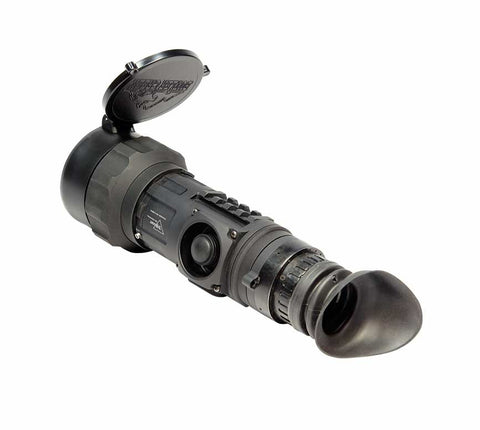
A thermal monocular is the single most underrated piece of predator hunting gear we own. Thermal scopes get all the hype, but a quality handheld thermal is what actually finds the coyote at 400 yards before you ever shoulder your rifle. We spent an entire predator season running four of the best thermal monoculars through real stands across open prairie, dense cedar breaks, and agricultural land — scanning, identifying, and calling predators in conditions ranging from mild fall evenings to brutal January nights with wind chills below zero. Every unit on this list earned its spot through our Benchmark Score system, which evaluates detection range, image quality, ergonomics, battery life, and real-world usability under actual hunting conditions.
Whether you are running a serious coyote management program, protecting livestock, or you simply want the tactical advantage of seeing every predator moving across a section before your first sequence plays, this roundup has a thermal monocular for your budget and hunting style. For broader predator hunting coverage, visit our predator hunting hub.
Quick Picks: Our Top 4 Thermal Monoculars
Here is the short version for hunters who already know what they need:
- Pulsar Axion 2 XQ35 Pro — Best overall thermal monocular. Exceptional image quality, reliable detection range, and the smoothest user experience of anything we tested.
- AGM Fuzion LRF TM35-384 — Best for long-range scanning. Built-in laser rangefinder and impressive detection distances make this the ultimate stand-planning tool.
- InfiRay Eye V2 — Best compact option. Pocketable size with surprisingly capable thermal performance for hunters who refuse to carry extra bulk.
- Trijicon IR-PATROL M250XR — Best for durability. Military-heritage build quality that thrives in the most punishing conditions you can throw at it.
Why Every Predator Hunter Needs a Thermal Handheld
If you have been predator hunting with only a thermal scope on your rifle — or worse, relying entirely on ambient light and hope — a dedicated thermal monocular will change how you hunt. We resisted adding another piece of gear to the pack for years, and we were dead wrong to wait.
Scanning without flagging your position. The fundamental problem with using a thermal rifle scope to scan is that your muzzle sweeps across everything in front of you, including ranch roads, other hunters, livestock, and structures you cannot identify until the thermal image resolves. A handheld monocular lets you glass an entire section from your truck or your stand without pointing a rifle at anything. This is not just a safety issue — it is an ethical obligation that every serious predator hunter should take seriously. Beyond safety, scanning with a monocular keeps your silhouette compact and motionless. A hunter swinging a scoped rifle on a bipod to glass a pasture is visible to every coyote within 500 yards. A hunter holding a small thermal device to one eye is nearly invisible.
Locating predators before you call. We have completely changed how we set up stands because of thermal monoculars. Before we start a calling sequence, we spend two to three minutes scanning every quadrant with the thermal. If we spot a coyote already moving through the area, we know where to focus. If we spot cattle bedded 200 yards to our east, we know not to take shots in that direction. If we see nothing at all, we still call — but we call differently, knowing we need to pull animals from further out. This pre-stand scan has directly led to more coyotes on the ground and fewer blown setups than anything else we have changed in our approach. Pair a quality thermal monocular with a capable electronic predator call and you have a system that lets you locate, attract, and engage predators with a level of precision that feels unfair.
Tracking wounded animals and reading the landscape. Even the best shooters occasionally need to track a coyote that ran after the shot. A thermal monocular lets you follow a heat signature through grass, brush, or standing crops where a flashlight would show you nothing. We have also used ours to locate downed coyotes in tall CRP grass where they would have taken thirty minutes to find otherwise. Beyond recovery, thermals let you read the landscape in ways visible light never will — you will spot deer, raccoons, rabbits, and other animals that tell you volumes about the ecosystem you are hunting in.
Preserving your night vision. If you hunt with a light or night vision setup on your rifle, pulling out a white-light flashlight to glass destroys your adapted vision for fifteen minutes or more. A thermal monocular requires zero ambient light, emits minimal screen glow (adjustable on every unit we tested), and lets you transition back to your rifle optic without any adaptation delay.
The bottom line is simple: a thermal monocular multiplies the effectiveness of every other piece of predator hunting gear you carry. It makes your electronic caller more effective because you can watch coyotes respond to sounds in real time and adjust your sequences based on what you see. It makes your rifle scope more effective because you are putting it on target faster instead of searching. For a deeper breakdown of how thermal technology compares to image-intensified night vision, read our full thermal vs. night vision guide.
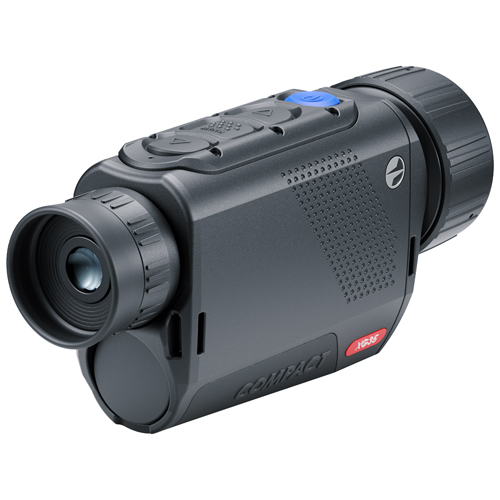
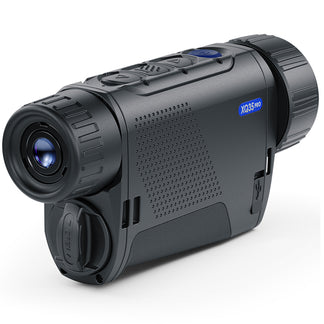
Pulsar Axion 2 XQ35 Pro
Best for: Predator hunters who want the best balance of image quality, detection range, and ease of use in a thermal monocular that just works every time you turn it on.
The Pulsar Axion 2 XQ35 Pro is the thermal monocular we reach for first, and it is not close. Pulsar has refined the Axion line over multiple generations, and the XQ35 Pro represents everything they have learned about making a handheld thermal that feels like an extension of your senses rather than a gadget you are fighting with in the dark.
Image quality is where the Axion 2 XQ35 Pro earns its keep. The 384x288 sensor paired with Pulsar’s latest image processing algorithms produces a thermal picture that is remarkably clean and detailed. During testing on open grassland, we consistently identified coyotes — not just detected heat blobs, but positively confirmed species by body shape, gait, and tail posture — at 350 to 400 yards. On calm, cool evenings with strong thermal contrast, we pushed positive identification past 450 yards on larger animals like deer. The 17-micron pixel pitch keeps the image tight, and Pulsar’s proprietary image boost technology smooths out noise without smearing fine detail. The eight available color palettes are genuinely useful, and we found ourselves switching between White Hot for general scanning and Red Monochrome for picking out animals against warm backgrounds like sunlit rock faces that were still radiating heat after sunset.
Detection range is rated at 1,750 yards by Pulsar, and while we did not have opportunities to confirm that exact figure against a standardized target, we can say that the Axion 2 consistently outranged every other monocular in this roundup when it came to spotting the presence of an animal-sized heat source on open terrain. On one memorable January night in central Kansas, we picked up what turned out to be a group of three coyotes moving along a fence line at a distance we later ranged at just over 900 yards with a laser rangefinder. At that distance, we could tell they were canine by their movement pattern, but positive species identification required them to close to about 600 yards.
Ergonomics are outstanding. The Axion 2 XQ35 Pro weighs just over 10 ounces, fits naturally in one hand, and the controls are operable with heavy gloves. The power button, menu navigation, and zoom toggle are all raised and tactile enough that we never needed to look at the unit to operate it. Boot-up time is under four seconds, which matters when a coyote appears unexpectedly and you need eyes on it immediately. The eyepiece is comfortable for extended scanning sessions, and we appreciated the adjustable screen brightness that prevents the eyepiece glow from illuminating your face in total darkness.
Battery life impressed us. Pulsar rates the Axion 2 at 11 hours on the internal rechargeable battery, and we consistently got 7 to 8 hours of active use with frequent scanning, brightness adjustments, and occasional video recording through the Stream Vision app. For a full evening of predator hunting that might span five to six hours, the battery is more than adequate on a single charge. The USB-C charging port means you can top it off from a vehicle charger between stands if needed.
The built-in photo and video recording is a nice bonus for documenting hunts, and the Wi-Fi connectivity to Pulsar’s Stream Vision 2 app lets a partner watch your thermal feed on their phone — useful when hunting with a spotter who is positioned differently. The IPX7 water resistance held up through rain and snow without fogging or moisture intrusion.
If we had to name a weakness, it would be the lack of a built-in laser rangefinder. You will need to carry a separate rangefinder or rely on reticle-based estimation, which is one area where the AGM Fuzion has an objective advantage. But for pure image quality, usability, and reliability in a handheld thermal, the Pulsar Axion 2 XQ35 Pro is the standard we measure everything else against.
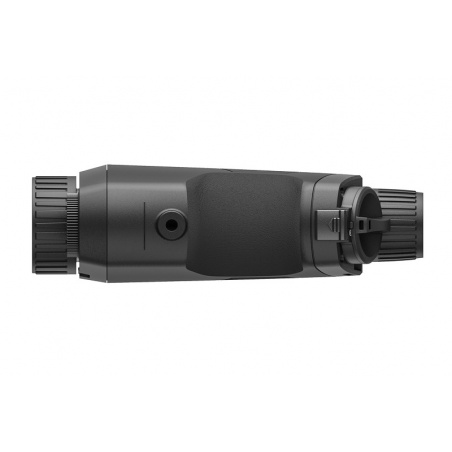
AGM Fuzion LRF TM35-384
Best for: Predator hunters who want integrated laser rangefinding and long-distance scanning capability in a single device to streamline their kit.
The AGM Fuzion LRF TM35-384 is the Swiss Army knife of thermal monoculars. It pairs a capable 384x288 thermal sensor with a built-in 600-yard laser rangefinder, which means you can detect, identify, and range a coyote without putting the monocular down to grab a separate device. For predator hunters who are calling in open country where distance estimation matters, this integration is a genuine tactical advantage that saves seconds when seconds count.
Image quality on the Fuzion is good — not quite at the level of the Pulsar Axion 2, but entirely capable for predator hunting applications. The 384x288 resolution with a 35mm objective lens produces a clean thermal image with solid contrast and respectable detail. We positively identified coyotes at 300 to 350 yards with confidence, and detected animal-sized heat sources well beyond 600 yards on cool nights with favorable conditions. The image is slightly noisier than the Pulsar when you zoom past 4x, showing some grain and minor detail loss that becomes noticeable during extended glassing sessions. For the quick-scan, locate, and engage workflow that defines most predator stands, this is a non-issue. You are scanning to find animals, not reading license plates.
The integrated laser rangefinder is the headline feature, and it works well. We tested it against a standalone Sig Kilo rangefinder across dozens of range checks and found the Fuzion’s readings to be consistently accurate within plus or minus two yards out to 500 yards. Beyond that distance, reflectivity of the target matters more, and we occasionally needed two or three presses to get a solid reading off a coyote at extended range. On hard targets like fence posts, hay bales, and metal buildings, the rangefinder was reliable to its full 600-yard rating. Having the range displayed directly on the thermal image overlay eliminates the mental context switching of glassing with a thermal, putting it down, picking up a rangefinder, finding the same target, ranging it, putting the rangefinder down, and relaying the distance to your brain. On fast-developing situations where a coyote is closing on the caller at a trot, this integration lets you continuously monitor both the thermal image and the shrinking distance in a single device.
Ergonomics are solid but bulkier than the Pulsar. The integrated rangefinder adds size and weight, and the Fuzion sits at about 14 ounces — noticeable compared to the sub-11-ounce Axion 2, but not burdensome for a device that replaces two pieces of equipment. The controls are well-placed, with the rangefinder activation button falling naturally under the index finger. Menu navigation is straightforward, though the interface is not as polished as Pulsar’s. We had no trouble operating it with insulated gloves.
Battery life is the one area where the Fuzion asks for compromise. The internal battery provided us with roughly 5 to 6 hours of mixed use — scanning, ranging, adjusting settings — which is adequate for a standard evening of predator hunting but cuts it close on marathon sessions. Active use of the laser rangefinder draws noticeably more power, so heavy ranging reduces runtime. We recommend carrying a USB power bank on extended hunts, as the unit can charge while in use.
The AGM Fuzion also offers onboard recording, Wi-Fi streaming, and multiple color palettes. Build quality is respectable with an aluminum alloy housing, and the IPX6 water resistance handled everything we encountered. For predator hunters who want to consolidate their kit and gain the speed advantage of integrated rangefinding, the Fuzion LRF TM35-384 is a compelling and unique option in this roundup.
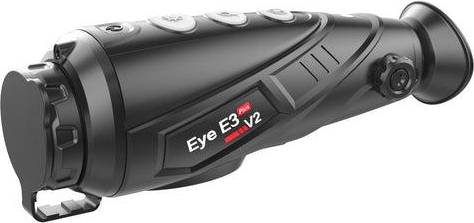
InfiRay Eye V2
Best for: Predator hunters who want a pocketable, ultralight thermal monocular for quick-scan capability without adding bulk to an already loaded hunting vest.
The InfiRay Eye V2 challenges everything we thought we knew about what a tiny thermal imager can do. This thing is barely larger than a pack of playing cards and weighs under 6 ounces, yet it produces a thermal image that competes with units twice its size and three times its price from just a few years ago. InfiRay’s sensor technology has advanced rapidly, and the Eye V2 is the most accessible expression of that progress.
Image quality punches well above its weight class. The 256x192 sensor is the smallest resolution in this roundup, and that lower pixel count is the primary trade-off you make for the radical miniaturization. At distances under 200 yards, the thermal picture is genuinely impressive — clean, contrasty, and more than sufficient to identify coyotes, foxes, raccoons, and other common predator hunting targets by body shape and movement. Push beyond 250 yards and the image becomes less definitive. We could still detect heat signatures at 400+ yards, but positive species identification at extended range required patience and favorable thermal contrast. On warm evenings where ambient temperatures were still above 60 degrees, the effective identification range dropped noticeably compared to the units with 384x288 sensors.
Where the Eye V2 excels is as an always-on-you scanning tool. Because it is so small and light, we actually carried it. Every single stand. No exceptions. Our larger monoculars occasionally got left in the truck when we were hiking into a spot and weight management mattered, but the Eye V2 lived in a chest pocket all season. This constant availability meant we used it more often, scanned more frequently, and spotted animals we would have missed entirely if our only thermal option was back in the vehicle. The best thermal monocular is the one you actually have with you, and the Eye V2 wins that category by a landslide.
Ergonomics are simple and effective. The single-button interface handles power, menu, and palette cycling without confusion. The small body is easy to grip, though hunters with very large hands may find it slightly fiddly. The eyepiece is compact but comfortable enough for scanning sessions of several minutes. We would not want to glass with it for 30 minutes straight the way we would with the Pulsar, but that is not how you use this device. It is a quick-look tool: pull it out, scan the field, confirm or deny the presence of predators, put it away, and pick up your rifle or caller.
Battery life is rated at 5 hours and we found that to be accurate. The internal rechargeable battery charges via USB-C, and the quick boot time of under three seconds means you can power it off between scans to extend runtime significantly. On nights where we powered it on only when actively scanning, we stretched the effective usage across 8+ hours of hunting without issue.
The InfiRay Eye V2 is not going to replace a higher-resolution monocular for hunters who need to identify targets at 400 yards across open rangeland. But for the hunter who wants a thermal scanning capability that is always available, always pocketable, and remarkably capable inside its effective range, the Eye V2 is a revelation. We genuinely believe every predator hunter should own something in this category, even if they also carry a larger primary thermal unit.
Trijicon IR-PATROL M250XR
Best for: Predator hunters who operate in extreme conditions and demand a thermal monocular built to the same standard as military combat optics.
The Trijicon IR-PATROL M250XR is the thermal monocular you buy when you have zero tolerance for equipment failure. Trijicon built this unit for military and law enforcement applications, and that heritage shows in every aspect of its construction, performance, and design philosophy. Where other monoculars in this roundup impress with features and software, the IR-PATROL impresses by being virtually indestructible.
Image quality is excellent. The 640x480 sensor — the highest resolution in this roundup — paired with a 19mm lens produces a thermal image with outstanding detail and clarity. This sensor advantage is most apparent at extended range, where the higher pixel count resolves finer details that 384x288 units simply cannot render. We consistently achieved positive coyote identification at 400+ yards, and the image remained usable and detailed well beyond that. The 60Hz refresh rate delivers smooth, real-time imagery with no perceptible lag or judder when panning across a field. For scanning a large area quickly — which is exactly what predator hunters need to do — the 60Hz rate is a meaningful advantage over the 50Hz units in this roundup. Fast-moving targets track cleanly, and the overall viewing experience feels more like watching a live video feed than looking at a processed thermal image.
Durability is where the IR-PATROL separates itself from civilian-focused competitors. The housing is machined from aircraft-grade aluminum with a mil-spec hard anodize finish. The unit is rated to withstand drops, submersion, extreme temperatures, and the general abuse that comes with military field use. During our testing, we deliberately subjected it to treatment that would void warranties on other devices — drops onto frozen ground from waist height, exposure to sustained heavy rain, and operation in temperatures ranging from minus 5 to over 90 degrees Fahrenheit. The IR-PATROL never flinched. Zero fogging, zero mechanical issues, zero loss of functionality. For predator hunters who operate out of UTVs, hunt in extreme cold, or simply tend to be hard on gear, this level of build quality provides genuine peace of mind.
Ergonomics reflect the military design philosophy: functional, intuitive, and devoid of unnecessary complexity. The controls are minimal — power, menu, brightness, polarity — and each button has a distinct tactile profile that is easily distinguished by touch alone. You can operate this monocular in complete darkness with heavy gloves and never press the wrong button. The eyepiece includes a built-in diopter adjustment, and the unit accepts standard helmet-mount adapters if you are running a night-vision-style head-mounted setup. Weight is moderate at around 12 ounces, placing it between the ultralight InfiRay and the rangefinder-equipped AGM.
Battery life is powered by a single CR123A lithium battery, which provides approximately 4 to 5 hours of continuous operation. This is the shortest battery life in our roundup, and it is a genuine consideration for extended hunts. The upside of the CR123A platform is that replacement batteries are widely available, lightweight, and you can carry a handful of spares without adding meaningful weight or bulk. We kept two spares in a vest pocket all season and the swap takes under ten seconds. For hunters accustomed to military-style optics, this battery system is familiar and reliable.
The IR-PATROL intentionally omits features that other monoculars include — no Wi-Fi, no onboard recording, no rangefinder, no smartphone app. Trijicon’s philosophy is clear: every additional feature is a potential point of failure, and this unit exists to provide a flawless thermal image under any conditions without exception. If you value absolute reliability and sensor quality over integrated features, and you plan to keep this monocular for a decade or more, the IR-PATROL M250XR is the most confidence-inspiring piece of thermal equipment we have tested.
Thermal Monocular vs. Thermal Scope: When You Need Which
One question we get constantly is whether a predator hunter should buy a thermal monocular or a thermal scope first. The honest answer depends entirely on how you hunt.
Buy the monocular first if you already have a capable rifle setup for predator hunting. If your rifle wears a quality daylight scope and you hunt with a light or you hunt during legal shooting hours, a thermal monocular adds scanning capability that transforms your situational awareness without changing anything about your existing shooting platform. You can spot predators at extreme range, confirm species before you call, and track responding animals in real time — all without shouldering your rifle. For daytime coyote hunters, a thermal monocular is a scouting tool that replaces hours of glassing. For night hunters using lights, it is the detection system that tells you when and where to deploy your light.
Buy the thermal scope first if you are specifically setting up for nighttime shooting. If your primary goal is killing coyotes at night and you need to see through the scope to make ethical shots in total darkness, the thermal scope is the tool that directly enables that. A monocular cannot help you aim. For dedicated night hunters, especially those protecting livestock or managing predator populations under depredation permits, the thermal scope is the higher-priority purchase. You can add a monocular later to improve your scanning efficiency.
The ideal setup uses both. Every experienced predator hunting team we know runs thermal monoculars for scanning and a thermal scope or clip-on thermal for shooting. The monocular finds and identifies targets. The scope engages them. Trying to do both jobs with one device means you are either scanning with your muzzle (unsafe and inefficient) or you are limited to scanning without being able to take a shot. If budget allows, the monocular-plus-scope combination is unequivocally the most effective predator hunting thermal system. For more detail on the differences between thermal and image-intensified night vision for hunting, check our dedicated thermal vs. night vision comparison.
What to Look for in a Thermal Monocular for Predator Hunting
Choosing a thermal monocular for predator hunting is different from choosing one for general wildlife observation or home security. Here are the specifications and features that actually matter for our application.
Sensor resolution matters, but not as much as marketing suggests. The three common resolutions you will encounter are 256x192, 384x288, and 640x480. Higher resolution means more detail at range, which translates to positive identification at greater distances. For predator hunting on open ground where you need to ID coyotes at 300+ yards, a 384x288 sensor is the practical minimum. If you hunt primarily in dense cover where engagement distances are under 200 yards, a 256x192 sensor is entirely adequate and saves money and weight.
Objective lens diameter drives detection range. A larger objective lens gathers more thermal radiation, extending the distance at which you can detect and identify targets. For predator hunting, 35mm is the sweet spot between detection capability and portability. Smaller lenses (19-25mm) favor compactness, while larger lenses (50mm) favor maximum range at the expense of size.
Refresh rate affects usability. A 50Hz or 60Hz refresh rate produces smooth, real-time imagery that makes scanning and tracking natural. Some budget units run at 30Hz, which introduces visible stutter when panning and makes tracking moving animals noticeably harder. For predator hunting, where you are scanning large areas and tracking fast-responding coyotes, 50Hz should be your minimum.
Ergonomics and weight determine how often you actually use it. A thermal monocular that is too heavy, too bulky, or too awkward to operate one-handed in the dark will stay in your pack while you scan with your rifle scope instead. Single-hand operation, glove-compatible controls, fast boot time, and a comfortable eyepiece are non-negotiable for a predator hunting monocular.
Battery life must cover your hunting window. Most predator stands last 15 to 30 minutes, but a full evening of hunting with drive time between stands can span 5 to 8 hours. Your monocular needs to last that entire window, either on a single charge or with a quick and easy battery swap. Rechargeable internal batteries are convenient but require planning. Replaceable batteries (CR123A, AA) are heavier but offer unlimited field endurance.
Water and dust resistance is baseline, not a bonus. You will use this device in rain, snow, dust, and humidity. IPX6 is the minimum acceptable rating. IPX7 or better is preferred.
Frequently Asked Questions
What is the difference between detection range and identification range on a thermal monocular?
Detection range is the maximum distance at which the sensor can register a heat signature — you can tell something warm is out there, but you cannot determine what it is. Identification range is the distance at which you can confirm species, body shape, and other details needed to make a positive identification. For predator hunting, identification range is the specification that actually matters. A monocular that detects at 1,800 yards but only identifies coyotes at 200 yards is less useful than one that detects at 1,200 yards and identifies at 400. Always prioritize identification range when comparing units, and recognize that manufacturer-stated detection ranges are measured against large, standardized targets under ideal conditions — not coyote-sized animals on a humid night.
Can I use a thermal monocular to aim and shoot?
No. A thermal monocular is a scanning and observation tool, not a weapon sight. It has no reticle, no zeroing capability, and no mounting system for a rifle. To shoot using thermal imagery, you need either a dedicated thermal rifle scope or a clip-on thermal device that mounts in front of your existing daytime scope. The monocular finds the target; the scope or clip-on engages it. Attempting to hold a monocular up to a rifle scope to shoot is dangerous, impractical, and will not produce ethical shot placement.
How does weather affect thermal monocular performance?
Temperature differential is the primary driver of thermal image quality. Cool, dry nights with clear skies produce the best thermal contrast because animals are significantly warmer than their surroundings. Hot, humid nights reduce contrast because the ambient environment retains heat, narrowing the temperature difference between an animal and the background. Rain has a moderate impact — heavy rain can reduce detection range by 20 to 30 percent due to thermal scattering, but all four monoculars in this roundup remained functional and useful in steady rain. Fog is the toughest condition, as water vapor in the air absorbs and scatters thermal radiation, significantly reducing both detection and identification range. Wind has no direct effect on thermal performance but can cool animal surfaces slightly, which marginally improves contrast on otherwise warm nights.
Is a 256x192 sensor good enough for predator hunting?
It depends on your typical engagement distances and terrain. For hunters who work dense brush, wooded creek bottoms, or small pastures where most predator activity happens inside 200 yards, a 256x192 sensor is genuinely capable and the smaller form factor of the units that use this sensor is a real advantage. For hunters who work open rangeland, large agricultural fields, or Western terrain where coyotes may respond from 400+ yards, the 256x192 sensor will frustrate you with its limited identification range. In those environments, a 384x288 sensor is the practical minimum for consistent species identification at the distances where you need to make calling decisions.
Do I need Wi-Fi and video recording on my thermal monocular?
For most predator hunters, Wi-Fi and onboard recording are nice-to-have features rather than mission-critical ones. Wi-Fi streaming to a phone is useful for team hunts where a spotter needs to see what the scanner sees, and onboard recording is valuable for documenting hunts, reviewing animal behavior, and creating content. However, these features add cost, complexity, and battery drain. If you are choosing between two similarly priced units and one offers Wi-Fi while the other offers a better sensor or longer battery life, prioritize the sensor and battery. The thermal image is the core function — everything else is secondary. That said, if video recording is important to you for documentation or content creation, buying a monocular with onboard recording is far more practical than trying to film through the eyepiece with a phone.
Quick Buy — Products in This Article