Choosing the right ice fishing flasher or sonar can make or break your season. We’ve been drilling holes and staring at circular displays since long before LCD screens took over the hardwater world, and the truth is that no single unit is perfect for every angler. Some of us want the raw, real-time feedback of a traditional flasher. Others want the mapping and recording capabilities of a modern sonar. And a growing number want forward-facing sonar that lets you watch fish react to your presentation in real time.
We spent the 2025-2026 ice season running five of the best ice fishing electronics through every condition we could find — from clear-water panfish lakes in Minnesota to stained walleye water in Wisconsin and deep lake trout basins in northern Ontario. Every unit on this list earned its spot through our Benchmark Score system, which evaluates target separation, interference rejection, display quality, battery life, portability, and overall value. For more hardwater coverage, check our ice fishing hub.
Quick Picks
- Best Overall Flasher: Vexilar FLX-28 — The gold standard. Unmatched target separation, rock-solid reliability, and an interface that disappears so you can focus on fishing.
- Best Value Flasher: MarCum LX-7 — Dual flasher and LCD modes in one unit at a price that makes sense for anglers who want flexibility without flagship cost.
- Best LCD Sonar: Humminbird ICE HELIX 7 — Full CHIRP sonar with GPS mapping in a package built specifically for ice. The most capable screen-based unit for hardwater.
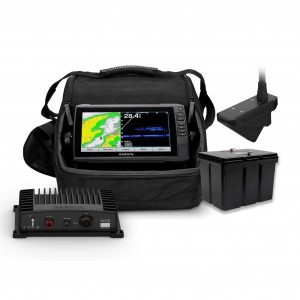
- Best Forward-Facing Sonar: Garmin LiveScope Ice Fishing Bundle — Nothing else shows you what’s happening under the ice with this level of detail. Game-changing for sight-fishing through the hole.
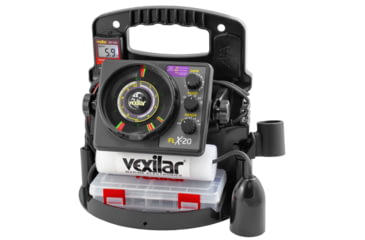
- Best Budget Flasher: Vexilar FLX-20 — Proven Vexilar performance at an entry price that won’t bury your gear budget. The smartest first flasher you can buy.
Flasher vs. Sonar vs. Forward-Facing: Which Do You Need?
This is the single most important question to answer before you spend a dollar, and we think a lot of anglers overcomplicate it. Let’s break it down plainly.
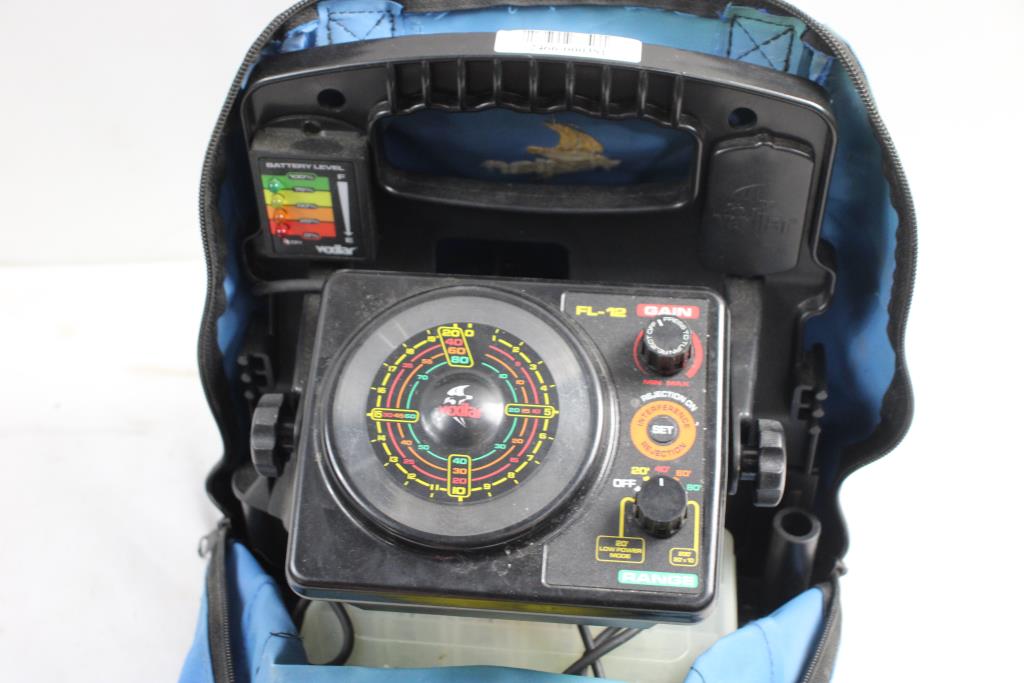
Traditional flashers display sonar returns on a circular dial using colored segments. The information updates in real time with zero lag — you see your jig, you see the fish, you see the reaction happening right now. That immediacy is why flashers have dominated ice fishing for decades and why many tournament anglers still refuse to use anything else. The learning curve is steeper than an LCD, but once the circular display clicks for you, you’ll read it faster than any screen. Flashers excel at showing target separation in the water column, letting you distinguish your bait from a fish sitting inches below it.
LCD sonar units display the same information on a scrolling screen, similar to what you’d see on a boat. The advantage is familiarity — if you’ve used a fishfinder on open water, you already know how to read it. Modern CHIRP-based ice sonar units also offer GPS mapping, waypoint storage, and the ability to record and review sonar history. The tradeoff is a slight delay in the display. What you see on screen happened a fraction of a second ago, not right now. For most fishing situations, that delay is irrelevant. But when you’re finesse jigging for pressured panfish and need to react to a fish that just appeared an inch below your tungsten jig, that fraction of a second matters.
Forward-facing sonar is the newest category, and it’s genuinely different from both flashers and traditional sonar. Instead of looking straight down, forward-facing units project a beam that shows you a live, real-time view of the water column in front of or around your transducer. You can watch a walleye cruise toward your bait from 30 feet away, see it pause, and adjust your jigging cadence before it commits or turns off. The technology is extraordinary. It’s also expensive, and it requires a fundamentally different approach to reading the display.
Our honest recommendation: If you’re primarily a panfish and walleye angler who fishes one or two holes at a time, a quality flasher is still the best bang for your buck. If you want mapping and history logging or you’re already comfortable with LCD fishfinders, a CHIRP ice sonar is the move. If you’re a committed hardwater angler who wants every possible edge and doesn’t mind a higher price of entry, forward-facing sonar will change how you ice fish. Many serious anglers — us included — run a flasher alongside a forward-facing unit. That combination covers every scenario.
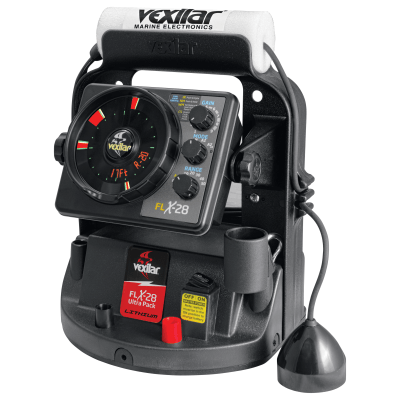
Vexilar FLX-28
Best for: Dedicated ice anglers who want the most refined flasher on the market with industry-leading target separation.
The Vexilar FLX-28 is the flasher that every other flasher is measured against, and after another full season of testing, nothing has knocked it off that throne. Vexilar essentially perfected the three-color flasher with this unit, delivering target separation that borders on surgical. We consistently marked individual fish sitting within two inches of our jig in 30-plus feet of water — something that lesser units simply cannot do with the same clarity.
The FLX-28’s display is bright, vivid, and readable in every lighting condition we encountered, from the pitch-dark interior of a flip-over shelter to direct sunlight on a bluebird day. The five-step interference rejection system is the best in the business. On popular lakes where you’re surrounded by a dozen other anglers running electronics, the FLX-28 locked onto our signal and ignored the noise. We fished a weekend tournament on Mille Lacs with flashers on every side of us, and the FLX-28 never once showed phantom marks or interference clutter.
The depth range is more than adequate for any freshwater ice fishing scenario, covering from as shallow as a foot and a half out to 300 feet. Zoom modes let you focus on a narrow band of the water column — critical for walleye anglers working the bottom third or crappie anglers keying on suspended fish. Battery life on the included 12-volt pack easily handles full-day sessions, and we’ve stretched it to nearly 20 hours of continuous use on a single charge.
Where the FLX-28 loses a few points is the lack of any LCD or mapping capability. This is a pure flasher — it does one thing, and it does it better than anything else. If you want waypoints, contour maps, or a scrolling history display, you’ll need a second unit. But for raw, real-time sonar information delivered with zero lag and absolute precision, the Vexilar FLX-28 remains the undisputed champion. It’s a tool that will last you a decade or more with minimal maintenance. Our full Benchmark Score evaluation puts it at the top of the flasher category across every weighted criterion.
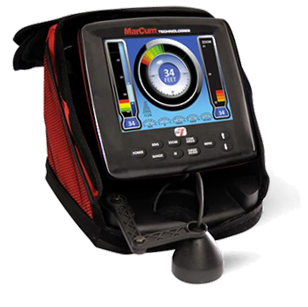
MarCum LX-7
Best for: Anglers who want both flasher and LCD sonar capabilities in a single, versatile package without paying flagship prices.
The MarCum LX-7 occupies a sweet spot that makes it one of the most popular ice fishing electronics on the market, and after extensive testing, we understand why. It’s a true dual-mode unit — flip between a traditional flasher display and a high-definition LCD sonar view with the push of a button. That flexibility means you get the real-time immediacy of a flasher when you need it and the historical scrolling display of an LCD when you want to study what’s been happening below you.
The 8-inch LCD screen is bright and sharp, with resolution that handles both the sonar view and the digital flasher mode cleanly. In flasher mode, the LX-7 delivers very good target separation — not quite at the FLX-28’s level, but close enough that most anglers won’t notice the difference in practical fishing situations. We marked fish reliably within three inches of our jig at depths to 40 feet, which covers the vast majority of ice fishing scenarios across the Midwest.
MarCum’s CHIRP-like sonar processing in the LCD mode provides solid detail, and the auto-ranging depth feature is genuinely useful when you’re hopping between holes of varying depth. The interference rejection worked well in moderate-traffic situations, though it struggled slightly more than the FLX-28 on the busiest tournament weekends. Not a dealbreaker, but worth noting if you primarily fish heavily pressured waters.
The LX-7 ships with a good soft pack and a 12-volt battery that delivered consistent all-day performance in our testing — typically 15 to 18 hours of continuous use. Build quality is solid, and the controls are intuitive enough to operate with heavy gloves. The price point sits well below the FLX-28, making the LX-7 the unit we most often recommend to anglers who want a capable, do-everything ice electronics package without spending top dollar. If you’ve been running an older single-mode unit and want to step up, the LX-7 is the upgrade that makes the most sense for the money.
Humminbird ICE HELIX 7
Best for: Anglers who want a full-featured CHIRP sonar with GPS mapping and the largest, highest-resolution display available for ice fishing.
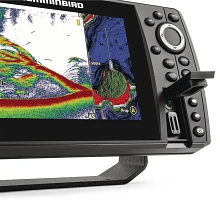
The Humminbird ICE HELIX 7 is what happens when you take one of the best open-water fishfinder platforms and optimize it for the hardwater world. This is a 7-inch CHIRP sonar with GPS, LakeMaster mapping compatibility, and a display that puts every traditional flasher to shame in terms of raw visual detail. If you’re an angler who already runs a Humminbird on your boat and wants a seamless transition to ice fishing, this is the obvious choice.
CHIRP sonar through ice is a genuine upgrade over traditional broadband sonar. The HELIX 7’s frequency sweep provides exceptional bottom definition and target separation that rivals dedicated flashers — particularly in deeper water where traditional sonar can lose resolution. We used the ICE HELIX 7 on deep lake trout structure in northern Ontario, marking individual fish suspended at 80 feet with a level of clarity that would be difficult to achieve on a standard flasher. The dual-beam transducer included in the ice bundle is designed specifically for ice fishing, with a narrow beam option for precision work and a wider beam for prospecting.
The GPS and LakeMaster integration is where the ICE HELIX 7 separates itself from pure sonar units. You can mark productive waypoints, follow underwater contour lines to locate structure, and build a database of spots that pays dividends across seasons. For anglers who fish large lakes and cover ground looking for nomadic walleye or whitefish, the ability to navigate to specific GPS coordinates and drop on exact spots is transformative. We stored over 200 waypoints across the season and the organizational features kept everything manageable.
The tradeoffs are size and weight. The ICE HELIX 7 is the largest unit on this list, and it demands a more involved mounting solution than a simple flasher on a shuttle. Battery draw is also higher than simpler units, so plan on a quality lithium battery if you want full-day runtime. The display does have a flasher mode, but it’s a digital approximation — functional, but lacking the immediacy of a dedicated analog flasher. For anglers who value information density, mapping capability, and the sheer detail of a large CHIRP display, the ICE HELIX 7 is the most capable screen-based ice fishing unit you can buy today.
Garmin LiveScope Ice Fishing Bundle
Best for: Committed ice anglers who want to see fish react to their presentation in real time with forward-facing sonar technology.
We’ll say it directly: the Garmin LiveScope Ice Fishing Bundle changed how we fish through the ice. Forward-facing sonar on a boat was already revolutionary, and Garmin’s purpose-built ice bundle brings that same technology to the hardwater in a package that actually works well in a shelter or on a bucket. The LiveScope perspective transducer, configured in down-looking mode for ice fishing, provides a live, real-time video-like view of the water column below and around your hole. You don’t just see a mark on a dial — you watch a fish swim toward your jig, pause, flare, and come back for another look.
The practical implications are enormous. We watched walleyes follow our jigging Raps from the edge of the cone, tracked how different cadences triggered reactions, and saw exactly when a fish committed versus when it turned away. We adjusted presentations in real time based on what we were seeing, and the result was a measurable increase in hook-up rates on pressured fish. For panfish, the LiveScope let us see micro-movements at close range that would be invisible on even the best flasher. We could tell the difference between a bluegill tentatively nipping and one that actually had the bait.
The 7-inch Garmin display included in the ice bundle is excellent — bright, responsive, and well-suited to the forward-facing sonar view. Setup takes a few minutes to get the transducer positioned correctly in the hole, but Garmin’s ice-specific accessories make it straightforward once you’ve done it a few times. The system runs on a separate Garmin battery or your own 12-volt source, and battery life was adequate for full-day sessions with the included power cable.
The downsides are real. This is the most expensive unit on our list by a significant margin. The LiveScope transducer is a precision instrument that demands careful handling — it’s not as rugged as a puck transducer on a flasher. And forward-facing sonar shows you so much information that it can actually slow you down if you’re not disciplined. We found ourselves watching the screen instead of setting the hook on more than one occasion early in our testing. There’s also a learning curve to interpreting the display that’s different from reading either a flasher or traditional sonar. But once you acclimate, the LiveScope provides a level of underwater awareness that nothing else on this list can match. For anglers who fish hard and want the ultimate technological edge, this is it.
Vexilar FLX-20
Best for: Anglers new to flashers or those who want proven Vexilar performance at an accessible price point.
The Vexilar FLX-20 is the flasher we hand to friends when they ask us what to buy for their first real ice fishing electronics setup. It’s built on the same fundamental platform as the FLX-28 — the same three-color display technology, the same proven transducer design, the same bulletproof Vexilar reliability — but at a price point that drops several hundred dollars. The difference is refinement, not capability. The FLX-20 gives you slightly less target separation than the FLX-28 and fewer interference rejection settings, but in practical fishing terms, this unit handles 90 percent of what the flagship does at roughly 70 percent of the cost.
We ran the FLX-20 as our primary unit for several weeks specifically to stress-test it as a standalone flasher, and it performed admirably. Target separation was very good, with reliable fish-from-jig distinction within about three to four inches at moderate depths. The display is bright and easy to read in shelter conditions, though it shows slightly less contrast than the FLX-28 in direct sunlight. The interference rejection is effective in normal fishing traffic — it only showed limitations on the most crowded tournament-style lakes, where the FLX-28’s additional rejection settings provide a noticeable advantage.
Battery life is excellent. The included 12-volt battery pack ran the FLX-20 for consistently longer sessions than the more power-hungry units in this roundup — we logged over 20 hours on a single charge multiple times. The soft pack system is well-designed and portable, making the FLX-20 easy to grab-and-go for quick trips or run-and-gun hole hopping. Vexilar’s build quality remains a strength across their lineup, and the FLX-20 feels like a tool that will endure years of hard use.
If budget is a primary consideration but you refuse to compromise on core sonar performance, the FLX-20 is the answer. It’s the most flasher you can get per dollar spent, and it’s backed by the same Vexilar service and reputation that has dominated ice fishing electronics for decades. We’ve seen FLX-series flashers that are 15 years old and still running strong. Buy this, learn it, and upgrade only when you find yourself needing features it doesn’t offer.
What to Look For in an Ice Fishing Flasher or Sonar
Not all ice electronics are created equal, and spec sheets only tell part of the story. Here’s what actually matters when you’re evaluating units, based on what we’ve learned through years of testing and fishing.
Target Separation
This is the single most important performance metric for ice fishing electronics. Target separation refers to the unit’s ability to distinguish between two objects that are close together in the water column — specifically, your jig and a fish sitting right below it. A flasher with excellent target separation will show you a distinct mark for your jig and a separate, distinct mark for a fish that’s within two inches of it. A unit with poor target separation will merge those two returns into a single blob, leaving you guessing whether that mark is a fish or just your bait bouncing.
Target separation is a function of both the transducer’s cone angle and the unit’s processing power. Narrower cones generally provide better separation, but they also cover less area. The best units balance these factors to give you precision without sacrificing too much coverage. In our testing, the Vexilar FLX-28 consistently delivered the best target separation, followed closely by the MarCum LX-7 in flasher mode.
Interference Rejection
If you fish popular lakes, interference rejection isn’t optional — it’s essential. Every flasher and sonar unit transmits a signal, and when there are a dozen units operating within close proximity, those signals can collide and create false marks, clutter, and noise on your display. Quality interference rejection filters out signals from other units and locks onto your transducer’s specific returns.
We test interference rejection by fishing in high-traffic tournament conditions, and the differences between units are stark. The Vexilar FLX-28’s five-step interference rejection system is the industry benchmark. The MarCum LX-7 handles interference well in most conditions. Budget units and older models can become nearly unusable in crowded situations.
Display Quality
You’re going to stare at this display for hours. Brightness, contrast, color accuracy, and viewing angle all matter — especially since ice fishing conditions range from a pitch-dark permanent shelter to blinding sunlight reflecting off snow. A display that washes out in bright light or becomes difficult to read at an angle is a constant source of frustration.
For flashers, display quality means the circular dial is vivid and individual color segments are clearly defined. For LCD sonar, it means the screen is sharp, responsive, and readable in varying light. The Humminbird ICE HELIX 7 and Garmin LiveScope bundle offer the best LCD displays on this list. Among flashers, the FLX-28 leads with the FLX-20 close behind.
Battery Life and Power
Ice fishing sessions often run eight to twelve hours, and you need electronics that can keep up. Lithium batteries have largely replaced lead-acid packs for serious anglers due to their lighter weight and more consistent voltage output in cold temperatures, but many units still ship with traditional sealed lead-acid batteries. Pay attention to both the battery type included and the unit’s power draw.
Cold temperatures degrade battery performance. A battery rated for 20 hours in a warm room might deliver 14 hours when it’s sitting on the ice in subzero conditions. We test all battery claims in real winter conditions, and the numbers we report reflect what you’ll actually experience. As a general rule, plan for about 75 percent of the manufacturer’s claimed runtime when fishing in temperatures below 10 degrees Fahrenheit.
Frequently Asked Questions
Do I really need a flasher if I already have a portable fishfinder?
A portable fishfinder with an LCD display will absolutely catch you fish through the ice, and if you already own one, there’s no reason to stop using it. But a dedicated flasher offers real-time feedback that LCD displays simply cannot match. The zero-lag response of a flasher lets you see a fish’s reaction to your jig movement the instant it happens, which is a tangible advantage when targeting pressured panfish or finicky walleyes. If you’re catching fish and happy with your current setup, keep using it. If you find yourself frustrated by missed bites or an inability to distinguish fish from your jig, a flasher will solve those problems.
Can I use my boat fishfinder for ice fishing?
Yes, with caveats. Many modern fishfinders from Humminbird, Garmin, and Lowrance can be used for ice fishing if you pair them with an ice transducer and a portable power source. The ICE HELIX 7 on this list is essentially Humminbird’s HELIX platform packaged for ice. However, not all boat fishfinders are optimized for shooting through ice or for the vertical presentation style of ice fishing. Side imaging and down imaging features that are valuable on a boat are generally less useful through a hole. If you go this route, make sure the unit supports a dedicated ice transducer and has a flasher or vertical sonar mode.
Is forward-facing sonar worth the cost for ice fishing?
If you fish regularly and target species where presentation matters — walleye, crappie, trout — forward-facing sonar is a genuine competitive advantage. Watching a fish react to your bait in real time fundamentally changes how you approach jigging cadence, bait selection, and timing the hookset. The Garmin LiveScope bundle is the current leader in this space, and it’s worth the investment for anglers who fish 30-plus days a season. For casual anglers who hit the ice a handful of times a winter, the cost is harder to justify when a quality flasher like the FLX-20 or LX-7 will serve you well at a fraction of the price.
How important is the transducer for ice fishing electronics?
The transducer is arguably more important than the head unit itself. It’s the component that sends and receives the sonar signal, and its cone angle, frequency, and build quality directly determine the information your display shows you. A great head unit paired with a mediocre transducer will underperform a mid-range unit with an excellent transducer. For ice fishing specifically, you want a transducer designed for shooting through ice or for use in an ice hole — not a repurposed trolling motor transducer. All five units on this list ship with ice-specific transducers that are optimized for vertical ice fishing presentation.
What’s the best flasher for a beginner ice angler on a budget?
The Vexilar FLX-20 is our unequivocal recommendation for beginners. It delivers core Vexilar performance — excellent target separation, a bright and readable display, solid interference rejection — at the lowest price point in the FLX lineup. The learning curve on a flasher is the same whether you spend $300 or $600, so starting with a proven mid-range unit makes more sense than buying the cheapest option or overspending on flagship features you won’t fully utilize in your first season. Learn to read the three-color display on the FLX-20, and you’ll know exactly what you need (or don’t need) when it’s time to upgrade down the road.