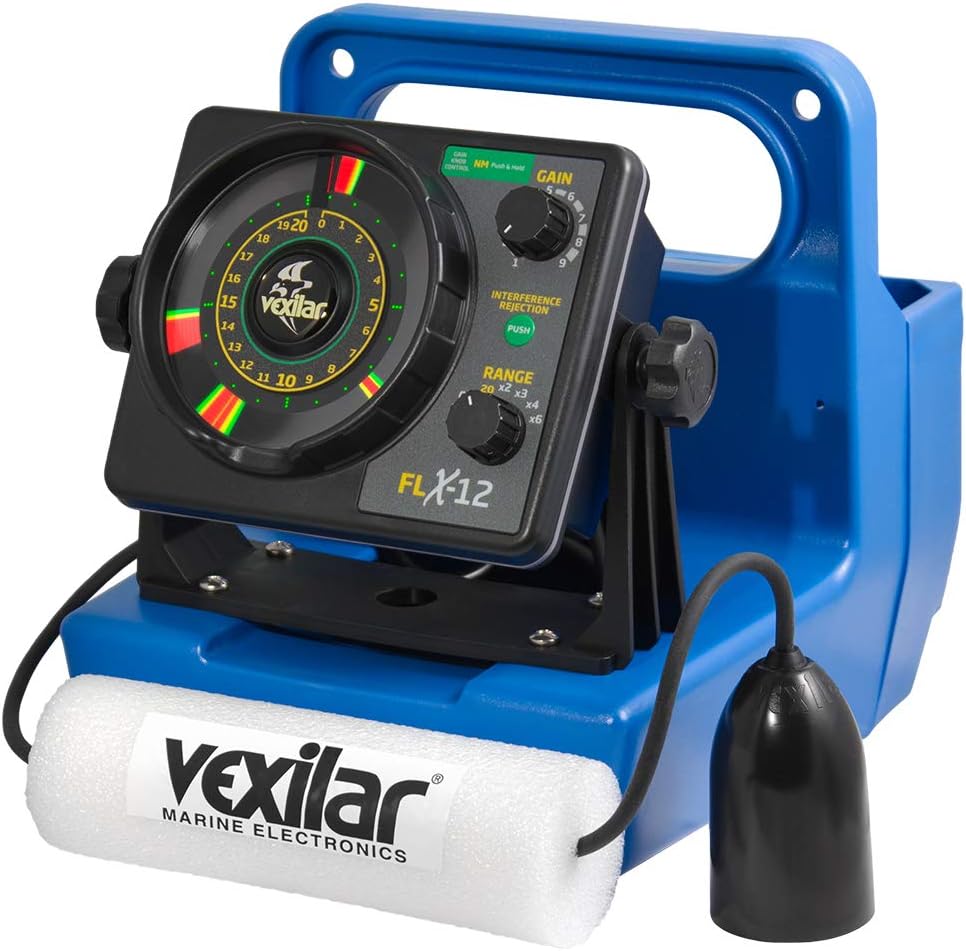
Pros
- Best-in-class target separation shows individual fish at close range
- Three-color flasher display is readable in any lighting
- Interference rejection handles crowded ice with ease
- Ultra Pack includes everything — rod case carry system is brilliant
- Rock-solid reliability season after season
Cons
- No GPS or mapping capability
- Display technology feels dated compared to LCD competitors
- Learning curve for reading a flasher vs a graph
- Bulkier than some competitors when packed
Every ice season, someone asks us whether traditional flashers are still worth buying. The market has exploded with LCD sonar, forward-facing live imaging, and mapping units that can practically drive you to the fish. Against all of that, the Vexilar FLX-28 Ultra Pack sits there doing exactly what it’s done for years — showing you what’s happening below your hole with a level of clarity and immediacy that nothing else matches.
We’ve been running the FLX-28 Ultra Pack as our primary ice electronics for multiple seasons across Minnesota panfish lakes, Wisconsin walleye water, and northern Ontario lake trout basins. After another full year of hard use, we wanted to give it the honest evaluation it deserves: is this still the flasher to beat, or has the technology curve finally caught up?
Who Should Buy the Vexilar FLX-28 Ultra Pack
The FLX-28 Ultra Pack is built for the angler who prioritizes real-time sonar feedback above everything else. If you’re a walleye angler who finesse jigs in 20 to 40 feet of water and needs to see your presentation separate from a fish sitting two inches below it, this is your unit. If you’re a panfish angler who fishes pressured metro lakes surrounded by a hundred other shelters running electronics, the interference rejection alone justifies the price. And if you’re an experienced hardwater angler who’s tried LCD units and found the slight display lag frustrating during reactive jigging, the FLX-28 will feel like coming home.
The Ultra Pack configuration specifically makes sense for mobile anglers who move between holes frequently. The rod case carry system consolidates your flasher, battery, and transducer into a single, grab-and-go package that straps to your back or slides into a sled without loose components bouncing around. If you’re a run-and-gun panfish hunter drilling 30 holes in an afternoon, that portability matters more than any spec on paper.
Skip this unit if: You want GPS mapping and waypoint storage — you’ll need a separate unit or a different platform entirely. If you’ve never used ice electronics before and the learning curve of reading a circular flasher display concerns you, the MarCum LX-7’s dual flasher-and-LCD mode is a gentler entry point. And if screen size and information density are your priorities, the Humminbird ICE HELIX 7 delivers a bigger, more detailed visual package. Check our best ice fishing flashers and sonar roundup for side-by-side comparisons across all categories. If you’re just getting started on the hardwater, our ice fishing beginner’s guide covers how to choose your first electronics setup.
Key Specifications
| Spec | Vexilar FLX-28 Ultra Pack |
|---|---|
| Display Type | Three-color LED flasher |
| Beam Angles | 9°, 19°, and combination |
| Depth Range | 0–300 ft |
| Interference Rejection | 5-step system |
| Zoom | Bottom lock, split screen |
| Battery | 12V 9Ah SLA (included) |
| Battery Life | ~20 hours continuous |
| Transducer | Ice-Ducer with stopper |
| Carry System | Ultra Pack rod case |
| Weight (packed) | ~13 lbs |
| MSRP | ~$650 |
Target Separation and Display
This is the reason people buy Vexilar flashers, and the FLX-28 delivers at a level that borders on unfair. Target separation — the unit’s ability to distinguish between objects that are close together in the water column — is the single most important metric for ice fishing electronics, and the FLX-28 is the best in the business at it. Period.
In practical terms, here’s what that means. We dropped a tungsten jig into 32 feet of stained walleye water on a mid-January trip to Lake of the Woods. A fish rose off the bottom and parked itself roughly two inches below our jig. On the FLX-28, we could see two distinct marks — our jig as a thin green line, the fish as a wider orange-to-red band directly beneath it. We watched that fish inch closer, saw the marks nearly merge, and set the hook. That kind of resolution at depth is what separates the FLX-28 from everything else we’ve tested.
The three-color display system — green for weak returns, orange for moderate, red for strong — provides an intuitive layer of information beyond simple presence or absence. A fish that’s actively tracking your bait shows up differently than one that’s passively sitting on the bottom. Your jig reads differently than a weed top. After a few hours on the ice, you stop “reading” the display and start feeling it. The color transitions become instinctive, and that’s when the flasher truly clicks.
Brightness and readability are flawless. We fished the FLX-28 in pitch-dark permanent shelters, inside flip-overs with the fabric glowing from afternoon sun, and on open ice with no shade at all. The display remained perfectly legible in every scenario. There’s no screen glare to manage, no viewing angle to worry about — the circular flasher dial looks the same from every direction, which is a genuine ergonomic advantage when you’re glancing at it from an awkward angle while fighting a fish.
Interference Rejection
If you’ve ever fished a popular lake on a Saturday morning, you know the problem. Dozens of anglers within a hundred yards, every one of them running electronics, and all those sonar signals bouncing around under the ice creating phantom marks, false bottoms, and general chaos on your screen. The FLX-28’s five-step interference rejection system is the most effective solution we’ve used.
We put this to the test during a walleye tournament on Mille Lacs — arguably the worst-case scenario for interference, with hundreds of competitors packed into a concentrated area, all running high-end electronics. We cycled through the interference rejection settings and found that level three eliminated all visible interference without sacrificing sensitivity to actual fish marks. On a standard weekend outing with moderate pressure, level one or two handled everything cleanly.
The key is that Vexilar’s IR system removes interference without dulling the unit’s ability to show you what matters. Some competing units achieve a clean display by essentially turning down the sensitivity, which means you lose subtle marks in the process. The FLX-28 maintains its fine-detail resolution even with interference rejection engaged. We could still pick out a single small panfish hovering near our jig in 25 feet of water on a lake with a dozen other flashers running within 50 yards of us. That’s not something every unit can claim.
Depth Range and Accuracy
The FLX-28 covers 0 to 300 feet of depth range, which exceeds any realistic freshwater ice fishing scenario in North America. We fished it in depths from 3 feet (shallow bay panfish) to 85 feet (Ontario lake trout) and the unit performed consistently across the full range. Shallow water performance is noteworthy — some flashers struggle to resolve targets cleanly in water under 6 feet because the bottom return overwhelms the display, but the FLX-28’s zoom and gain adjustments let us fish effectively in surprisingly skinny water.
The zoom function deserves specific praise. Bottom-lock zoom lets you focus the entire display on the bottom six feet (or any depth window you choose) of the water column, effectively magnifying the area where the action is happening. For walleye anglers who know their fish are hugging bottom, this turns your display into a hyper-focused window that shows every twitch and movement in granular detail. We ran bottom-lock zoom for probably 70% of our walleye fishing this season and the improvement in our ability to read fish behavior was dramatic.
Depth accuracy is dead-on. We verified against a marked line at multiple depths and the FLX-28 never deviated by more than a few inches. When the display tells you bottom is at 27 feet, bottom is at 27 feet. That consistency matters when you’re sharing depth information with partners or navigating structure based on your sonar readings.
Portability and the Ultra Pack System
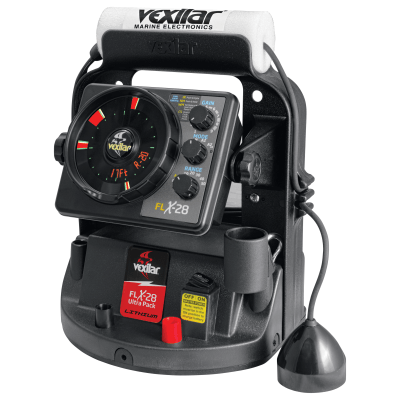
The Ultra Pack is what elevates the FLX-28 from a great flasher to a great ice fishing system. Vexilar’s rod case carry design consolidates the flasher head, battery, charger, and transducer into a hard-sided case that looks and carries like a fishing rod tube. Everything has a dedicated spot, nothing rattles around, and the entire package is ready to fish within 30 seconds of opening it.
We’ve carried the Ultra Pack strapped across a backpack on long walks to remote spots, tossed it into sleds, dropped it in truck beds, and handed it off to fishing partners without worrying about loose wires or a transducer getting crushed. The rod case provides genuine protection that a soft pack can’t match, and the form factor slides into spaces where a traditional flasher shuttle wouldn’t fit.
That said, the FLX-28 Ultra Pack is not the lightest or most compact option on the market. At roughly 13 pounds fully loaded, it’s heavier than some competitors — particularly units that use lithium batteries instead of the included sealed lead-acid pack. If you’re an ultra-mobile angler who counts every ounce, the weight and bulk are a legitimate consideration. For the majority of ice anglers who are loading gear into a sled or a permanent shack, though, the Ultra Pack’s organization and protection outweigh the extra pounds.
Battery and Cold Weather Performance
The included 12-volt 9Ah sealed lead-acid battery is a workhorse. In our testing, we consistently pulled 18 to 20 hours of continuous run time on a single charge, even in temperatures well below zero Fahrenheit. That’s enough to handle a full day of fishing with plenty of margin, and we regularly fished two consecutive half-day sessions on a single charge without issue.
Cold weather performance is where the Vexilar earns its reputation for reliability. The FLX-28 powered on instantly at 15 below zero on a brutal January morning in northern Minnesota. The display didn’t dim, the transducer signal didn’t weaken, and the unit operated identically to how it runs at 25 degrees. We’ve heard reports from anglers running the FLX-28 in extreme Arctic conditions at 40 below and beyond without issues. The simplicity of the flasher technology contributes to this — fewer electronic components means fewer things that can fail when temperatures plunge.
The SLA battery is heavier than a comparable lithium pack, and it does lose some capacity in extreme cold. If you’re consistently fishing in temperatures below minus 20, consider upgrading to a lithium battery, which maintains voltage output more consistently in deep cold. But for the vast majority of ice fishing conditions — the 0 to 20 degree days that make up most of the season — the included battery is more than adequate and will last for years with proper maintenance.
Benchmark Score Breakdown
We score every piece of ice electronics against our standardized testing methodology to maintain consistency across reviews. Here’s how the FLX-28 Ultra Pack breaks down:
- Target Separation: 9.5/10 — The best we’ve tested. Individual fish marks are resolvable at distances that other units show as a single blob.
- Display Quality: 8/10 — The three-color LED is perfectly functional and readable everywhere, but the technology is inherently less information-dense than a modern LCD.
- Interference Rejection: 9.5/10 — Five-step system handled the worst tournament conditions we encountered without sacrificing sensitivity.
- Depth Range & Accuracy: 9/10 — 300-foot range covers everything, zoom modes are excellent, and depth readings are consistently accurate.
- Portability: 7.5/10 — The Ultra Pack carry system is brilliant, but the overall weight and bulk are higher than some modern alternatives.
- Battery & Cold Weather: 9/10 — 20-hour runtime and flawless cold-weather operation. SLA battery adds weight but delivers reliable performance.
- Value: 8/10 — Not cheap, but the longevity and performance justify the investment. This is a decade-plus tool.
Overall: 8.6/10
The score reflects a unit that dominates the categories that matter most on the ice — target separation and interference rejection — while honestly trailing in display technology and portability against newer competitors. For the full breakdown of how we weight these categories, see our testing methodology.
How It Compares
Vexilar FLX-28 vs. MarCum LX-7
The MarCum LX-7 is the comparison we get asked about most often, and it’s a fair fight. The LX-7 offers something the FLX-28 fundamentally cannot: a dual-mode display that switches between traditional flasher and LCD sonar views. That flexibility is genuinely valuable, especially for anglers who are still learning to read a circular flasher display or who want the scrolling history that an LCD provides.
On pure target separation in flasher mode, the FLX-28 wins. The difference is subtle — we’re talking about resolving targets that are two inches apart versus three inches apart — but it’s consistently measurable. In practical fishing terms, you’ll notice it most when finesse jigging for walleye in deeper water or when panfish are pinning tight to your bait. The FLX-28’s interference rejection also edges the LX-7 on the most crowded ice we fished.
The LX-7 wins on versatility and price. The 8-inch LCD mode is genuinely useful, the price point is lower, and the dual-mode operation means you’re getting two tools in one housing. If you want a single unit that covers the widest range of fishing situations, the LX-7 makes a compelling case. If you want the absolute best flasher performance and are willing to pay for that specialization, the FLX-28 is the answer.
Vexilar FLX-28 vs. Humminbird ICE HELIX 7
This is less a direct comparison and more a philosophical choice between two fundamentally different approaches to ice fishing electronics. The ICE HELIX 7 is a 7-inch CHIRP sonar with GPS mapping, LakeMaster compatibility, and waypoint storage. It provides vastly more information than the FLX-28 — contour maps, marked waypoints, sonar history, and a display that shows more data at a glance than any flasher can.
The FLX-28 wins on real-time feedback speed and target separation. The flasher display updates with zero perceptible lag, and the target resolution is sharper than the HELIX 7’s flasher mode emulation. For reactive jigging — where you’re adjusting your cadence based on how a fish is responding to your bait right now — the FLX-28 provides faster, cleaner information.
The ICE HELIX 7 wins on everything else. GPS navigation to waypoints, mapping structure you’ve never fished before, recording sonar history to review later, and a display that frankly shows more useful information per square inch. If you fish big water, move frequently, and value mapping capability, the HELIX 7 is the more capable overall tool.
Many serious anglers we fish with — including us — have landed on running both. A flasher for the real-time jigging feedback and a mapping unit for navigation and structure hunting. That’s the ideal setup, though obviously it doubles your electronics budget. If you’re choosing one, the decision comes down to whether you value real-time jigging precision (FLX-28) or information breadth and mapping (ICE HELIX 7). Browse our ice fishing hub for more on how these units fit into a complete hardwater setup.
Frequently Asked Questions
Is the Vexilar FLX-28 worth the upgrade from the FLX-20?
If you’re fishing pressured water or deeper than 25 feet regularly, yes. The FLX-28 provides finer target separation, better interference rejection, and a brighter display than the FLX-20. The improvement is most noticeable in the situations that test a flasher’s limits — deep water, closely spaced targets, and crowded ice. If you’re primarily fishing shallow panfish on low-pressure lakes, the FLX-20 will serve you well and the upgrade is harder to justify purely on performance. The Ultra Pack carry system is also a meaningful practical upgrade over the FLX-20’s shuttle pack.
Can a beginner learn to read the Vexilar FLX-28?
Absolutely — but expect a learning curve. Reading a circular flasher display is a different skill than reading an LCD fishfinder, and it takes ice time to develop. Most anglers we’ve introduced to flashers report that the display “clicks” after four to six outings. We’d recommend spending your first few sessions on a known lake at a known depth, dropping your jig and just watching how it appears on the display. Raise it, lower it, jig it aggressively, dead-stick it — learn what each action looks like on the dial. Once you can instinctively find your jig on the display, reading fish marks becomes intuitive. Our ice fishing beginner’s guide covers the fundamentals of reading sonar returns if you want a head start before hitting the ice.
How long does the Vexilar FLX-28 battery last in extreme cold?
With the included sealed lead-acid battery, expect 15 to 20 hours in moderate cold (0 to 20 degrees Fahrenheit) and 12 to 16 hours in extreme cold (below minus 10). SLA batteries lose some capacity as temperatures drop, which is normal. For anglers who consistently fish in extreme conditions, upgrading to a 12-volt lithium battery maintains more consistent voltage output in deep cold and shaves a couple pounds off the total weight. Either way, the FLX-28 itself operates normally regardless of temperature — we’ve never experienced a cold-related malfunction.
Does the Vexilar FLX-28 work for open water fishing?
Technically yes, with the right transducer. Vexilar offers open-water transducers that convert the FLX-28 into a boat-mounted flasher, and some anglers — particularly walleye trollers — swear by the real-time feedback of a flasher over a graph when watching their presentation track along a contour break. That said, you’ll lose any mapping, GPS, or trolling motor integration that modern boat electronics provide. We’d consider the FLX-28 primarily an ice fishing tool that can pull double duty on open water in a pinch, not a replacement for a dedicated marine fishfinder.
Is forward-facing sonar like Garmin LiveScope making flashers obsolete?
Not yet, and we’d argue not anytime soon. Forward-facing sonar is extraordinary technology — it shows you things a flasher never can, and it’s genuinely changing how elite anglers approach the ice. But it comes with significant tradeoffs: cost, complexity, fragility, and a learning curve that’s arguably steeper than a flasher’s. The FLX-28 powers on in two seconds, runs for 20 hours, handles abuse, and delivers the core information you need to catch fish. Forward-facing sonar is additive — it’s a tool you add alongside a flasher, not one that replaces it. The most effective electronic setups we’ve seen on the ice combine both technologies, using the flasher for immediate jigging feedback and forward-facing sonar for scouting and fish tracking. The FLX-28 remains the foundation of that combination for most serious ice anglers.
Final Thoughts
The Vexilar FLX-28 Ultra Pack doesn’t have a touchscreen. It won’t show you a GPS map. It can’t record video of your sonar history or stream to your phone. In a market that’s racing toward more features, bigger screens, and flashier technology, the FLX-28 stubbornly does one thing — and does it better than anything else you can buy.
We’ve fished this unit through blizzards, tournament pressure, marathon panfish sessions, and quiet walleye mornings in the dark. It has never let us down. The target separation is unmatched, the interference rejection handles the worst conditions we can throw at it, and the Ultra Pack system makes it genuinely pleasant to carry and deploy. When we drill a hole and drop the transducer, we trust what the FLX-28 shows us. That trust, built over seasons of consistent performance, is worth more than any feature list.
If you value precision, reliability, and the kind of real-time feedback that helps you catch more fish through the ice, the Vexilar FLX-28 Ultra Pack is still the king. The crown fits as well as it ever did.
For more on our ice fishing electronics coverage, visit our ice fishing hub. To understand exactly how we test and score every unit, check our testing methodology.