Walk into any ice fishing forum, bait shop, or shelter on a frozen lake in January and you’ll hear the same question come up within five minutes: should I buy a flasher or a fish finder? It’s the most common electronics question in ice fishing, and it’s been debated for as long as LCD screens have been competing with the circular dial.
We get it. You’re staring at two fundamentally different displays that claim to do the same thing — show you what’s happening under the ice — and the price tags overlap enough to make the decision genuinely difficult. A flagship flasher costs about the same as a mid-tier fish finder. A high-end fish finder costs about the same as a flasher-and-forward-facing-sonar combo. The marketing doesn’t help, because every manufacturer promises you’ll catch more fish with their unit.
Here’s what we know after spending years running both types of electronics across dozens of lakes, from shallow panfish bowls to 60-foot walleye basins: neither one is universally better. But one of them is almost certainly better for you, and by the time you finish this guide, you’ll know which one that is. For more hardwater content, explore our ice fishing hub. And if you’re just getting started, our ice fishing beginner’s guide covers the foundational gear and techniques you need before worrying about electronics.
What Is a Flasher?
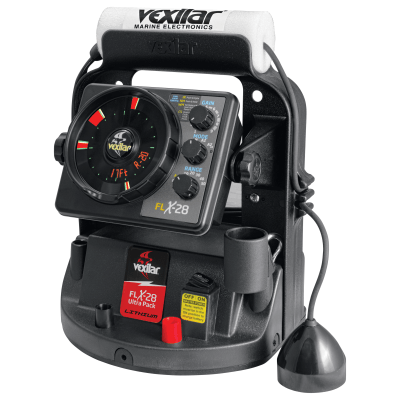
A flasher is a sonar unit that displays returns on a circular dial using colored bands of light. The transducer sends a sonar cone straight down through your ice hole, and the returning signal is painted on the dial in real time — literally as it happens. There is no processing delay, no screen refresh rate to worry about, and no scrolling history. What you see on the dial is what is happening beneath you right now.
The dial reads like a clock. The surface (zero depth) is at the top, and maximum depth wraps around the bottom. When your jig drops through the water column, you watch a colored mark descend around the dial in real time. When a fish moves into your sonar cone, a new mark appears. The color of those marks tells you signal strength — typically green for weak returns, orange for moderate, and red for strong. A fat red mark sitting just below your jig? That’s a fish directly beneath your bait, close enough to eat. A thin green flicker at the edge of the cone? That’s a fish passing through the fringe, probably not committed.
Why the circular display matters
The circular flasher display isn’t just an aesthetic choice — it’s an engineering decision rooted in how sonar works. A flasher paints each sonar return on the dial as a single, instantaneous sweep. The result is zero latency between what’s happening in the water and what you see on the display. When you twitch your jig, the mark on the flasher moves at the exact same instant. When a fish rises toward your bait, you see it happening in perfect synchronization with reality.
This matters enormously for reactive presentations. If you’re jigging a tungsten teardrop for bluegill in 18 feet of water and a fish appears two inches below your bait, you need to know immediately — not a half-second later, not after the screen scrolls another pixel. The best flashers, like the Vexilar FLX-28, deliver target separation that lets you distinguish your jig from a fish sitting within an inch or two of it. That level of precision is what keeps tournament panfish anglers loyal to flashers despite every technological advancement in the past two decades.
The learning curve is real, though. If you’ve never used a flasher, the circular display looks like a mess of colored lights for the first few outings. There’s no picture of a fish, no little fish icon swimming across a screen. It’s raw sonar data presented in its purest form, and your brain has to learn how to interpret it. Most anglers we’ve guided through the transition say the flasher “clicks” after about three or four trips on the ice. Once it does, you’ll read it faster than any LCD screen.
What Is a Fish Finder (Sonar Graph)?
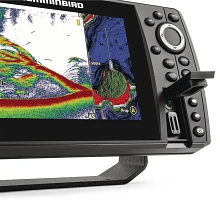
A fish finder — more accurately called a sonar graph or LCD sonar — takes the same sonar data that a flasher uses and displays it on a scrolling screen. Time moves from right to left. The newest sonar return appears on the right edge of the display, and older returns scroll off the left side. The result is a historical record of everything that’s passed through your sonar cone, laid out visually so you can see patterns and trends over time.
Modern ice fishing fish finders use CHIRP sonar (Compressed High-Intensity Radiated Pulse), which sweeps through a range of frequencies rather than pinging a single frequency. CHIRP provides significantly better target definition than traditional single-frequency sonar, and it’s a major reason why LCD units have closed the performance gap with flashers in the past five years. Units like the Humminbird ICE HELIX 7 pair CHIRP sonar with high-resolution displays that present remarkably detailed views of the water column.
The scrolling display advantage
Where a fish finder shines is context. A flasher tells you what’s happening right now. A fish finder tells you what’s happening right now and what happened over the past several minutes. You can see whether fish have been moving through your area, whether they’re trending shallower or deeper, and whether your jigging cadence is attracting or repelling traffic.
The scrolling display also offers GPS mapping on most mid-range and higher units. You can mark waypoints on productive holes, overlay lake contour maps to identify structure without drilling a grid of test holes, and build a digital record of a lake that pays dividends across multiple seasons. For anglers who fish large, unfamiliar bodies of water, the mapping capability alone justifies the investment.
Fish finders also record sonar history, which you can review after the fact to study fish behavior, identify patterns you missed in real time, and share screenshots with fishing partners. It’s a research tool as much as a real-time fishing tool, and that dual utility appeals to a lot of analytical anglers.
The tradeoff? Latency. Even the fastest LCD display introduces a small processing delay between the sonar return and what you see on screen. For most fishing situations — walleye on the bottom, pike cruising through, trout suspended at 30 feet — this delay is functionally irrelevant. But for high-speed finesse presentations where you’re reacting to fish movements measured in fractions of an inch, that tiny lag can cost you bites.
What About Forward-Facing Sonar?
Forward-facing sonar (FFS) deserves its own mention because it’s a fundamentally different technology that doesn’t fit neatly into the flasher-vs-fish-finder debate. Units like the Garmin LiveScope and Humminbird MEGA Live project a sonar beam horizontally or at an angle rather than straight down, showing you a real-time, video-like view of the water column around your hole.
Forward-facing sonar is extraordinary. You can watch a walleye approach from 40 feet away, see it react to your jigging motion, and adjust your presentation in real time before the fish ever enters a traditional sonar cone directly below you. It has genuinely changed how some anglers approach ice fishing.
But here’s our honest take: forward-facing sonar is a complement, not a replacement. It doesn’t do what a flasher does — give you precise, zero-latency depth information with surgical target separation directly below your rod. And it doesn’t do what a fish finder does — log historical data and overlay GPS maps. Most serious FFS anglers run it alongside a flasher, using the flasher for vertical jigging precision and the FFS for situational awareness. If your budget only allows one unit, FFS is not where we’d start. Get your foundational vertical sonar dialed in first with a quality flasher or fish finder, then add FFS when your budget allows.
Head-to-Head Comparison
Here’s how flashers and fish finders stack up across the metrics that matter most for ice fishing:
| Feature | Flasher | Fish Finder (LCD Sonar) |
|---|---|---|
| Display type | Circular dial, real-time | Scrolling screen, historical |
| Latency | Zero — truly instantaneous | Slight delay (0.25-0.5 sec typical) |
| Target separation | Excellent — 0.5” to 1” on flagship units | Good — 1” to 2” on CHIRP units |
| Interference rejection | Very good to excellent | Moderate to good |
| GPS/Mapping | Not available | Available on most mid-tier+ units |
| Sonar history/recording | Not available | Built-in on most units |
| Battery life | 15-20+ hours typical | 6-12 hours typical |
| Display in direct sunlight | Excellent | Moderate (varies by screen) |
| Learning curve | Steep (3-5 trips to become fluent) | Gentle (familiar scrolling screen) |
| Price range | $200-$600 | $300-$1,200+ |
| Portability | Typically lighter, simpler setup | Heavier with more components |
| Cold weather reliability | Excellent (simple electronics) | Good (LCD can slow in extreme cold) |
The takeaway from this table isn’t that one column is clearly superior. It’s that flashers and fish finders optimize for different things. Flashers optimize for real-time precision. Fish finders optimize for information richness. Which one matters more depends entirely on how you fish.
When a Flasher Wins
There are specific scenarios where a flasher isn’t just competitive with a fish finder — it’s decisively better.
Panfish jigging
This is where flashers earn their reputation. When you’re targeting bluegill, crappie, or perch with tiny tungsten jigs, the game is measured in fractions of an inch. A panfish will rise to your jig, hover just below it, and either commit or turn away in under a second. A flasher shows you that entire interaction with zero delay. You see the fish appear, you see it rise, and you react — holding still, twitching, or dead-sticking — based on what’s happening right now. That instant feedback loop is why the best panfish anglers on pressured Midwest lakes are still overwhelmingly running flashers.
Walleye in the bottom third
Walleye anglers working jigs near the bottom need to distinguish their bait from fish sitting tight to the substrate. A quality flasher’s target separation makes this straightforward. You can see your jig mark, see a walleye mark rise off the bottom toward it, and adjust your lift and drop cadence accordingly. The real-time display means your rod movement and the flasher response are perfectly synchronized — there’s no mental offset to account for.
Crowded ice and tournament fishing
Interference from other anglers’ electronics is a real problem on popular lakes and during tournaments. Flashers — particularly flagship models with multi-step interference rejection — handle this significantly better than most LCD units. The Vexilar FLX-28’s interference rejection is legendary for good reason. We’ve fished in situations with 15+ anglers within a 50-yard radius, all running electronics, and the FLX-28 displayed clean, usable returns while some LCD units nearby were cluttered with false marks. For our deep dive on the top flasher options, see our best ice fishing flashers and sonar roundup.
Extreme cold
Flashers use simple, robust electronics that don’t care if it’s -25F outside. LCD screens can become sluggish in extreme cold, with slower refresh rates and reduced responsiveness. If you regularly fish in brutal conditions — northern Minnesota, the Dakotas, northern Ontario — a flasher’s reliability in deep cold is a practical advantage.
Run-and-gun mobility
Flashers are typically lighter, pack smaller, and set up faster than LCD sonar units. If your style involves drilling 20 holes and checking each one for five minutes before moving on, the flasher’s quick deploy-and-read cycle saves meaningful time over the course of a day. Drop the transducer, glance at the dial, decide if there’s life below, and move. No waiting for a screen to boot or a GPS to acquire signal.
When a Fish Finder Wins
Fish finders have their own set of scenarios where they’re the clearly superior choice.
Mapping and waypoint management
If you fish large bodies of water and want to build a database of productive spots season over season, a fish finder with GPS mapping is invaluable. You can overlay LakeMaster or Navionics contour maps, mark waypoints on every productive hole, track your movement across the ice, and navigate back to a honey hole with precision. A flasher simply cannot do any of this. For anglers who approach ice fishing systematically — pre-scouting structure, logging patterns, building a body of knowledge about a lake — the mapping capability alone justifies the fish finder.
Deep water fishing
In water deeper than 40 feet — lake trout basins, deep cisco bites, reservoir fishing — the scrolling display of a fish finder provides better context than a flasher. You can see fish moving at multiple depths simultaneously and track their behavior over time. CHIRP sonar’s frequency-sweeping technology also performs better than single-frequency flasher sonar at extreme depths, delivering cleaner returns with less noise.
Recording and review
Fish finders record sonar logs that you can review after the trip. This is more useful than it sounds. You can study how fish responded to different presentations, identify peak feeding windows by reviewing the sonar history, and share data with partners who are scouting the same lake. If you treat ice fishing as a data-driven pursuit, the recording capability is a game-changer.
Familiar transition from open water
If you already run a Humminbird, Lowrance, or Garmin on your boat, an ice-specific version of the same platform puts you on familiar ground immediately. No learning curve, no adaptation period — you already know how to read the display and navigate the menus. Some units even let you swap the same head unit between your boat mount and an ice fishing shuttle, giving you year-round use from a single investment.
Multi-species versatility
Fish finders handle a wider variety of fishing situations out of the box. If you target panfish in the morning, walleye in the afternoon, and pike at sunset — across different lakes and depths — the fish finder’s combination of CHIRP sonar, mapping, and scrolling history makes it adaptable to all of those scenarios without any tradeoff in information. Flashers are masters of the reactive, single-hole game, but fish finders are generalists that do everything reasonably well.
Can You Use Both?
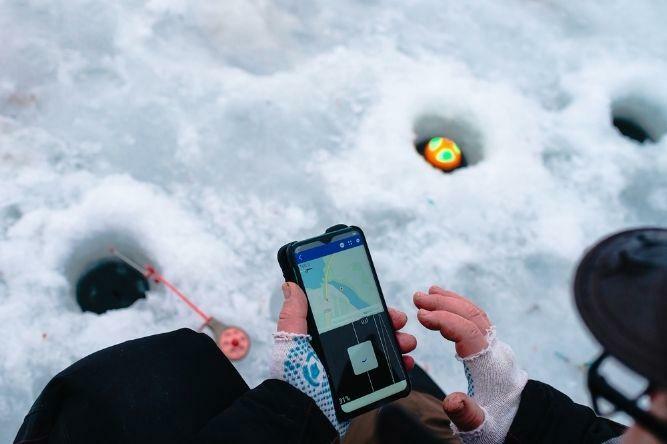
Absolutely, and many dedicated ice anglers do exactly this. Running a flasher alongside an LCD sonar or forward-facing sonar gives you the best of both worlds: the flasher’s zero-latency target separation for active jigging and the fish finder’s mapping, history, and contextual information for strategic decision-making.
The most common dual-setup we see on the ice is a flasher as the primary jigging tool paired with a fish finder running in the background for mapping and sonar logging. You fish off the flasher, but you glance at the fish finder to check your position on the contour map, review recent fish activity, or mark a waypoint when you find an active school.
Is this overkill? For the casual angler who fishes a dozen times a season on familiar lakes, probably. For the serious hardwater angler who fishes 50+ days a year, chases multiple species, and scouts new water regularly, the dual setup pays for itself in information and efficiency. It’s a real investment — you’re looking at $800 to $1,500+ for two quality units — but if ice fishing is your primary winter pursuit, you’ll use every dollar of it.
Budget Recommendations
Choosing your budget tier helps narrow the decision dramatically. Here’s where we’d put our money at three common price points.
Under $300
Buy a flasher. At this price point, the best fish finders cut too many corners on sonar quality and display resolution to compete with a quality entry-level flasher. A Vexilar FLX-20 or MarCum M1 gives you excellent real-time sonar with proven target separation and reliability. You’ll outfish anglers running cheap LCD units all day because the flasher’s core strength — instant, high-resolution sonar feedback — isn’t compromised at this price the way a budget fish finder’s feature set is.
$500
This is where the decision gets personal. You can buy a flagship flasher like the Vexilar FLX-28 and have the best vertical jigging tool money can buy. Or you can buy a solid mid-range fish finder with CHIRP sonar and GPS mapping — something like the Humminbird ICE HELIX 5 — and get mapping capability that the flasher can’t touch. Our recommendation: if you fish fewer than five lakes and you primarily jig for panfish and walleye, get the FLX-28. If you fish a dozen or more lakes and want GPS mapping for structure fishing, get the fish finder.
$1,000 and up
Start building a dual setup. A flagship flasher ($400-$550) paired with a capable fish finder ($500-$700) gives you comprehensive coverage. Alternatively, if you’re committed to one unit, a high-end fish finder like the Humminbird ICE HELIX 7 with CHIRP and full mapping gives you the most capability in a single package. At this budget, you can also consider adding a forward-facing sonar unit down the road. Start with the flasher or fish finder that matches your primary fishing style, then expand.
Frequently Asked Questions
Can a fish finder completely replace a flasher for ice fishing?
Functionally, yes — a quality CHIRP fish finder shows you depth, structure, your jig, and fish marks. But it doesn’t match a flasher’s real-time performance for active jigging presentations. The slight display latency on an LCD unit and the marginally lower target separation mean you’re giving up a small but real edge in scenarios where split-second reactions matter. For casual ice anglers who fish a few times a season and don’t want to learn the circular display, a fish finder is a perfectly good standalone choice. For dedicated jig anglers who live on the ice, the flasher’s real-time precision is hard to give up entirely.
Is the flasher learning curve really that steep?
It’s not as bad as people make it sound, but it’s real. The first time you stare at a spinning dial with colored bars, your brain has no framework for interpreting the information. After two or three focused trips — where you drop your jig deliberately, watch the mark appear, and correlate what you feel in your rod with what you see on the dial — the display starts making intuitive sense. By your fifth trip, you’ll read a flasher faster than most people read an LCD screen. The key is to fish with someone who already knows how to read a flasher, or to spend your first few sessions in shallow water where you can verify what the flasher is showing you by sight.
Do flashers work in deep water?
Yes, but with caveats. Most quality flashers are rated to 200-300 feet, which covers virtually every freshwater ice fishing scenario in North America. However, in water deeper than 40-50 feet, the sonar cone widens significantly, which can reduce target separation. CHIRP-based fish finders tend to maintain cleaner returns at extreme depths because they sweep through multiple frequencies. If you primarily fish deep lake trout water or deep reservoirs, a CHIRP fish finder has a meaningful advantage. For the vast majority of ice fishing — panfish, walleye, perch, pike in water under 40 feet — a flasher’s depth performance is more than adequate.
What about used or previous-generation units?
The used market for ice fishing electronics is excellent, and we actively encourage anglers to consider it. A used Vexilar FLX-28 in good condition is one of the best values in ice fishing — these units are built like tanks and hold up for years. Previous-generation Humminbird ICE HELIX units are also solid buys if you can find them. The main thing to verify on used units is transducer condition (check the cable and connector for damage) and battery health (ask how old the battery is and test it under load). Avoid used units with cracked displays, corroded connections, or batteries that won’t hold a full charge.
Should a beginner start with a flasher or fish finder?
We recommend a flasher for beginners who are committed to ice fishing and a fish finder for beginners who want something familiar. If you’re going to put in the time to learn the circular display — and you plan to ice fish regularly — a flasher teaches you sonar fundamentals in a way that makes you a better angler long-term. You develop an instinct for reading raw sonar data that translates to any electronics you use in the future. If you’re more of a casual participant who wants to see what’s under the ice without climbing a learning curve, a fish finder’s scrolling display is immediately intuitive. There’s no wrong answer here, but we think the flasher investment pays bigger dividends over time for anyone who plans to make ice fishing a serious part of their outdoor life.
Quick Buy — Products in This Article