A good portable ice fishing shelter changes what’s possible on the ice. It turns a two-hour window of tolerable cold into a full day of productive fishing. It blocks wind that would otherwise freeze your line guides solid within minutes. And when the weather turns nasty — which it always does at least once per trip — it gives you a warm, stable basecamp right over the fish you came to catch.
We’ve been fishing out of portable shelters for well over a decade, dragging them across frozen lakes in Minnesota, Wisconsin, North Dakota, and Ontario through some of the most brutal conditions the hardwater season can deliver. This season, we ran four of the best portable ice shelters through our complete Benchmark Score evaluation, testing them in sustained winds over 25 mph, temperatures well below zero, and on lakes ranging from small metro panfish spots to sprawling walleye basins where you might be a mile from shore.
Every shelter on this list earned its place by performing where it matters — on the ice, in real conditions, over full-day sessions. For more hardwater coverage, visit our ice fishing hub. If you’re still dialing in your electronics setup, our guide to the best ice fishing flashers and sonar covers the units we trust inside these shelters.
Quick Picks
- Best Overall Hub Shelter: Eskimo Outbreak 450XD — The most livable portable hub we’ve tested. Generous floor space, excellent wind performance, and a setup time that makes it practical for mobile anglers.
- Best Flip-Over Shelter: Clam Yukon XT — A proven thermal flip-over with a warm, quiet interior and a sled base that tows like a dream. The benchmark for one-person hardwater comfort.
- Best for Groups: Otter Vortex Pro Lodge — Massive fishable area with room for four anglers and their gear. Purpose-built for extended sessions where you want everyone under one roof.
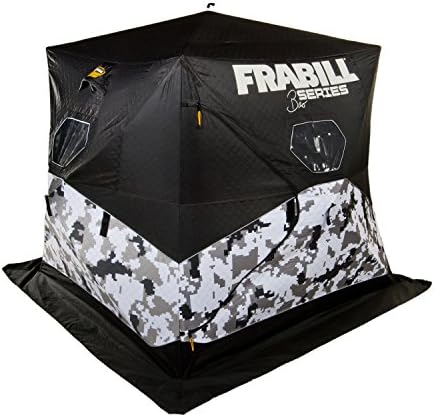
- Best Cabin-Style Shelter: Frabill Bro Hub Top Shelter — Cabin-style walls with hub-style portability. Excellent headroom, serious insulation, and a design that splits the difference between permanent and portable.
Hub vs. Flip-Over vs. Cabin: Which Style Is Right for You?
Before you compare individual models, you need to answer one fundamental question: which shelter style matches how you actually fish? We see a lot of anglers buy the wrong style and then blame the shelter when the real issue was a mismatch between their fishing approach and the design philosophy of the shelter they chose. Let’s cut through the confusion.
Hub-style shelters collapse down to a compact disc shape and pop open using a hub-and-pole framework, similar to a large camping tent. They offer the best ratio of fishable interior space to packed size, and most quality hubs can be set up solo in under two minutes. The tradeoff is that hubs don’t include a sled base, so you’ll need a separate sled or gear hauler to transport your equipment. Hub shelters are the best choice for anglers who want maximum interior room, fish with two to four people regularly, and don’t mind packing their gear separately. They’re also the style that handles wind the best when properly anchored, because the low-profile dome shape sheds gusts rather than catching them like a sail.
Flip-over shelters integrate the shelter fabric directly onto a sled base. You load your gear into the sled, tow it to your spot, flip the shelter portion over the sled, and you’re fishing. The all-in-one design is incredibly efficient for solo anglers and two-person teams who want to stay mobile. Setup is as fast as it gets — literally flip and fish. The compromise is interior space. Because the shelter is built around the sled footprint, you generally get less fishable area than a comparably priced hub. Flip-overs are the ideal choice for run-and-gun anglers who move frequently, solo panfish hunters, and anyone who values streamlined mobility above all else.
Cabin-style shelters feature vertical or near-vertical walls that maximize interior volume and headroom. They feel the most like being inside a permanent fish house. You get the most usable space per square foot of floor area, and the tall walls mean you can stand fully upright, organize gear on shelves, and fish in genuine comfort. The downside is pack size and setup complexity — cabins are typically the bulkiest to transport and take the longest to deploy. Some newer designs, like the Frabill Bro series, use hub-inspired frameworks that reduce setup time significantly, but they’re still not as fast or compact as a true hub or flip-over. Cabin shelters are best for anglers who set up camp for the day, fish with family or groups, and prioritize interior comfort and livability.
Our honest take: There is no universally best style. We own and regularly use all three. For solo walleye runs where we’re moving every hour, a flip-over can’t be beat. For weekend trips with friends where we’re setting up on a proven spot and staying put, a hub or cabin is the move. Think about how you actually fish — not how you want to fish in an ideal world — and match the style to your reality.
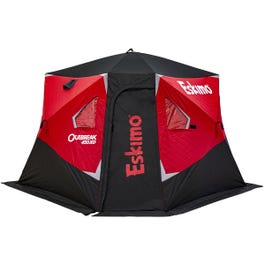
Eskimo Outbreak 450XD
Best for: Anglers who want a spacious, portable hub shelter that handles wind like a permanent fish house and sets up fast enough for mobile fishing.
The Eskimo Outbreak 450XD is the hub shelter that made us rethink what a portable structure can do on the ice. With a 94-by-94-inch footprint and a center height just over 80 inches, this is a genuinely roomy shelter that comfortably fishes three anglers with gear or gives two anglers a luxurious amount of working space. We ran it through the entire 2025-2026 season and it handled everything we threw at it.
Setup time is where the Outbreak 450XD first earns your respect. Eskimo’s hub framework pops into shape quickly, and after a few practice runs in the garage, we had it consistently going from packed bag to fully deployed and anchored in under 90 seconds. That’s fast enough to justify setting it up even on short sessions when you weren’t originally planning to shelter up. The poles lock with positive detents that you can feel through heavy gloves, and the overall mechanism inspires confidence that you’re not going to have a catastrophic collapse mid-session.
Wind resistance is the headline feature, and it delivers. The 450XD uses Eskimo’s wide-base hub geometry combined with heavy-duty fabric and a low center of gravity that sheds wind rather than fighting it. We fished this shelter in sustained 30-mph gusts on Lake of the Woods with zero anxiety about structural failure. The fabric barely fluttered. For comparison, we’ve had other hub shelters of similar size start flexing and popping at half those wind speeds. Proper anchoring with the included ice anchors is critical — no shelter defies physics without being tied down — but the Outbreak 450XD gives you a stability platform that actually holds up when you do your part.
The insulated version we tested uses Eskimo’s IQ insulated quilted fabric, and the thermal performance is impressive. Two anglers running a single portable heater brought the interior from minus-15 ambient to a comfortable 45 degrees within about 10 minutes. The insulation also dramatically reduces condensation buildup on the interior walls, which is a persistent annoyance in non-insulated shelters that drips on your electronics and gear.
Interior organization is thoughtful. Multiple gear pockets line the walls, and the removable floor allows you to cut holes exactly where you want them without fighting fabric. Ventilation flaps are positioned for effective airflow when running a heater, which matters more than most anglers realize from a safety perspective. The pack size collapses down to a manageable disc that fits in the bed of a truck or on a large gear sled, though it is on the heavier side for a hub at just over 40 pounds. Solo transport from the truck to the spot isn’t a problem with a decent sled, but you’ll notice the weight on a long walk.
Where the 450XD loses a small number of points is the absence of a sled base, which means you need a separate transport solution for your gear and the packed shelter itself. That’s inherent to the hub style, not a flaw in this particular shelter, but it’s a real logistical consideration. The zippers are robust and operated smoothly even in sub-zero temperatures, which is more than we can say for some competitors that seize up when the mercury drops. Our full Benchmark Score evaluation places the Outbreak 450XD at the top of the hub category for its combination of interior space, wind performance, thermal efficiency, and setup speed.
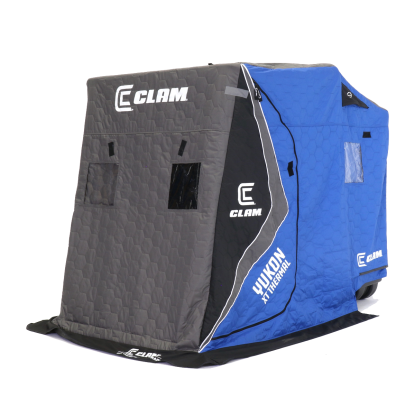
Clam Yukon XT
Best for: Solo and two-person anglers who want a warm, dead-simple flip-over shelter that tows easily and gets you fishing in seconds.
The Clam Yukon XT represents everything we love about the flip-over concept executed at a high level. This is a shelter designed around a single idea: get you on the ice, out of the wind, and fishing as fast as humanly possible. And it does exactly that, every single time.
The sled base is the foundation, and Clam gets it right. The Yukon XT’s sled is wide enough to haul a meaningful gear load — your auger, bucket, tackle, heater, and electronics all fit with room to organize — and the runners track straight when you’re towing it behind an ATV or snowmobile. The sled material is thick, durable UHMW-style plastic that slides over pressure ridges and rough ice without hanging up. We’ve towed the Yukon XT over some genuinely punishing terrain and the sled shows surface scratches but zero structural compromise.
Setup is where the flip-over concept shines, and the Yukon XT is among the fastest we’ve used. Unhook from your tow vehicle, flip the shelter over the sled, snap the two support poles into position, and you’re done. Thirty seconds, generously timed. No anchoring is required in calm conditions because the sled and your gear weight provide sufficient ballast, though we always recommend ice anchors when wind picks up above 15 mph.
The thermal fabric on the Yukon XT is Clam’s Thermal X360 material, and it’s legitimately warm. The insulation traps heat effectively, and the dark interior absorbs solar radiation on sunny days to create a greenhouse effect that can make the shelter surprisingly comfortable even without a heater. On a calm, sunny day at 10 degrees, we fished comfortably in just a base layer and fleece inside the Yukon XT with no supplemental heat. That’s the mark of quality insulation.
Interior space is the expected limitation of a flip-over this size. The Yukon XT is designed for one angler fishing in real comfort or two anglers fishing in close quarters. With two people, you can run two holes but you’ll be bumping elbows during rod changes. For solo panfish sessions, though, the space is perfectly adequate and the intimate proportions actually help retain heat more efficiently than a larger shelter would.
The seating system uses padded, adjustable seats mounted to the sled base, and they’re comfortable enough for full-day sessions. The sight-fishing windows are generously sized and positioned to give you a clear view of your holes without craning your neck. Wind resistance is inherently good with flip-overs because of the low profile, and the Yukon XT’s sled-weighted base keeps it planted. We fished it in 20-mph sustained winds without anchors and felt secure, though we did add anchors when gusts pushed past 25.
One consideration is that flip-overs don’t vent as naturally as hub shelters with multiple zippered openings. If you’re running a propane heater, crack the door or a vent flap and monitor your carbon monoxide situation carefully. Clam includes ventilation options in the design, but the enclosed nature of a flip-over demands extra vigilance on air quality. The Yukon XT strikes the ideal balance of portability, warmth, and simplicity that makes the flip-over style so effective. It’s the shelter we grab first for solo walleye missions and panfish sessions where speed and mobility are the priority.
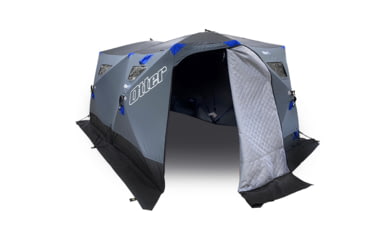
Otter Vortex Pro Lodge
Best for: Groups of three to four anglers who want serious interior space, premium build quality, and a shelter that can handle extended multi-day sessions on the ice.
The Otter Vortex Pro Lodge is the shelter you bring when you’re setting up camp, not just fishing for a few hours. With a footprint that accommodates four anglers drilling multiple holes each, this is a hub-style shelter that approaches the livable space of a permanent fish house while still packing down for transport. It’s the biggest shelter in our roundup, and that size is the entire point.
The interior is cavernous. Four anglers sat comfortably during our testing sessions with room for a gear table, portable heater, and a cooler between them. The center height exceeds six feet, so everyone in our testing crew could stand fully upright without brushing the ceiling. That headroom makes a dramatic difference in comfort during long sessions — hunching over holes for eight hours destroys your back, and the Vortex Pro Lodge eliminates that problem entirely.
Setup takes slightly longer than the Eskimo Outbreak due to the larger footprint, but Otter’s hub framework is well-engineered and the poles click into place with satisfying precision. We averaged about two and a half minutes from bag to fully deployed with two people working together. Solo setup is possible but awkward — the fabric panels are large enough that wind can catch them before you get the last poles locked. We’d recommend having at least one extra set of hands for the initial deployment.
Build quality is where Otter has historically separated itself from the pack, and the Vortex Pro Lodge continues that tradition. The fabric is thick, the stitching is reinforced at every stress point, and the hub poles feel overbuilt in the best possible way. We’ve fished Otter shelters for years and the longevity is genuinely impressive — our previous-generation Otter is still in service after six seasons with zero structural issues. The Vortex Pro Lodge appears to be built to the same standard.
Wind performance is excellent given the size. The wide-base design keeps the center of gravity low, and with all four ice anchors set, the shelter handled 25-mph gusts without any concerning movement. The insulated panels do an admirable job of maintaining interior temperature, and with four bodies generating heat plus a single portable heater, we were comfortable at minus-20 ambient. Condensation management is above average, with the insulation layer reducing the cold-surface dripping that plagues uninsulated shelters.
The practical consideration with the Vortex Pro Lodge is logistics. This is a big, heavy shelter that requires a sled, truck bed, or trailer to transport. You won’t want to hand-carry it any meaningful distance. It’s also overkill for solo or two-person outings — you’d be heating and setting up far more shelter than you need. But for the crew that fishes together every weekend, runs a regular spot on a walleye lake, or brings the family out for a full Saturday on the ice, the Vortex Pro Lodge creates an experience that converts casual ice anglers into committed ones. There’s something about sitting in a warm, spacious shelter watching your flasher marks while your buddy hooks up three feet away that makes ice fishing feel less like enduring the cold and more like genuinely enjoying winter.
Frabill Bro Hub Top Shelter
Best for: Anglers who want cabin-style headroom and vertical walls with hub-style portability and setup speed.
The Frabill Bro Hub Top Shelter represents a genuinely clever hybrid approach to ice shelter design. Traditional cabin shelters offer the most livable interior space but come with the penalty of slow, complex setup and bulky transport. Pure hubs set up fast but have sloped walls that reduce usable space at the edges. The Bro Hub Top splits the difference by using near-vertical walls supported by a hub-inspired framework, giving you cabin-like interior volume with a setup experience much closer to a standard hub.
The result is immediately noticeable when you step inside. The vertical walls mean that the space you see on the floor plan is the space you can actually use. In a traditional hub, the sloped walls force you to sit toward the center, effectively reducing the functional floor area. In the Bro Hub Top, you can fish right at the wall edges with full headroom, which means three anglers have genuine elbow room rather than just theoretical floor space.
Setup time falls between a hub and a traditional cabin. We averaged about two minutes solo, which is roughly 30 seconds longer than the Outbreak 450XD but a full five to ten minutes faster than a comparable cabin with individual pole sleeves. The hub-top mechanism unfolds the roof section first, then the walls drop and lock into position. It’s intuitive after one or two practice runs and doesn’t require any tools or complex pole threading.
Frabill’s insulation in this shelter is among the thickest we’ve tested, and it shows in the thermal performance. The Bro Hub Top heated up faster and retained warmth longer than any other shelter in our roundup during side-by-side comparisons. On a minus-10 day with moderate wind, we maintained a 50-degree interior with a small buddy heater running on low. The insulation also provides meaningful sound dampening — conversation stays inside the shelter rather than broadcasting across the ice, which matters more than you’d think on pressured public water where spooked fish are a real concern.
Wind resistance is solid thanks to the wider base and the fact that the near-vertical walls present a cleaner aerodynamic profile than you might expect. The flat panels don’t billow and catch wind the way some cabin designs do. That said, the taller profile compared to a dome-shaped hub does catch more wind at the top, so anchoring is non-negotiable. We used all included anchors plus supplemental guy ropes on our windiest testing day and the shelter held firm through sustained 25-mph gusts.
Interior features are well thought out. The removable floor lets you cut holes freely, zippered windows provide sight-fishing capability and ventilation, and the wall pockets are deep enough to actually hold useful items rather than being decorative afterthoughts. The door is oversized and easy to enter and exit even in full winter gear, which sounds like a minor detail until you’ve wrestled with a tiny hub door while wearing bibs and a parka.
The primary compromise is packed size. The Bro Hub Top is bulkier than a standard hub when collapsed because the vertical wall panels don’t compress as tightly as sloped hub panels. It still fits in a truck bed without issue, but it’s noticeably larger than the Outbreak 450XD in its carry bag. Weight is also slightly above average. For anglers who prioritize interior livability and comfort above all else but still want reasonable portability, the Frabill Bro Hub Top Shelter is a compelling choice that doesn’t force you to pick between a cabin experience and a hub’s convenience.
What to Look for in a Portable Ice Fishing Shelter
Choosing the right shelter comes down to matching specific features to how you fish. Here’s what actually matters when you’re evaluating options.
Fishable floor space is more important than total floor space. Measure where you can actually sit, drill holes, and work without your back pressed against a sloped wall. Hub shelters exaggerate usable space because their dimensions are measured at the base, not at seating height. Cabin-style and vertical-wall shelters give you the most honest square footage.
Insulation quality directly determines how much fuel you’ll burn and how long you can fish comfortably. Insulated shelters cost more upfront but save money on propane over a season and dramatically extend your fishing time in extreme cold. If you fish regularly in temperatures below zero, insulation isn’t optional — it’s essential.
Wind rating and anchor system matter more than most anglers realize until they’re chasing a shelter across the ice. Look for shelters with included ice anchors and guy-out points. Wide-base designs with low centers of gravity handle wind best. Always anchor, even when it seems calm — conditions change fast on open ice.
Setup time and complexity determine whether you’ll actually use the shelter on quick sessions. If setup takes 10 minutes, you’ll skip it on short outings and miss the benefit. The best shelters deploy in under two minutes, which removes any excuse not to set up. Practice at home before your first trip — fumbling with a new shelter in freezing wind is miserable.
Packed size and weight dictate your transport options. If you’re walking onto the ice, every pound matters. If you’re running an ATV or snowmobile, weight is less critical but packed dimensions still need to fit your sled or trailer. Be realistic about how you get to your fishing spot and choose accordingly.
Ventilation is a safety issue, not just a comfort feature. Any time you run a propane heater inside an enclosed shelter, you need adequate airflow to prevent carbon monoxide buildup. Look for shelters with dedicated vent openings positioned to create passive airflow. Carry a battery-operated CO detector on every trip — this is non-negotiable.
Frequently Asked Questions
How do you anchor an ice fishing shelter in high wind?
Ice anchors are the standard method and the most effective for most conditions. The anchors that ship with quality shelters are threaded metal stakes that screw into the ice at each corner tie-down point. For the best hold, drill a shallow pilot hole with your auger or a chisel, then thread the anchor in at a slight angle away from the shelter. In extreme wind, supplement the corner anchors with guy ropes attached to mid-wall tie-out loops and secured to additional ice anchors. We carry four extra anchors and 50 feet of paracord on every trip for exactly this purpose. Some anglers use frozen-in anchors — drilling a hole, inserting a t-bar anchor, and letting it freeze in place — for multi-day setups where maximum hold strength is needed.
Can you run a heater inside a portable ice shelter safely?
Yes, but only with proper ventilation and a carbon monoxide detector. Portable propane heaters designed for indoor or tent use — such as the Buddy Heater series — are the standard choice for ice shelters. Always crack a vent or door opening to ensure fresh air circulation, even if it costs you a few degrees of warmth. Position the heater on a stable, non-flammable surface away from fabric walls. Never sleep in a heated shelter without a functioning CO alarm. We run a battery-powered CO detector clipped to our gear bag on every single outing, regardless of whether we plan to use a heater. Carbon monoxide is odorless, and the consequences of exposure on a remote frozen lake are severe. This is the one piece of safety gear we consider as essential as the shelter itself.
How long do portable ice shelters last with regular use?
A quality portable shelter from any of the brands in this roundup should give you five to eight seasons of regular use with proper care, and many last longer. The most common failure points are zipper degradation, fabric wear at stress points, and hub pole fatigue. You can extend lifespan significantly by drying the shelter completely before storage — mildew and mold are the primary killers of shelter fabric. After each trip, set the shelter up in a garage or basement, wipe down any moisture, and let it air-dry fully before packing it away. Store it loosely in a dry space rather than compressed in its bag for months. Replace any bent or fatigued hub poles before they fail on the ice. Zipper lubrication with a silicone-based product at the start of each season prevents the most common in-field frustration.
Is an insulated shelter worth the extra cost?
For anglers who fish more than a handful of times per season, absolutely. The price difference between insulated and non-insulated versions of the same shelter typically runs 75 to 150 dollars, and you’ll recoup that in propane savings and extended fishing time within the first season. Insulated shelters heat up faster, maintain temperature more efficiently, and dramatically reduce interior condensation that drips on your gear and electronics. They’re also noticeably quieter inside, which creates a more pleasant fishing experience and reduces noise transmission through the ice. The only scenario where we’d recommend a non-insulated shelter is for anglers who exclusively fish in milder late-season conditions or who rarely use supplemental heat. For anyone fishing in the core of winter — December through February in the upper Midwest — insulation is one of the best investments you can make in your hardwater setup.
What size shelter do I need for ice fishing?
Match the shelter to your typical crew size plus a margin for gear. A solo angler fishing one or two holes is well served by a flip-over or small two-person hub. Two anglers fishing comfortably want a shelter rated for three, because manufacturer capacity ratings assume you’re sitting shoulder-to-shoulder with no gear between you, which isn’t realistic. Three to four anglers need a large hub or cabin-style shelter rated for five or more. The key measurement is not just floor area but how many holes you can reasonably drill within that floor area while maintaining enough space to fight fish, manage tip-ups, and move without tangling lines. We’ve found that roughly 20 square feet per angler is the comfort threshold — below that, you’re functional but cramped. Above that, you have room to fish, organize, and actually enjoy the experience rather than endure it.
Quick Buy — Products in This Article