If you hunt after dark — whether it’s chasing hogs tearing up your food plots or calling coyotes under a January moon — you’ve probably asked yourself the same question every nighttime hunter eventually faces: thermal vs night vision for hunting, which one should I actually buy?
It’s a legitimate debate, and the answer isn’t as simple as one being universally better than the other. Both technologies have been battle-tested by military forces for decades, and both have matured to the point where civilian hunters can access genuinely capable units without taking out a second mortgage. But they work in fundamentally different ways, excel in different conditions, and fit different hunting styles.
We’ve spent hundreds of hours testing both thermal and night vision optics across real hunts — from Texas hog fields to Midwest predator setups. In this guide, we’ll break down exactly how each technology works, compare them head-to-head on the metrics that actually matter, and help you figure out which one deserves a spot on your rifle or in your pack.
If you’re new to how we evaluate gear, check out our Benchmark Score system for the full breakdown. And for more optics coverage, visit our hunting optics hub.
How Thermal Imaging Works
Thermal imaging doesn’t rely on visible light at all. Instead, thermal devices detect infrared radiation — the heat energy that every object with a temperature above absolute zero emits. Your thermal scope or monocular contains a microbolometer sensor that reads these heat signatures and converts them into a visual image on your display.
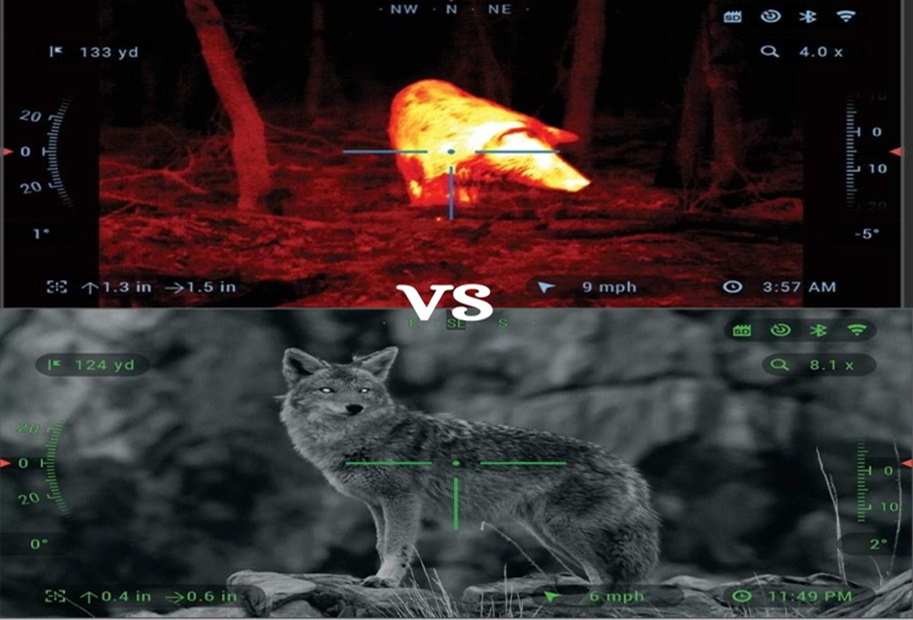
The practical result is striking. Living creatures — deer, hogs, coyotes, even rodents — show up as bright, high-contrast shapes against the cooler background. A 200-pound hog standing in a dark tree line at 300 yards lights up on a thermal display like a beacon, regardless of how thick the vegetation is between you and the animal.
Key thermal imaging characteristics
- Does not require any ambient light. Total darkness, overcast nights, new moon — it doesn’t matter. Thermal reads heat, not light.
- Sees through visual obstructions like fog, light rain, smoke, and tall grass to varying degrees. If the obstruction doesn’t completely block infrared radiation, thermal can often see past it.
- Cannot see through glass. Standard window glass blocks thermal radiation, which means you can’t scan through your truck windshield with a thermal unit.
- Produces a heat map, not a photorealistic image. You’ll see shapes and relative temperatures, but you won’t see fine details like antler tines or facial features the way you would through night vision.
- Detection range is typically excellent. Quality thermal units can detect large animals at 1,000+ yards, though positive identification usually happens at closer distances.
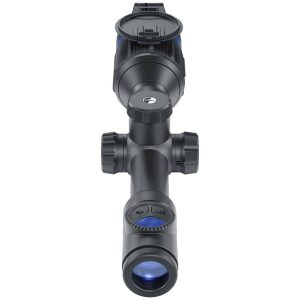
Modern thermal scopes like the Pulsar Thermion 2 have made enormous strides in resolution and refresh rate. Early civilian thermals displayed choppy, low-resolution images that made shot placement difficult. Today’s 640x480 sensors with 50Hz refresh rates deliver smooth, detailed imagery that’s genuinely usable for precision shooting.
How Night Vision Works
Night vision technology takes a completely different approach. Rather than detecting heat, night vision devices amplify existing ambient light — moonlight, starlight, even distant artificial light sources — and present you with a brightened image of your surroundings.
Traditional night vision uses an image intensifier tube that captures photons, converts them to electrons, amplifies those electrons through a microchannel plate, and then converts them back into visible light on a phosphor screen. This is why classic night vision produces that distinctive green-tinted image (though newer units use white phosphor for a more natural black-and-white view).
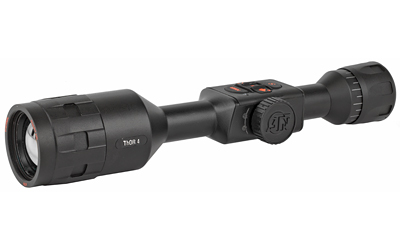
Digital night vision, found in units like the ATN ThOR 4, takes a different path. These devices use a sensitive digital sensor (similar to a camera sensor optimized for low light) paired with an infrared illuminator. The IR illuminator floods the scene with infrared light invisible to the naked eye, and the sensor picks it up to produce a viewable image on screen.
Key night vision characteristics
- Requires some ambient light (for traditional intensifier tubes) or uses an IR illuminator (for digital units). In complete darkness with no IR illuminator, traditional night vision is useless.
- Produces a photorealistic image. You can identify species, count antler points, distinguish between a dog and a coyote, and read environmental details like fences, trails, and terrain features.
- Affected by atmospheric conditions. Heavy fog, rain, and dust significantly degrade night vision performance because these conditions scatter the light the device is trying to amplify.
- Can see through glass. Unlike thermal, night vision works fine through windows since it relies on visible and near-infrared light.
- Generally shorter detection range than thermal for initial target acquisition, though identification at range can be superior once you’re on target.
Generation matters enormously with traditional night vision. Gen 1 devices are cheap but dim and grainy. Gen 2 improves significantly. Gen 3, the current military standard, delivers remarkable clarity with excellent light amplification and tube life. Digital night vision sidesteps the generational system entirely, relying instead on sensor quality and processing power.
Head-to-Head Comparison
Now that you understand the underlying technology, let’s put thermal and night vision side by side on the factors that matter most when you’re spending real money on hunting optics.
Detection Range
Winner: Thermal
This one isn’t close. Thermal imaging excels at detecting living targets at extreme distances because heat signatures stand out dramatically against the ambient environment. A quality thermal unit will let you spot a hog or coyote at 500 to 1,000+ yards in conditions where night vision might struggle to reveal anything beyond 200 to 300 yards.
The caveat is that detection isn’t the same as identification. You might spot a heat signature at 800 yards with thermal, but determining whether it’s a trophy buck or a neighbor’s cow requires getting closer — or pairing your thermal scope with a separate thermal monocular at higher magnification.
Night vision detection range depends heavily on ambient light conditions and whether you’re using an IR illuminator. Under a bright moon, a good Gen 3 or quality digital unit can reveal targets at 300+ yards with enough detail for identification. On a dark, overcast night, you might be limited to whatever your IR illuminator can reach — often 150 to 250 yards for built-in units.
Image Quality and Target Identification
Winner: Night Vision
Here’s where night vision pulls ahead. Because night vision amplifies actual light rather than reading heat, the resulting image is photorealistic. You see texture, shape, color (in some digital units), and environmental context. Telling the difference between a spike buck and a mature doe at 150 yards is straightforward with night vision. With thermal, that same determination can be challenging because you’re working with heat shapes rather than visual detail.
For hunters who need to positively identify their target before taking a shot — which should be all of us — night vision’s image quality advantage is significant. This is especially true in areas where you might encounter livestock, pets, or non-target wildlife species.
That said, modern thermal scopes have narrowed this gap considerably. High-resolution 640-core sensors produce remarkably detailed thermal images, and experienced thermal hunters develop an eye for identifying animals by their heat signature shape and movement patterns.
Versatility Across Conditions
Winner: Thermal
Thermal imaging works in a broader range of conditions than night vision. Rain, fog, smoke, dust, and total darkness — thermal handles them all because it reads heat rather than light. We’ve used thermal on nights where fog was so thick that headlights barely illuminated 50 feet of road, and hogs were still plainly visible on the thermal display at 200+ yards.
Night vision struggles when ambient light drops to near zero (without an IR illuminator) and when atmospheric conditions scatter light. A foggy night that merely annoys a thermal user can render night vision almost useless.
However, night vision has its own versatility advantages. It works through glass, making it useful for scanning from a vehicle. It provides better spatial awareness for navigation since you see the actual terrain rather than a heat map. And digital night vision units often offer recording capabilities, multiple reticle options, and ballistic calculators built into the same platform.
Price
Winner: Night Vision (at entry level) / Thermal (at the mid-range)
The price landscape has shifted dramatically in recent years. Entry-level digital night vision scopes start around $500 to $800, making them accessible to most hunters. A quality Gen 3 traditional night vision setup, however, can run $3,000 to $6,000+.
Thermal scopes have come down in price significantly. Budget-friendly options from brands like AGM and entry-level Pulsar units start around $1,500 to $2,000. Mid-range thermal scopes from Pulsar, ATN, and Trijicon run $2,500 to $5,000. Top-tier units from FLIR and high-end Pulsar models push $6,000 to $10,000+.
For a hunter on a budget, digital night vision offers the lowest barrier to entry. But if you’re spending $2,500 to $4,000, you’re in the sweet spot where both thermal and digital night vision offer compelling options, and thermal arguably delivers more capability per dollar at that tier.
Legal Considerations
Winner: Neither (this varies enormously by state)
This is the factor many hunters overlook until they’ve already bought a unit. Night hunting regulations and the legality of thermal and night vision devices vary significantly by state, and in some cases by county. Some states allow thermal and night vision for specific species only (typically hogs and predators). Others prohibit any electronic sighting device for hunting. A few states have no restrictions at all.
Before you spend a dime on either technology, check your state’s specific regulations. Many states have updated their laws in recent years as thermal and night vision have become more popular, so even if you checked a few years ago, verify the current rules. Pay particular attention to:
- Which species can be hunted at night
- Whether electronic optics (thermal/NV) are permitted on weapons
- Whether you need a special permit or license for night hunting
- Whether there are specific hours or seasons for night hunting
- Whether handheld devices are treated differently than weapon-mounted scopes
Some states allow handheld thermal monoculars for scouting and observation but prohibit mounting thermal or night vision optics on a firearm. Others allow weapon-mounted optics but only for certain species. The distinctions can be surprisingly granular, so do your homework.
Which Is Better for Specific Use Cases
The “which one should I buy” question almost always comes down to what you’re actually hunting and where.
Hog Hunting
Our pick: Thermal
Hog hunting is where thermal absolutely dominates. Feral hogs are typically hunted at night over open or semi-open areas — agricultural fields, feeders, food plots, and clearings. The hunting scenario plays directly to thermal’s strengths: you need to detect groups of animals at distance, often in challenging conditions, and hogs don’t require the same level of positive identification that antlered game does.
A sounder of hogs moving across a field at 400 yards is instantly visible on a thermal display. You can count them, gauge their size relative to each other, plan your approach, and take a shot with confidence. Night vision can certainly work for hog hunting, but thermal’s detection range and ability to see through vegetation give it a decisive edge.
For dedicated thermal hog setups, check out our guide to the best thermal scopes for hog hunting.
Predator Hunting
Our pick: Thermal (with caveats)
Predator hunting — primarily coyotes and foxes — is another strong use case for thermal. Calling in predators at night means you need to detect incoming animals quickly, often across open terrain. Thermal excels at this. You’ll spot a coyote committing to your call at 300+ yards, giving you time to prepare for the shot.
The caveat is that predator hunting sometimes happens in areas with domestic dogs, livestock, and other non-target animals. In those situations, night vision’s superior image quality can be an important safety advantage. Some experienced predator hunters run a thermal monocular for scanning and detection paired with a night vision scope for shot placement and positive identification — the best of both worlds, though obviously at a higher total cost.
General Hunting and Deer Hunting
Our pick: Night Vision
For general hunting applications — particularly deer hunting in states that allow night hunting — night vision is often the better choice. The photorealistic image quality allows for confident species and sex identification at ranges where thermal might leave you guessing. Being able to count antler points, distinguish between a mature buck and a doe, and clearly see what’s beyond your target are all critical capabilities for ethical, legal hunting.
Night vision also provides better situational awareness for navigation — getting to and from your stand, moving through timber, and reading terrain features. If you’re hunting from a blind with windows, night vision works through the glass while thermal does not.
That said, if you’re hunting in an area with dense vegetation, frequent fog, or very low ambient light, thermal may serve you better even for general hunting.
Can You Use Both?
Absolutely, and many serious nighttime hunters do exactly that. The most common dual-setup approach is:
- Thermal handheld monocular for scanning, detection, and tracking at longer ranges
- Night vision weapon-mounted scope for positive target identification and precision shot placement
This combination gives you thermal’s unmatched detection capability paired with night vision’s superior image quality when it’s time to take the shot. You scan with thermal, locate your target, then transition to your night vision scope for identification and engagement.
The downside is cost. Running both a quality thermal monocular and a night vision scope can easily run $4,000 to $8,000+ for the pair. But for hunters who hunt frequently at night and take it seriously, the investment pays dividends in effectiveness and confidence.
A more budget-friendly approach is to start with one technology and add the other later. If you hunt primarily hogs and predators in open country, start with thermal. If you’re doing more general hunting and need positive identification capability, start with night vision.
Some newer digital platforms are also beginning to offer fusion modes that combine thermal overlay with night vision imagery. These hybrid approaches are still maturing, but they represent an exciting future where you won’t have to choose between technologies.
Making Your Decision
Here’s a straightforward framework for choosing between thermal and night vision:
Choose thermal if:
- You primarily hunt hogs or predators
- You hunt in open to semi-open terrain
- Detection range is your top priority
- You frequently hunt in fog, rain, or heavy cover
- You want the widest range of usable conditions
Choose night vision if:
- You need to positively identify targets (species, sex, antler quality)
- You hunt in areas with livestock or domestic animals nearby
- You want a photorealistic image for situational awareness
- You hunt from blinds or vehicles (thermal can’t see through glass)
- Budget is a primary concern (digital NV entry point is lower)
Choose both if:
- You’re a dedicated nighttime hunter who goes out regularly
- You hunt multiple species in varying conditions
- Maximum effectiveness and safety are worth the investment
- You want thermal detection paired with night vision identification
Whichever direction you go, buy the best you can afford. The performance gap between a $500 unit and a $2,500 unit is enormous in both thermal and night vision. A quality optic in either technology will dramatically outperform a cheap unit in the other.
Frequently Asked Questions
Can you use thermal imaging during the day for hunting?
Yes. Modern thermal scopes work 24/7 since they detect heat rather than amplify light. Many hunters use thermal during daylight hours for spotting game in thick cover or heavy vegetation where animals would be invisible to the naked eye. However, daytime thermal can be challenging in extreme heat when the temperature difference between animals and their environment narrows. Most hunters find thermal most effective from late afternoon through early morning when temperature contrasts are greatest.
Is night vision or thermal better for tracking wounded game?
Thermal is significantly better for tracking wounded game. A blood trail shows up on thermal as a temperature contrast against the ground, and the animal itself remains a bright heat signature even in the thickest cover. We’ve used thermal to recover animals in dense brush where a visual search would have taken hours. Night vision can help you follow a blood trail if you have an IR illuminator, but thermal makes the actual animal far easier to locate.
Do night vision and thermal scopes hold zero like traditional rifle scopes?
Quality units from reputable manufacturers do hold zero reliably. Both the Pulsar Thermion 2 and ATN ThOR 4 series are designed as weapon-mounted optics and are built to handle recoil. That said, we always recommend confirming zero before every hunt session. Digital and thermal scopes have more electronic components than traditional glass, so periodic zero checks are good practice. Avoid the cheapest no-name imports if you need reliable zero retention.
How far can you shoot with thermal and night vision scopes?
Effective shooting distance depends on the specific unit, its magnification, sensor resolution, and your shooting ability. Mid-range thermal scopes typically allow confident shot placement on hog-sized targets out to 300 to 400 yards. High-end units push that to 500+ yards. Digital night vision scopes generally max out at 200 to 300 yards for reliable shot placement, depending on ambient light and IR illuminator strength. These are practical shooting distances, not detection distances — both technologies can detect targets much farther than you should be taking shots.
Are thermal scopes legal for deer hunting?
It depends entirely on your state. As of now, most states that allow night hunting restrict it to non-game species like feral hogs and predators. Relatively few states permit the use of thermal scopes for deer hunting specifically. Texas, for example, allows thermal for hog and predator hunting but has specific regulations around deer. Always verify your state’s current regulations before hunting with any electronic optic, as laws are changing frequently as these technologies become more mainstream.
What’s the difference between a thermal monocular and a thermal scope?
A thermal monocular is a handheld observation device — think of it as thermal binoculars (though most are single-eye units). You use it to scan, detect, and observe. A thermal scope is a weapon-mounted sighting device with a reticle, zero adjustments, and the ability to aim and shoot accurately. Many hunters use a monocular for scanning and a traditional scope or separate thermal/NV scope for shooting. Some monoculars can be helmet-mounted for hands-free navigation and observation.
Can animals see infrared illuminators used by night vision devices?
Most mammals cannot see the IR light emitted by night vision illuminators, which operate in the near-infrared spectrum (typically 850nm or 940nm). However, some research suggests certain animals may have limited sensitivity to 850nm light, which can appear as a faint red glow. Units using 940nm illuminators are considered fully invisible to wildlife but produce a slightly dimmer image. If you’re hunting pressured or wary animals, a 940nm illuminator or thermal (which emits nothing detectable) is the safer choice.
Quick Buy — Products in This Article