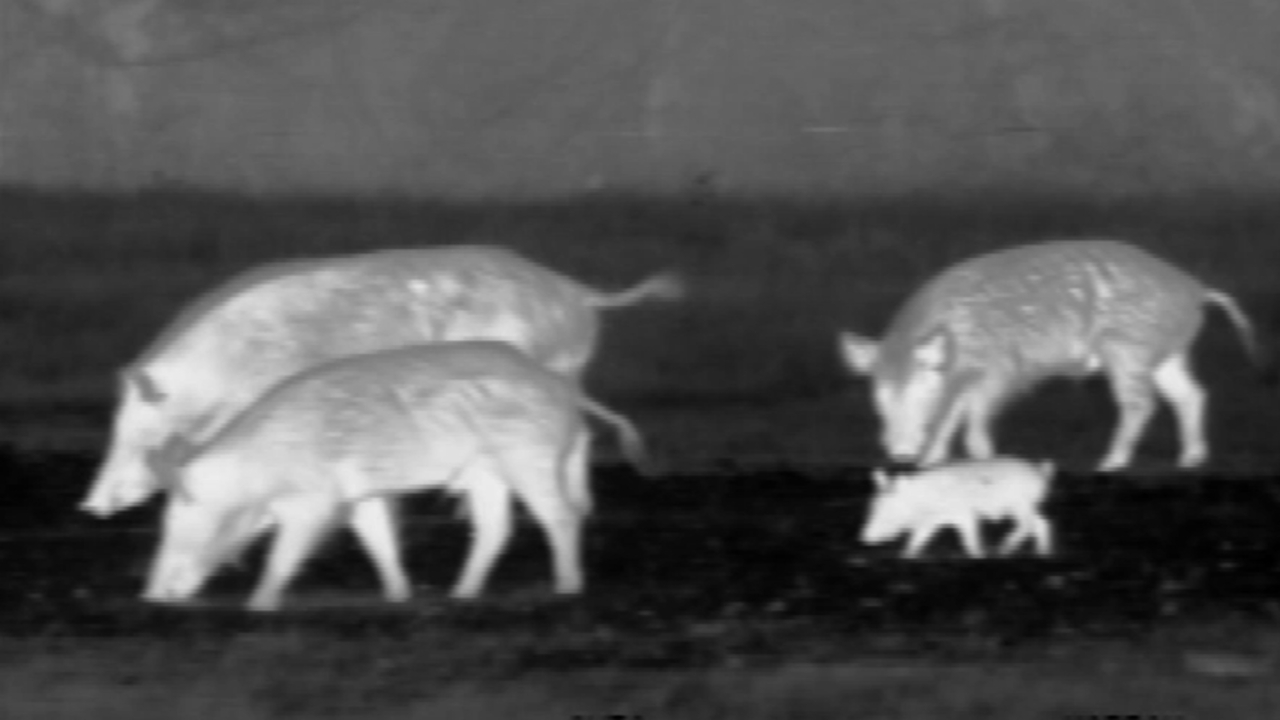
Feral hogs are not just a nuisance — they are an ecological and agricultural catastrophe. The USDA estimates that wild hogs cause over $2.5 billion in damage across the United States every year, destroying crops, tearing up pastures, contaminating water sources, and outcompeting native wildlife. They breed at an alarming rate, with a single sow capable of producing two litters per year averaging five to six piglets each. At that pace, a population can triple in a matter of months. Daytime hunting alone does not put a meaningful dent in the problem.
That is where night hunting comes in. Feral hogs are primarily nocturnal, especially in areas where they face hunting pressure. During the heat of summer and in regions with significant human activity, sounders move almost exclusively after dark. If you want to be effective — whether you are protecting agricultural land or simply pursuing one of the most challenging and exciting hunts available — you need to be in the field when the hogs are. Night hunting with thermal optics has become the most effective method for managing feral hog populations, and it is hands down the most adrenaline-fueled hunting experience we have ever had.
We have spent hundreds of hours hunting hogs after dark across Texas, Oklahoma, Georgia, and Florida. This guide covers everything we have learned: the legal landscape, the gear that actually works, how to find and pattern hogs, the tactics that put you in position for clean shots, and the safety considerations that keep everyone going home in one piece. For more predator and hog hunting content, visit our predator hunting hub.
Night Hunting Legality: A State-by-State Overview
Before you load a single round, you need to understand the legal framework for night hog hunting in your state. This is not a gray area you can afford to be casual about. Regulations vary dramatically, and violations can result in license revocation, equipment confiscation, and criminal charges.
The good news is that the majority of states with significant feral hog populations allow night hunting in some form. Texas is the gold standard — night hunting of feral hogs is legal year-round on private land with landowner permission, and there are no restrictions on the use of thermal optics, night vision, or suppressors (beyond standard NFA compliance). Oklahoma, Louisiana, Georgia, Florida, Alabama, Mississippi, and the Carolinas all permit night hunting of feral hogs with varying degrees of restriction.
Here is what you need to verify for your state before heading out:
- Is night hunting of feral hogs explicitly legal? Some states permit night hunting for hogs but not for other species. Do not assume hog regulations mirror coyote or predator regulations.
- Are thermal and night vision optics legal? Most hog-friendly states allow thermal scopes and monoculars. A handful restrict weapon-mounted night vision or require specific permits for electronic optics. Our thermal vs. night vision comparison covers the legal and practical differences between these technologies.
- Are there lighting restrictions? Some states allow weapon-mounted lights, spotlights, or feeders with lights. Others prohibit all artificial light sources or allow only specific types.
- Is a special permit or notification required? Several states require you to notify the local game warden before hunting hogs at night. Others require a depredation permit if you are hunting on agricultural land under a nuisance exemption.
- Are suppressors legal for hunting? In states where suppressors are legal for general use, they are typically legal for night hog hunting as well. Suppressors are not just a convenience — they are a practical tool that reduces noise disturbance to neighbors, protects your hearing during repeated shots, and prevents the rest of a sounder from scattering as quickly.
- Public land restrictions. Even in states where night hog hunting is broadly legal, public land often has additional restrictions or outright prohibitions on night hunting. Verify regulations for the specific Wildlife Management Area or national forest you plan to hunt.
States where night hog hunting is broadly legal on private land (as of early 2026, always verify current regulations): Texas, Oklahoma, Louisiana, Georgia, Florida, Alabama, Mississippi, South Carolina, North Carolina, Tennessee, Arkansas, and Missouri. Several other states allow it under specific depredation permits.
States with notable restrictions or prohibitions: California generally does not allow night hunting. Some Midwestern states with emerging hog populations may not have specific night hunting provisions because their regulatory frameworks have not caught up with the feral hog expansion.
Your state wildlife agency’s website is the definitive source. Call them directly if you have any doubt — game wardens are typically happy to clarify regulations over the phone, and a five-minute conversation beats a citation every time.
Essential Gear for Night Hog Hunting
Night hog hunting demands specialized equipment that daytime hunting does not. The darkness is absolute, hogs can appear and vanish in seconds, and you need to positively identify your target and what is behind it before pulling the trigger. Here is what we consider essential, and what we actually carry on every hunt.
Thermal Rifle Scope
A thermal scope is the centerpiece of your night hog hunting setup. It allows you to detect, identify, and engage hogs in complete darkness without any supplemental lighting. Unlike night vision, which amplifies ambient light, thermal reads heat signatures — meaning it works in zero-light conditions, through light fog, and in thick brush where a hog’s body heat bleeds through vegetation.
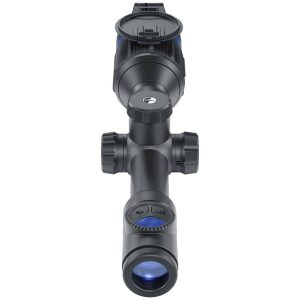
We run the Pulsar Thermion 2 XP50 Pro as our primary night hunting optic. The 640x480 sensor resolution and 50mm objective lens deliver an image that lets us positively ID individual hogs at 400+ yards and make confident shots at distances where lesser sensors show indistinct blobs. Image quality matters enormously in this application — you need to distinguish a hog from a calf, a deer, or a person at distance and in unfamiliar terrain.
Key features to prioritize when choosing a thermal scope for hog hunting:
- Sensor resolution. 640x480 is the sweet spot for serious night hunters. 320x240 sensors work at shorter ranges but limit your effective identification distance.
- Refresh rate. A 60Hz refresh rate produces a smooth image when tracking moving hogs. 30Hz is usable but noticeably less fluid.
- Magnification range. A 2-16x or similar variable magnification lets you scan at low power and zoom in for shot placement.
- Battery life. You need a minimum of 6 hours for an all-night sit. Carry spare batteries regardless.
- Zero reliability. A thermal scope that shifts zero after recoil is worse than useless — it is dangerous. Buy from reputable manufacturers with proven track records.
For a full breakdown of the best options at every price point, read our best thermal scopes for hog hunting roundup.
Thermal Handheld Monocular
A handheld thermal monocular is your scanning and detection tool. You use it to locate hogs before you ever shoulder your rifle. Glassing with a weapon-mounted optic means pointing your muzzle at everything you look at, which is a fundamental safety violation. A handheld unit lets you scan fields, tree lines, and travel corridors safely and then transition to your rifle scope only when you have confirmed a hog and are ready to take a shot.
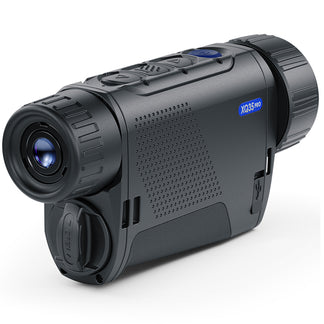
The Pulsar Axion 2 XQ35 Pro is what we carry on every night hunt. It is compact enough to fit in a cargo pocket, produces a sharp thermal image for scanning out to 600+ yards, and the battery runs long enough to last a full night. We use it constantly — checking fields before setting up, monitoring treelines for approaching sounders, and verifying that downed hogs are not getting back up.
Our best thermal monoculars for predator hunting roundup covers the full range of options if you are shopping for a scanning thermal.
Weapon Platform
The most common night hog hunting platforms are AR-pattern rifles in .308 Winchester, .300 Blackout, or 6.5 Creedmoor, and bolt-action rifles in similar calibers. Each has trade-offs.
AR-platform rifles in .308 or .300 Blackout are the dominant choice for night hog hunting, and for good reason. Semi-automatic operation lets you put follow-up shots on multiple hogs in a sounder before they scatter. When a group of 15 hogs is working a field and you drop the lead sow, the rest will mill around in confusion for a few seconds before bolting. A semi-auto platform lets you capitalize on that window. The .300 Blackout is particularly popular for suppressed setups because subsonic loads cycle reliably and are extremely quiet.
Bolt-action rifles in .308 or 6.5 Creedmoor are excellent for longer-range setups where you are engaging hogs at 200+ yards across open fields. The inherent accuracy advantage and the simplicity of a bolt gun appeal to many hunters. The trade-off is a slower rate of fire when multiple hogs present themselves.
Regardless of platform, mount your thermal scope on a quality base and rings rated for the recoil of your caliber. A loose scope mount in the dark is a nightmare you do not want to experience.
Suppressor Considerations
If you are legally able to own and hunt with a suppressor, it is one of the best investments you can make for night hog hunting. The benefits are practical, not tactical:
- Hearing protection. Repeated shots from an unsuppressed rifle without ear protection will damage your hearing. Period. Wearing electronic ear protection at night reduces your situational awareness and can interfere with your cheek weld. A suppressor solves both problems.
- Reduced muzzle flash. A suppressor virtually eliminates muzzle flash, which preserves your night-adapted vision and does not spook hogs at distance as aggressively.
- Reduced disturbance. Night hunting often happens on agricultural land near homes and livestock. A suppressed rifle is a courtesy to neighbors and reduces stress on nearby cattle and horses.
- Sounder management. Suppressed shots, especially with subsonic .300 Blackout, can allow you to take multiple hogs from the same sounder before the group identifies the threat source and flees.
The NFA process takes time and money. Plan accordingly. If you are not running a suppressor, wear quality electronic ear protection and accept the trade-offs.
Supplemental Lighting
While thermal optics eliminate the need for visible light during the hunt itself, you will need lighting for navigation, setup, and recovery. We carry the following:
- Red or green headlamp. For walking to and from your setup. Red and green light are less likely to spook game than white light, though hogs are less sensitive to light than deer.
- Handheld white flashlight. For tracking and recovery after the shot. A quality 1,000+ lumen light makes blood trailing at night far easier.
- Weapon-mounted light (optional). Some hunters run a weapon-mounted white light as a backup if their thermal goes down. This is state-law dependent.
Scouting and Location
Killing hogs at night starts with putting in the work during the day. Hogs are habitual animals with predictable patterns, and if you invest time in scouting, you will know where they are going to show up before they do.
Feeders and Food Sources
Feral hogs are driven by food above all else. Corn feeders are the most common attractant on private land, and they work extremely well. A timed feeder throwing corn at dusk creates a reliable pattern that pulls hogs into a specific location on a predictable schedule. If the landowner already runs feeders for deer, those same feeders are almost certainly attracting hogs.
Agricultural fields — particularly corn, soybeans, peanuts, and rice — are magnets. Hogs can destroy an entire crop in a single night, and farmers dealing with this damage are often eager to give you access. Look for fresh rooting along field edges, which tells you exactly where hogs are entering.
Mast crops like acorns and pecans draw hogs into hardwood bottoms seasonally. In the fall, a white oak flat dropping acorns will concentrate hogs more reliably than any feeder.
Trail Cameras
Trail cameras are essential for patterning hog activity. Run cameras on feeders, water sources, field edges, and trail crossings for at least two weeks before your hunt. You are looking for three pieces of information:
- What time are the hogs arriving? This tells you when to be in position. Most activity will fall between 10 PM and 3 AM.
- How many hogs are using this location? Sounder size affects your setup, your shot plan, and whether the location is worth hunting.
- What direction are they coming from? This is critical for positioning your setup downwind of their approach.
Set cameras to video mode when possible. Video gives you movement patterns and behavioral information that still photos miss.
Travel Corridors and Water Sources
Hogs travel on established routes between bedding areas and food sources. These corridors are visible during daylight scouting — look for worn trails through brush, creek crossings with tracks and muddy slides, gaps in fences, and wallows along the route. Setting up on a corridor between bedding cover and a food source gives you an ambush point even if hogs are not committed to a specific feeder.
Water is as important as food. Hogs need to drink and wallow, especially in warm weather. Stock tanks, creek bends, and pond edges with fresh tracks and mud wallows are high-probability setups. During summer, water sources can be more reliable than food sources because hogs must visit them regardless of what they are eating.
Setup and Tactics
Finding hogs is half the battle. Getting into position without alerting them and executing a clean shot in the dark is the other half.
Ground Blinds vs. Elevated Positions
Elevated positions — whether a box blind, a tripod stand, or the bed of a truck — are the most popular setup for night hog hunting, and they are what we recommend for most situations. Elevation gets your scent above the hogs, gives you a better field of view through thermal optics, and provides a natural backstop for your shots (you are shooting downward into the ground). A 10 to 15 foot tripod stand overlooking a feeder or field edge is the classic Texas hog setup, and it works.
Ground setups work when terrain dictates — hunting creek bottoms, travel corridors through thick brush, or situations where stands are not available. Ground hunting hogs at night requires stricter wind discipline and more careful concealment, but it also gives you flexibility to move and reposition. If you are hunting from the ground, set up with a solid backstop behind you (large tree, brush pile, terrain feature) to break your outline.
Truck-based hunting is legal and effective in many states, particularly on large ranches in Texas. Driving ranch roads with a spotter running a handheld thermal and a shooter ready with a thermal-equipped rifle covers enormous amounts of ground. This is the most efficient method for population control on large properties. Verify that your state allows shooting from or near a vehicle before employing this tactic.
Wind Management
Feral hogs have a sense of smell that rivals any animal in North America. They may have poor eyesight, but their nose will ruin your hunt faster than any mistake you can make with your setup or movement.
Always set up downwind of where you expect hogs to appear. This is non-negotiable. Check the wind before you leave the truck and verify it has not shifted when you reach your setup. Carry a wind indicator — a small squeeze bottle of milkweed or unscented powder — and use it frequently. Thermals (air currents, not optics) shift at dawn and dusk, and a wind that was perfect at 9 PM can betray you at midnight.
If you are hunting a feeder, set up so the prevailing wind carries your scent away from the primary approach route you identified during scouting. If the wind is wrong, hunt a different location. Do not convince yourself that hogs will not smell you — they will.
Approach and Setup Timing
Get to your setup early — at least an hour before you expect hog activity based on your trail camera data. Walk in quietly using the longest route that keeps the wind in your favor, even if it takes twice as long. Hogs that are bedded within earshot of your setup will hear you if you crash through brush or slam a truck door at close range.
Once in position, settle in and scan methodically with your handheld thermal. Check every tree line, brush pile, and terrain feature within your field of view. Hogs can be bedded closer than you think, and spotting them before they move gives you time to plan your shot.
Shot Placement on Hogs
Shot placement on feral hogs is fundamentally different from shot placement on deer, and getting this wrong is one of the most common mistakes new hog hunters make.
A hog’s vital zone sits lower and farther forward than a deer’s. The heart and lungs are protected by a thick, cartilaginous shoulder shield — especially on mature boars — that can deflect or slow bullets that would be lethal on a deer. The classic broadside deer shot (behind the shoulder, mid-body) placed on a hog often results in a paunch hit and a long, ugly tracking job.
The ideal broadside shot on a hog is placed directly on the shoulder crease, tight to the front leg, in the lower third of the body. This targets the heart and the bottom of the lungs, below the heaviest part of the shield. With adequate bullet construction and velocity, this shot drops hogs quickly and reliably.
The headshot is extremely effective on hogs when conditions allow. A hog’s brain is a small target — roughly the size of a baseball — but a well-placed shot between the ear and the eye on a broadside or slightly quartering head results in an instant kill with no tracking required. We take headshots when hogs are stationary, inside 100 yards, and we have a solid rest. Beyond that range or on a moving hog, the margin for error is too small.
Quartering-to shots are common when hogs are approaching a feeder and should be placed in the center of the chest to drive the bullet through the vitals lengthwise.
Avoid quartering-away and straight-on shots when possible. The shield and heavy bone structure in a hog’s front end can absorb a surprising amount of energy, and quartering-away shots through the paunch are the single biggest cause of lost hogs.
Use enough gun. A .308 Winchester with quality 150 to 168 grain bonded or monolithic bullets is our standard recommendation. The .300 Blackout with supersonic loads works well inside 150 yards. The .223 Remington can kill hogs, but it is marginal on larger boars and we do not recommend it as a primary hog cartridge.
After the Shot
Tracking and Recovery
After the shot, wait. Give the hog a minimum of 10 to 15 minutes before you leave your position, even if you saw it drop through your thermal scope. Hogs are incredibly tough animals, and a hog you believe is dead can get up and disappear into brush — or charge you in close quarters. Use your handheld thermal to monitor the downed hog from your setup. If you see movement, be prepared with a follow-up shot.
When you move in to recover, approach from a direction that gives you a clear shooting lane. Keep your rifle ready and use your thermal to confirm the animal is down before you close the final distance. Look for the absence of a heat signature in the legs (indicating the animal has expired) and watch for chest movement. Approach from behind the animal when possible.
If the hog ran after the shot, blood trailing at night is challenging but manageable. Your white flashlight is critical here — blood shows up well under bright white light. Mark your shot location, find first blood, and follow the trail methodically. A handheld thermal can help locate a downed hog in cover where you cannot see blood.
Processing and Disposal
Feral hog meat is excellent table fare when handled properly, particularly from younger animals under 150 pounds. The meat should be cooled as quickly as possible — bring coolers with ice to the field if you intend to keep the meat. Field dress the hog promptly, remove the hide, and get the meat on ice within an hour.
Larger boars, especially those over 200 pounds, can have strong-tasting meat. Many hunters process these animals for sausage, grinding the meat with pork fat and seasoning to mitigate the flavor.
On large-scale depredation hunts where dozens of hogs are harvested, disposal becomes a logistical consideration. Many ranches have designated burial pits or compost areas. Check local regulations on carcass disposal, and never dump hog carcasses on public land or near water sources.
Safety Considerations for Night Hunting
Night hunting introduces safety variables that do not exist during daytime hunts. Take these seriously — every single one of them.
Positive target identification is your absolute first responsibility. Before you put your finger on the trigger, you must confirm through your thermal optic that you are looking at a feral hog and not a deer, a calf, a dog, or a person. Thermal imaging can make identification challenging at extreme distances or through heavy cover. If you cannot positively identify your target, do not shoot. Period.
Know what is beyond your target. This basic firearms safety rule is harder to apply in the dark. Use your thermal to scan behind and around your target for other heat signatures. Be aware of roads, structures, and property lines relative to your shooting position.
Communicate with everyone on the property. If other hunters, ranch hands, or landowners are active at night, everyone needs to know where everyone else is. Establish zones, share GPS coordinates, and use radios. Two hunters with thermal scopes operating independently on the same property is a recipe for tragedy.
Carry a first aid kit and a communication device. Cell service is unreliable on remote ranches. A satellite communicator or personal locator beacon provides emergency communication when your phone has no signal. Carry a basic trauma kit — you are handling firearms in the dark in remote locations with large, potentially dangerous animals.
Watch for venomous snakes. In the Southern states where hog hunting is most popular, rattlesnakes, copperheads, and water moccasins are active at night during warm months. Wear snake boots or gaiters, use your light when walking, and watch where you step and sit.
Maintain your footing. Walking through uneven terrain in the dark, often carrying a rifle and gear, creates fall hazards that do not exist during the day. Move deliberately, use your headlamp, and do not rush.
Frequently Asked Questions
What is the best caliber for night hog hunting?
The .308 Winchester is the most versatile and effective caliber for night hog hunting. It offers the terminal performance needed to reliably anchor hogs of any size at typical engagement distances out to 300 yards. The .300 Blackout is an excellent choice for suppressed setups and shorter-range work inside 150 yards, especially with supersonic ammunition. The 6.5 Creedmoor provides flatter trajectory and less recoil than the .308 for hunters taking longer shots across open terrain. We do not recommend calibers smaller than .243 Winchester for dedicated hog hunting.
How much does a thermal scope setup cost?
A complete night hog hunting setup — thermal rifle scope, handheld thermal monocular, rifle, suppressor, and supporting gear — represents a significant investment. Entry-level thermal rifle scopes with 320x240 resolution start around $1,500. Mid-range 640x480 scopes run $3,000 to $5,000. Premium scopes like the Pulsar Thermion 2 are $5,000 and up. A handheld thermal monocular adds $1,000 to $3,000. You can get started with a quality thermal scope and no handheld unit if budget is a constraint, but we strongly recommend adding a scanning thermal as soon as you can. The safety and effectiveness benefits of separating your scanning optic from your weapon-mounted optic are substantial.
Can I use night vision instead of thermal for hog hunting?
Yes, but thermal is superior for hog hunting in nearly every scenario. Night vision amplifies ambient light and requires at least some illumination — from the moon, stars, or an infrared illuminator — to produce an image. Thermal reads heat signatures and works in zero-light conditions, through light fog, and in heavy brush where night vision struggles. Thermal also makes target identification faster and more reliable because a 200-pound heat source is unmistakable, whereas a hog under night vision can be difficult to distinguish from other animals in cluttered terrain. For a detailed comparison, read our thermal vs. night vision for hunting guide.
Do I need a hunting license to hunt hogs at night?
In most states, yes. While feral hogs are classified as invasive or nuisance animals, the majority of states still require a valid hunting license to pursue them. Some states offer specific feral hog permits or depredation authorizations that may be separate from a general hunting license. Texas, for example, requires a hunting license for hog hunting on public land but allows landowners and their agents to kill hogs on private land without a license. Always verify your state’s requirements before hunting. Contact your state wildlife agency directly if the regulations are ambiguous — this is not an area where you want to guess.
How do I find private land access for night hog hunting?
Landowners dealing with hog damage are often willing — even eager — to allow hunters on their property. Start by networking through local agricultural communities, feed stores, co-ops, and farming forums. Many state wildlife agencies maintain lists of landowners seeking help with hog depredation. Online platforms connecting hunters with landowners have become more common as well. When approaching a landowner, lead with the service you are providing — you are helping them solve a costly problem. Be professional, carry insurance if possible, share your plan for the hunt, and always leave the property better than you found it. A good first impression on one property often leads to referrals across an entire farming community.
Night hog hunting is demanding, gear-intensive, and requires real preparation. It is also one of the most effective conservation tools available for managing the feral hog crisis, and it is a hunting experience unlike anything else. The combination of thermal technology, the challenge of operating in darkness, and the explosive action when a sounder hits a field creates an intensity that keeps us coming back season after season. Invest in quality optics, do your scouting homework, hunt safely, and you will find that night hog hunting delivers results that daytime efforts simply cannot match. For the gear we trust on every hunt, start with our thermal scope and thermal monocular roundups, and review our testing methodology to understand how we evaluate every product on this site.
Quick Buy — Products in This Article