Pros
- Exceptional 640x480 sensor resolution
- 2300yd detection range
- Smooth 50Hz refresh
- Excellent recoil rating
- Intuitive on-screen menu
Cons
- Premium price point
- 31.7oz is heavy for extended carry
- Battery life could be better in extreme cold
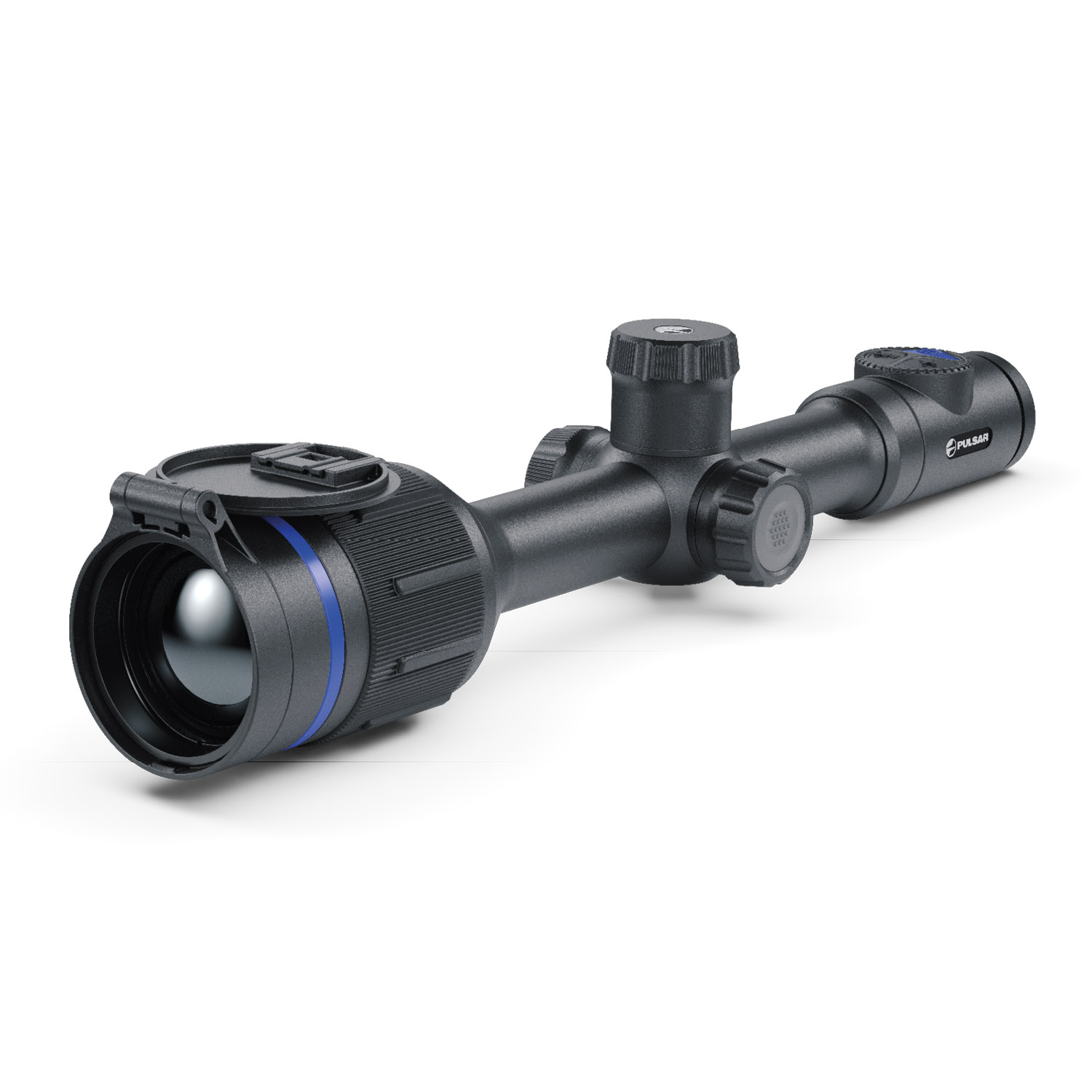
We’ve spent the last six months running the Pulsar Thermion 2 XP50 Pro through nighttime hog hunts in Texas, coyote setups in Oklahoma, and freezing predator sits in Kansas. After hundreds of hours behind this optic — and thousands of rounds downrange — we’re ready to tell you exactly who should buy it, who shouldn’t, and whether the premium price tag is actually justified.
This isn’t a first-impressions piece. We put the Thermion 2 XP50 Pro through our full Benchmark testing methodology and scored it against every thermal scope we’ve evaluated. Here’s where it landed.
Who Is This For?
The Pulsar Thermion 2 XP50 Pro is built for hunters who are serious about nighttime and low-light hunting and need the absolute best thermal image quality available in a traditional riflescope form factor. If you’re running a dedicated hog rig, calling predators after dark, or managing wildlife on large properties, this scope belongs at the top of your shortlist.
It’s also an excellent choice for hunters who have tried budget or mid-tier thermal scopes and found themselves frustrated by grainy images, slow refresh rates, or unreliable zero retention. The Thermion 2 is the answer to every complaint we hear about lesser thermal optics.
Skip this scope if: You’re just getting into thermal hunting and aren’t sure you’ll stick with it (start with something in the $2,000-3,000 range first). Also skip it if you hunt exclusively from a truck or UTV and weight is irrelevant — you might prefer the clip-on thermal approach instead. And if your budget is firmly under $4,000, check out our best thermal scopes for hog hunting roundup for strong alternatives.
Key Specifications
| Spec | Detail |
|---|---|
| Sensor Resolution | 640x480 (17µm pixel pitch) |
| Objective Lens | 50mm |
| Magnification | 2x-16x (2x optical, 8x digital) |
| Detection Range | 2,300 yards |
| Recognition Range | ~600 yards |
| Refresh Rate | 50Hz |
| Display | 1024x768 AMOLED |
| Battery Life | 7-8 hours (internal), expandable via USB-C |
| Weight | 31.7 oz |
| Reticle Options | 10 reticle styles, multiple color options |
| Recording | Built-in video/photo, 16GB onboard storage |
| Connectivity | WiFi, Stream Vision 2 app |
| Eye Relief | 50mm |
| NETD | ≤25 mK |
| Mount | 30mm rings (standard) |
Image Quality
This is where the Thermion 2 XP50 Pro earns its keep, and frankly, it’s the single biggest reason we scored it as high as we did.
The 640x480 sensor paired with Pulsar’s latest image processing algorithms produces the cleanest, most detailed thermal image we’ve seen in a hunting riflescope. Period. During our testing on a ranch outside Abilene, we were positively identifying individual hogs at 450+ yards in conditions that reduced competing scopes to useless noise. The 17-micron pixel pitch means you’re getting genuine detail — ear shape, body posture, even tail movement — at distances where other scopes show you vaguely hog-shaped heat blobs.
The NETD (thermal sensitivity) rating of ≤25 mK is among the best in this class, and it shows. On nights where ambient ground temperatures were still radiating heat well after sunset — the exact conditions that kill image contrast on lesser sensors — the Thermion 2 maintained clear subject-to-background separation. We tested extensively during a late-August Texas hog hunt where ground temps stayed above 85°F until midnight. Hogs still popped off the background with enough contrast for confident shot placement at 300 yards.
The 1024x768 AMOLED display is bright, crisp, and renders the thermal image beautifully. Compared to LCD displays on older thermal scopes, the difference is immediately noticeable — deeper blacks, better color accuracy across all eight palette modes, and no visible pixel grid even at higher digital magnification.
We found the White Hot palette best for scanning and general hunting, Rainbow for tracking wounded game through vegetation, and Red Hot useful in cold-weather situations where temperature contrast was already high. The ability to quickly cycle palettes with a single button press, rather than diving into menus, is a small but meaningful design choice that pays off when a sounder appears unexpectedly.
Detection Range
Pulsar claims 2,300 yards of detection range, and our testing confirmed this is legitimate — with a caveat. At 2,300 yards, you can detect that something warm exists. That’s useful for initial scanning across large properties, but it’s not where you’re making shooting decisions.
More practically relevant: we consistently achieved positive hog identification at 500-600 yards and comfortable shot-placement confidence out to about 400 yards, depending on conditions. Coyotes, being smaller targets, were identifiable at roughly 350-400 yards. These numbers are excellent and meaningfully better than what we recorded from the ATN ThOR 4 640 (which dropped off around 300 yards for positive ID) and comparable to the Trijicon REAP-IR.
The 50mm objective lens is a big part of this. It gathers more thermal energy than 35mm alternatives, giving the sensor more data to work with. If you’re hunting open country — Texas senderos, Oklahoma wheat fields, food plots — the extra detection capability is worth the size and weight trade-off.
One thing we appreciated: the Thermion 2’s digital zoom (up to 16x total) remains surprisingly usable. Most thermal scopes turn into a pixelated mess beyond 4x digital zoom, but Pulsar’s image processing keeps things clean through about 8x total magnification. Beyond that, you’re losing detail, but it’s still useful for confirming what you’re looking at before committing to a stalk.
Recoil and Zero Retention
We tested zero retention across 500+ rounds of .308 Winchester and 200+ rounds of 6.5 Creedmoor on two different rifles. The Thermion 2 XP50 Pro held zero throughout with no measurable drift. We confirmed this by returning to our 100-yard zero check target after every hunting session and found no deviation beyond what we’d attribute to shooter error.
Pulsar rates this scope for use on calibers up to .375 H&H, and based on our testing, we believe it. The internal construction feels overbuilt — there’s no rattle, no looseness in the adjustment turrets, and the housing shows zero signs of stress after months of hard use.
The zeroing process itself is straightforward. Pulsar uses a “freeze and adjust” system: you fire a shot, freeze the display, then move the reticle to your point of impact. It’s faster than the traditional click-adjust-and-shoot method and gets you on paper in 3-5 rounds consistently. We zeroed on two different rifles and had both dialed in within 10 minutes each.
The windage and elevation turrets offer precise, tactile clicks with a reassuring feel. Each click moves the point of impact a predictable amount, and the scope tracks accurately through the adjustment range. We didn’t experience any turret drift or inconsistency across our testing period — a problem we’ve encountered with some competing thermal scopes.
User Interface
The Thermion 2’s on-screen menu is the most intuitive interface we’ve used on a thermal scope. Pulsar clearly iterated on user feedback from earlier generations, because everything you need is accessible within one or two button presses.
The four-button control layout on top of the scope falls naturally under your support hand. Power, menu, up/down — there’s no fumbling, even with heavy gloves. We used this scope extensively with Mechanix winter gloves and had zero issues navigating the interface. The buttons are spaced well and have enough tactile feedback that you know when you’ve pressed them without looking.
Quick-access functions include: color palette cycling, digital zoom, brightness adjustment, and video recording toggle. None of these require entering the main menu. For a scope you’re operating in the dark, often while trying to stay quiet and steady, this matters enormously.
The Stream Vision 2 app connects via WiFi and mirrors your scope’s display on your phone or tablet. We used this primarily to show a spotter what we were seeing, and it worked reliably at distances up to about 15 feet. The app also handles firmware updates, which Pulsar pushes regularly. Over our testing period, two firmware updates improved image processing quality and added a new reticle option — a nice sign that Pulsar actively supports their products post-purchase.
The built-in video recording captured clean footage at 1024x768, and the 16GB of onboard storage held roughly 4-5 hours of continuous recording. The recoil-activated recording feature — which saves a buffer of footage before and after each shot — is genuinely useful for documenting hunts without manually starting and stopping recordings.
Battery Life
Pulsar claims 7-8 hours of battery life from the internal rechargeable battery, and our results tracked closely with that — in moderate temperatures. During our Texas and Oklahoma hunts (nighttime temps between 55-80°F), we consistently got 6.5-7.5 hours of continuous use. That’s enough for a long night sit with some margin to spare.
Where battery performance drops off is in cold weather. During our January and February predator hunts in Kansas (temps between 10-25°F), battery life fell to roughly 5-5.5 hours. Still usable for a single sit, but tight for all-night hunts without a backup plan.
The good news: the Thermion 2 charges and runs via USB-C. We kept a 20,000mAh power bank in our pack and topped off the scope during breaks. You can also run the scope continuously off external power, which is a smart design choice. If you’re hunting from a blind with access to a battery pack, runtime is effectively unlimited.
One minor complaint: the charging port cover feels like the weakest point on an otherwise tank-like scope. It’s a rubber plug that we could see wearing out over a few years of heavy use. A screw-cap or magnetic cover would be more confidence-inspiring at this price point.
Benchmark Score Breakdown
We scored the Pulsar Thermion 2 XP50 Pro against our standard methodology criteria for thermal riflescopes:
- Image Quality: 9.5/10 — Best-in-class 640x480 sensor with outstanding image processing and AMOLED display
- Detection Range: 9/10 — 2,300yd detection, 500-600yd positive ID, excellent digital zoom quality
- Recoil & Durability: 9.5/10 — Flawless zero retention across 700+ rounds, robust construction
- User Interface: 9/10 — Intuitive controls, fast palette switching, excellent app integration
- Battery Life: 8/10 — Solid in moderate temps, drops in extreme cold, USB-C backup mitigates
- Value: 8.5/10 — Premium price is justified by performance, but it’s still a lot of money
- Ergonomics: 8.5/10 — Weight is the only real penalty; balance and eye relief are excellent
Overall Benchmark Score: 9.1/10
How It Compares
We’ve tested the Thermion 2 XP50 Pro head-to-head against the two scopes hunters most often cross-shop it against. Here’s the short version — we’ll link to the full comparison articles below.
vs. ATN ThOR 4 640
The ATN ThOR 4 640 costs roughly $2,000 less and packs more technology features — ballistic calculator, rangefinder integration, dual-stream recording. If you want the most features per dollar, the ThOR 4 wins. But the Thermion 2 beats it decisively on image quality, detection range, and refresh rate smoothness. The ThOR 4’s image has a noticeable graininess compared to the Pulsar, and its 30Hz refresh produces visible stuttering when tracking moving targets. For dedicated nighttime hunters who prioritize what they see through the eyepiece above all else, the Pulsar is worth the premium.
vs. Trijicon REAP-IR
The REAP-IR is the Thermion 2’s closest competitor on pure optical performance. Image quality is comparable, and the Trijicon’s 60Hz refresh rate actually edges out Pulsar’s 50Hz for the smoothest possible image. The REAP-IR also holds zero like it’s bolted to the rifle — arguably the best in class. Where the Thermion 2 wins is features and value. It includes video recording, WiFi streaming, app connectivity, and a more user-friendly interface — all things the stripped-down REAP-IR lacks. At similar price points, the Thermion 2 gives you more scope for your money unless raw durability is your single highest priority.
For the full breakdown on all the top contenders, see our best thermal scopes for hog hunting roundup, which covers these comparisons in depth.
Frequently Asked Questions
Is the Pulsar Thermion 2 XP50 Pro worth the price?
For hunters who use thermal optics regularly — multiple times per month during season — yes. The image quality, detection range, and feature set represent the best overall package in the thermal riflescope market right now. If you hunt with thermal a few times a year, you’d be well-served by options in the $2,500-3,500 range. But if thermal hunting is a core part of your program, the Thermion 2 pays for itself in confidence and capability.
Can you use the Thermion 2 XP50 Pro for daytime hunting?
Technically yes — thermal scopes work regardless of lighting conditions. However, thermal imaging doesn’t provide the same level of target detail as traditional glass in daylight. You won’t see antler points or distinguish between similar-sized animals as easily. Most hunters run the Thermion 2 as a dedicated nighttime optic and keep a conventional scope for daytime hunts.
How does the Thermion 2 handle rain and humidity?
Exceptionally well. The scope is IPX7 waterproof rated, and we used it through multiple hunts in light to moderate rain without any issues. More importantly, thermal imaging actually performs well in fog and high humidity — conditions that render traditional night vision nearly useless. The Thermion 2’s sensor cuts through moisture in the air effectively, maintaining usable image quality when visible-light optics would be blind.
What rings and mounts work with the Thermion 2 XP50 Pro?
The Thermion 2 uses a standard 30mm tube, so any quality 30mm rings will work. We ran ours in Vortex Precision Matched rings and Warne Skyline mounts during testing without issues. Given the scope’s 31.7oz weight, we recommend medium-height rings with a secure clamping system. Avoid ultralight aluminum rings — this scope deserves a mount that matches its build quality.
How often does Pulsar release firmware updates?
Pulsar has been consistently active with firmware support. During our six-month testing window, we received two firmware updates that improved image processing and added features. Updates are pushed through the Stream Vision 2 app and take about 10 minutes to install. This ongoing software support is a meaningful advantage over competitors who treat their scopes as ship-and-forget products.
Final Thoughts
The Pulsar Thermion 2 XP50 Pro isn’t cheap, and it isn’t the lightest thermal scope you can buy. But it delivers where it counts — image quality, detection range, zero retention, and a user experience that stays out of your way when hunting. After six months of hard use, it’s the thermal scope we reach for first, and the one we’d recommend to any serious nighttime hunter ready to invest in the best. Browse more of our reviews and guides in the hunting optics hub.