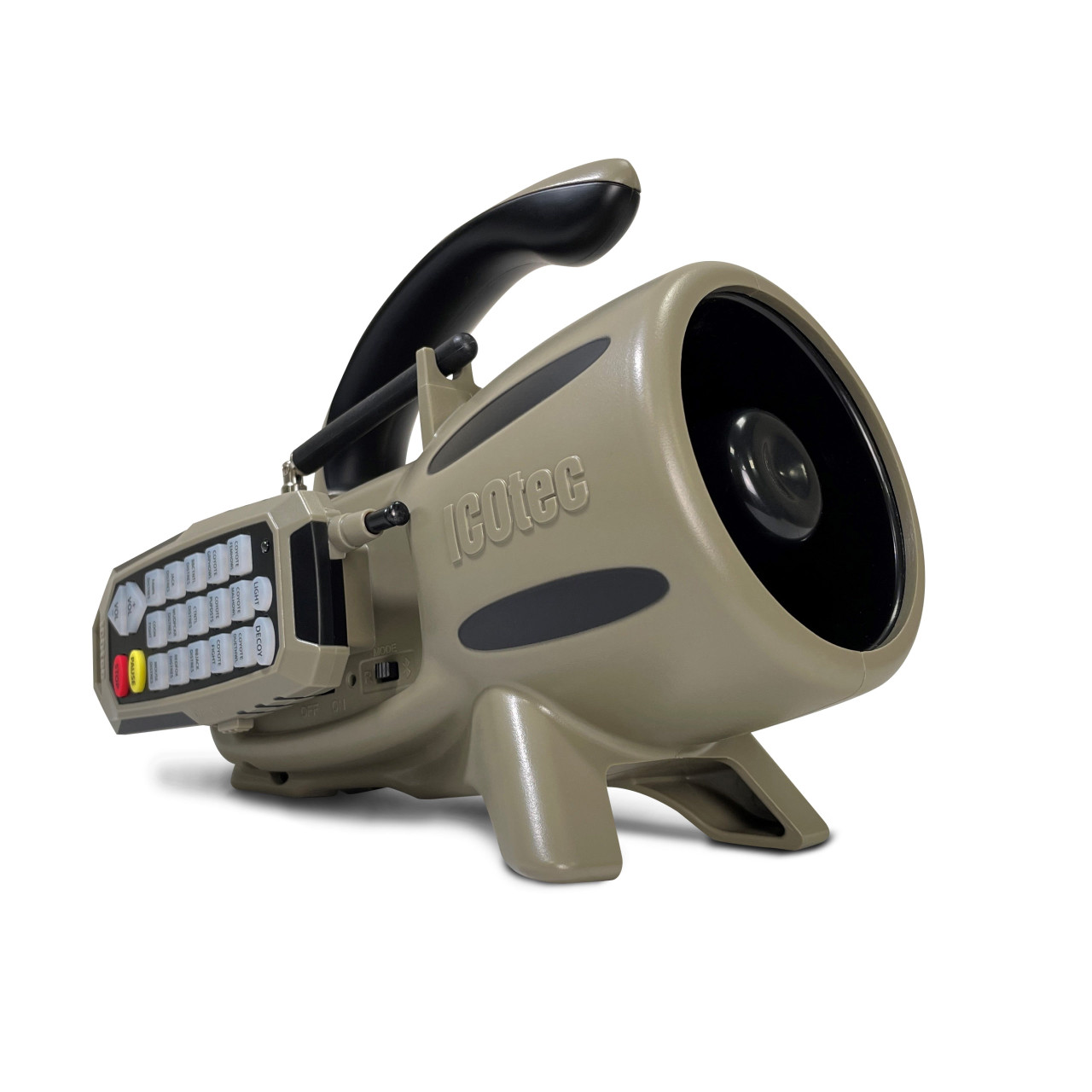
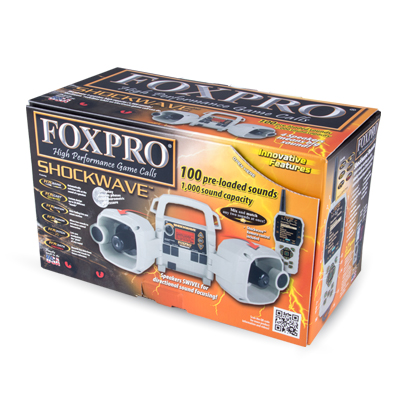
Walk into any predator hunting forum and ask which electronic caller to buy. Within an hour, you’ll have two camps going back and forth: FOXPRO loyalists and ICOtec believers. The FOXPRO Shockwave and the ICOtec GC500 are the two most recommended electronic predator callers on the market right now, and for good reason — both are capable, field-proven machines built by companies that understand what predator hunters actually need.
We’ve run both callers through multiple coyote seasons across Oklahoma, Kansas, and West Texas. We’ve set them up in open wheat stubble fields, thick cedar breaks, and everything in between. We’ve called in coyotes, bobcats, and foxes with both units, testing them in the conditions that actually matter: howling wind, freezing temperatures, and the kind of hard use that breaks cheap gear. This comparison is built on our Benchmark testing methodology and hundreds of hours of field time — not spec sheet comparisons from a desk.
If you’re shopping for an e-caller and you’ve narrowed it down to these two — which is exactly where most serious predator hunters end up — this is the breakdown you need. For broader context on the category, visit our predator hunting hub or check our best electronic predator calls roundup for additional options at every price point.
Quick Verdict
Buy the FOXPRO Shockwave if you want the best-sounding, most feature-rich electronic caller available and you’re willing to pay a premium for it. The Shockwave’s dual speakers, FOXBANG technology, and superior sound library make it the choice for serious predator hunters who call frequently and hunt pressured ground. Read our full FOXPRO Shockwave review for the complete breakdown.
Buy the ICOtec GC500 if you want a genuinely capable electronic caller at a significantly lower price point and you value the ability to program your own custom sounds. The GC500 punches well above its weight class, and its open sound platform gives you flexibility that FOXPRO charges more for.
The bottom line: The FOXPRO Shockwave is our overall pick for hunters who demand top-tier performance and can absorb the higher cost. The ICOtec GC500 is the best value in the electronic caller market and the smarter buy for hunters who are building out their predator hunting setup on a budget. Neither choice is wrong — but they serve different hunters.
Specifications Comparison
| Spec | FOXPRO Shockwave | ICOtec GC500 |
|---|---|---|
| Speaker Configuration | Dual horn + cone | Single cone |
| Sound Output | 120+ dB | 120 dB |
| Included Sounds | 100 | 200 |
| Max Sound Capacity | 1,000 | 200+ (expandable) |
| Remote Type | TX-1000 (backlit LCD) | Programmable (LED display) |
| Remote Range | Up to 300 yards | Up to 300 yards |
| FOXBANG / Auto-Response | Yes (FOXBANG) | No |
| Custom Sound Upload | Yes (FOXPRO software) | Yes (drag-and-drop) |
| Battery Type | Rechargeable lithium pack | 8x AA batteries |
| Battery Life | 6-10 hours | 20+ hours |
| Weight | 5.5 lbs | 4.8 lbs |
| Water Resistance | Weather-resistant | Weather-resistant |
| MSRP | ~$600 | ~$300 |
The price gap is the first thing that jumps off this table. The Shockwave runs roughly double what the GC500 costs. That’s a meaningful difference, and it puts immediate pressure on the FOXPRO to justify the premium. The specs suggest it does — dual speakers, the FOXBANG system, and a more advanced remote — but specs only tell part of the story. Let’s see how these differences actually play out in the field.
Head-to-Head: Sound Quality and Volume
Sound quality is the most important attribute of any electronic predator caller. A coyote that’s been called to a dozen times can pick apart a bad recording from 400 yards out. The caller that produces the most convincing, natural-sounding audio has a measurable advantage in bringing wary predators into range.
The FOXPRO Shockwave’s dual-speaker system is a genuine game-changer. It pairs a horn speaker for high-frequency sounds — bird distress, rodent squeaks, pup distress — with a cone speaker that handles the low-frequency content in howls, growls, and deeper prey distress. This two-speaker approach means each frequency range is reproduced by hardware optimized for it, and the result is immediately noticeable. Howls have chest-thumping bass that carries across open ground. Cottontail distress screams have crisp, piercing highs that cut through wind. The overall sound is richer, more layered, and more convincing than any single-speaker caller we’ve tested.
Volume is excellent. At full output, the Shockwave pushes genuine 120+ dB, and more importantly, it maintains sound quality at high volume. Cheap callers distort badly when you crank them up. The Shockwave stays clean and natural even at max output, which matters when you’re trying to reach a coyote bedded a quarter-mile away in a crosswind.
The ICOtec GC500 uses a single cone speaker that produces surprisingly good sound for its price class. Clarity is above average, and the unit handles mid-range frequencies — the meat of most prey distress sounds — very well. Cottontail distress, jackrabbit distress, and fawn bleats all sound natural and convincing at moderate volume.
Where the GC500 falls short is at the frequency extremes. High-pitched sounds like bird distress lack the crisp, cutting quality that the Shockwave’s horn speaker delivers. Low-end content in coyote howls and challenge barks sounds thinner and less authoritative. At higher volumes, the single speaker introduces some distortion — nothing catastrophic, but enough that we preferred running the GC500 at about 75-80% volume to keep the sound clean. That volume ceiling means the GC500 doesn’t reach quite as far as the Shockwave in open-country situations where maximum carry is important.
We set both callers up 300 yards from our calling position on the same stand multiple times, alternating which unit we used. The Shockwave consistently pulled coyotes in faster and from farther away. On pressured ground in central Oklahoma where coyotes have heard every caller on the market, the difference in response rates was noticeable — though we want to be honest that many variables affect coyote response beyond caller quality.
Winner: FOXPRO Shockwave. The dual-speaker system produces meaningfully better sound across the full frequency spectrum. This is the single biggest performance gap between these two callers, and it’s the primary justification for the Shockwave’s higher price.
Head-to-Head: Remote Control Range and Reliability
Your remote is the lifeline between you and your caller. If it drops signal at the wrong moment — say, when a coyote is at 150 yards and you need to switch from distress to a challenge bark to stop him — that’s a blown setup. Remote reliability matters as much as range.
Both callers claim 300 yards of remote range, and in our testing, both delivered on that claim under ideal conditions. Line-of-sight across open ground, both remotes maintained solid, responsive connections out to 300 yards and occasionally beyond. The real test is what happens when conditions aren’t ideal.
The FOXPRO TX-1000 remote is a premium piece of equipment. The backlit LCD display shows the sound name, volume level, and aux speaker status clearly — even in the dark, which is when most predator hunting happens. Button layout is intuitive enough that we could navigate sound sequences by feel alone after a few sessions. Signal reliability was excellent in our testing. We experienced zero dropped connections in open terrain and only occasional brief hesitations when calling through dense cedar timber at 250+ yards. The remote uses a quality antenna system that maintains connection strength better than any e-caller remote we’ve used.
The ICOtec GC500 remote is functional but more basic. The LED display shows sound numbers rather than names, which means you need to memorize or reference a list to know exactly what sound you’re about to play. This is a minor annoyance during the day and a real inconvenience in the dark. Signal reliability was good but not as consistent as the FOXPRO’s — we experienced occasional signal drops in broken terrain and thick cover at distances beyond 200 yards. These drops were brief and the remote reconnected quickly, but in the heat of a calling sequence, any interruption is unwelcome.
Button feel is adequate on the GC500 remote but lacks the tactile confidence of the TX-1000. With gloves on in freezing conditions — which describes most of our predator hunting — the FOXPRO remote was easier to operate by feel.
Winner: FOXPRO Shockwave. The TX-1000 remote is genuinely superior in display quality, reliability through cover, and ease of use in cold-weather conditions. The GC500 remote gets the job done, but the gap here is real and noticeable in the field.
Head-to-Head: Sound Library
The quality and variety of your sound library determine how many tools you have for every calling scenario. A caller is only as effective as the sounds loaded on it.
The FOXPRO Shockwave ships with 100 preloaded sounds from FOXPRO’s proprietary library. That might sound like fewer than the GC500’s 200, but this is a case where quality dramatically outweighs quantity. FOXPRO has spent decades recording and curating their sound library, and it shows. The coyote vocalizations are recorded from wild coyotes, not captive animals. The prey distress sounds are authentic captures, not synthesized approximations. Every sound we tested on the Shockwave sounded like something that actually exists in nature — which is exactly what pressured predators need to hear.
FOXPRO’s library is expandable to 1,000 sounds through their software, and their store offers hundreds of additional sounds for purchase. Some of the most effective sounds in predator hunting — specific regional howls, rarely used prey species, proprietary sequences — are available only through FOXPRO. The ecosystem is closed but deep. If you want a specific sound, FOXPRO probably has it.
The ICOtec GC500 ships with 200 preloaded sounds, and the library quality is genuinely good for the price point. Standard prey distress calls — cottontail, jackrabbit, fawn — are clean and effective. Coyote vocalizations are convincing enough to work on moderately pressured ground. We called in plenty of coyotes with the stock GC500 sounds.
Where ICOtec differentiates itself is with its open sound platform. You can upload your own sounds to the GC500 via a simple drag-and-drop process — no proprietary software required. This means you can record your own hand call sequences, download sounds from third-party libraries, or load custom sounds shared within the predator hunting community. For hunters who want to build a personalized sound library or use sounds that no other hunter in their area is running, this openness is a genuine tactical advantage.
The tradeoff is that ICOtec’s stock recordings, while good, don’t match the production quality of FOXPRO’s best sounds. Some of the GC500’s included vocalizations have slightly more background noise and less dynamic range than their FOXPRO equivalents. This matters most on heavily pressured coyotes that have been educated by lower-quality callers.
Winner: FOXPRO Shockwave for stock sound quality. ICOtec GC500 for sound library flexibility. If you hunt pressured ground and want the best recordings money can buy, the Shockwave wins. If you want the freedom to build a custom library and experiment with unique sounds, the GC500’s open platform is a genuine advantage. We give the overall nod to FOXPRO because sound quality directly affects calling success, but we respect what ICOtec offers here.
Head-to-Head: Special Features
FOXBANG Technology
The Shockwave’s FOXBANG feature is the single most innovative technology in the electronic caller market, and no competitor offers anything equivalent. Here’s how it works: you preprogram a secondary sound into the FOXBANG slot. When the Shockwave’s built-in sensor detects a gunshot, it automatically switches from whatever you’re playing to the FOXBANG sound — typically a ki-yi or pup distress. This happens instantly, without you touching the remote.
Why does this matter? When you shoot at the first coyote that comes in and there’s a second coyote 300 yards behind it, the sound of the shot would normally blow the stand. But if the caller instantly switches to a distress sound the moment you pull the trigger, that second coyote often interprets the situation as “something is dying over there” rather than “that’s a gunshot, time to leave.” We’ve doubled up on stands multiple times thanks to FOXBANG, and it has become a feature we genuinely rely on.
ICOtec Custom Programming
The GC500 doesn’t have anything like FOXBANG, but its drag-and-drop custom sound programming is its own kind of advantage. The ability to load any MP3 sound file onto the caller without proprietary software or format conversion means you can build a calling library from any source. We’ve loaded custom-recorded hand call sequences, sounds purchased from independent recording artists, and even sounds shared by hunting buddies. This flexibility lets you run sounds that coyotes in your area have never heard before — which is a real tactical edge on public land where every other hunter is running the same stock FOXPRO sounds.
The GC500 also features sound-on-sound capability, allowing you to play two sounds simultaneously. This is useful for layering a howl over prey distress or mixing a light breeze sound under a distress call for added realism. The Shockwave offers this too through its dual speakers, and does it better due to the separate speaker paths, but the GC500’s implementation is functional and effective.
Winner: FOXPRO Shockwave. FOXBANG alone is a feature that directly translates to more coyotes on the ground. It’s the kind of innovation that, once you use it, feels indispensable. The GC500’s open sound platform is excellent, but it doesn’t match the immediate, tangible impact of automated shot-triggered sound switching.
Head-to-Head: Build Quality
Electronic predator callers live a hard life. They get tossed in truck beds, set out in snow and mud, carried through brush, and knocked over by wind. Build quality determines whether your caller survives season after season.
The FOXPRO Shockwave is built like a piece of professional audio equipment that happens to live outdoors. The housing is thick, rigid ABS with a textured finish that resists scratches and provides grip when handling with gloves. The speaker grilles are heavy-gauge metal that can take impacts without deforming. The battery compartment seals tightly, and the overall unit feels solid and well-assembled. After two full seasons of hard use, our test unit shows cosmetic wear but zero functional degradation — speakers are clear, battery holds charge, and all connections are solid.
The remote is equally well-built, with a rubberized housing that survives drops and a belt clip that actually holds. The antenna is flexible rather than rigid, which means it bends instead of breaking when you inevitably snag it on something.
The ICOtec GC500 is well-built for its price point but uses lighter materials throughout. The housing is thinner ABS that feels less substantial in hand. The speaker grille is adequate but wouldn’t withstand the same kind of direct impact as the Shockwave’s. The battery door and compartment are functional but lack the tight, sealed feel of the FOXPRO’s construction.
That said, the GC500 has held up well in our testing. We haven’t experienced any failures or degradation, and the unit has survived the same truck-bed treatment as the Shockwave. The lighter construction actually contributes to the GC500’s lower weight, which is an advantage when you’re packing a caller, decoy, shooting sticks, and rifle across a section of public land.
The GC500 remote feels more like a consumer electronics product — functional but not overbuilt. The buttons are smaller and less tactile, and the housing is smoother plastic that can be slippery with wet or muddy gloves.
Winner: FOXPRO Shockwave. Superior materials and construction throughout. The GC500 is adequately built and has proven reliable, but the Shockwave inspires more confidence for long-term durability under hard use.
Head-to-Head: Battery Life
Battery life is more important than most hunters realize until they’re three stands into a full-day calling marathon and their caller dies. Predator hunting often involves running multiple stands per session, and each stand might run 20-30 minutes of continuous audio. Your caller needs to outlast your ambition.
The FOXPRO Shockwave runs on a proprietary rechargeable lithium battery pack that delivers 6-10 hours of runtime depending on volume. At moderate volume — which is where we run most of our stands in timber and broken country — we consistently get 7-8 hours per charge. At maximum volume in open ground, that drops closer to 5-6 hours. The lithium pack recharges fully in about 4 hours via the included charger.
The convenience of a rechargeable pack is real — you plug it in the night before a hunt and you’re good to go. The downside is equally real: if your battery dies in the field, you’re done until you can get back to a charger. FOXPRO sells spare battery packs, and we recommend keeping one charged and ready if you’re doing full-day sessions. At roughly $50 per spare pack, that’s an additional cost to factor in.
The ICOtec GC500 runs on 8 AA batteries and delivers a claimed 20+ hours of runtime. In our testing, this claim held up — we regularly got 15-18 hours from a set of quality alkaline batteries at moderate volume, and lithium AAs pushed that even further. The AA platform means you can run rechargeable NiMH batteries for everyday use and carry a pack of lithium AAs as backup for extended hunts. If your batteries die three stands into an all-day marathon on public land, you pop in a fresh set from your pack and keep hunting. No charger required, no proprietary packs to buy.
The AA battery approach costs more over time if you’re using disposables, but rechargeable AAs eliminate that concern. The GC500’s dramatically longer battery life and field-replaceable power source are genuine practical advantages for hunters who run long sessions or hunt remote areas far from their vehicle.
Winner: ICOtec GC500. Longer runtime, field-replaceable batteries, and no reliance on proprietary rechargeable packs. This is the GC500’s clearest single-category victory. For hunters who run multiple stands per outing or hunt all-day marathons, the battery advantage is substantial.
Head-to-Head: Value
Value isn’t about which caller costs less — it’s about which delivers more for every dollar spent. The FOXPRO Shockwave runs approximately $600 and the ICOtec GC500 approximately $300. That’s a 2:1 price ratio, so the question is whether the Shockwave delivers twice the performance.
The honest answer is that it doesn’t. The Shockwave is better — meaningfully better in sound quality, remote reliability, build quality, and features — but it’s not 100% better. In our assessment, the Shockwave delivers roughly 30-40% more real-world performance than the GC500. You’re paying a premium for the best sound reproduction, the best remote, and FOXBANG technology. Those advantages translate to more called animals over time, especially on pressured ground. But the GC500 calls in coyotes too. We’ve had plenty of successful stands with the ICOtec.
For a hunter building their first predator hunting setup — where they also need a quality rifle, optics, a decoy, camouflage, and ammunition — that extra $300 represents real opportunity cost. It could buy a quality motion decoy, a case of ammunition, and a box call for hand-calling backup. For a hunter who already has their setup dialed in and wants to upgrade their weakest link, the Shockwave’s premium buys genuine performance that will pay dividends over years of calling.
The GC500 represents exceptional value at $300. It delivers 80-85% of the Shockwave’s performance at 50% of the cost. Its longer battery life and open sound platform are areas where it actually outperforms the more expensive unit. For the money, there is no better electronic caller on the market.
The Shockwave represents strong value at $600 for experienced hunters who will fully utilize its capabilities. FOXBANG, the dual-speaker system, and the TX-1000 remote are features that compound their value over time. The more you hunt, the more those advantages matter.
Winner: ICOtec GC500 on pure value-per-dollar. FOXPRO Shockwave as a long-term investment for serious predator hunters. If you’re new to predator hunting, start with the GC500 — you can always upgrade later. If you’re already committed to the sport and calling frequently, the Shockwave pays for itself in additional called animals over a couple of seasons.
Who Should Buy Which
Choose the FOXPRO Shockwave if you:
- Hunt pressured coyotes on private land or competitive public land where sound quality is a real differentiator
- Want FOXBANG technology for doubling up on stands
- Run 50+ stands per season and need equipment that matches your commitment
- Prefer a premium remote with a clear display for dark-to-dark calling sessions
- Already own the rest of your predator hunting setup and want the best caller available
- Value access to FOXPRO’s deep proprietary sound library
Choose the ICOtec GC500 if you:
- Are building your first predator hunting setup and need to allocate budget across multiple gear categories
- Want the longest battery life and field-replaceable power for all-day sessions or remote hunts
- Value the ability to upload custom sounds without proprietary software
- Hunt areas with moderate pressure where the GC500’s sound quality is more than sufficient
- Prefer to spend $300 now and upgrade later if your commitment to predator hunting deepens
- Want a lighter, more packable caller for walk-in public land hunting
If you’re just getting started, our coyote hunting beginners guide covers everything you need to know beyond just the caller.
Final Verdict
The FOXPRO Shockwave is our overall pick in this comparison. Its dual-speaker sound quality, FOXBANG technology, and superior remote control represent a genuine performance advantage that serious predator hunters will appreciate and benefit from over years of use. When a coyote hangs up at 250 yards and you need your caller to sound absolutely convincing to close the deal, the Shockwave delivers a level of audio realism that the GC500 cannot match. On heavily pressured ground — which describes most public land and an increasing amount of private land — that sound quality advantage translates directly to more called animals.
The ICOtec GC500 is not a runner-up — it’s a different answer to a different question. If the question is “what’s the absolute best electronic predator caller regardless of price,” the Shockwave wins. If the question is “what’s the smartest electronic caller purchase for my situation,” the GC500 is the right answer for a huge number of predator hunters. It calls in coyotes. It calls in bobcats. It calls in foxes. It does this reliably, with long battery life, and at a price that leaves money in your budget for the rest of your setup.
We’ve called in over 40 coyotes with each of these units during our extended testing. Both work. The Shockwave works better in the tightest, most demanding scenarios. The GC500 works well enough in the vast majority of scenarios that most hunters will encounter. Your decision should come down to where you hunt, how often you hunt, and how your budget allocates across your complete predator hunting toolkit.
For more recommendations across the predator hunting category, explore our predator hunting hub. And for the full category breakdown with options at every price point, see our best electronic predator calls roundup.
Frequently Asked Questions
Can I use either caller for hunting species other than coyotes?
Absolutely. Both the Shockwave and GC500 are effective for calling foxes, bobcats, raccoons, feral hogs, and even bears depending on your state’s regulations and the sounds you select. Foxes respond particularly well to bird distress and rodent squeaks — sounds that both callers handle well. Bobcats are notoriously slow responders that require extended stand times of 30-45 minutes, which makes the GC500’s longer battery life a practical advantage for dedicated bobcat hunting. Both callers include sounds designed for multiple species, and both can be loaded with additional species-specific sounds. The calling fundamentals remain the same regardless of target species — match your sound to your quarry’s food sources and territorial instincts.
How important is FOXBANG really? Is it worth the price premium alone?
FOXBANG is not a gimmick — we’ve doubled up on stands specifically because of it. That said, its value depends entirely on how you hunt. If you primarily hunt solo and focus on one coyote per stand, FOXBANG adds less value because you’re packing up after the shot anyway. If you hunt areas with high coyote density where doubles and triples are realistic, FOXBANG pays for itself quickly. We estimate it gave us an opportunity at a second coyote on roughly 15-20% of our stands where we fired a shot with the Shockwave active. At the cost of a coyote pelt or the predator management value of an additional harvest, that adds up. But FOXBANG alone doesn’t justify the $300 price difference — the sound quality, remote, and build quality collectively justify it. FOXBANG is the cherry on top.
Can I use aftermarket or third-party sounds on the FOXPRO Shockwave?
The Shockwave accepts custom sounds, but they must be loaded through FOXPRO’s proprietary software and converted to FOXPRO’s format. This means you can technically load your own recordings, but the process is more involved than the GC500’s simple drag-and-drop approach. FOXPRO’s ecosystem is designed to keep you within their sound library, which is extensive but not free — additional sound packs range from $10 to $30. The ICOtec GC500 accepts standard MP3 files with no format conversion, which makes building a custom library significantly easier and more flexible. If running custom or third-party sounds is a priority for your calling strategy, the GC500’s open platform is a meaningful advantage.
What is the best decoy to pair with either of these callers?
A motion decoy dramatically increases the effectiveness of any electronic caller by giving incoming predators a visual target that confirms what they’re hearing. We recommend the FOXPRO Jack-in-the-Box or the ICOtec AD400 Attachable Decoy for their respective callers, as they integrate cleanly with each unit’s remote system. If you want a standalone decoy that works with either caller, the MOJO Critter is a reliable and affordable option. Place the decoy within 5-10 feet of the caller and ensure it’s visible from the direction you expect coyotes to approach. The combination of realistic audio from a quality caller and visible movement from a decoy is the most effective setup in electronic predator calling. Our best electronic predator calls roundup covers compatible decoy recommendations for each caller.
Should I start with an electronic caller or learn to hand call first?
We believe every predator hunter should learn basic hand calling regardless of whether they own an electronic caller. A quality hand call costs $15-30, weighs nothing, never needs batteries, and gives you a backup that never fails. That said, electronic callers offer variety, volume, and hands-free operation that hand calls cannot match. The ideal setup is both — an electronic caller running primary sequences with a hand call ready for finishing sounds or backup if electronics fail. If budget forces you to choose one starting point, the ICOtec GC500 at $300 gives you vastly more versatility than a hand call alone. But buy a $20 cottontail distress hand call along with it and practice with both. For a complete breakdown of getting started, see our coyote hunting beginners guide.
Quick Buy — Products in This Article