A spotting scope is the single most important piece of glass you carry into western big game country. Your binoculars find the animal. Your spotting scope tells you whether that animal is worth the next four hours of your life — the stalk, the elevation change, the risk of blowing out an entire basin. We’ve watched too many hunters try to judge a mule deer buck at 1,200 yards through 10x binoculars, convince themselves he’s a shooter, and burn an entire day chasing a buck they’d have passed on in 30 seconds with a good spotter.
We spent two full seasons running three of the best spotting scopes on the market through elk hunts in Montana, mule deer seasons in Colorado and Wyoming, and antelope glassing sessions across the Wyoming plains. Every scope was mounted on a quality tripod and used in the conditions western hunters actually face: high-altitude wind, sub-freezing mornings, midday heat shimmer, and the thin golden light at the edges of legal shooting hours. These three earned their spots through performance, not spec sheets.
For details on how we evaluate optics, visit our Benchmark Score methodology. For more reviews and comparisons across binoculars, rangefinders, and riflescopes, explore our full hunting optics hub.
Quick Picks
- Best Overall: Vortex Razor HD 27-60x85 — Elite optical clarity and the warranty that backs it for life. The standard-bearer for western hunting glass.
- Best Direct-to-Consumer Value: Maven S.1A 25-50x80 — Premium Japanese glass at a price that undercuts the competition by hundreds.
- Best for Lightweight Backcountry Hunts: Leupold SX-5 Santiam HD 27-55x80 — The lightest full-size spotter we trust for serious field judging.
Why You Need a Spotting Scope for Western Hunting
Western hunting is a different discipline than anything east of the Rockies. The distances are measured in miles, not yards. The terrain is open, broken, and massive. A whitetail hunter can spend an entire career without ever needing magnification above 10x. A western hunter without a spotting scope is operating blind in country that demands precision at extreme range.
The core job of a spotting scope in western hunting is field judging. Whether you’re trying to count points on a bull elk bedded at 1,400 yards across a drainage, evaluating the width of a mule deer buck against his ears at a mile, or deciding if a pronghorn buck’s prongs are worth the crawl across 600 yards of open sage, a spotting scope gives you the resolution to make that call with confidence. Binoculars, even excellent ones, simply cannot deliver enough magnification and detail at those distances. The math doesn’t work — a 10x binocular at 1,000 yards shows you what your naked eye sees at 100 yards. A 60x spotting scope at 1,000 yards shows you what your eye sees at roughly 17 yards. That’s the difference between guessing and knowing.
Beyond field judging, a spotting scope is your planning tool. You glass a basin, find animals, then study terrain to build a stalk route. You identify obstacles — cliffs, thick timber, exposed ridgelines where you’ll skyline yourself — before committing. We’ve planned stalks through spotting scopes that saved us hours of wasted effort because we could see, before we ever started moving, that the approach wouldn’t work.
There’s also the simple reality of efficiency. Western hunting tags are expensive, time is limited, and most units hold more country than you can physically cover. A spotting scope lets you effectively hunt thousands of acres from a single glassing point. We’ve glassed up animals at two miles that we never would have found by walking. In open western terrain, your optics cover ground faster than your boots ever will.
If you’re hunting elk, mule deer, antelope, sheep, goat, or moose in country where you can see more than 500 yards in any direction, a spotting scope isn’t optional gear. It’s foundational.
Vortex Razor HD 27-60x85
Best for: Hunters who want best-in-class optics backed by the best warranty in the business
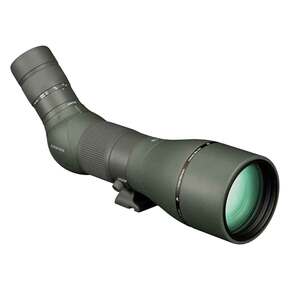
The Vortex Razor HD 27-60x85 has been the benchmark western hunting spotting scope for years, and the current generation continues to justify that reputation. We’ve used this scope on more western hunts than any other optic in our lineup, and it has never once been the reason we couldn’t make a call on an animal.
Optical performance is where the Razor HD earns its price. The 85mm objective lens pulls in a tremendous amount of light, and Vortex’s APO optical system with HD glass delivers images that are sharp, bright, and color-accurate from edge to edge. At 27x, the field of view is generous enough for scanning large basins and picking apart timbered hillsides. Crank it up to 45x or 50x and the image remains remarkably crisp — this is where you do your real field judging work, counting tines on a bull or measuring a buck’s spread against his ears. The scope holds usable sharpness even at 60x in stable atmospheric conditions, though realistically, heat mirage and wind will limit you to 45-50x on most western days by late morning.
Low-light performance is a genuine strength. During September elk hunts in Montana, we were picking up bulls moving through timber 30 minutes before legal shooting light with enough detail to evaluate them. That’s not unusual for an 85mm objective at this quality level, but it’s worth noting for hunters who do most of their glassing in the first and last hour of the day — which is most of us. The color fidelity runs neutral to slightly cool, which works well for western landscapes. Contrast is excellent, particularly when glassing sage-covered hillsides where you need to separate a gray-brown animal from gray-brown terrain.
The build is what you’d expect from Vortex at this tier: magnesium alloy housing, ArmorTek exterior lens coatings that resist scratches from field use, and full waterproofing. It weighs 68 ounces, which puts it firmly in the “truck to glassing point” category rather than deep backcountry. The included helical focus is smooth and precise, with minimal play. And then there’s the warranty — Vortex’s unconditional, transferable, no-receipt-needed VIP warranty means this scope is a lifetime investment. Break it, send it back, get it fixed or replaced. No questions asked. For a piece of glass you’re trusting to perform on a once-in-a-decade tag, that peace of mind matters.
Maven S.1A 25-50x80
Best for: Hunters who want premium optical performance at a direct-to-consumer price that undercuts traditional retail brands
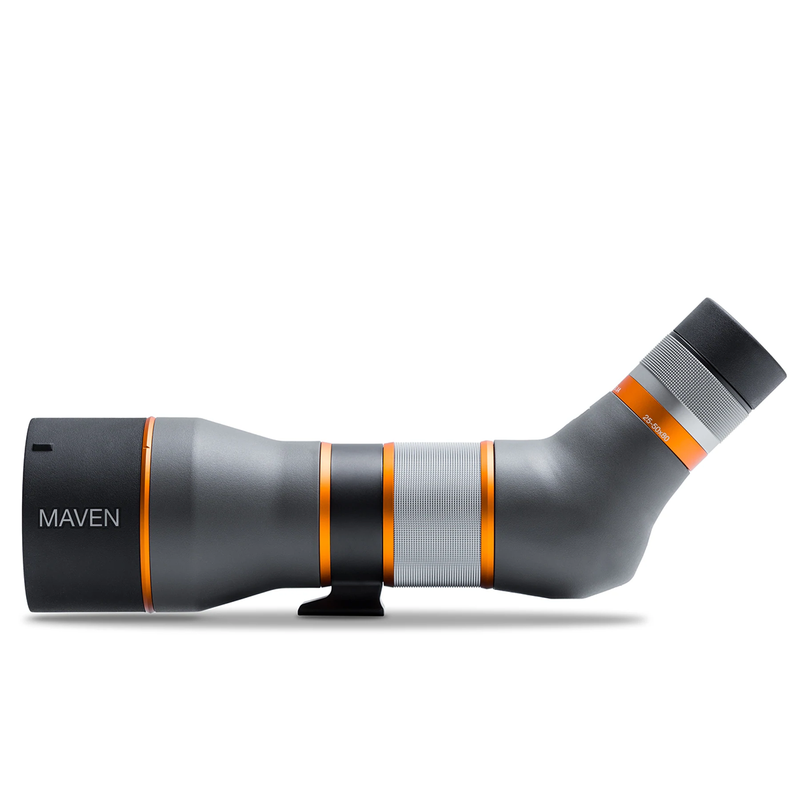
Maven continues to prove that cutting out the middleman isn’t just a marketing story — it’s a genuine value proposition backed by serious glass. The S.1A 25-50x80 is Maven’s flagship spotting scope, and it competes optically with scopes that cost $400-$600 more from established brands. That’s not hyperbole; it’s what we observed side by side in the field.
The S.1A uses ED fluorite glass sourced from Japanese manufacturers, and the result is an image that is remarkably clean. Chromatic aberration — that colored fringing around high-contrast edges that plagues lesser optics — is almost nonexistent at 25x and remains well-controlled through the zoom range up to 50x. Resolution is the S.1A’s calling card. Fine details snap into focus in a way that makes field judging faster and more confident. We used the S.1A extensively during a Wyoming mule deer hunt and found ourselves making definitive pass-or-shoot calls at distances over 1,200 yards without the second-guessing that happens when you’re straining to see through an image that isn’t quite sharp enough.
The 80mm objective lens gives up 5mm to the Razor HD’s 85mm aperture, and in practice, that translates to a slight disadvantage in the absolute last minutes of usable light. It’s a small gap — maybe two to three minutes of lost detail at dawn and dusk compared to the Vortex — but it’s real and repeatable. If extreme low-light performance is your top priority, the larger 85mm class wins. For the vast majority of glassing situations, the S.1A delivers more than enough brightness to do the job.
Where Maven differentiates beyond price is the customization and the buying experience. You configure your scope on their website, choose your color scheme, and it’s built to order. The build quality is excellent — the body is magnesium, the focus mechanism is smooth with good tension, and the overall package feels premium. At around $1,200-$1,400 depending on configuration, the S.1A sits in a pricing tier that’s genuinely difficult to compete with. You’re getting optics that trade blows with $2,000+ scopes. Maven’s warranty is lifetime and transferable, adding long-term value to the equation.
The trade-off with Maven’s direct model is availability. You can’t hold one in a store before buying, and during peak season, popular configurations can take weeks to arrive. Plan ahead if you’re ordering for a fall hunt.
Leupold SX-5 Santiam HD 27-55x80
Best for: Backcountry hunters who cover serious miles and need the lightest full-performance spotting scope available
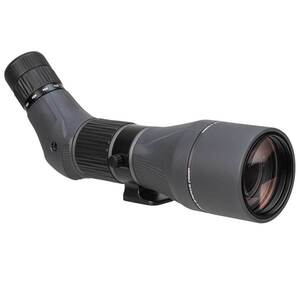
Weight is the eternal negotiation of backcountry western hunting. Every ounce you carry up the mountain has to justify itself, and spotting scopes are one of the heaviest items in a glassing kit. The Leupold SX-5 Santiam HD exists to win that negotiation. At 56 ounces — a full 12 ounces lighter than the Vortex Razor HD — the Santiam is the lightest scope in this roundup by a meaningful margin. Over a five-day backcountry elk hunt where you’re hiking 8-12 miles a day, that weight savings compounds into real fatigue reduction.
But light weight means nothing if the optics can’t do the job, and the Santiam delivers. Leupold’s Twilight Max HD Light Management System and Guard-Ion hydrophobic lens coatings produce an image that’s bright, sharp, and handles moisture and fingerprints better than any scope we tested. The 27-55x zoom range tops out 5x lower than the Razor HD, and in practice, you’ll rarely miss those extra 5 degrees of magnification. Most useful field judging happens between 30x and 50x in real-world atmospheric conditions. The Santiam is crisp and contrasty through that entire range.
Color rendering skews slightly warmer than the Vortex, which some hunters prefer for autumn landscapes. Chromatic aberration is well-controlled through the lower and middle magnification range but becomes slightly more noticeable at 50x and above compared to the Maven or Vortex. It’s not a dealbreaker — we’re talking about edge cases at maximum zoom — but it’s where you feel the weight savings in the optical design. The 80mm objective provides strong light gathering, and low-light performance is competitive with the Maven S.1A.
The Santiam’s build is typical Leupold: understated, utilitarian, and tough. The body is magnesium with a matte finish that doesn’t reflect light during a stalk. The focus wheel has a snappy, precise action that we found slightly faster than the helical designs on the other two scopes — a minor preference, but it matters when an animal stands up from its bed and you have seconds to zoom in and evaluate before it moves into timber. Leupold backs the Santiam with their Full Lifetime Guarantee, which covers the original purchaser against defects. It’s not as broad as Vortex’s unconditional policy, but Leupold’s repair turnaround is consistently fast.
If your hunting style involves significant hiking — whether that’s backcountry archery elk, high-country mule deer, wilderness goat or sheep, or any scenario where base camp is miles from the trailhead — the Santiam’s weight advantage is its decisive feature. You’ll carry it when you might leave a heavier scope behind, and the scope you actually have with you is infinitely better than the one sitting in camp.
Angled vs. Straight Body: Which Configuration for Western Hunting
This debate generates more opinions than it should. Here’s what actually matters.
Angled bodies (typically 45 degrees) are the dominant choice for western hunting, and for good reason. When you’re glassing from a seated or prone position behind a tripod — which is how you’ll spend 90% of your time — an angled eyepiece puts your head in a natural, comfortable position without cranking your tripod up high. This matters enormously during multi-hour glassing sessions. An angled scope also makes it easier to glass uphill, which is common when you’re sitting in a valley bottom scanning the slopes above.
Straight bodies are simpler to aim intuitively — you point the scope at what you want to see. They’re also slightly faster for quick target acquisition because the straight-line alignment between the objective lens and your eye is more natural. Some hunters prefer them for digiscoping because the camera alignment is simpler.
For dedicated western hunting, we recommend angled. All three scopes in this roundup are available in angled configurations, and that’s how we tested them. The comfort advantage over long glassing sessions is significant, and once you’ve used an angled scope for a few sessions, the aiming adjustment becomes second nature.
If you’re buying one scope that also needs to work from a vehicle window or a benchrest at the range, a straight body has more versatility. But for the specific job of sitting behind a tripod on a mountain and glassing for hours, angled is the right answer.
What to Look for in a Western Hunting Spotting Scope
Objective Lens Size
For western hunting, 80mm is the practical minimum for a primary spotting scope. The 80-85mm range delivers the best balance of light gathering, resolution, and portability. Larger 95-100mm objectives exist and offer marginally better light transmission, but the weight and bulk penalty is severe — those scopes belong on a bench, not in a hunting pack.
If you need a compact option for deep backcountry trips where every ounce is critical, 65mm scopes offer a reasonable compromise. Just know that you’re giving up meaningful resolution and low-light performance. A 65mm scope at 40x does not show you what an 85mm scope shows you at 40x. For most western hunters, an 80mm spotter is the right tool.
Magnification Range
A zoom range starting at 25-27x and topping out at 50-60x covers virtually every western hunting scenario. The low end gives you a wide field of view for scanning and finding animals. The high end gives you the resolution for field judging at distance.
Be skeptical of scopes advertising 20-80x or similar extreme ranges. The image quality at maximum magnification on those designs is usually poor, and atmospheric conditions will limit you to 50-60x on most days anyway. A scope that delivers a crisp, bright image at 50x is far more useful than one that technically reaches 80x but turns to mush above 60x.
Glass Quality and Coatings
ED (extra-low dispersion) or HD (high-definition) glass is non-negotiable at this level. These designations indicate glass elements that reduce chromatic aberration and improve resolution. Fully multi-coated lenses on all air-to-glass surfaces maximize light transmission. Look for phase-corrected prisms if the scope uses a roof prism design.
The quality hierarchy in spotting scope glass roughly follows price. There are no secret bargains where a $400 scope optically matches a $1,500 scope. What the direct-to-consumer brands like Maven prove is that you can get $1,800 optical performance for $1,200 by eliminating retail margins — but the glass itself still costs what it costs.
Tripod Compatibility
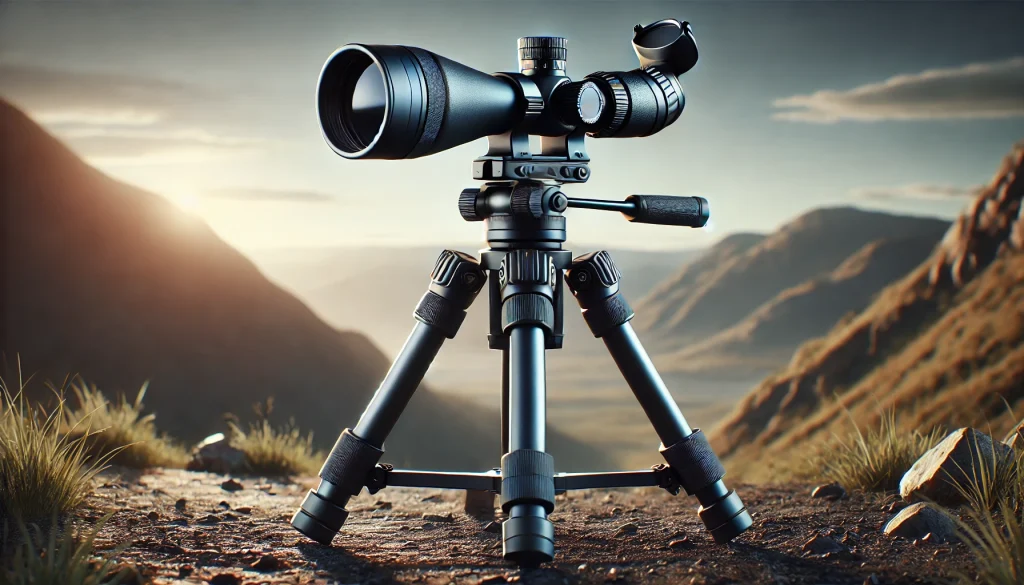
A spotting scope is only as good as its tripod. Budget at least $150-$300 for a quality tripod and head. Carbon fiber saves weight; aluminum saves money. Either works, but don’t mount a $2,000 spotting scope on a $40 tripod from a big-box store. The vibration and instability will destroy the image quality you paid for.
Ensure the scope’s mounting foot is compatible with your tripod head. Arca-Swiss compatible mounts have become the standard and make swapping between scopes and cameras fast and secure.
Frequently Asked Questions
Can I use a spotting scope instead of binoculars for western hunting?
No. They serve different functions. Binoculars are your scanning tool — wide field of view, handheld, fast to deploy. You use them constantly throughout the day. A spotting scope is your evaluation tool — high magnification, tripod-mounted, slower to set up. The workflow is: scan with binoculars, find something worth examining, then switch to the spotting scope for detail. Trying to replace one with the other leaves a critical gap in your system.
What magnification do I actually need for field judging big game?
For elk, 30-45x handles most field judging at distances up to a mile. For mule deer, where you’re evaluating finer details like tine length and mass, 40-50x is more useful. Antelope can often be judged at 30-40x because the criteria — prong length relative to ear length — are simpler. Atmospheric conditions, not scope capability, are usually the limiting factor above 50x. Heat mirage, wind currents, and dust will degrade your image long before your optic runs out of resolution.
How much should I spend on a spotting scope for western hunting?
Plan on $1,000-$2,500 for a scope that will genuinely serve you in big western country. Below $1,000, the optical compromises become significant at the magnifications and distances western hunting demands. The three scopes in this roundup — ranging from roughly $1,200 to $2,200 — represent the sweet spot where you’re getting excellent optics without entering the rarefied air of $3,000+ European glass. Add $150-$300 for a quality tripod.
Is an 85mm scope worth the extra weight over an 80mm?
The optical advantage of an 85mm objective over an 80mm is modest — roughly 6% more light-gathering area. In practical terms, you might gain two to three minutes of usable detail at dawn and dusk. Whether that’s worth the extra 8-12 ounces depends entirely on how you hunt. If you drive to your glassing points, the weight is irrelevant and the extra aperture is free performance. If you’re hiking five-plus miles into backcountry, those ounces matter and the 80mm class is the smarter choice.
Do I need a phone adapter for digiscoping through my spotting scope?
It’s useful but not essential. A phone adapter lets you photograph or video what you see through the scope, which is helpful for documenting animals you want to study later, sharing with hunting partners, or saving waypoints for stalks. Several affordable universal adapters ($25-$50) work well enough for field documentation. Don’t expect DSLR-quality images — digiscoping through a phone is a documentation tool, not a photography system. That said, we’ve captured surprisingly useful footage of distant animals that helped us make better decisions on whether to pursue them the following day.
Quick Buy — Products in This Article