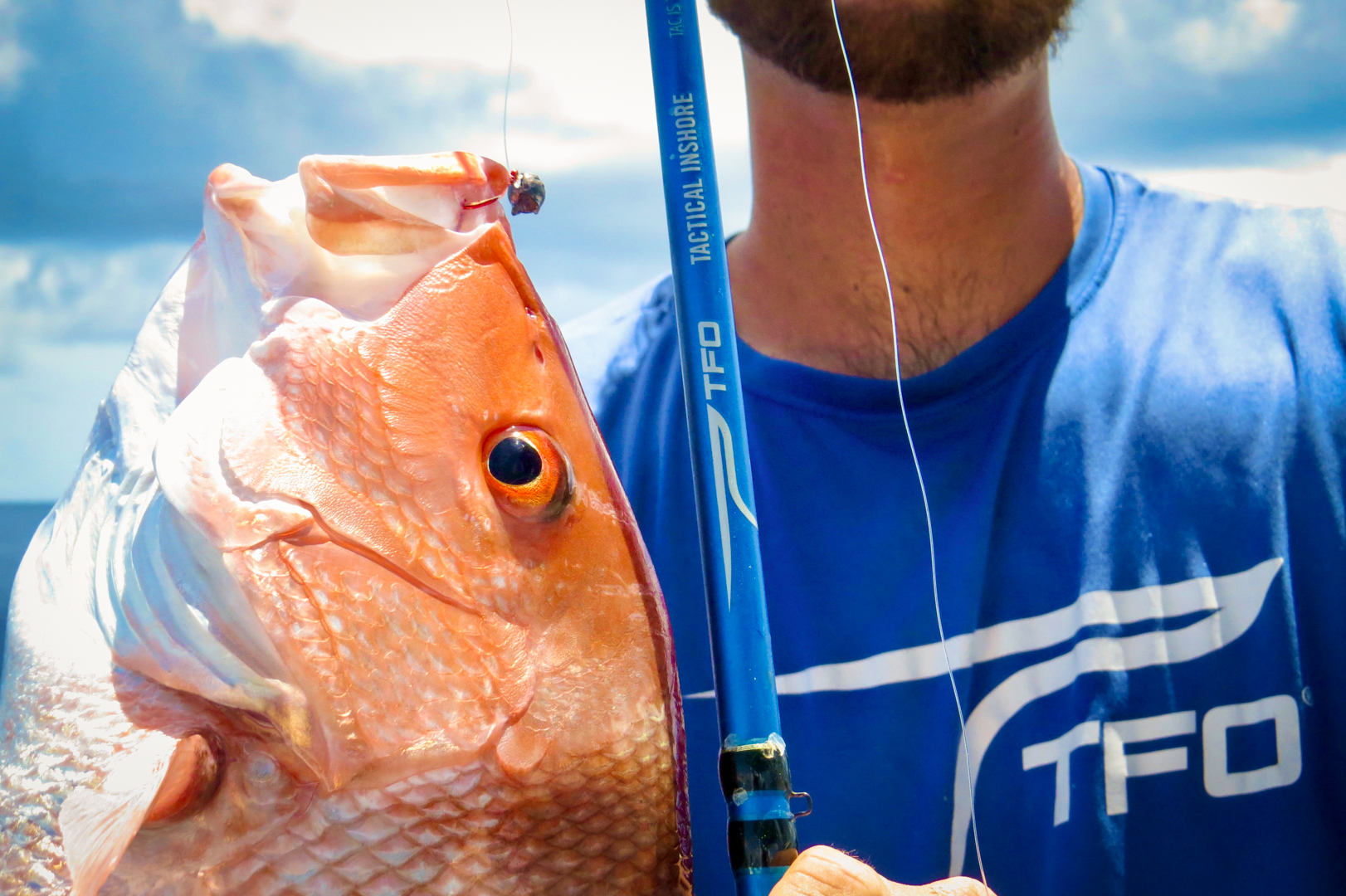
Grouper and snapper are the two species groups that define bottom fishing in the Gulf of Mexico, the South Atlantic, and the Caribbean. They share the same reefs, wrecks, and ledges, but they behave differently on the bite, fight differently once hooked, and respond to very different rig presentations. The angler who shows up with one rig and expects to catch both consistently is going to have a frustrating day.
We’ve spent years refining our bottom fishing approach across hundreds of trips targeting everything from red grouper on limestone ledges to mutton snapper on deep wrecks. The difference between limiting out and going home with an empty box almost always comes down to matching the right rig to the right species in the right conditions. This guide covers the five rigs that we rely on most heavily when the target is grouper, snapper, or both, along with the hook, weight, leader, and bait decisions that make each rig perform at its best.
If you’re looking for a broader overview of bottom fishing fundamentals, start with our complete guide to bottom fishing rigs and techniques. For help choosing the right reel to pair with these setups, check out our deep sea fishing reel roundup. Everything we recommend here is grounded in the same hands-on evaluation process we outline in our testing methodology.
Quick Picks: Which Rig for Which Species
Before we get into the details on each rig, here is a fast reference for matching rig type to target species and fishing scenario.
- Knocker Rig — Best for gag grouper, red grouper, and black grouper on heavy structure. The go-to when you need to pull fish out of wrecks and rock piles.
- Chicken Rig (High-Low) — Best for red snapper, vermilion snapper, lane snapper, and mixed-bag reef fishing. Doubles your bait presentation on every drop.
- Fish Finder Rig — Best for large mutton snapper, mangrove snapper on sandy bottom, and pressured grouper over open ledges. Natural bait movement is the advantage.
- Carolina Rig — Best for mangrove snapper, yellowtail snapper, and other line-shy snapper species in moderate depths. Subtle presentation that outperforms heavier rigs on educated fish.
- Vertical Jig — Best for amberjack, gag grouper, and aggressive snapper species. The fastest way to target the biggest fish on a piece of structure.
Why Rig Selection Matters More Than Bait
Most anglers overthink bait and underthink rigging. A fresh sardine on the wrong rig in the wrong situation will get outfished by a mediocre chunk of squid on the right rig every single time. Rig selection determines three things that matter more than any other variable in bottom fishing: how your bait behaves in the water column, how much resistance a fish feels when it picks up the bait, and how quickly you can get that fish moving away from structure after the hookset.
Grouper live in the nastiest, most snag-prone structure on the ocean floor. They ambush prey by exploding out of their hole, inhaling the bait, and immediately reversing back into cover. If your rig creates any hesitation on the hookset, or if your terminal tackle hangs on structure while you’re trying to turn the fish, you lose. Snapper, by contrast, are generally more cautious feeders that inspect bait carefully, especially in pressured fisheries. They feed higher in the water column than grouper, and they are far more sensitive to unnatural resistance from heavy terminal tackle.
These behavioral differences mean that a single all-purpose rig is always a compromise. The rig that gets grouper out of a wreck is overkill for vermilion snapper suspended ten feet above the reef. The finesse rig that fools a spooky mutton snapper won’t survive three seconds in a grouper hole. Understanding the five rigs below gives you the tactical flexibility to target exactly what you want under any conditions you encounter.
For more on deep sea fishing strategy and gear selection, explore the full cluster of guides we’ve built around offshore bottom fishing.
Knocker Rig
Best for: Gag grouper, red grouper, black grouper, scamp grouper on wrecks, rock piles, and hard ledges.
The knocker rig is the most effective grouper rig ever devised, and it has been the standard on grouper boats throughout the Gulf and South Atlantic for decades. Its design is brutally simple: an egg sinker threaded on a fluorocarbon leader above a circle hook tied to the terminal end. The sinker slides freely and rests against the hook eye when the rig hangs vertically.
How to Tie It
Start with 3 to 4 feet of 80- to 100-pound fluorocarbon leader. Thread an egg sinker, typically 4 to 8 ounces depending on depth and current, onto the leader. Tie a 7/0 to 9/0 inline circle hook to the tag end using a snell knot or improved clinch knot. Connect the opposite end of the leader to your mainline using a barrel swivel or loop-to-loop connection. There are no beads, no crimps, and no additional hardware. The simplicity is the entire point.
When to Use It
Deploy the knocker rig any time you are fishing heavy structure and your primary target is grouper. Wrecks, artificial reefs, rock ledges with undercuts, and natural bottom with scattered boulders are all knocker rig territory. Because the weight sits directly at the hook, the entire rig stays compact as it descends through the water column and threads into tight spaces where grouper stage. This snag resistance is the knocker rig’s defining advantage. A chicken rig with dropper loops and extended hooks will hang up on the same structure that a knocker rig slides through cleanly.
The knocker rig also excels at transmitting bites. You feel the sinker “knock” against the hook eye when a fish mouths the bait, giving you a direct telegraph of the strike before the fish fully commits. With grouper, that early detection is critical because you have a very small window to get the fish moving upward before it dives back into its hole and rocks you.
Target Species Notes
Gag grouper and black grouper are the two species most commonly targeted with knocker rigs because they inhabit the heaviest structure. Red grouper, which tend to live over slightly less aggressive bottom, also respond well to knocker rigs, especially when they are staged near isolated rocks or rubble patches. Scamp grouper on deep ledges in 200 to 350 feet are another prime knocker rig target. While the knocker rig can catch snapper incidentally, it is not optimized for them because the single heavy presentation sits tight to the bottom where snapper are less likely to feed compared to higher in the water column.
Chicken Rig (High-Low Rig)
Best for: Red snapper, vermilion snapper, lane snapper, triggerfish, sea bass, and mixed-bag reef fishing.
The chicken rig, also called a high-low rig, is the most versatile bottom rig for multi-species fishing and the default choice when snapper are the primary target. It uses two hooks tied on short dropper loops at different heights above a bank sinker at the terminal end, presenting two baits simultaneously at two different positions in the water column.
How to Tie It
Cut 4 to 5 feet of 60- to 80-pound fluorocarbon leader. Tie a dropper loop approximately 12 inches from the bottom end, and a second dropper loop 18 to 24 inches above the first. Attach a bank sinker to the bottom using a surgeon’s loop or snap swivel. Clip 5/0 to 7/0 circle hooks onto each dropper loop. Keep the dropper loops short, around 4 to 6 inches, to minimize tangles during the drop. Some anglers use pre-made chicken rigs from tackle shops, but tying your own allows you to customize hook size, dropper length, and leader weight for the specific conditions you’re fishing.
When to Use It
The chicken rig is the right call when you are fishing over hard bottom, natural reef, or artificial structure and your goal is to maximize catch rate across snapper species. It is the standard rig on party boats and headboats throughout the Southeast because it produces consistent fish for anglers of all skill levels. The dual-hook presentation doubles your odds on every drop. Red snapper feeding near the bottom hit the lower hook while vermilion snapper and triggerfish, which tend to suspend slightly above structure, hit the upper hook.
Use the chicken rig over relatively clean bottom where hang-ups are not a constant problem. On heavy wreck structure, switch to a knocker rig instead, because the dropper loops on a chicken rig are magnets for snags. The chicken rig also performs well in moderate to strong current because the bank sinker anchors the rig vertically and the short dropper loops keep the hooks from fouling.
Target Species Notes
Red snapper are the signature chicken rig species. They stage over structure in large schools and feed aggressively enough that the slightly less natural presentation of a dropper loop rig does not deter them. Vermilion snapper, often called “beeliners,” are another ideal chicken rig target because they feed higher in the water column and the upper hook consistently connects with fish that would be missed by a single-hook bottom rig. Lane snapper, mangrove snapper over reef, and triggerfish all show up regularly on chicken rigs.
Fish Finder Rig
Best for: Large mutton snapper, pressured mangrove snapper, cobia near bottom structure, and grouper on open ledges.
The fish finder rig uses a sliding sinker on the mainline above a swivel, with a separate leader running from the swivel to the hook. The sinker slides freely so a fish can pick up the bait and move without feeling any weight from the lead. This creates the most natural bait presentation of any bottom rig, and it is the rig we reach for when the fish are being selective.
How to Tie It
Thread a sinker slide onto your mainline. Tie a barrel swivel to the terminal end of the mainline. Attach 3 to 5 feet of 50- to 80-pound fluorocarbon leader to the opposite eye of the swivel, and tie a 5/0 to 8/0 circle hook to the tag end. Use a bank sinker heavy enough to hold bottom, typically 3 to 6 ounces. The sinker slide allows the weight to move freely on the mainline while keeping the rig oriented properly.
When to Use It
The fish finder rig is the best option when you need natural bait movement to fool wary fish. Mutton snapper on deep wrecks in the Keys and Bahamas are a classic fish finder rig target because they are cautious feeders that reject baits with unnatural resistance. Pressured mangrove snapper on heavily fished reefs also respond better to a fish finder than to a chicken rig because the free-sliding sinker lets them take the bait and run without immediately detecting the weight.
This rig shines when anchored in moderate current over sandy or mixed bottom. The current sweeps the bait back naturally behind the sinker, creating a presentation that looks like a free-swimming or drifting piece of forage. It is less effective on heavy wreck structure because the extended leader length increases the risk of hang-ups and the extra distance between hook and weight makes it harder to muscle grouper away from cover. However, on open ledges and scattered bottom where grouper are less entrenched in hard structure, the fish finder rig can be devastatingly effective because it allows the bait to drift into strike zones that a fixed rig would never reach.
Target Species Notes
Mutton snapper are the premier fish finder rig species. They have excellent eyesight, feed deliberately, and will reject a bait that feels wrong. The fish finder’s zero-resistance presentation is often the only way to get consistent bites from big muttons. Large mangrove snapper over deeper reefs respond similarly. Cobia that hang near bottom structure are another strong match because they cruise and pick up baits opportunistically, and the sliding sinker lets them do so without spooking. We have also caught our share of red grouper on fish finder rigs fished over flat limestone bottom where the fish hold in depressions rather than true vertical structure.
Carolina Rig (for Snapper)
Best for: Yellowtail snapper, mangrove snapper in shallow to moderate depths, schoolmaster snapper, and any line-shy snapper species.
The Carolina rig is traditionally associated with freshwater bass fishing, but it is one of the most underrated presentations for snapper in saltwater. The concept is identical: a sliding egg sinker on the mainline above a swivel, followed by a long fluorocarbon leader to the hook. The difference from a fish finder rig is the leader length and the overall finesse of the presentation. Where a fish finder rig uses 3 to 5 feet of heavy leader, a Carolina rig for snapper uses 5 to 8 feet of lighter fluorocarbon, creating a far more subtle presentation.
How to Tie It
Thread a 1- to 3-ounce egg sinker onto your mainline, followed by a small plastic bead to protect the knot. Tie a barrel swivel to the mainline. Attach 5 to 8 feet of 30- to 50-pound fluorocarbon leader to the swivel, and tie a 3/0 to 5/0 circle hook or light-wire J-hook to the tag end. The longer, lighter leader is the key to this rig’s effectiveness. It allows the bait to drift and move with far more freedom than any heavier bottom rig.
When to Use It
The Carolina rig is the right choice when you are targeting snapper species that are extremely line-shy or feeding in a way that demands a finesse approach. Yellowtail snapper in South Florida and the Keys are the textbook Carolina rig species. They feed in the current column above the reef and will inspect a bait closely before committing. A heavy chicken rig falling through their zone spooks them. A Carolina rig with a long light leader lets the bait drift naturally into their feeding lane.
Use the Carolina rig when fishing in 60 to 150 feet of water over reef or mixed bottom where snapper are the primary target and you do not expect to encounter large grouper that would snap the lighter leader. It is also effective when drift fishing over long stretches of reef, because the sinker maintains bottom contact while the long leader lets the bait sweep naturally across the structure below.
Target Species Notes
Yellowtail snapper are the number one Carolina rig species in saltwater. They are notorious for ignoring heavy presentations and the long leader separates the bait from the visible terminal tackle. Mangrove snapper on shallow wrecks and patch reefs respond well because they share yellowtail’s wariness around line and hardware. Schoolmaster snapper and mutton snapper in shallower water are also strong Carolina rig targets. This rig is not appropriate for grouper because the lighter leader will not survive a grouper’s initial dive into structure.
Vertical Jig
Best for: Amberjack, gag grouper, large red snapper, African pompano, and any aggressive species feeding on fast-moving prey.
The vertical jig is not a bait rig in the traditional sense, but it is one of the most effective ways to target the biggest fish on any piece of structure. A heavy metal jig, typically 4 to 16 ounces, is dropped to the bottom and worked vertically with sharp, aggressive rod strokes. The jig mimics a wounded baitfish darting upward off the bottom, which triggers explosive reaction strikes from predatory species.
How to Tie It
Tie your jig directly to 60- to 100-pound fluorocarbon leader using a loop knot, which allows the jig to swing freely for maximum action. Connect the leader to your mainline with a barrel swivel. Some jigs come with an assist hook on a short length of cord attached near the head of the jig, which significantly improves hookup rates because fish often strike the head of the bait. If your jig does not have an assist hook, add one using a short length of Kevlar cord and a strong inline hook.
When to Use It
Drop the jig when you’re marking fish stacked on structure and you want to target the biggest specimens. Amberjack are the premier vertical jigging species because they are aggressive, competitive feeders that will chase a jig from the bottom to mid-water on nearly every drop. Gag grouper respond to jigs worked aggressively near the bottom, especially when they are staged on the top of a wreck or ledge rather than buried inside structure. Large red snapper also hit jigs, particularly when they are fired up and competing with other species over active structure.
Vertical jigging is the fastest way to sort through a school and pull the biggest fish out first, because the aggressive presentation selects for the most dominant, most aggressive feeders. It is also the most physically demanding bottom fishing technique, which is why we recommend it as a supplement to bait rigs rather than a full-day strategy. For the reel power needed to jig all day, see our breakdown of the best deep sea fishing reels with specific recommendations for jigging applications.
Target Species Notes
Amberjack are the undisputed kings of vertical jigging on bottom structure. They hit jigs harder than almost any other fish in the water column and will often race each other to the jig on the way down. Gag grouper hit jigs worked tight to the bottom with short, sharp strokes, and a jig can sometimes pull a gag out of cover that would ignore a dead bait because the fast-moving presentation triggers a reaction strike. Red snapper hit jigs readily, especially in the 10- to 20-pound class on active reefs. African pompano, almaco jack, and bar jack are all bonus species that show up regularly on vertical jigs.
Hook Selection: Circle Hooks vs. J-Hooks by Species
Hook choice is not a personal preference on the bottom. Federal regulations in the Gulf of Mexico and South Atlantic require the use of non-stainless, non-offset circle hooks when fishing for reef fish species, which includes all grouper and snapper. This is a conservation measure designed to reduce deep-hooking mortality in catch-and-release situations, and it applies regardless of which rig you are using.
Beyond the legal requirement, circle hooks are genuinely better for bottom fishing in almost every scenario. They hook fish in the corner of the mouth with high consistency, which means cleaner hooksets, less gut-hooking, and higher survival rates for released fish. The key to using circle hooks effectively is to never set the hook with a sharp upward strike. Instead, reel tight and let the rod load steadily. The circle hook rotates into the jaw on its own as the fish turns away.
For grouper, use 7/0 to 9/0 inline circle hooks. Grouper have large, hard mouths, and a bigger hook with a wide gap penetrates more reliably. A hook that is too small will straighten under the strain of pulling a grouper out of structure. Match your hook size to the expected fish size: 7/0 for red grouper and scamp in the 10- to 20-pound range, 8/0 to 9/0 for gag grouper and black grouper where fish over 30 pounds are realistic.
For snapper, use 5/0 to 7/0 circle hooks. Snapper have smaller mouths relative to their body size compared to grouper, and a hook that is too large will reduce your hookup rate. Red snapper in the 5- to 15-pound class are well matched to a 6/0 circle. Vermilion snapper, lane snapper, and other smaller reef snapper call for a 5/0 or even a 4/0. Mutton snapper, which grow larger, handle a 6/0 to 7/0 well.
The one exception for J-hooks is the Carolina rig for yellowtail snapper in areas where regulations permit it. A light-wire 3/0 to 4/0 J-hook penetrates faster on the subtle, quick bites that yellowtail are known for, and the finesse presentation benefits from the lighter hook weight. Always check current regulations for your specific fishery before using J-hooks on any reef species.
Weight and Leader Considerations
Getting the right weight and leader combination is the invisible skill that separates experienced bottom fishermen from everyone else. Too much lead and your rig falls unnaturally fast, creating slack that delays hooksets. Too little and you never reach the bottom or you drift off the structure you’re targeting.
Weight selection is driven primarily by depth and current. As a baseline, use 1 ounce of lead for every 30 feet of depth in calm conditions. In strong current, increase by 50 to 100 percent. A 200-foot drop in moderate Gulf current typically calls for 6 to 8 ounces. In light current over shallow reef at 80 feet, you may get away with 3 ounces. The goal is always to use the minimum weight that holds bottom, because lighter weights produce more natural bait movement and better bite sensitivity.
Leader material should be fluorocarbon in every bottom fishing scenario. Fluorocarbon is nearly invisible underwater, resists abrasion from rocks and structure far better than monofilament, and has enough stiffness to resist tangles on the drop. For grouper rigs, use 80- to 100-pound fluorocarbon. Grouper are not line-shy, and the heavy leader gives you the abrasion resistance needed to survive contact with sharp structure during the fight. For snapper rigs, 40- to 60-pound fluorocarbon is appropriate. Snapper are more line-conscious, and the lighter leader produces noticeably more bites on pressured reefs. For the Carolina rig targeting yellowtail and other small snapper, drop to 30-pound fluorocarbon for maximum subtlety.
Leader length varies by rig, but the principle is consistent: shorter leaders give you more control and snag resistance, while longer leaders give you more natural bait movement. Knocker rigs use 3 to 4 feet of leader. Fish finder rigs use 3 to 5 feet. Carolina rigs use 5 to 8 feet. The chicken rig is built entirely from leader material, so the total length of the rig itself is your leader.
Bait Pairing for Each Rig
The right bait on the right rig creates a combination that is far more effective than either element alone. Here is what we use most consistently for each rig type.
Knocker Rig: Live pinfish, live grunts, or large chunks of bonito and squid. Live bait is strongly preferred for grouper because the movement and scent draw fish out of structure more aggressively than dead bait. A frisky pinfish on a knocker rig dropped next to a wreck is one of the most reliable ways to catch a big gag grouper. When live bait is not available, a strip of fresh bonito belly threaded onto the hook creates a fluttering action that grouper respond to well.
Chicken Rig: Cut squid strips, cut sardines, cut cigar minnows, or small pieces of bonito. Cut bait is the standard on chicken rigs because you are fishing two hooks and the goal is efficiency and consistency rather than trophy hunting. Squid is durable and stays on the hook through long drops and multiple bites, making it ideal for the upper hook. Cut sardine or cigar minnow on the lower hook adds scent to draw fish into range.
Fish Finder Rig: Live pilchards, live pinfish, or whole dead cigar minnows. The fish finder rig is designed for natural bait movement, and live bait maximizes that advantage. A live pilchard drifting behind the sinker in current is one of the most irresistible presentations for mutton snapper. Whole dead cigar minnows, hooked through the head and allowed to drift, are an effective alternative when live bait is scarce.
Carolina Rig: Live shrimp, small live pilchards, or thin strips of fresh squid. The Carolina rig is a finesse presentation, and the bait should match that philosophy. Live shrimp on a long fluorocarbon leader drifting above the reef is the gold standard for yellowtail snapper. Small live pilchards work equally well. When using cut bait, keep the pieces small and trim so they do not overpower the light hook and impede the natural drift.
Vertical Jig: No bait needed. The jig itself is the presentation. However, tipping the assist hook with a thin strip of bonito belly or squid adds scent and can convert followers into biters, particularly when fish are lethargic or when the bite slows between flurries of activity.
Frequently Asked Questions
What is the best all-around bottom fishing rig for grouper and snapper?
If we had to pick one rig for both species, the fish finder rig comes closest to a universal bottom rig. It is natural enough for snapper, strong enough for grouper on moderate structure, and adaptable to both live and cut bait. That said, you will always be more productive with species-specific rigs. Carry pre-tied knocker rigs and chicken rigs in your tackle box and switch based on what the fish finder is showing you. A day of bottom fishing usually involves deploying at least two different rigs depending on the structure and species you encounter at each stop.
How do I prevent getting rocked by grouper on bottom structure?
Getting “rocked” means a grouper inhales your bait, turns, and dives back into its hole before you can react. The knocker rig minimizes this risk because the compact design lets you feel the bite immediately. Use a heavy-action rod with a fast tip, keep your drag set tight enough to turn the fish, and when you feel the bite, reel as fast as possible to get the fish moving upward. Do not set the hook with a dramatic sweep if you are using circle hooks. Just reel hard and let the hook rotate into the jaw as the fish pulls away. The first five seconds after the bite determine whether you land the fish or lose it to the structure.
Can I use braided line for bottom fishing, or should I use monofilament?
Braided mainline is superior to monofilament for bottom fishing in every meaningful way. Braid has zero stretch, which gives you direct sensitivity to feel bites in deep water and instant hookset power. It also has a thinner diameter at equivalent strength, which means less drag in the current and faster drops to the bottom. Use braided mainline in 50- to 80-pound test, connected to a fluorocarbon leader via a swivel or FG knot. The fluorocarbon leader provides the abrasion resistance and near-invisibility that braid lacks. Monofilament mainline is outdated for serious deep water bottom fishing because the stretch absorbs too much of the strike energy and delays hooksets.
What depth range are these rigs designed for?
All five rigs in this guide are effective from about 60 feet to 400 feet, which covers the vast majority of grouper and snapper bottom fishing situations in the Gulf of Mexico and South Atlantic. Adjust your sinker weight upward as depth increases and current intensifies. Beyond 400 feet, you are entering deep-drop territory where electric reels and specialized terminal tackle become necessary, and the rig selection shifts accordingly. For shallower reef fishing under 60 feet, the Carolina rig and lighter versions of the chicken rig work well, but you can usually reduce leader weight and sinker size significantly.
How do I choose between a knocker rig and a fish finder rig when targeting grouper?
The deciding factor is bottom composition. If the structure is heavy, meaning wrecks, dense rock piles, or ledges with overhangs and caves, use the knocker rig. Its compact profile threads into tight spaces without hanging up, and the direct connection between sinker and hook gives you maximum leverage to pull fish away from cover. If the bottom is more open, such as scattered hard bottom, limestone flats with isolated holes, or low-relief ledges, the fish finder rig gives you a more natural bait presentation that can trigger bites from grouper that would ignore a knocker rig. When in doubt, start with the knocker rig. You can always switch to a fish finder if the bottom turns out to be cleaner than expected, but you cannot get a lost fish back after getting rocked because your rig was not snag-resistant enough.