Every offshore angler remembers the first time they dropped a bait to the bottom in 200 feet of water and felt something absolutely crush it. The rod doubles over, the drag screams, and you realize there is an entire world of fish living on structure you can’t see but can definitely feel. Bottom fishing is the backbone of deep sea fishing, and whether you’re targeting red snapper on a reef, grouper on a wreck, or tilefish along a mud ledge, the fundamentals remain the same: get the right rig to the bottom, keep your bait in the strike zone, and be ready when the bite happens.
We’ve spent thousands of hours dropping baits offshore, from party boats in the mid-Atlantic to private charters in the Gulf of Mexico and headboats running the ledge off the Carolinas. The difference between the angler who limits out and the one who goes home frustrated almost always comes down to rig selection, bait presentation, and understanding what’s happening 300 feet below the hull. This guide breaks down everything you need to put fish on the deck consistently.
If you’re new to the offshore game entirely, start with our deep sea fishing beginner’s guide for a broader foundation, then come back here for the specialized bottom fishing knowledge. For deeper coverage of offshore tackle and techniques, explore our full deep sea fishing hub.
Essential Bottom Fishing Rigs
Rig selection is not a matter of personal preference — it’s a tactical decision based on current, depth, bottom composition, and target species. Each of the four rigs below solves a specific problem, and understanding when to deploy each one separates productive trips from long boat rides.
Chicken Rig (High-Low Rig)
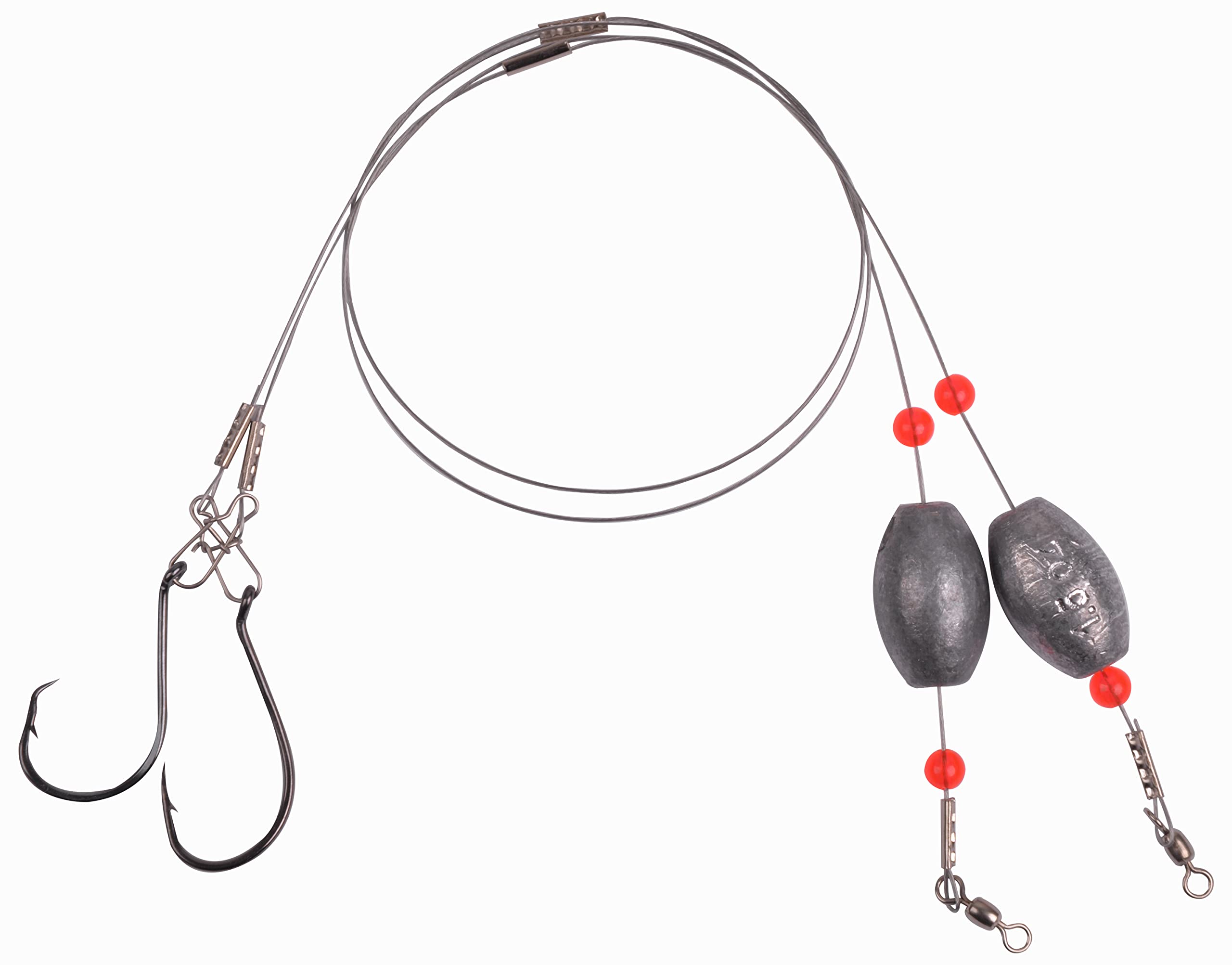
The chicken rig, also called a high-low rig or two-hook bottom rig, is the workhorse of deep sea bottom fishing and the rig you’ll encounter most often on party boats and headboats. It’s built with two hooks tied on dropper loops at different heights above a bank sinker at the terminal end. The upper hook typically sits 18 to 24 inches above the lower hook, and the lower hook hangs 6 to 12 inches above the sinker.
Why it works: The chicken rig presents two baits at two different heights in the water column simultaneously, which doubles your chances on every drop. Fish feeding tight to the bottom hit the lower hook, while species that suspend slightly above structure — like vermilion snapper and triggerfish — hit the upper hook. On a good reef, you can catch two fish at once, which is exactly how the rig earned its name: you’re “chickening” by hedging your bet with two baits instead of committing to one.
When to use it: The chicken rig excels over hard bottom, natural reef, and artificial structure where you’re targeting a mix of bottom species. It’s the default rig for snapper fishing in the Gulf, sea bass fishing in the mid-Atlantic, and general reef fishing anywhere the bottom is relatively clean and free of heavy snag hazards. If you’re fishing a spot for the first time and you’re not sure what’s down there, a chicken rig is the safest starting point.
How to build it: Use 60 to 80-pound fluorocarbon leader material. Tie a dropper loop about 12 inches from the bottom, another dropper loop 18 to 24 inches above the first, and attach your sinker to the terminal end with a surgeon’s loop or snap swivel. Clip your hooks — typically 5/0 to 7/0 circle hooks — onto the dropper loops. Keep dropper loops short, around 4 to 6 inches, to prevent tangles on the drop.
Knocker Rig
The knocker rig is the simplest and most effective bottom rig for targeting big fish on heavy structure. It’s nothing more than a circle hook tied to the end of a fluorocarbon leader with an egg sinker threaded on the leader above the hook. The sinker slides freely and rests directly against the hook’s eye when the rig hangs vertically.
Why it works: Because the weight sits right at the hook, the entire rig stays compact and snag-resistant. When a fish picks up the bait, it feels minimal resistance as the sinker slides up the leader, which means fewer dropped baits. The knocker rig also transmits bites with exceptional sensitivity — you feel the “knock” of the sinker against the hook eye when a fish mouths the bait, giving you a direct telegraph of what’s happening at the bottom.
When to use it: The knocker rig is your go-to for fishing heavy structure — wrecks, rock piles, ledges with overhangs, and any bottom where snags eat tackle. It’s the premier rig for targeting grouper, because grouper live in the nastiest structure and will dive straight back into their hole the instant they feel the hook. The compact profile of the knocker rig gets into those tight spots where a chicken rig would hang up immediately. It’s also the preferred rig when you want to target a single large fish rather than catch a mixed bag.
How to build it: Thread an egg sinker (2 to 8 ounces depending on current and depth) onto 80 to 100-pound fluorocarbon leader. Tie a 7/0 to 9/0 circle hook to the tag end. Connect the leader to your mainline with a barrel swivel or loop-to-loop connection. That’s it — no beads, no crimps, no extras. Simplicity is the point.
Fish Finder Rig
The fish finder rig uses a sliding sinker on the mainline above a swivel, with a leader running from the swivel to the hook. The sinker slides freely on the mainline, typically held in place by a sinker slide or plastic sleeve, so a fish can pick up the bait and move without feeling the weight of the lead.
Why it works: The fish finder rig gives the most natural bait presentation of any bottom rig. Because the sinker is separated from the hook by a swivel and leader, the bait has freedom to drift and move with the current, which looks far more natural than a bait pinned to the bottom by a fixed weight. When a fish picks up the bait, line feeds through the sinker slide with zero resistance, so the fish commits fully before you engage.
When to use it: The fish finder rig shines when targeting wary, bite-sensitive species over sandy or mixed bottom. It’s outstanding for cobia hanging near bottom structure, large snapper that have seen pressure, and any situation where you need the bait to behave naturally. It also works well when anchored in moderate current, allowing the bait to sweep back naturally behind the sinker. It’s less ideal for heavy structure because the extended leader length increases hang-up risk.
How to build it: Thread a sinker slide onto your mainline. Attach a barrel swivel to the mainline’s terminal end. Tie 3 to 5 feet of 50 to 80-pound fluorocarbon leader to the swivel’s opposite eye, and finish with a 5/0 to 8/0 circle hook. Use a bank sinker heavy enough to hold bottom — the sinker slide lets it move freely while keeping the rig oriented vertically.
Dropper Loop Rig
The dropper loop rig is a single-hook variation of the chicken rig concept, using one dropper loop tied directly into heavy leader material with the sinker at the bottom. It’s popular among experienced bottom fishermen who want a clean, tangle-free presentation on a single hook.
Why it works: The dropper loop rig combines the snag resistance of the knocker rig with the off-bottom presentation of the chicken rig. The single hook on a short dropper loop sits above the sinker, keeping the bait slightly elevated where fish cruising the structure can find it. Because there’s only one hook, the rig tangles less on the drop and you can use heavier tackle without worrying about a second hook fouling.
When to use it: Use a dropper loop rig when you’re targeting a specific species that feeds just above the bottom — tilefish, vermilion snapper, and triggerfish are classic dropper loop targets. It’s also the right call when conditions are rough and you need a rig that drops cleanly without tangling in current or boat drift. Many experienced deep-drop anglers use dropper loop rigs exclusively for tilefish because the bait presentation at a consistent height off the bottom is critical for that species.
How to build it: Tie a dropper loop 8 to 16 inches above the sinker in 60 to 100-pound fluorocarbon. Attach a circle hook to the loop. The sinker attaches to the terminal end via a loop or snap. Adjust the dropper loop height based on how far off the bottom your target species typically feeds.
Circle Hooks vs. J-Hooks for Bottom Fishing
This is not a debate anymore — circle hooks are the correct choice for bottom fishing in almost every situation, and in many fisheries they’re legally required. But understanding why they work and how to use them properly matters, because a circle hook fished incorrectly is worse than a J-hook.
Circle hooks work by design. When a fish takes the bait and swims away, the hook’s curved point rotates and catches in the corner of the jaw as the line comes tight. This happens passively — you do not set the hook with a circle hook. You reel into the fish, apply steady pressure, and let the hook geometry do its job. The result is a jaw-hooked fish nearly every time, which means higher hookup rates, fewer gut-hooked fish, and dramatically better release survival for species with size or bag limits.
J-hooks require a hookset, and in deep water, that hookset is often poorly timed. The delay between a fish biting 300 feet down and the angler feeling the bite means J-hooks gut-hook a far higher percentage of fish. For catch-and-release fisheries, that’s a conservation problem. For catch-and-keep fisheries, it’s still a problem because gut-hooked fish fight poorly and bleed out.
The critical technique change: When you feel a bite on a circle hook rig, do not swing. Lower your rod tip, reel until the line comes tight, then lift steadily. The fish will load against the rod, the hook will rotate into the jaw corner, and you’re connected. The hardest part of switching to circle hooks is overriding the instinct to set the hook aggressively. Fight that instinct. Reel and lift.
Use 5/0 to 7/0 inline circle hooks for most snapper and sea bass applications. Step up to 7/0 to 9/0 for grouper and amberjack. Offset circle hooks (where the point is bent slightly to one side) are prohibited in some federal fisheries, so check your local regulations and default to inline when in doubt.
Weight Selection: Getting to the Bottom and Staying There
Weight selection is one of the most overlooked aspects of bottom fishing, and it directly impacts your catch rate. Too light and your bait never reaches the zone. Too heavy and your presentation is unnatural, your bites are muffled, and your arms are destroyed by the end of the day.
Types of Sinkers
Bank sinkers are the standard for chicken rigs and dropper loop rigs. Their elongated torpedo shape cuts through the water column efficiently and resists rolling on the bottom. They come in sizes from 2 ounces to over a pound, and you should carry a range.
Egg sinkers are the choice for knocker rigs and fish finder rigs because of their sliding design. The hole through the center lets line pass freely, and the oval shape reduces snags on structure. Carry them in 2 to 8-ounce sizes for most applications.
How Much Weight for the Conditions
The right amount of weight is the minimum amount that holds bottom. Start lighter than you think you need and add weight only if you’re not reaching or maintaining the zone.
General guidelines by depth and current:
- Under 100 feet, light current: 4 to 6 ounces
- 100 to 200 feet, moderate current: 6 to 10 ounces
- 200 to 400 feet, moderate to strong current: 10 to 16 ounces
- Deep dropping beyond 400 feet: 16 ounces to 2 pounds or more
Current strength matters more than depth. A ripping Gulf Stream eddy at 120 feet can demand more weight than a calm day at 350 feet. Watch your line angle — if your line enters the water at more than a 45-degree angle from vertical, you need more weight or you need to wait for the current to ease. Fishing at extreme angles means your bait is dragging unnaturally and you’ve lost sensitivity to bites.
When fishing from a drifting boat, you’ll need more weight than when anchored because the boat’s movement adds to the effective current speed. Conversely, a good anchor position in moderate current lets you fish lighter weight with better presentation.
Bait Selection by Target Species
The right bait for bottom fishing depends on what you’re targeting, but a handful of options cover the vast majority of situations.
Cut bait is the backbone of bottom fishing. Fresh-cut bonito, little tunny (false albacore), and skipjack tuna are premier bottom baits because they’re oily, they hold the hook well, and their scent carries through the water column. Cut your strips about 3 to 4 inches long and an inch wide, tapering to a point so they flutter naturally. Boston mackerel, bluefish, and mullet also produce well as cut bait when the premium tunas aren’t available.
Squid is the universal bottom fishing bait. It’s tough, it stays on the hook through long drops and aggressive bait stealers, and almost everything that lives on the bottom will eat it. Use whole small squid or cut strips from larger squid. Thread the hook through the mantle or tentacles so the bait hangs naturally. Squid is especially effective for tilefish, sea bass, and triggerfish — species that respond to a tough, persistent bait that outlasts the nibblers.
Live bait is the upgrade when targeting large predators on structure. A live pinfish, grunt, or blue runner dropped on a knocker rig next to a wreck is the most effective way to target large grouper and mutton snapper. The challenge with live bait in deep water is keeping the bait alive during the drop — use a circle hook through the nose or behind the dorsal spine, drop quickly, and reel up at the first sign the bait has been eaten or killed.
Match your bait to the bite. If bait stealers are destroying your presentation before the target species can find it, switch to a tougher bait (squid over cut bait) or a larger bait (whole squid over strips). If the fish are there but not committing, downsize to a smaller, more natural-looking piece.
Reading the Bottom: Finding Where Fish Live
You can have perfect rigs, premium bait, and top-shelf tackle, and you’ll catch nothing if you’re dropping on barren sand. Bottom composition and structure dictate where fish concentrate, and learning to read the bottom through your sounder and through feel is the highest-leverage skill in bottom fishing.
Structure Types
Hard bottom — natural limestone ledges, coral outcroppings, and rock formations — holds the most consistent concentrations of reef fish. Hard bottom shows up on your fish finder as a strong, defined return with a distinct second echo. Learn to recognize the difference between hard and soft returns on your sounder, because that distinction is the difference between productive drops and wasted time.
Wrecks are artificial structure magnets. A shipwreck or artificial reef in the right depth range will hold grouper, snapper, amberjack, and a host of other species. The best wreck fishing happens on the up-current side where bait concentrates and predators set up to ambush. Position your boat so your bait drops directly onto or immediately adjacent to the wreck — even 50 feet off target means you’re fishing sand.
Ledges and drop-offs create current breaks where fish hold with minimal effort while waiting for food to wash over the edge. Ledges are prime tilefish, snowy grouper, and deep-water snapper territory. Fish the edge itself, not the flat on either side.
Live bottom — areas with soft coral, sponges, and other marine growth on otherwise moderate structure — often holds more biomass than the dramatic wrecks and reefs. Don’t overlook subtle bottom changes. A slight rise with scattered rock on your sounder can produce better than a charted wreck that gets pounded every weekend.
Using Your Sounder
Modern fish finders make bottom reading accessible, but you still need to interpret what you’re seeing. Slow the boat down over a spot and watch the bottom trace. Look for irregular contours, hard returns, and marks above the bottom that indicate baitfish or suspended predators. The best bottom fishing spots usually show a combination of hard structure and biological activity — bait marks above a defined ledge or wreck are the signals that trigger a drop.
Technique: Working the Bottom
Getting a rig to the bottom is the easy part. Keeping your bait in the productive zone and detecting bites in deep water requires deliberate technique.
Feeling the Bite
Bottom fishing bites in deep water come through as subtle changes in rod-tip behavior, not dramatic slams. A grouper inhaling a bait at 250 feet feels like a slight heaviness or a series of gentle taps transmitted through hundreds of feet of braided line. Maintain contact with your sinker at all times by keeping your rod tip low and your line near-vertical. Any slack in the system kills your ability to detect bites.
Hold the rod. We know it’s tempting to put it in the rod holder and wait, but you will miss bites and you will lose fish that rock you before you can react. Keep the rod in your hand with your thumb on the spool or your finger on the line, and stay engaged with what’s happening at the bottom.
The Drop and Retrieve
Free-spool your rig to the bottom with your thumb lightly controlling the spool to prevent backlash. The instant your sinker hits bottom — you’ll feel the line go slack — engage the reel and take up two to three cranks. This lifts your bait off the bottom and into the feeding zone. Periodically drop back to confirm you’re still near bottom, especially if the boat is drifting or the current is shifting.
When you get a bite, reel down, come tight, and lift. On circle hooks, a steady lift is all you need. On a chicken rig, the temptation to rip a hookset is strong — resist it. The fish will hook itself in the jaw corner as you apply steady upward pressure.
Keeping Bait in the Zone
Current and boat movement constantly pull your bait away from the bottom and away from structure. Reel up and re-drop every few minutes even if you haven’t had a bite. A fresh drop resets your bait position and puts fresh scent in the water. If you’re drifting, your effective time on structure might be only 30 to 60 seconds per drop before you’ve moved past the spot. Make every drop count by having your bait ready to go before the captain calls the drop.
Species-Specific Bottom Fishing Tips
Grouper
Grouper fishing is a war of inches. These fish live in caves, ledges, and wreck structure, and the moment they feel the hook they sprint for the nearest hole. Use a knocker rig with heavy fluorocarbon (80 to 130-pound), a stout rod rated for at least 50-pound braid, and a reel with serious drag power. When a grouper bites, you have about two seconds to turn its head before it rocks you. Reel hard and lift aggressively — this is the one situation where finesse takes a back seat to brute force. Live bait is king for trophy grouper.
Red Snapper
Red snapper are the bread and butter of Gulf bottom fishing and respond well to chicken rigs with cut bait or squid. They’re aggressive feeders that often hit the bait on the initial drop, so be ready the instant your sinker touches down. Circle hooks are mandatory in the Gulf federal fishery. Red snapper tend to stack vertically on structure, so if you’re catching them on the upper hook of a chicken rig, there are likely more below. Smaller baits (3 to 4-inch strips of bonito) produce more consistent hookups than oversized offerings.
Tilefish
Tilefish are a deep-water delicacy that lives on mud and clay bottom along the continental shelf edge, typically in 400 to 1,000 feet of water. Use a dropper loop rig with squid or cut bait, heavy weights (16 ounces or more), and electric reels — hand-cranking from 600 feet gets old fast. Tilefish build burrows in the mud bottom, and the best fishing happens along subtle mud ledges and canyon edges. They bite gently, so use sensitive braided line and stay alert for the soft tap that signals a fish investigating your bait.
Black Sea Bass
Sea bass are structure-oriented and aggressive, making them one of the most cooperative bottom species on the Atlantic coast. A chicken rig with squid or clam strips is the classic approach. Sea bass school heavily over wrecks, reefs, and rock piles, and when you find them, the action can be nonstop. Use smaller hooks (3/0 to 5/0 circle hooks) because sea bass have relatively small mouths. They’re excellent eating and readily come to both bait and jigs, so if the bait bite slows, try dropping a bucktail jig tipped with a strip of squid.
Frequently Asked Questions
What is the best all-around bottom fishing rig for beginners?
The chicken rig (high-low rig) is the best starting point for anyone new to bottom fishing. It’s easy to tie, presents two baits simultaneously, and works effectively across a wide range of species and bottom types. You can buy pre-made chicken rigs at most tackle shops, but learning to tie your own from fluorocarbon leader material gives you control over hook size, dropper loop height, and leader strength — all of which matter once you start targeting specific species. Pair it with circle hooks in the 5/0 to 7/0 range, a bank sinker heavy enough to hold bottom, and fresh cut bait or squid, and you’re fishing.
How do I stop losing rigs to bottom snags?
Snag losses come down to rig choice and technique. Switch to a knocker rig when fishing heavy structure — its compact profile hangs up far less than a chicken rig with dropper loops catching on every ledge. Use the minimum weight necessary to reach bottom, and keep your line as vertical as possible. When you feel your sinker wedge into structure, don’t pull harder — instead, reel up slack, point your rod directly at the snag, and apply a steady pull with the reel. If the rig is truly stuck, wrap the line around a cleat or rod butt and let the boat’s drift pop it free. Carry plenty of pre-tied rigs so a lost rig doesn’t end your day.
Do I really need fluorocarbon leader for bottom fishing?
In most deep-water bottom fishing, fluorocarbon is strongly recommended but not strictly mandatory for every species. Fluorocarbon’s advantages are abrasion resistance (critical around sharp structure, rocks, and wreck metal), near-invisibility underwater, and stiffer body that resists tangling. In water deeper than 150 feet where light penetration is minimal, the invisibility factor matters less, but the abrasion resistance alone justifies the cost. Use 60 to 100-pound fluorocarbon for leader material. If you’re on a tight budget, heavy monofilament works in a pinch for species that aren’t line-shy, but expect more cut-offs around structure.
How do I know if my bait is still on the hook at depth?
This is one of the persistent challenges of deep-water bottom fishing. Monitor your rod tip for changes in behavior. A baited rig has a slightly different feel than a bare hook — there’s more resistance in the current and a subtle liveliness to the tip movement. When bait stealers clean your hook, the rod tip often goes dead or the line feels lighter. If you’ve been soaking without a bite for more than 5 to 10 minutes in an area with known bait stealers (triggerfish, grunts, tomtates), reel up and check. It’s better to spend a minute re-baiting than to fish a bare hook for half an hour. Tough baits like squid last longer than cut fish, so switch to squid when the nibblers are relentless.
What pound test braid should I use for deep sea bottom fishing?
For most bottom fishing in depths up to 400 feet, 50 to 65-pound braided line is the sweet spot. It’s strong enough to handle large reef fish and provides a thin enough diameter to cut through current without excessive bow. Step up to 80-pound braid if you’re targeting grouper on heavy structure where you need maximum stopping power, or if you’re fishing beyond 400 feet where line stretch and current drag become more significant factors. Pair your braid with a fluorocarbon leader connected via an FG knot or improved Bristol knot — the knot needs to pass smoothly through your rod guides and reel’s levelwind without catching. Avoid going heavier than necessary, as thicker braid creates more water resistance and requires more weight to hold bottom.
Bottom fishing is the foundation of deep sea angling, and the anglers who consistently load the fish box are the ones who understand their rigs, read the bottom, and adapt their presentations to what the fish are telling them. Every trip teaches you something new about how fish relate to structure, how current affects your presentation, and how small adjustments in leader length, hook size, or bait choice can turn a slow bite into a wide-open one. Build your skills methodically, carry a variety of rigs, and pay attention to the details that most anglers overlook.
For a deeper look at how we evaluate and recommend fishing gear, visit our methodology page. And if you’re just getting started in the offshore world, don’t miss our complete deep sea fishing beginner’s guide for the broader picture of what to expect on your first trip beyond the inlet.