Choosing a deep sea fishing reel is one of the most consequential gear decisions you’ll make as a saltwater angler. Get it right and you’ve got a tool that fights hundred-pound fish in brutal conditions for years. Get it wrong and you’re watching a spool melt down while the fish of a lifetime pulls drag into the backing and keeps going.
We’ve put serious hours on the water with all five of the reels in this roundup — trolling for marlin, dropping jigs into deep structure, and winching fish from the bottom in heavy current. These aren’t paper-spec comparisons. We’ve felt the drag systems heat up, listened to the gears under load, and watched the frames flex (or not) when a big fish decides to go vertical. Every reel on this list earned its spot through real performance in real deep sea fishing conditions, evaluated against our testing methodology.
Below, we cover the five reels that stood out in 2026, break down when you need a conventional versus an electric, and walk through how to match the right reel to your specific style of offshore fishing.
Quick Picks
- Best Overall Conventional: Penn International VI — The gold standard for offshore trolling. Legendary drag system, bulletproof build, proven track record on every pelagic species that swims.
- Best for Tournament Anglers: Shimano Tiagra — Precision-machined two-speed performance with silky-smooth drag that excels in the chair on long fights.
- Best Lightweight Conventional: Accurate Boss Valiant — A compact, twin-drag reel that punches well above its size class with serious stopping power.
- Best Electric for Deep Dropping: Daiwa Seaborg Electric — Programmable jigging functions and relentless winch power for pulling fish from 500 feet and beyond.
- Best Electric for Versatility: Shimano Beastmaster Electric — The most refined electric reel on the market, with smooth power delivery and intuitive controls that work across multiple deep sea techniques.
Conventional vs. Electric: Which Do You Need?
Before we get into individual reels, this is the first question to answer honestly, because it shapes everything else about your setup.
Conventional reels are purely mechanical. You fight the fish with your hands, your back, and a drag system that converts your mechanical advantage into stopping power. They’re lighter, simpler, less expensive at comparable quality levels, and — for a lot of anglers — more satisfying to use. When a yellowfin tuna pulls three hundred yards of line off a conventional reel and you earn every inch of it back, that’s a deeply physical experience that connects you to the fish in a way that matters to many of us.
Conventional reels dominate trolling for billfish, tuna, wahoo, and mahi. They excel anywhere the fight is primarily horizontal — where the fish runs, you recover line, the fish runs again, and eventually you bring it to the boat. The mechanical simplicity also means there’s less to fail. A quality conventional reel has fewer components, no electronics to corrode, and no batteries to die at the wrong moment.
Electric reels solve a specific problem: vertical depth. When you’re fishing in 400, 600, or 1,000-plus feet of water, the simple act of retrieving terminal tackle — let alone fighting a fish — becomes genuinely exhausting with a conventional reel. Electric reels use a motor to assist or fully power the retrieve, which means you can fish deeper water for longer without destroying your arms and back. They’re transformative for deep dropping swordfish, tilefish, grouper, and snapper in extreme depths. They’re also increasingly popular for speed jigging, where the electric motor can create jigging cadences that are difficult or impossible to sustain manually.
The honest answer for most offshore anglers is that you need both. A conventional reel for trolling and upper-column work, and an electric for anything consistently deeper than 300 feet. If you’re forced to choose one, it depends on what you fish for most. Trolling blue water? Go conventional. Targeting deep structure species? Go electric. Neither choice is wrong — they’re purpose-built tools for different jobs.
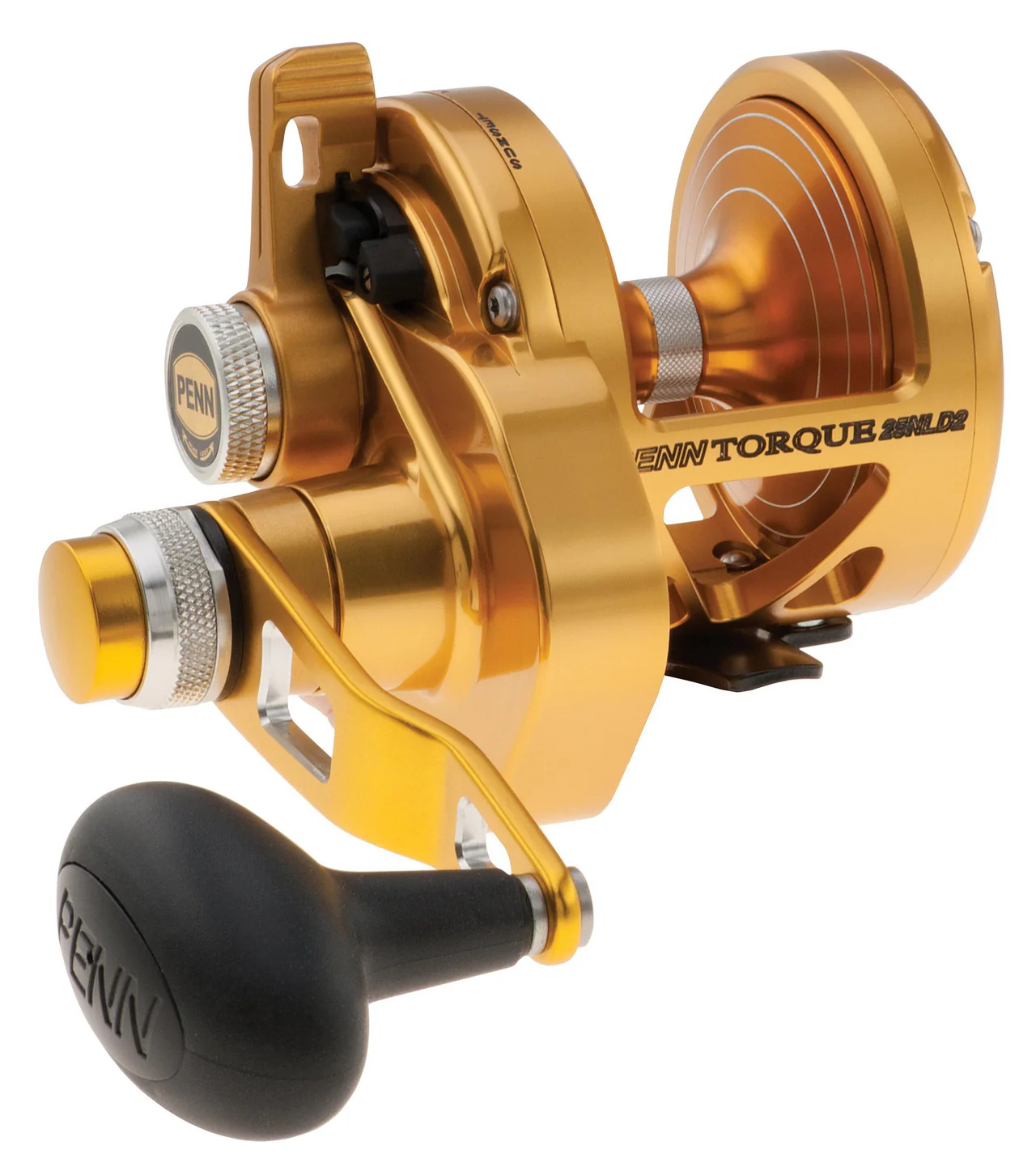
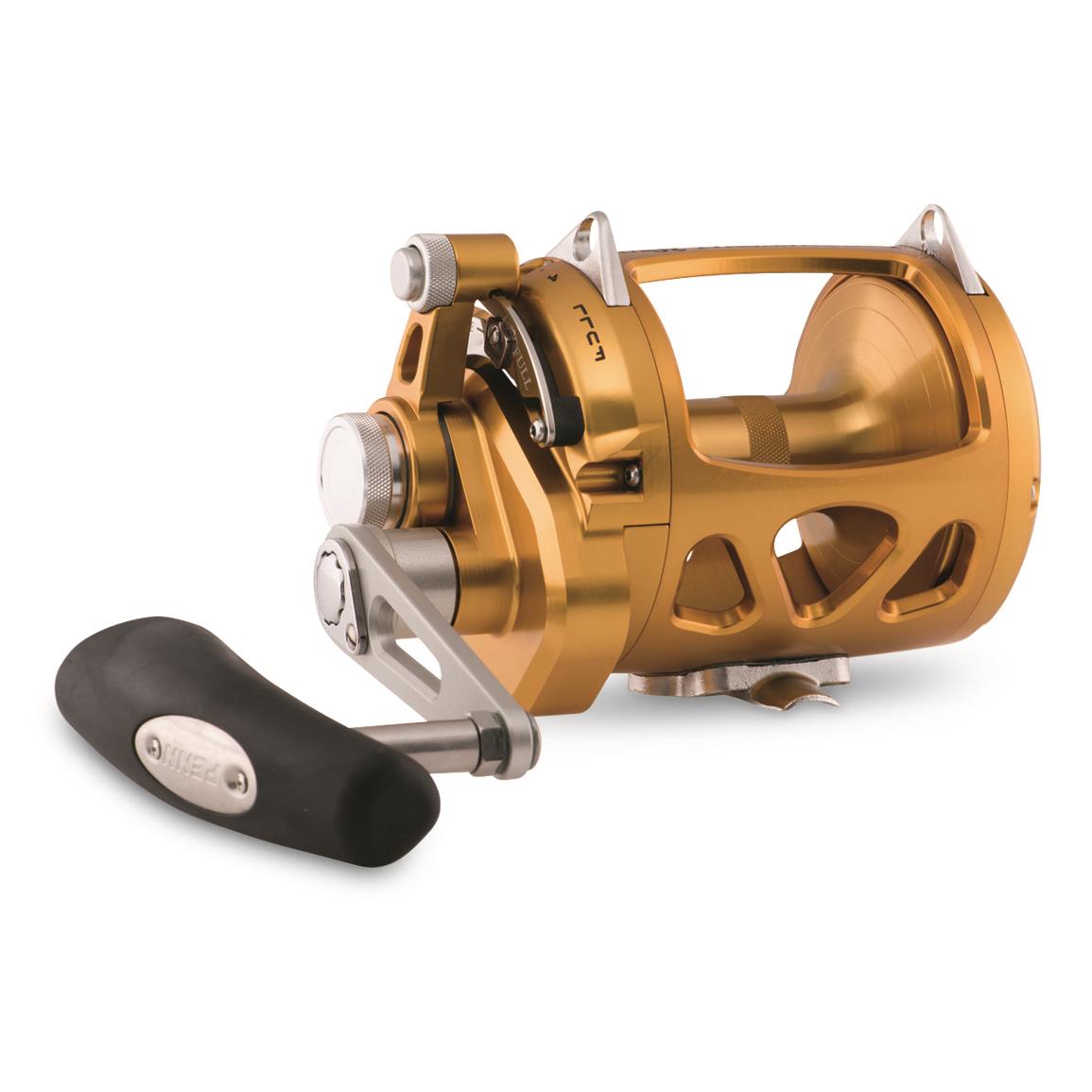
Penn International VI
Best for: Offshore trolling, big game target species, charter and tournament use where reliability is non-negotiable.
The Penn International VI is the reel that has put more billfish and tuna on the dock than arguably any other reel in production. That’s not marketing — it’s decades of accumulated track record across charter fleets, tournament circuits, and private sportfishing boats worldwide. The VI generation refines what was already a proven platform, and the result is a reel that we consider the benchmark for offshore trolling.
The drag system is the centerpiece. Penn uses a stacked carbon fiber drag washer setup that delivers smooth, progressive pressure without the stick-slip issues that plague lesser reels. At full lockdown, the International VI in the 50 size produces north of 50 pounds of strike drag, with a maximum drag approaching 100 pounds. More importantly, the drag curve is linear and predictable — when you move the lever, you know exactly what’s happening to the pressure on the fish. During extended fights in high heat, the drag maintains its characteristics without fading. We’ve seen International VIs perform consistently through fights lasting well over an hour in tropical conditions.
The gear ratio is purpose-built for trolling. In the standard retrieve configuration, you’re getting a ratio that prioritizes power over speed, which is exactly what you want when you’re trying to move a stubborn tuna away from the bow or pump a blue marlin toward the boat. The gear train is all machined stainless and bronze, and the feel under load is like turning a precision instrument rather than winding a winch. There’s no slop, no play, and no flex in the frame during heavy lifts.
Line capacity is substantial. The 50VI holds enough line to handle any realistic offshore scenario, including letting a marlin take an initial run of several hundred yards without getting into your backing. The spool is machined aluminum, and the frame is a full one-piece construction that eliminates flex points. This matters more than most anglers realize — a frame that twists under load creates uneven drag pressure and can cause gear alignment issues over time.
Durability is where the International VI separates from the field. These reels are designed to live in a saltwater environment and take physical abuse. Charter captains run them for years with basic maintenance. The finish holds up, the internal components resist corrosion, and replacement parts are readily available worldwide. If you’re buying a trolling reel that needs to work every single time you clip it to a rod, this is the safest choice you can make.
Shimano Tiagra
Best for: Tournament-level offshore fishing where drag precision and two-speed versatility are essential.
The Shimano Tiagra occupies a unique position in the offshore reel market. It’s the reel that serious tournament anglers reach for when drag smoothness, two-speed functionality, and mechanical refinement matter more than raw stopping power. The Tiagra doesn’t try to outmuscle the competition — it outperforms them through precision engineering.
The two-speed gear system is the Tiagra’s defining feature. With a simple shift mechanism, you can toggle between a high-speed retrieve for recovering line quickly and a low-speed power gear for pumping fish during the grind phase of a fight. In practice, this is invaluable during a billfish fight. You’re in high gear recovering line while the fish swims toward the boat, then you click into low gear when it turns and you need to apply maximum mechanical advantage. The transition is smooth enough that you don’t lose rhythm during the fight.
Shimano’s drag system in the Tiagra uses their proprietary multi-disc design that delivers exceptionally smooth pressure curves. Where some reels feel like they have a “notch” when transitioning from free spool to strike drag, the Tiagra’s lever moves through a continuous, butter-smooth progression. For anglers who fight fish from the chair, this smoothness translates directly into fewer pulled hooks and fewer broken-off fish. The drag washers maintain their characteristics even after extended heat buildup, which is critical during a prolonged tuna or marlin fight in warm water.
Line capacity is competitive with the International VI, and the machined aluminum spool is balanced to eliminate wobble at high rotation speeds. The frame construction uses Shimano’s cold-forged aluminum process, which produces a rigid, lightweight chassis that doesn’t flex under load. Fit and finish are outstanding — every component feels like it was machined to exacting tolerances, because it was.
Where the Tiagra gives up ground is in absolute brute-force scenarios. If you’re fishing heavy stand-up tackle for giant bluefin or fighting fish on short lines, the Penn’s raw drag power gives it an edge. But for the vast majority of offshore trolling and chair-fighting scenarios, the Tiagra’s combination of two-speed versatility, drag refinement, and mechanical quality makes it the choice of anglers who value technique and finesse in their big-game fishing.
Accurate Boss Valiant
Best for: Anglers who want conventional reel stopping power in a compact, lightweight package for stand-up and live bait fishing.
The Accurate Boss Valiant breaks the mold of what a deep sea conventional reel can be. While the Penn and Shimano occupy the full-size trolling reel space, the Boss Valiant delivers serious offshore performance in a form factor that’s dramatically smaller and lighter. It’s the reel that proved you don’t need a massive frame to stop big fish — you need a great drag system and precise engineering.
Accurate’s twin-drag system is the heart of this reel. Instead of a single drag stack, the Boss Valiant places drag washers on both sides of the spool, effectively doubling the drag surface area relative to the reel’s size. This design produces maximum drag numbers that are startling for a reel this compact. The 500 size generates over 30 pounds of drag from a reel that fits comfortably in your hand. The drag is smooth, heat-resistant, and holds its settings without creeping — even during fights that push the system to its rated limits.
The gear ratio on the Valiant favors a slightly higher retrieve speed than traditional trolling reels, which makes it exceptionally versatile. It retrieves fast enough for live bait fishing and popping, while still having the mechanical advantage to pump fish from depth on heavier jig setups. The gear train uses Accurate’s stainless steel and bronze construction, and the mesh is tight and precise. You can feel every head shake and direction change through the handle.
Spool capacity is naturally more limited than the full-size reels in this roundup, but Accurate designs the Valiant’s spool around modern braided lines. With braid, you get ample capacity for most offshore scenarios short of true blue-water trolling where 600-yard runs are possible. The narrower spool also provides more consistent drag pressure, because the lever-to-drag-pressure ratio doesn’t change as dramatically between a full and half-empty spool.
Build quality is exceptional. The one-piece machined aluminum frame is rigid and corrosion-resistant. The finish holds up well to daily saltwater exposure, and the overall construction reflects Accurate’s commitment to American-made precision manufacturing. For stand-up fishing, live bait fishing, kite fishing, and lighter jigging applications, the Boss Valiant offers a compelling combination of power, portability, and refinement that bigger reels simply can’t match.
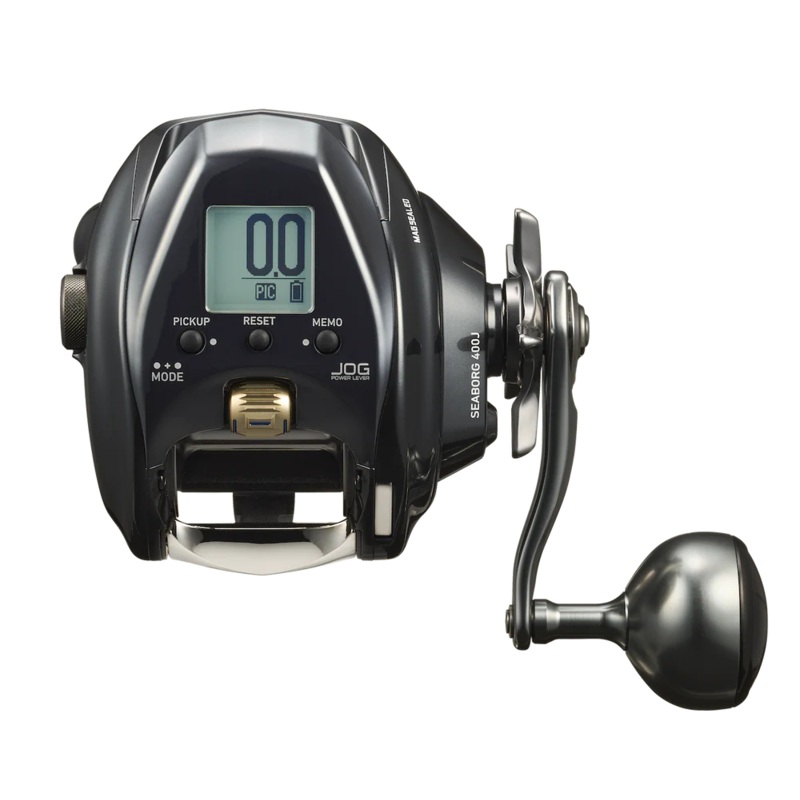
Daiwa Seaborg Electric
Best for: Dedicated deep dropping for swordfish, tilefish, and deep-structure species in 500-plus feet of water.
The Daiwa Seaborg is the reel that changed how many of us think about deep dropping. Before capable electric reels became accessible, fishing below 500 feet was a physical ordeal — you spent more energy cranking gear up from the bottom than you did actually fishing. The Seaborg eliminates that problem with a high-torque electric motor that retrieves terminal tackle and fights fish from extreme depths with relentless mechanical efficiency.
Motor power is the Seaborg’s headline specification. Daiwa’s Magmax motor generates sustained torque that pulls heavy rigs and resistant fish from deep water without the motor bogging down or overheating. The retrieve speed is adjustable through a range that lets you dial in everything from a slow, steady pump to a rapid retrieve when you’re relocating your bait. Under load, the motor maintains consistent speed without surging, which is critical for both fighting fish and preventing gear tangles in deep water.
The programmable jigging function is where the Seaborg truly stands apart. You can program the reel to execute automatic jigging patterns — varying the retrieve speed, pause duration, and stroke length to create a mechanical jigging action that’s impossible to sustain manually over a full day of fishing. For targeting swordfish and deep-dropping tilefish, this automated approach lets you fish more effectively for longer periods. You set the pattern, monitor the rod tip, and intervene when you get a bite.
Drag performance on the Seaborg is more than adequate for deep-dropping applications. The drag system handles the sustained pressure of pulling fish from extreme depth, and the carbon washers manage heat well during extended vertical fights. It’s not going to match a dedicated conventional reel for pure drag refinement, but it doesn’t need to — the motor is doing most of the work that your arms and back would normally handle.
Line capacity is built around braided line in the 80- to 130-pound class, which is standard for deep-dropping applications. The spool holds enough braid to fish comfortably in 1,000-plus feet of water with appropriate terminal tackle. The reel body is sealed against saltwater intrusion, and the electrical connections use waterproof fittings that hold up to the constant spray and wash-down of offshore fishing. Battery life is sufficient for a full day of deep dropping, though we recommend carrying a spare battery on longer trips.
Durability has been strong in our testing. The motor maintains its performance characteristics over extended use, and the mechanical components hold up to the demands of repeated deep drops. Daiwa’s build quality on the Seaborg is in line with their reputation for producing serious fishing tools. If deep dropping is a primary part of your offshore rotation, the Seaborg is purpose-built for exactly that job.
Shimano Beastmaster Electric
Best for: Anglers who want a versatile electric reel that handles deep dropping, speed jigging, and general bottom fishing with equal competence.
The Shimano Beastmaster is the most refined electric reel we’ve used. Where the Daiwa Seaborg is a dedicated deep-dropping machine, the Beastmaster takes a broader approach — delivering electric-assist performance across a wider range of deep sea techniques. It’s the electric reel for the angler who doesn’t want to specialize.
Shimano’s Giga-Max motor is the foundation. Power delivery is exceptionally smooth — the motor spools up progressively rather than lurching into gear, which gives you finer control during the fight. Variable speed control is intuitive, with a thumb-operated dial that lets you make real-time adjustments to retrieve speed without taking your hand off the rod. This matters when you’re fighting a fish that alternates between running and coming toward the boat. The motor is quiet compared to some competitors, which is a minor but appreciated detail during long hours on the water.
The gear ratio and mechanical drivetrain benefit from Shimano’s precision manufacturing heritage. The Beastmaster can be operated as a purely conventional reel when the motor is disengaged, and in that mode, it feels like a quality two-speed conventional reel. The drag system uses Shimano’s proven carbon washer technology, and it delivers smooth, consistent pressure across its full range. For an electric reel, the Beastmaster’s drag performance is genuinely impressive — it rivals some dedicated conventional reels in smoothness and heat management.
Versatility is where the Beastmaster earns its place. It handles deep dropping with authority, matching the Seaborg’s depth capability and motor endurance. But it also excels at speed jigging, where the electric motor creates high-speed vertical presentations that are physically demanding to sustain manually. For general bottom fishing in the 200- to 600-foot range, the electric retrieve turns a physically punishing grind into a manageable process that lets you fish more drops in a day.
Build quality is top-tier Shimano. The frame is rigid, corrosion-resistant, and finished to a standard that reflects the reel’s premium positioning. Waterproofing is thorough, and the electrical connections are robust enough for daily offshore use. Battery management is efficient — the Beastmaster’s power consumption is well-optimized, and a single charge typically carries through a full day of mixed fishing. For anglers who want one electric reel that does everything well, the Beastmaster is the most capable all-around option on the market.
Matching Your Reel to Your Fishing Style
The right reel depends less on brand loyalty and more on how you actually fish. Here’s how to think about the match.
Bottom Fishing
Bottom fishing in deep water — grouper, snapper, tilefish — is defined by vertical retrieves under load. You’re pulling fish and heavy terminal tackle up through the water column, often fighting current the entire way. If you’re regularly fishing below 300 feet, an electric reel saves your body and lets you fish more drops. The Daiwa Seaborg and Shimano Beastmaster both handle this work exceptionally well. For shallower structure work in the 100- to 300-foot range, a conventional reel like the Accurate Boss Valiant provides more than enough power without the weight and complexity of an electric.
Trolling
Trolling is the domain of the conventional reel. You need a smooth, progressive drag system that can manage a fish’s initial strike and long runs without over-pressuring the line or pulling the hook. The Penn International VI and Shimano Tiagra are purpose-built for this application. Lever drag controls give you real-time adjustment during the fight, and the mechanical simplicity of a conventional reel means there’s nothing to malfunction while you’re connected to a fish that might fight for an hour or more. Electric reels are unnecessary and generally unwanted for trolling — the fish do the running, and the angler does the pumping.
Jigging
Jigging spans the gap between conventional and electric. For slow-pitch jigging in moderate depths, a conventional reel like the Boss Valiant gives you the direct feel and control you need to work the jig properly. For speed jigging in deep water, an electric reel like the Beastmaster opens up techniques that are physically unsustainable with a manual retrieve. The motor can create rapid vertical presentations at depths where even a fit angler would burn out after a few drops. If you jig in varied depths and styles, the Beastmaster’s ability to toggle between electric and conventional operation makes it the most versatile option.
Maintaining Your Reel in Saltwater
Salt is relentless. Every deep sea reel on this list is built to handle marine environments, but none of them are maintenance-free. Neglect a saltwater reel and you’ll shorten its life dramatically. Here’s the maintenance routine we follow on every trip.
After every trip, rinse the reel thoroughly with fresh water. Don’t use a high-pressure nozzle — gentle running water for several minutes is more effective and less likely to force salt crystals into sealed areas. Focus on the drag lever mechanism, the handle knobs, and any joints or seams where salt can accumulate. Let the reel air dry completely before storing it. Never store a reel in a sealed bag while it’s still wet — you’re creating a corrosion chamber.
Monthly (or every five to six trips, whichever comes first), apply a light reel oil to the handle bearings, spool shaft, and any accessible pivot points. Use oil specifically designed for fishing reels — not WD-40, not household lubricant. For electric reels, inspect the electrical connections and apply dielectric grease to the power terminals and any exposed connectors. Check the battery for corrosion or swelling.
Annually, consider a full service. For conventional reels, this means disassembly, cleaning, inspecting drag washers and gears, replacing worn components, and reassembling with fresh grease and oil. Many anglers send their reels to authorized service centers for this work, which is worth the cost to maintain peak performance. For electric reels, annual service should include a motor inspection and bearing check in addition to the standard mechanical service. Penn, Shimano, Accurate, and Daiwa all have service networks that know their products inside and out.
The non-negotiable rule is simple: never skip the post-trip rinse. Twenty minutes of fresh water after each trip prevents the vast majority of salt corrosion issues. We’ve seen reels last a decade or more with consistent basic care, and we’ve seen premium reels fail within two seasons when maintenance was skipped.
Frequently Asked Questions
How much should I spend on a deep sea fishing reel?
Budget at least $400 to $600 for a quality conventional reel that will hold up to serious offshore use. Premium conventional reels like the Penn International VI and Shimano Tiagra range from $700 to over $1,000 depending on size. Electric reels start around $600 for entry-level models and climb past $1,500 for full-featured options like the Shimano Beastmaster and Daiwa Seaborg in larger sizes. Spending less than $400 on a deep sea reel usually means compromising on drag performance, corrosion resistance, or gear quality — all of which matter when you’re offshore with a big fish on the line.
Can I use an electric reel for trolling?
Technically yes, but there’s no practical advantage. Trolling requires a smooth lever drag system and the ability to fight fish that make long horizontal runs. Electric reels are designed around vertical retrieve power, which isn’t what trolling demands. The extra weight and complexity of an electric motor don’t contribute anything meaningful to the trolling experience. Every experienced captain we’ve fished with uses conventional reels for trolling and reserves electrics for deep dropping and deep jigging.
What line should I spool on a deep sea reel?
For conventional trolling reels, many anglers still prefer monofilament in the 50- to 130-pound class for its stretch and shock-absorbing properties during a fight. Increasingly, anglers spool braided line as a backing with a monofilament topshot, which maximizes capacity while keeping mono’s fish-fighting benefits where they matter — near the fish. For electric reels used in deep dropping, braided line is essential. Braid’s thin diameter lets you fit enough line on the spool to reach extreme depths, and its zero-stretch property transmits bites from hundreds of feet below. Match your line class to your target species and the reel manufacturer’s capacity recommendations.
How long do deep sea fishing reels last?
With proper maintenance, a quality conventional reel will last 10 to 20 years of regular use. The Penn International series is famous for reels that are still in service after decades of charter fishing. Electric reels have a shorter service life due to motor and battery wear — expect 5 to 10 years of peak performance with proper maintenance and periodic motor service. Drag washers and bearings are consumable components on any reel and should be replaced as they wear, but the frame, gears, and core mechanical components on these premium reels are built to last far beyond the typical angler’s needs.
Do I need different reels for different species?
Not necessarily different reels, but potentially different sizes. A 30-class conventional reel handles yellowfin tuna, wahoo, and mahi beautifully, but you’ll want a 50- or 80-class for serious blue marlin or giant bluefin work. Rather than buying a different reel brand for each species, most experienced offshore anglers invest in two or three sizes of their preferred reel. For example, a Penn International VI in the 30 and 50 sizes covers the vast majority of offshore trolling scenarios. Similarly, one mid-size electric reel like the Shimano Beastmaster handles deep dropping for swordfish, tilefish, and deep grouper without needing separate reels for each species. Match the reel size to the expected drag pressure and line capacity demands of your target species, and you’ll cover most situations with a modest arsenal.
Quick Buy — Products in This Article