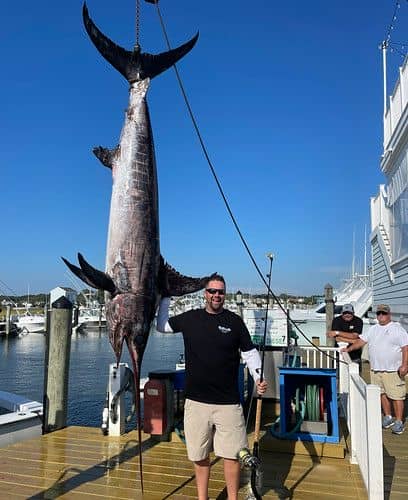
For decades, swordfish were ghosts. You fished for them at night, drifting in the dark with a light stick glowing 200 feet below the surface, hoping a broadbill would rise from the abyss to eat a rigged squid under the stars. It worked — sometimes. But daytime swordfishing has completely rewritten the playbook, and what was once considered nearly impossible has become one of the most exciting and reliable pursuits in offshore fishing.
The daytime deep drop revolution started in South Florida in the early 2000s when a handful of charter captains began experimenting with dropping baits to 1,200 to 1,800 feet during daylight hours, targeting swordfish where they actually live during the day — deep along continental shelf edges, canyon walls, and thermocline breaks. The results were staggering. Catch rates climbed dramatically compared to traditional nighttime drifting, and suddenly anglers who had spent years chasing swords in the dark were landing them before lunch.
We’ve been deep dropping for swordfish for years across multiple fisheries, from the Florida Straits to the Gulf of Mexico canyons and the mid-Atlantic shelf edge. The learning curve is real — this is not a fishery where you show up and wing it. The gear is specialized, the technique is precise, and the margin for error at 1,500 feet is razor thin. But once you understand the system, daytime swordfishing delivers a level of consistency that the nighttime bite never could.
This guide covers everything you need to start catching swordfish during the day — from the specialized tackle required to bait rigging, fish-finding strategy, the drop-and-drift technique, and the fight itself. If you’re new to offshore fishing entirely, we’d recommend starting with our deep sea fishing beginner’s guide for foundational knowledge before diving into this specialized technique. For a broader look at the gear that makes deep water fishing possible, visit our deep sea fishing hub.
Gear Requirements for Daytime Swordfishing
Daytime swordfishing demands purpose-built tackle. The depths involved, the size of the fish, and the duration of the fight create equipment requirements that are non-negotiable. Cutting corners on gear in this fishery doesn’t just cost you fish — it costs you hundreds of dollars in lost terminal tackle every time something fails at depth.
Electric Reels
An electric reel is not optional for daytime swordfishing. You are deploying and retrieving rigs from 1,200 to 1,800 feet repeatedly throughout the day, and doing that manually on a conventional reel will destroy you physically and burn hours of fishing time on retrieval alone. A single crank-up from 1,500 feet takes 15 to 20 minutes by hand. An electric reel does it in 3 to 5 minutes, which means more drops per day and more opportunities to connect with fish.
The standard choices are the Daiwa Tanacom 1000, Daiwa Marine Power 3000, and Shimano Forcemaster series. These reels pair powerful electric motors with manual drag systems that let you fight a fish traditionally once it’s hooked. The electric motor handles the grunt work of deployment and retrieval, while you maintain full control of the drag during the fight. Look for a reel that holds at least 1,000 yards of braided line in the 65 to 80-pound class — you need every yard of it when a swordfish takes a screaming run from 1,400 feet down.
Most electric reels run off the boat’s 12-volt system or a dedicated battery pack. We run a dedicated deep-cycle marine battery for our sword reels to avoid any voltage drop issues during critical moments. A reel that loses power mid-fight or mid-retrieve is a disaster you only experience once before you invest in a dedicated power source. For more on choosing reels for deep water applications, check our best deep sea fishing reels guide.
Rods
The rod needs to accomplish two things simultaneously: it must have enough backbone to pressure a large swordfish during a fight that can last 30 minutes to over two hours, and it must have a tip sensitive enough to detect a subtle bite transmitted through 1,500 feet of braided line and water column.
A dedicated swordfish rod is typically 5.5 to 6.5 feet, rated 50 to 80-pound class, with a fast-action tip and a powerful butt section. Shorter rods give you more leverage during the fight and work better in a rod holder during the drift. Some anglers prefer stand-up rods with a gimbal butt for belly-bucket fights, while others use bent-butt rods in a fighting chair. The choice depends on your boat setup and physical ability.
Composite blanks that blend fiberglass and graphite tend to perform best in this application. Pure graphite rods are too brittle for the sustained load of a deep swordfish fight, and pure fiberglass rods lack the tip sensitivity to detect bites at extreme depth. A quality composite blank gives you both.
Braided Line and Backing
Braided line is mandatory for deep dropping. Monofilament stretches roughly 25 to 30 percent under load, which means at 1,500 feet you’d have hundreds of feet of stretch absorbing your hook sets and masking bites. Braided line has near-zero stretch, which transmits every bump, tap, and headshake directly to the rod tip.
We spool our sword reels with 65 to 80-pound braided line — the thinner diameter cuts through the current better and allows faster sink rates. Color-metered braid is extremely helpful for tracking how much line is out, since most electric reels also have a digital line counter. Having both a visual and electronic reference prevents costly miscalculations about your bait’s depth.
Leader Material
The leader system is where many anglers new to swordfishing make mistakes. Swordfish have a bill, they thrash violently, and they have rough skin around their head and shoulders that can saw through lighter leaders in seconds.
We run a two-part leader system: a 30 to 40-foot top section of 200 to 300-pound monofilament connected to a 15-foot wind-on section of 300 to 400-pound monofilament or fluorocarbon near the hook. The long top section provides abrasion resistance against the bill during the fight, while the heavier wind-on section survives the most violent thrashing during the endgame when the fish is close to the boat.
Crimped connections with aluminum or copper sleeves are standard for leader-to-leader junctions and hook connections. Knots in leader material this heavy are unreliable under the extreme loads a swordfish generates. Use quality crimps, double-sleeve every connection, and pull-test your crimps before each trip.
Terminal Tackle
Terminal tackle for daytime swordfishing is surprisingly simple but critically important:
- Hooks: 9/0 to 11/0 J-hooks or circle hooks, depending on your preference and local regulations. Many fisheries are moving toward circle hooks for swordfish, and they work exceptionally well when the fish eats at depth and you come tight during the retrieve. J-hooks give you more aggressive hook-setting ability if you’re detecting bites in real time.
- Swivels: Heavy-duty ball-bearing swivels rated to at least 400 pounds. The bait and weight system spins during deployment and retrieval, and a swivel that seizes under load will twist your leader into a nightmare.
- Lead weights: 8 to 16 pounds, depending on current. These are break-away weights designed to detach once a fish is hooked, which we’ll cover in detail in the rigging section.
Bait Rigging for Daytime Swordfishing
Bait presentation matters enormously in the swordfish game. You’re asking a fish to eat something 1,500 feet below the surface where light barely penetrates and the bait needs to look, smell, and move naturally in a deep-water environment. Every component of the rig serves a purpose.
Rigging a Whole Squid
The whole squid is the gold standard bait for daytime swordfishing. Large squid — in the 12 to 18-inch range — present a natural profile that swordfish encounter regularly in the deep scattering layer. We use either fresh-caught squid or high-quality frozen squid, and the rigging is straightforward.
Insert the hook through the mantle of the squid so the point exits cleanly near the head. Using waxed rigging thread or copper wire, secure the squid to the leader by stitching the mantle closed around the leader material. The goal is a streamlined presentation where the squid looks natural and stays on the hook through a 1,500-foot drop, the drift, and the initial strike. A sloppy rig that falls apart on the way down is wasted effort.
Some anglers add a second hook — a stinger hook on a short piece of cable or heavy mono — that sits further back on the squid’s body. This increases hookup rates on fish that slash at the bait with their bill before turning to eat it, which is a common swordfish feeding behavior.
Belly Strips and Combination Baits
When whole squid aren’t available or aren’t producing, belly strips cut from bonito, skipjack tuna, or dolphinfish work well as primary baits or as additions to a squid rig. A belly strip adds scent, flash, and a fluttering action that can trigger strikes from fish that ignore a stationary squid.
Cut belly strips roughly 8 to 12 inches long and 2 to 3 inches wide, tapered to a point at the tail end. Score the flesh side lightly with a knife to release more scent into the water. Thread the strip onto the hook or wire it alongside a whole squid for a combination bait that offers both profile and scent.
Light Sticks and LED Lights
Swordfish are visual predators, and even at extreme depths, light plays a role in triggering feeding behavior. Attaching a light stick or battery-powered LED light 6 to 10 feet above the bait is standard practice for daytime deep drops. Green and blue light sticks are most common, though some anglers swear by white or pink LED options.
The light serves two functions: it attracts baitfish and squid to the area around your rig, creating a micro-ecosystem of activity that draws in predators, and it provides a visual reference point that helps a swordfish zero in on your bait in the dim twilight zone where you’re fishing. At 1,200 to 1,800 feet, very little sunlight penetrates, and even a small light source creates significant contrast.
Break-Away Weight Systems
The break-away weight is one of the most important innovations in daytime swordfishing. You need 8 to 16 pounds of lead to get your bait down to depth efficiently and keep it there during the drift, but fighting a swordfish with that much dead weight attached to your line would be brutal and would dramatically increase the chances of losing the fish.
The solution is a weight that detaches when a fish strikes. The most common system uses a heavy bank sinker or sash weight connected to the main rig with a rubber band or a mechanical release clip. When a swordfish hits the bait and you come tight on the line, the force of the strike snaps the rubber band or trips the release, and the weight falls away to the bottom. You’re now fighting just the fish on a clean line with no dead weight.
Dial in the break-away tension before fishing. Too light and the weight drops off during deployment or from current pressure. Too heavy and the weight stays attached through the strike, making the fight exponentially harder. We typically use a single #64 rubber band looped through the weight’s eye and attached to a snap swivel on the main rig. Test it by pulling sharply — it should release with about 15 to 20 pounds of sudden force.
Finding Swordfish: Reading the Deep Water
Dropping a bait blindly into 1,500 feet of water is a lottery ticket. Finding swordfish consistently requires understanding where they live during the day and what environmental factors concentrate them in specific areas.
Depth and the Deep Scattering Layer
During daylight hours, swordfish descend to the deep scattering layer (DSL) — a dense band of baitfish, squid, and other organisms that migrates vertically in the water column. During the day, the DSL typically sits between 1,200 and 1,800 feet in most Atlantic and Gulf fisheries. This is where swordfish spend their days feeding, and this is where your bait needs to be.
A quality fish finder with a high-powered transducer capable of reading bottom and bait at these extreme depths is essential. Look for the DSL on your sounder — it appears as a thick, fuzzy band of marks at depth. Position your bait at or just below the top edge of this layer, where swordfish patrol and ambush prey moving up and down through the column.
Temperature Breaks and Current Edges
Swordfish are highly sensitive to water temperature and tend to concentrate along thermocline breaks — areas where warm surface water meets cooler deep water at a distinct boundary. These thermal boundaries often coincide with current edges, particularly where the Gulf Stream or Loop Current creates defined walls of temperature change.
Use satellite sea surface temperature (SST) charts to identify current edges and temperature breaks before you leave the dock. Apps and services like Hilton’s Offshore, ROFFS, and FishTrack provide daily SST imagery that shows exactly where these boundaries form. The most productive sword grounds are often where a current edge intersects with favorable bottom structure — the convergence creates a buffet line that concentrates both baitfish and predators.
Bottom Structure and Contour
Swordfish during the day often orient to bottom structure at depth — submarine canyons, steep drop-offs, humps, and ledges along the continental shelf edge. These features create upwelling, concentrate bait, and provide navigational reference points for fish moving through the deep water.
Study your charts carefully. The slope angle of the bottom matters — swordfish favor areas where the bottom drops steeply rather than gradually. Canyon walls, the edges of underwater plateaus, and areas where the bottom contour changes abruptly are all high-percentage zones. Mark these areas on your plotter and plan your drifts to cover them systematically.
The Technique: Deploy, Drift, Detect, Fight
Daytime swordfishing follows a specific sequence that you’ll repeat throughout the day. Each phase of the sequence matters, and rushing or shortcutting any step costs you fish.
Deploying the Rig
Position the boat up-current and up-wind of your target zone. Free-spool the reel with the clicker engaged and let the weighted rig descend. Do not thumb the spool or slow the descent — you want the bait to reach depth as quickly as possible to minimize the time it spends in the unproductive mid-water column.
Watch your line counter and color-metered braid. When the bait reaches your target depth — typically 1,200 to 1,600 feet — engage the reel and set the drag to strike position. Place the rod in a rod holder and watch the tip closely. The entire deployment should take 5 to 8 minutes depending on current and weight.
The Drift
Once deployed, you drift with the current and wind, dragging the bait through the target zone. A productive drift covers ground — you’re searching for fish, not sitting in one spot waiting for them to come to you. Drift speed of 0.5 to 1.5 knots is ideal. If the drift is too fast, you can deploy a sea anchor or drogue to slow the boat. If there’s no drift at all, use the engines to create a slow troll.
Monitor your depth during the drift. As the bottom contour changes, adjust your bait depth to maintain the proper position relative to the DSL and the bottom. If you’re drifting off the shelf edge into deeper water, let out more line. If you’re drifting shallower, retrieve to avoid dragging bottom and losing your rig.
Detecting the Bite
This is where the entire system comes together — or falls apart. A swordfish bite at 1,500 feet doesn’t feel like a tuna crash-striking a trolling lure. It’s subtle. You’re watching the rod tip for any deviation from the normal rhythmic bounce of the drift.
A swordfish bite typically presents as a series of rapid taps followed by a sustained pull-down on the rod tip. The taps are the fish striking the bait with its bill — swordfish slash prey with their bill to stun it before turning to swallow it. The pull-down is the fish eating the bait and swimming away. Some bites are more aggressive and skip the tapping phase entirely, loading the rod in a single heavy pull.
When you see the bite develop, resist the urge to immediately grab the rod. Let the fish eat. Wait for the rod to load fully — the tip should be buried and the line should be coming tight against the drag. This patience is the hardest part of the technique and the single biggest factor separating anglers who hook swordfish from those who pull baits away from them.
The Hook Set and Fight
Once the rod is fully loaded and the fish is moving away, pick up the rod and drive the hook home with a firm, sustained sweep — not a violent jerk. If you’re using circle hooks, simply reel tight and let the hook rotate into the jaw corner. The initial moments of the fight determine everything: apply maximum drag pressure to prevent the fish from running back to the bottom and tangling in your weight or structure.
The fight unfolds in phases. The first run is usually the most violent — the fish realizes it’s hooked and bolts, peeling line against the drag. Let it run. Once the fish slows, begin a steady pump-and-reel retrieve, gaining line on every upstroke. A swordfish will make multiple runs, often punctuated by spectacular jumps when the fish nears the upper water column and feels the pressure change.
The endgame — from 200 feet to the surface — is the most dangerous part. Swordfish are powerful, unpredictable, and armed with a bill that can puncture a hull. As color shows on the leader, communicate with your crew. The wireman needs to be ready, the gaff team needs to be positioned, and everyone needs to be clear of the bill. A green swordfish at the boat is a serious safety hazard, and we’ll cover that in the safety section below.
Expect the fight to last anywhere from 30 minutes for a smaller fish (under 100 pounds) to over two hours for a large swordfish exceeding 300 pounds. Sustained drag pressure, proper rod work, and a functional harness system make the difference between landing the fish and getting beaten by fatigue.
Daytime vs. Nighttime Swordfishing
Both approaches catch swordfish, but they target the fish in fundamentally different states and require completely different tactics.
Nighttime swordfishing targets fish that have migrated vertically from the deep water to feed in the upper 100 to 300 feet of the water column. At night, the DSL rises toward the surface, and swordfish follow their food upward. The traditional technique involves drifting with baits set at various depths from 50 to 300 feet, marked with light sticks. The gear is lighter — conventional 50-pound-class tackle, no electric reels, shorter leaders. Night bites tend to be more aggressive because the fish are actively feeding in shallower water with better visibility.
Daytime swordfishing targets the same fish 1,000+ feet deeper, where they spend the daylight hours. The gear is heavier, the technique is more technical, and the bites are more subtle. But the consistency advantage is overwhelming. During the day, swordfish are concentrated in predictable depth bands along predictable structure. At night, they scatter across a much wider area of the water column, and finding them is more dependent on luck and current conditions.
Our recommendation: Learn the daytime technique first. It produces more consistent results, teaches you the fundamentals of deep water fishing, and puts more fish beside the boat over a season. Night fishing is a fantastic complement — especially during the summer months when days are long and you can fish both shifts — but daytime is the foundation of modern swordfishing.
Safety Considerations
Daytime swordfishing involves unique hazards that go beyond standard offshore safety. The extreme depths, heavy tackle, and the fish itself all demand respect and preparation.
Line Management at Depth
You have over 1,500 feet of braided line under tension during every drift. If that line snaps or a component fails, the stored energy can cause the line to whip back violently. Never stand directly behind a loaded rod during a drift or fight. Keep crew positioned to the sides and maintain awareness of where the line runs at all times. Braided line under tension can cut through skin instantly — heavy gloves are mandatory for anyone handling the line during leader pulls.
Break-Away Weight Hazards
When a break-away weight fails to release and drops during the fight, 8 to 16 pounds of lead is swinging freely below the fish. If the weight detaches near the surface, it can pendulum into the boat or crew. Be aware of the weight’s status throughout the fight and communicate it to the crew.
Fish Handling at the Boat
A swordfish’s bill is a weapon. It’s dense, sharp-edged, and attached to several hundred pounds of panicked muscle. Never lean over the gunwale within reach of a green swordfish. The fish should be fought to exhaustion before any attempt to leader, gaff, or subdue it. The wireman should wear heavy gloves and be prepared to release the leader instantly if the fish surges. A flying gaff, rather than a fixed gaff, is the standard tool for boating a swordfish — it allows the gaff head to pull free of the handle if the fish makes a final run.
Once the fish is subdued and secured alongside, brain it immediately with a kill spike before attempting to bring it over the rail. An un-subdued swordfish thrashing on the deck is one of the most dangerous situations in offshore fishing.
General Offshore Safety
You’re fishing far offshore in deep water. Ensure your boat’s safety equipment is current and inspected: life jackets, EPIRB, VHF radio, flares, first-aid kit, and a float plan filed with someone onshore. Deep dropping for swordfish often takes you 15 to 30 miles offshore or more, where weather can change quickly and help is far away. Monitor weather radar throughout the day and never hesitate to cut a drift short if conditions deteriorate.
Top Swordfishing Locations in the United States
South Florida and the Florida Straits
South Florida is ground zero for the daytime swordfishing revolution. The continental shelf drops off steeply just miles from the coast, putting fishable sword depths within a 20-minute run from inlets like Government Cut, Hillsboro, and Port Everglades. The Gulf Stream runs close to shore here, creating reliable temperature breaks and current edges that concentrate swordfish year-round. This is where the daytime technique was pioneered, and the fleet of experienced captains and well-equipped charter boats makes it the best place for a first-timer to learn the fishery.
Gulf of Mexico: Louisiana, Mississippi, and Alabama
The Gulf offers outstanding swordfishing along the continental shelf edge south of the Mississippi River Delta and in the submarine canyons — the DeSoto Canyon, Mississippi Canyon, and others. The run to fishable depths is longer than South Florida, typically 60 to 100 miles offshore, but the fish are there in numbers. The Gulf’s warmer water temperatures and abundant bait make it a productive fishery from spring through late fall.
Mid-Atlantic: Virginia to New Jersey
The mid-Atlantic shelf edge and its system of submarine canyons — Norfolk, Washington, Baltimore, Wilmington, and Hudson — produce exceptional swordfishing from June through October. The continental shelf drops from 100 fathoms to over 1,000 fathoms along these canyon edges, creating the steep contours and current interactions that swordfish favor. The runs are long — often 80 to 120 miles from inlet to grounds — but the quality of fish in this region is outstanding, with consistent shots at swordfish over 200 pounds.
Southern California
The West Coast swordfish fishery is growing rapidly. Broadbill swordfish inhabit the deep water off San Diego, Los Angeles, and the Channel Islands, with the best fishing from late summer through fall when warm water pushes north. The Pacific fishery requires longer runs and often produces in slightly shallower depths than the Atlantic, with productive drops between 800 and 1,400 feet. Regulations differ from the Atlantic — check current NOAA rules for hook types, retention limits, and reporting requirements before fishing.
Frequently Asked Questions
How deep do you need to fish for daytime swordfish?
The productive depth range for daytime swordfishing typically falls between 1,200 and 1,800 feet in the Atlantic and Gulf of Mexico. The exact depth on any given day depends on where the deep scattering layer sits, which is influenced by water clarity, temperature, and current conditions. Start your first drop at 1,400 to 1,500 feet and adjust based on what your sounder shows and where bites occur. In the Pacific, productive depths can be slightly shallower, sometimes as little as 800 to 1,200 feet. The key is finding the DSL on your fish finder and positioning your bait at or just below its upper edge.
How much does it cost to get into daytime swordfishing?
The gear investment for daytime swordfishing is significant. A quality electric reel runs $700 to $2,500, a dedicated swordfish rod is $200 to $600, and braided line, leader material, and terminal tackle add another $300 to $500 to get started. You’ll also spend $50 to $100 per trip on consumable terminal tackle — weights, light sticks, crimps, and hooks. For your first experience, booking a charter that provides the gear is far more economical. Full-day swordfish charters run $2,500 to $5,000 depending on the port, boat, and captain. That investment gets you on the water with experienced crew and proper equipment while you learn whether this fishery is something you want to pursue with your own gear.
What is the best bait for daytime swordfish?
Whole squid in the 12 to 18-inch range is the most consistently productive bait for daytime swordfishing. Fresh squid is ideal, but high-quality frozen squid from a reputable bait supplier works nearly as well. Belly strips from bonito, skipjack tuna, or dolphinfish are effective as secondary baits or combined with a squid for a combination presentation. Some captains in the Gulf have success with whole Boston mackerel and large sardines. The bait matters less than the rigging — a perfectly rigged squid that swims naturally at depth will outfish a sloppy rig with premium bait every time. Pair any bait with a light stick or LED light 6 to 10 feet above the hook for maximum effectiveness.
Do you need a charter boat to go swordfishing?
You don’t need a charter, but you do need a capable offshore boat and the proper equipment. A center console or sportfisher in the 30-foot-and-up range with a reliable power system for electric reels, quality electronics capable of reading deep water, and adequate safety equipment for runs of 15 to 100+ miles offshore is the minimum platform. You also need someone aboard who knows the technique — the learning curve for daytime swordfishing is steep enough that going out blind wastes time and money. If you’re new to the fishery, we strongly recommend chartering with an experienced swordfish captain for your first several trips. Learn the technique, ask questions, and then apply that knowledge on your own boat. The investment in charter trips upfront saves you months of trial-and-error and hundreds of dollars in lost terminal tackle.
Is swordfishing catch and release or catch and keep?
Swordfish regulations vary by region, but most US fisheries allow both harvest and release under specific size and bag limits. In the Atlantic and Gulf, the federal minimum size is 47 inches lower jaw fork length (LJFL), with a recreational bag limit of one swordfish per person per trip or four per vessel, whichever is less. There is no closed season for recreational swordfishing in most Atlantic waters, though regulations change — always verify current NMFS rules before fishing. In the Pacific, regulations are managed differently and may require specific permits. Many anglers practice voluntary release of smaller swordfish and fish under the slot to support the fishery’s long-term health. When releasing a swordfish, minimize fight time by using appropriate drag pressure, keep the fish in the water during dehooking, and use circle hooks to improve post-release survival. For detailed information on how we evaluate gear and techniques across all fisheries, visit our methodology page.