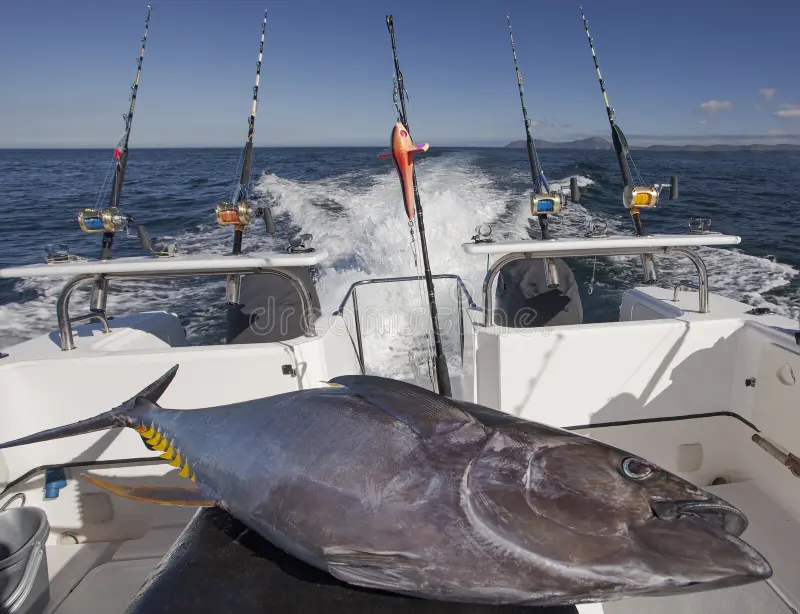
Few fish in the ocean can match the raw, relentless power of a yellowfin tuna on the end of your line. The first run alone — a blistering, drag-screaming sprint that can peel 200 yards of braid in seconds — is enough to ruin you for every other species. Yellowfin are built like torpedoes, fight like machines, and taste like the finest sashimi you’ve ever put in your mouth. They are, by almost every measure, the ultimate offshore game fish for anglers who want both the fight and the reward.
We’ve chased yellowfin across every major fishery in U.S. waters — from the rigs in the Gulf of Mexico to the canyons off the Mid-Atlantic, the warm eddies spinning off the Gulf Stream at the Outer Banks, and the kelp paddies drifting off San Diego. What we’ve learned across hundreds of trips is that yellowfin are not a one-method fish. They respond to trolling, chunking, live bait, jigging, popping, and a half-dozen variations of each. The anglers who consistently put big yellowfin on the deck are the ones who understand the species, read the conditions, and carry the versatility to adapt when plan A isn’t producing.
This guide covers everything we know about catching yellowfin tuna — the behavior that drives where and when they feed, the techniques that put them on the hook, the tackle required to land them, and the destinations where your odds are highest. Whether you’re booking your first offshore charter or running your own bluewater campaign, this is the playbook. For a broader introduction to bluewater angling, start with our offshore fishing hub and our beginner’s guide to offshore fishing. If you want to understand how we evaluate and recommend gear, our methodology page explains the process.
Understanding Yellowfin Tuna Behavior
Before we get into rods, reels, and lure spreads, you need to understand what makes yellowfin tick. Every technique in this guide is built on an understanding of how these fish move, feed, and relate to structure. Skipping this section is like navigating offshore without a chart — you might get lucky, but you’re leaving fish on the table.
Schooling and Size Classes
Yellowfin tuna are pelagic schooling fish that travel in groups organized roughly by size. Smaller “football” yellowfin in the 15- to 40-pound range often school in massive groups numbering in the hundreds or thousands. These schools are frequently mixed with skipjack tuna, blackfin tuna, and sometimes juvenile bigeye. They feed aggressively, compete with each other for food, and are the most predictable yellowfin to target.
As yellowfin grow beyond the 60- to 80-pound mark, the schools shrink. Fish in the 100-pound class typically travel in groups of a dozen or fewer. The true giants — fish pushing 150 pounds and beyond — are often found in pairs or small pods of three to five fish. These big fish are more selective, less frantic, and far more challenging to hook. They’ve survived years of avoiding hooks and predators, and they don’t make many mistakes.
Understanding size-class behavior matters because it dictates technique. A school of 30-pound footballs crashing bait on the surface calls for a completely different approach than a pair of 150-pound cows cruising the thermocline at 200 feet.
Feeding Patterns and Prey
Yellowfin are opportunistic predators with a diet that includes squid, flying fish, sardines, herring, anchovies, small mackerel, and crustaceans. Their feeding behavior shifts throughout the day and varies by region, but the general pattern is consistent: yellowfin feed most aggressively during low-light periods at dawn and dusk, with a secondary feeding window in the middle of the day when bait concentrates around structure or temperature breaks.
When yellowfin are actively feeding on the surface — a phenomenon often visible as boiling water, diving birds, and scattered baitfish — they’re in full competitive mode. Every fish in the school is racing to eat before the bait disappears. This is when casting, trolling, and topwater techniques are most effective because the fish are already committed to eating and aggression overrides caution.
When surface activity dies down, yellowfin drop below the thermocline and transition to a more calculated feeding mode. They’ll cruise structure edges, follow bait schools at depth, and pick off prey with far less urgency. This is when vertical jigging, deep live baiting, and slow-trolled natural baits excel.
Temperature Preferences
Water temperature is the single most reliable predictor of yellowfin location. Yellowfin strongly prefer water between 72 and 82 degrees Fahrenheit, with the sweet spot falling between 74 and 78 degrees in most fisheries. They can tolerate water slightly outside this range, but they concentrate — and feed most actively — within it.
Temperature breaks are critical. A sharp edge where 74-degree water meets 70-degree water creates a wall that concentrates bait and predators alike. Yellowfin patrol these edges relentlessly, picking off prey that gets pushed against the temperature gradient. Before every trip, we study sea surface temperature (SST) charts to identify these breaks and plan our lines accordingly. This single habit — reading SST data and running to temperature edges — has put us on more yellowfin than any other planning technique.
Structure Association
Yellowfin relate to structure far more than most anglers realize. Offshore, “structure” includes oil and gas platforms, floating weed lines, debris fields, current rips, seamounts, submarine canyons, and fish aggregating devices (FADs). Each of these creates a micro-ecosystem: plankton concentrates, baitfish gather, and predators — including yellowfin — show up to feed.
Oil platforms in the Gulf of Mexico are legendary yellowfin producers because they function as permanent artificial reefs. The submerged structure attracts baitfish and creates current breaks that concentrate forage at predictable locations. Weed lines along current edges in the Mid-Atlantic and Outer Banks fisheries serve a similar purpose on a more transient basis. Floating sargassum accumulates small fish and crustaceans, and yellowfin cruise beneath these weed mats picking off prey throughout the day.
Trolling for Yellowfin Tuna
Trolling is the most common and arguably the most effective method for locating and catching yellowfin tuna. It covers water efficiently, mimics fleeing baitfish, and triggers the competitive feeding instinct that makes yellowfin such aggressive predators. When we’re running offshore and don’t yet have eyes on fish, trolling is always our first play.
Setting the Spread
A standard yellowfin trolling spread runs five to seven lines from a combination of outriggers, flat lines, and a center shotgun position. The goal is to create a staggered, multi-depth presentation that simulates a panicked school of bait being chased to the surface. For a detailed breakdown of spread positions and strategies, see our best tuna fishing lures guide.
We typically set our spread as follows:
- Short riggers (left and right): 50 to 75 feet back, running skirted lures or skirted ballyhoo in the propwash. These are your most visible positions and the first ones aggressive yellowfin attack.
- Long riggers (left and right): 100 to 150 feet back, running diving plugs or subsurface swimmers. The extra distance lets these lures reach their intended running depth in cleaner water.
- Flat lines (left and right): 75 to 125 feet back, straight off the transom. Cedar plugs, small skirted lures, and rigged natural baits work well here.
- Shotgun line: 175 to 300 feet back from the center. This is the longest line in the spread and picks up fish that follow the presentation from a distance before committing.
Lure Selection
Yellowfin respond to a wide variety of trolling lures, but certain categories consistently outperform others. Skirted lures with cupped or concave heads create a bubble trail and erratic swimming action that mimics a wounded baitfish. Colors like purple-and-black, blue-and-white, and green-and-yellow are proven producers across fisheries. Cedar plugs — the simplest and most time-tested offshore lure — are deadly on yellowfin when run from the flat line or shotgun position. Diving plugs like the Rapala Magnum and Yo-Zuri Bonita reach the subsurface zone where yellowfin often cruise just below the surface chaos.
We always run a mix of lure types in our spread. An all-skirted-lure spread catches fish, but a diversified spread that combines skirted lures, diving plugs, cedar plugs, and at least one rigged natural bait covers more of the water column and appeals to a wider range of feeding moods.
Trolling Speed
Yellowfin prefer a faster trolling speed than most offshore species. We run our yellowfin spread between 7 and 9.5 knots — significantly faster than what you’d run for bigeye or swordfish. At these speeds, skirted lures track properly in the propwash, diving plugs reach their target depth, and the overall presentation looks like bait fleeing at full speed, which is exactly what triggers yellowfin into striking.
Bait Trolling
Natural bait trolling — particularly rigged ballyhoo and belly strips — is devastatingly effective on yellowfin that have seen too many artificial lures. A ballyhoo rigged on a chin-weight with a small skirt produces a lifelike swimming action at trolling speeds that artificial lures simply cannot replicate. We run at least one or two natural baits in every spread, typically on the flat lines or short rigger positions where they’re most visible.
The downside of natural bait trolling is that baits wash out faster and require more frequent replacement. A well-rigged ballyhoo holds up for 30 to 45 minutes at speed before it needs to be swapped. It’s worth the effort — when the lure bite slows down, a fresh ballyhoo in the spread often produces the next hookup.
Chunking and Chumming for Yellowfin
When we find a concentration of yellowfin on structure — an oil platform, a temperature break, a weed line — we often shut down the trolling spread and switch to chunking. This technique is less glamorous than trolling but can produce numbers and size that trolling rarely matches, particularly on larger fish that have grown wary of noisy boat presentations.
The Anchor-and-Chum Technique
Chunking starts with positioning the boat up-current of the structure or break where yellowfin are holding. In areas with fixed structure like oil platforms, we’ll anchor or tie off. Along temperature breaks and weed lines, we drift and use the engines to maintain position.
The process is straightforward: cut fresh bait — typically butterfish, sardines, herring, or skipjack tuna — into chunks roughly the size of your thumb and begin tossing them overboard in a steady stream. The current carries these chunks down-current, creating a slick of scent and visual cues that draws yellowfin up from depth and toward the boat. The key is consistency. A steady stream of five to ten chunks per minute is more effective than dumping a bucket all at once. You want to establish a continuous trail that fish follow back to the source.
Fishing the Chunk Line
Once the chum line is established, you fish baited hooks within it. We use chunks identical to what we’re throwing for chum, threaded onto 7/0 to 9/0 circle hooks tied to 60- to 100-pound fluorocarbon leaders. The baited hooks drift naturally with the chum, and yellowfin feeding in the slick inhale them without suspicion.
The critical rule in chunk fishing is that your hooked bait must look and drift exactly like the free-floating chum. Any unnatural resistance, unusual movement, or visible hardware spooks educated yellowfin instantly. We use long fluorocarbon leaders — eight to fifteen feet — to keep the mainline connection well away from the bait, and we feed line freely so the chunk drifts at the same speed as the chum.
When a yellowfin picks up a chunk bait, you’ll feel a steady pull rather than a sharp strike. With circle hooks, the fish hooks itself — resist the urge to set the hook with a hard strike. Simply engage the reel, come tight, and let the circle hook rotate into the corner of the jaw as the fish turns away. This technique produces clean jaw hookups the vast majority of the time and dramatically reduces gut-hooking.
Live Bait Fishing for Yellowfin
Live bait is the highest-percentage method for targeting trophy-class yellowfin tuna. A live skipjack, goggle-eye, blue runner, or sardine triggers an instinctive predatory response that no artificial lure can match. Big yellowfin that have ignored trolling spreads and turned away from chunk lines will commit without hesitation to a lively baitfish struggling on the surface.
Kite Fishing
Kite fishing is the most effective live bait delivery system for yellowfin, and it’s standard practice in the Gulf of Mexico and South Florida fisheries. A fishing kite is deployed from the boat and suspends your live bait at the surface via a release clip. The bait splashes and struggles on the surface — visible and audible to any yellowfin in the area — while the line and leader angle down from the kite rather than from the boat, keeping the presentation completely separated from the hull.
The visual of a live bait being dangled at the surface is often more than a yellowfin can resist. We’ve watched 100-pound-class fish launch completely out of the water to grab a kite bait. When the fish strikes, the release clip pops free, and you’re connected directly to the fish on your rod.
Freelining
Freelining is the simplest form of live bait fishing — hook a live bait through the back or nose, cast it away from the boat, and let it swim freely with no weight, float, or additional hardware. The bait’s natural swimming action does all the work. We use this technique when we can see yellowfin feeding on the surface or cruising near structure. A live goggle-eye or blue runner pitched into the path of a cruising yellowfin is about as close to a guaranteed hookup as offshore fishing gets.
Butterfly Jigs and Slow-Pitch Jigging
Although not strictly “live bait fishing,” slow-pitch jigging with butterfly-style jigs deserves mention here because it mimics injured baitfish with remarkable realism. These flat, fluttering metal jigs are worked with a specialized rod action — a slow, rhythmic pitch that sends the jig spiraling and flashing through the water column. Yellowfin that are holding deep and refusing surface presentations often cannot resist the erratic, wounded-baitfish action of a well-worked butterfly jig.
We deploy slow-pitch jigs when our electronics mark yellowfin at depth — typically between 100 and 300 feet — and surface techniques aren’t producing. Drop the jig to the bottom of the marked school, and begin the slow-pitch retrieve. Strikes often come on the fall as the jig flutters downward, so stay alert for any interruption in the jig’s descent.
Popping and Jigging: Topwater and Vertical Techniques
For pure adrenaline, nothing in offshore fishing compares to watching a 100-pound yellowfin explode on a topwater popper. Popping and jigging are active, casting-based techniques that have surged in popularity over the past decade, and for good reason — they produce spectacular strikes and allow anglers to target specific fish rather than dragging lures and hoping for the best.
Topwater Popping
Topwater popping for yellowfin uses large, cupped-face plugs (poppers) and pencil-shaped stickbaits cast to actively feeding fish. When you see yellowfin crashing bait on the surface — marked by boiling water, diving birds, and scattered baitfish — position the boat up-current at casting range and start launching poppers into the melee.
The retrieve is aggressive: sharp, downward rod strokes that cause the popper to spit water, dive, and create a commotion on the surface. Yellowfin in a feeding frenzy compete for food, and a popper crashing through the surface chaos often draws strikes from the largest fish in the school — the ones with enough size and confidence to dominate the feeding zone.
Effective popper sizes for yellowfin range from 130mm to 200mm, with weights between two and six ounces depending on conditions and casting distance required. Cup-face poppers that throw a big splash work best in calm conditions, while pencil poppers and stickbaits excel in rougher water where a subtler surface presentation is more visible.
Vertical Jigging
Vertical jigging targets yellowfin holding below the surface, typically marked on sonar between 80 and 400 feet. Heavy metal jigs — 150 to 400 grams depending on depth and current — are dropped to the target zone and retrieved with fast, aggressive rod strokes that make the jig dart and flash through the water column.
Speed jigging, the fastest variant, uses an overhead rod stroke and high-speed reel retrieve to rip the jig upward through the water column. This technique is physically demanding — a full day of speed jigging is a serious workout — but it provokes reaction strikes from yellowfin that aren’t actively feeding. The jig’s rapid, erratic movement triggers a predatory reflex that overrides the fish’s caution.
Tackle Requirements for Yellowfin Tuna
Yellowfin tuna punish weak tackle. Their initial runs generate enough force to explode knots, strip gears, and snap rods that aren’t built for the job. Matching your tackle to both the technique and the expected size class is essential.
Trolling Tackle
- Rods: 5’6” to 6’6” stand-up trolling rods rated 30- to 80-pound class, with roller guides or heavy-duty ring guides. Bent-butt models provide leverage during extended fights.
- Reels: Two-speed lever-drag conventional reels in the 30W to 50W class. The two-speed feature is critical — high gear for clearing lines during a hookup, low gear for grinding a big yellowfin away from structure. For our top picks, see our best offshore trolling reels guide.
- Line: 50- to 80-pound braided mainline with a topshot of 60- to 100-pound monofilament or fluorocarbon. Braid provides capacity and sensitivity; the topshot adds abrasion resistance and stretch for shock absorption during the initial run.
- Leader: 80- to 130-pound fluorocarbon leader, six to fifteen feet long. Yellowfin have excellent eyesight and will reject presentations with visible hardware or heavy leader material in clear water.
Chunking Tackle
- Rods: 6’6” to 7’ medium-heavy conventional rods with a moderate action that loads progressively under the weight of a big fish. Too stiff and you’ll pull hooks; too soft and you can’t control the fight.
- Reels: 30- to 50-class lever-drag conventional reels with smooth, reliable drag systems. The drag must perform flawlessly under sustained pressure — yellowfin chunk fights can last 30 minutes or more on big fish.
- Line: 65- to 80-pound braid with a 10- to 15-foot topshot of 60- to 80-pound fluorocarbon.
- Leader: 60- to 100-pound fluorocarbon, eight to fifteen feet. Longer leaders are critical in clear water or when targeting larger, more cautious fish.
- Hooks: 7/0 to 9/0 inline circle hooks. Circle hooks are non-negotiable for chunk fishing — they produce clean jaw hookups and are increasingly required by regulations in many fisheries.
Popping and Jigging Tackle
- Rods: 7’ to 8’ heavy-action spinning or conventional rods designed specifically for popping or jigging. These are specialized sticks with fast tips for lure action and powerful butt sections for fighting fish. Do not try to substitute a general-purpose rod — the casting loads and fight dynamics will destroy it.
- Reels: Heavy-duty spinning reels in the 10000 to 18000 size class (Shimano/Daiwa sizing), with sealed drags capable of 40 to 55 pounds of max drag. Conventional reels work for vertical jigging but spinning reels are preferred for casting poppers.
- Line: 80- to 100-pound braid straight to the lure or jig (no topshot needed for most jigging applications). For popping, some anglers add a short section of 100- to 130-pound fluorocarbon leader to prevent bite-offs from wahoo or barracuda that crash the party.
- Jigs: 150 to 400 grams depending on depth and current. Carry an assortment of weights and colors — pink, blue-silver, and green-gold are consistently productive across fisheries.
Best Yellowfin Tuna Destinations
Yellowfin tuna are a circumtropical species found in warm and temperate waters worldwide, but certain U.S. fisheries stand out for consistency, accessibility, and the caliber of fish they produce.
Gulf of Mexico (Louisiana and Texas)
The Gulf of Mexico — particularly the waters off Venice, Louisiana — is arguably the best yellowfin tuna fishery in the continental United States. The combination of deep water close to shore, hundreds of oil and gas platforms that function as permanent fish-aggregating structure, and a warm loop current that delivers clean blue water creates a year-round yellowfin fishery that is difficult to match anywhere else. Fish in the 60- to 150-pound class are common, and fish exceeding 200 pounds are landed every season.
The key advantage of the Gulf fishery is access. Blue water and productive platforms are often within 30 to 50 miles of the dock in Venice, making single-day trips not only possible but standard. Most boats are fishing within two hours of leaving the marina.
Mid-Atlantic Canyons (New Jersey to Virginia)
The submarine canyons along the continental shelf edge — Hudson Canyon, Baltimore Canyon, Norfolk Canyon, and Wilmington Canyon — are world-class yellowfin producers from June through October. Warm Gulf Stream eddies push blue water into the canyon heads, concentrating baitfish and creating temperature breaks that yellowfin patrol aggressively.
The trade-off is distance. The canyon edges are typically 60 to 100 miles offshore, requiring long runs and often overnight trips. But the reward is access to yellowfin in the 40- to 120-pound class, with occasional shots at true giants. Canyon trips also produce bigeye tuna, longfin albacore, mahi-mahi, and white marlin, making every trip a multi-species event.
Outer Banks (North Carolina)
The Outer Banks fishery benefits from the Gulf Stream pushing closer to shore than almost anywhere else on the East Coast. Blue water is often just 30 to 40 miles offshore, and the convergence of warm Gulf Stream water with cooler shelf water creates dramatic temperature breaks that concentrate yellowfin from late spring through fall.
Oregon Inlet and Hatteras are the primary launch points. The fleet targets yellowfin along the Gulf Stream edge and around floating structure — weed lines, debris fields, and current rips — that accumulate along the breaks. Fish in the 30- to 80-pound range are the most common catches, with larger fish available during peak periods in late summer and early fall.
San Diego (California)
San Diego’s long-range sportfishing fleet targets yellowfin on multi-day trips to the offshore banks and islands south of the border — Guadalupe Island, the Tanner and Cortes Banks, and the productive waters off Baja California. These trips run two to sixteen days and access fisheries that are virtually untouched by daily boat traffic.
The San Diego yellowfin fishery is heavily live-bait oriented. The fleet loads thousands of live sardines and anchovies before departure, and the primary technique is chumming with live bait and fishing fly-lined live sardines on light fluorocarbon leaders. This method produces incredible numbers, and the fish — commonly in the 30- to 80-pound class with shots at 100-plus-pound models — fight spectacularly on the lighter tackle used for this style of fishing.
Seasons and Timing
Yellowfin tuna availability is strongly seasonal in most U.S. fisheries, driven primarily by water temperature and the movement of warm currents.
Gulf of Mexico: Year-round, with peak fishing from March through October. Winter fishing remains productive around deepwater platforms and along the loop current edge, though rougher seas and shorter days make logistics more challenging.
Mid-Atlantic Canyons: June through October, with peak yellowfin fishing from July through September when warm eddies are most consistently pushing blue water into the canyon heads. The fishery effectively shuts down in November as water temperatures drop.
Outer Banks: April through November, with peak action from June through October. Early-season fish tend to be smaller school yellowfin, while the largest fish appear in August and September when water temperatures peak.
San Diego Long-Range: The yellowfin bite off Baja and the offshore banks runs from late spring through early winter, with peak fishing from August through November. Multi-day trips are available year-round, but yellowfin availability is most reliable during the warm months.
Across all fisheries, tide changes, moon phases, and time of day influence bite windows. Dawn and dusk are consistently the most productive periods. New and full moon phases often trigger more aggressive feeding, particularly on the days immediately before and after the actual phase change. Plan your trips around these windows when possible — the difference between fishing a strong tide change at dawn during a new moon and fishing a slack midday tide during a quarter moon is often the difference between a hero trip and a boat ride.
Frequently Asked Questions
What size yellowfin tuna can I expect to catch?
Size varies dramatically by fishery and season. In most U.S. waters, the bread-and-butter catch is school yellowfin in the 20- to 60-pound range. These fish are abundant, aggressive, and tremendous fun on appropriate tackle. Fish in the 80- to 120-pound class are landed regularly in the Gulf of Mexico and Mid-Atlantic canyons by experienced crews targeting larger specimens with refined techniques. True trophy yellowfin — fish exceeding 150 pounds — are rare events that require dedicated effort, the right conditions, and a measure of luck. The all-tackle world record stands at 427 pounds, caught off Cabo San Lucas in 2012.
What is the best technique for big yellowfin tuna?
Live bait fishing — particularly kite fishing and freelining large baits like skipjack and goggle-eyes — consistently produces the largest yellowfin. Big yellowfin have survived years in the open ocean by being cautious and selective. They’ve seen trolling spreads, they’ve swum through chum slicks, and they don’t make impulsive decisions. A struggling live bait, presented naturally on a long fluorocarbon leader with minimal hardware, triggers an instinctive response that overrides learned caution. Chunking is a close second for trophy fish, particularly when you can establish a long chum line that pulls big fish away from structure and into a competitive feeding situation.
Do I need a charter to fish for yellowfin tuna?
For your first several yellowfin trips, absolutely. Chartering puts you on an experienced captain’s boat with proper safety equipment, navigation electronics, tackle, and local knowledge that takes years to develop independently. A good yellowfin charter captain knows the water temperature patterns, the productive structure, the current conditions, and the seasonal timing that put fish on the deck. Once you’ve gained experience and understand the fishery, transitioning to private boat fishing is a natural progression — but the learning curve is steep and the stakes are high when you’re running 50 to 100 miles offshore. Start on charters, learn from the captain and mate, and build your knowledge base before going it alone. Our offshore fishing beginner’s guide covers the charter selection process in detail.
What pound test line should I use for yellowfin tuna?
Line class depends on technique and target size. For trolling school yellowfin in the 20- to 60-pound class, 50-pound braid with a 60-pound fluorocarbon topshot is a solid starting point. For chunking and live bait fishing where larger fish are expected, step up to 65- to 80-pound braid with 80- to 100-pound fluorocarbon leaders. For popping and jigging, 80- to 100-pound braid provides the backbone needed to stop hard-running fish before they reach structure or spool you. The critical principle is that your weakest link — whether that’s the mainline, leader, knot, or connection — must be strong enough to withstand the initial run of the largest fish you’re likely to hook. Yellowfin don’t give second chances on failed tackle.
When is the best time of year to catch yellowfin tuna?
The peak window varies by region, but the short answer for most U.S. fisheries is summer through early fall. The Gulf of Mexico offers the widest window — March through October with year-round opportunities around deep structure. The Mid-Atlantic canyons and Outer Banks fisheries peak from July through September. San Diego long-range trips produce best from August through November. Within those seasonal windows, target your trips around new and full moon phases, and plan to be on the water at dawn. The combination of a strong tide change, low-light conditions, and an active moon phase creates the highest-percentage bite windows for yellowfin tuna in any fishery.