Choosing the right offshore trolling reel is one of the highest-stakes gear decisions you’ll make as a saltwater angler. When a 300-pound blue marlin smokes your spread at 20 knots or a 150-pound yellowfin tuna puts your drag system through a 45-minute stress test, your reel either performs or it doesn’t. There’s no faking it offshore. We’ve spent years running trolling reels across the Gulf Stream, the canyons off the mid-Atlantic, and the blue water off Kona, and the five reels on this list have consistently proven they belong in the rod holders of any serious offshore boat.
This roundup covers five trolling reels that earned their spot through our Benchmark Score system, which evaluates drag performance under sustained load, gear durability, line capacity, ergonomics, and overall value. Whether you’re rigging a new boat or replacing reels that have finally given up after a decade of salt and sun, these are the offshore trolling reels we trust. For more saltwater coverage, check our offshore fishing hub.
Quick Picks
- Best Overall: Penn International VI VISX 50 — The gold standard for offshore trolling. Legendary drag system, bombproof construction, and a two-speed gearbox that handles everything from white marlin to giant bluefin.
- Best Premium: Shimano Tiagra 50WLRSA — Japanese precision engineering with the smoothest drag curve in the category. The reel tournament captains reach for when second place isn’t an option.
- Best Machined Reel: Accurate ATD Platinum 50 — Full CNC-machined construction with Accurate’s patented TwinDrag system. The highest drag output on this list, built for anglers who demand the absolute best.
- Best High-Performance Value: Avet HXJ 5/2 Raptor — A serious two-speed trolling reel with performance that punches well above its price point. The smart money pick for anglers building a spread on a budget.
- Best Budget-Friendly: Penn Squall II Lever Drag 60 — Proven Penn durability and a reliable drag system at a price that lets you fill every rod holder without a second mortgage.
Two-Speed vs. Single-Speed for Offshore Trolling
Before we break down individual reels, we need to address the single most important decision in offshore trolling reel selection: two-speed or single-speed. This choice affects how you fight fish, how versatile your spread is, and ultimately how many fish make it to the gaff.
Two-speed reels give you a high gear and a low gear, switchable with a button or lever while fighting a fish. High gear is your retrieval speed — cranking in slack line, picking up baits, and handling the initial stages of a fight. Low gear is your power gear — the mechanical advantage you shift into when a big fish sounds deep and you need torque to turn its head and gain line. Think of it like downshifting a truck to climb a steep hill. The physics are the same.
For serious offshore trolling, we strongly recommend two-speed reels for your primary positions. When a 200-pound yellowfin tuna sounds 400 feet below the boat and you’re standing in a fighting belt trying to pump and wind, that low gear ratio is the difference between gaining ground and staring at a motionless spool for 20 minutes. Every reel on this list except the Penn Squall II is a two-speed, and that’s intentional.
Single-speed reels absolutely have a place on an offshore boat. They’re simpler, lighter, typically less expensive, and have fewer internal components that can fail. For flat-line positions running lighter tackle, targeting schoolie dolphin or smaller tuna, or as dedicated pitch-bait reels, a quality single-speed is perfectly adequate. The Penn Squall II earns its spot on this list precisely because it fills that role better than anything else at its price.
The bottom line: If you’re building a trolling spread from scratch, put two-speed reels in your primary outrigger and flat-line positions. Use single-speed reels for short riggers, pitch baits, and lighter applications. That combination gives you the power where you need it and saves money where you don’t.
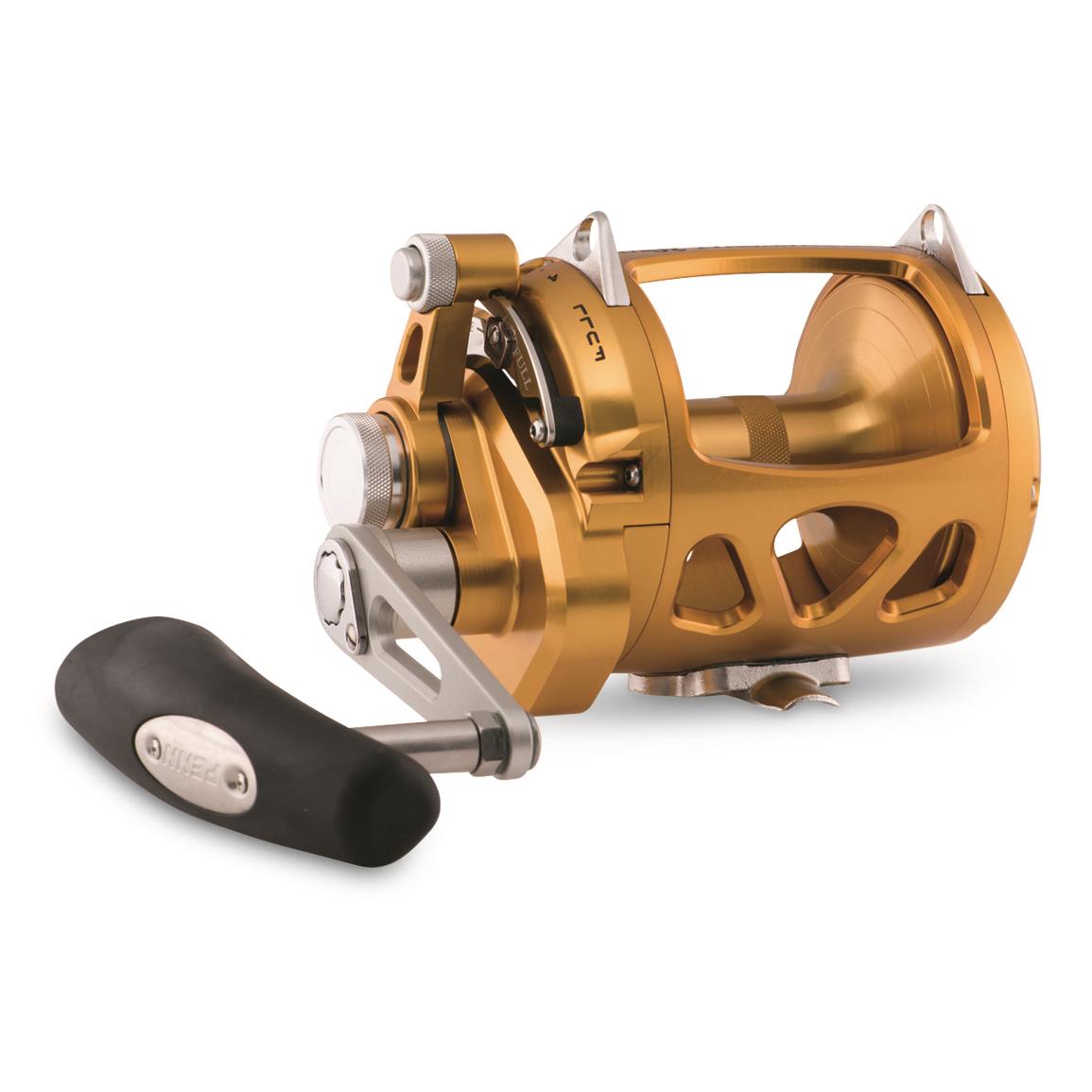
Penn International VI VISX 50
Best for: Anglers who want the most proven, reliable offshore trolling reel on the planet with a track record spanning decades of big game fishing.
The Penn International VI VISX 50 is the reel that every serious offshore trolling reel is measured against, and after another full season of testing it against every competitor in its class, nothing has knocked it off that perch. Penn essentially perfected the lever-drag trolling reel with the VI series, and the VISX 50 is the size that covers the widest range of offshore applications — from 30-pound white marlin tackle to 80-pound stand-up bluefin gear.
The Dura-Drag system is the heart of this reel, and it delivers what matters most: consistent, predictable drag pressure under sustained load without fade. We ran extended drag tests simulating long runs on heavy fish, and the VISX 50 maintained its set drag pressure with minimal variance even after 30 minutes of continuous output. The drag washers are oversized relative to the reel’s frame, which is how Penn achieves that kind of heat dissipation. Maximum drag output sits at roughly 50 pounds at strike and significantly more at full, which is more than adequate for any fish you’ll hook on trolling tackle.
The two-speed gearbox shifts cleanly under load, which sounds like a given but isn’t — we’ve used reels from other manufacturers where the gear shift under heavy pressure feels like a coin flip. The VISX 50’s shift mechanism is positive and deliberate. High gear retrieves at approximately 3.5:1, giving you decent pickup speed for clearing lines. Low gear drops to around 1.7:1, delivering the torque that turns big fish.
Line capacity on 80-pound monofilament is generous at roughly 750 yards, and the machined aluminum spool handles uneven line lay without the digging issues that plague lesser reels. The full stainless steel and machined aluminum construction resists corrosion well, though like any offshore reel, it needs a freshwater rinse after every trip. Build quality is what you’d expect from Penn’s flagship line — this reel is built to last a decade or more with proper maintenance.
Where the International VI shows its age slightly is weight. At just over 62 ounces, it’s heavier than some of the machined competitors on this list. And while Penn has refined the aesthetics, the VISX 50 doesn’t have the visual polish of an Accurate or Shimano. None of that matters when a blue marlin is greyhounding behind the boat and your drag system is humming along exactly where you set it. The Penn International VI VISX 50 earns our top recommendation because it does the job, every single time, without drama.
Shimano Tiagra 50WLRSA
Best for: Tournament anglers and serious big game fishermen who demand the smoothest drag curve and most refined engineering available in a production trolling reel.
The Shimano Tiagra 50WLRSA is the reel you see most often on tournament-rigged boats from Cabo to the Outer Banks, and that reputation isn’t accidental. Shimano’s approach to the Tiagra line is precision engineering taken to its logical conclusion — every component is designed, machined, and assembled to tolerances that most reel manufacturers don’t attempt. The result is a trolling reel that feels like it was built by watchmakers who happen to fish.
The drag system is where the Tiagra separates itself. Shimano uses a multi-disc carbon drag stack that delivers the smoothest startup inertia of any reel we’ve tested. That initial moment when a fish hits and the drag engages is critical — a harsh, grabby drag at strike can pop a hook or snap light leader on the initial run. The Tiagra’s drag engages like silk. It transitions from static to dynamic friction so smoothly that you’ll set the drag and forget about it, which is exactly what you want when a fish eats at 10 knots and you’ve got three seconds to react.
Maximum drag output is competitive with every reel on this list, and the Tiagra maintains its set pressure across a wide temperature range. We’ve fished it in the summer Gulf Stream where reel temperatures climb well above ambient and in cool Northeast canyon trips, and the drag calibration remains consistent. The two-speed gear system uses Shimano’s proven A/R mechanism, providing a clean, reliable shift between high (approximately 3.1:1) and low (approximately 1.7:1) gears. Gear engagement under heavy load is smooth and confident.
Line capacity on the 50WLRSA is excellent — roughly 800 yards of 80-pound monofilament — and the machined aluminum spool is among the best in the business. The reel frame is a cold-forged aluminum alloy that strikes a balance between rigidity and weight, coming in slightly lighter than the Penn International at comparable drag output. The lever drag mechanism itself is beautifully machined with a positive detent at strike that you can find by feel even in the chaos of a multiple hookup.
The Tiagra’s premium is real — this is one of the more expensive reels in the category. But for anglers who fish tournaments, target granders, or simply refuse to compromise on the quality of their tackle, the Shimano Tiagra 50WLRSA justifies every dollar. It’s the reel equivalent of buying a precision instrument, and it performs like one.
Accurate ATD Platinum 50
Best for: Anglers who want the highest drag output, lightest weight, and most advanced engineering available in a full-size offshore trolling reel regardless of cost.
The Accurate ATD Platinum 50 is what happens when you remove every compromise from the design process and build a trolling reel purely on the basis of performance. Accurate machines every component from billet — the frame, sideplates, spool, and gear train are all CNC-machined from solid aluminum and stainless steel. There are no castings, no stampings, and no shortcuts. The result is a reel that is visibly, tangibly, and functionally superior in its construction to anything that comes off a production casting line.
The TwinDrag system is Accurate’s signature technology, and it’s a genuine engineering advantage. Instead of a single drag stack on one side of the spool, the ATD Platinum uses matched drag stacks on both sides, applying pressure evenly across the spool shaft. The practical benefit is enormous maximum drag output — the ATD 50 will deliver north of 60 pounds of smooth, consistent drag at strike — along with dramatically reduced spool flex under heavy load. When you’re connected to a fish that can pull 80-plus pounds of drag and the spool is under extreme torsional stress, that even pressure distribution prevents the warping and binding that can occur with single-sided drag systems.
The drag curve itself is exceptionally smooth, rivaling the Tiagra’s startup and maintaining precision across the full range of the lever. We tested the ATD Platinum in sustained-load scenarios that would expose any inconsistency, and the drag pressure held within a remarkably tight window throughout. Heat dissipation is excellent thanks to the twin-stack design spreading thermal load across a larger total drag surface area.
The two-speed gear system is clean and precise, with gear ratios (approximately 3.8:1 high, 1.8:1 low) that give you slightly faster retrieval than the Penn or Shimano in high gear without sacrificing low-gear torque. The shift mechanism is positive and reliable under load. Line capacity is comparable to the competition at this size class.
Where the ATD Platinum truly stands apart is weight. Despite its massive drag output and fully machined construction, it’s noticeably lighter in the hand and in the rod holder than the Penn International. That weight savings adds up across a full day of trolling, especially if you’re doing stand-up fishing. The fit and finish are extraordinary — the Platinum version features polished sideplates and cosmetic touches that make it arguably the best-looking reel on this list.
The cost is substantial. The Accurate ATD Platinum 50 is a premium reel with a premium price, and it’s not the choice for anglers building a budget spread. But for those who want the absolute pinnacle of trolling reel engineering, the ATD Platinum delivers performance that justifies the investment.
Avet HXJ 5/2 Raptor
Best for: Performance-focused anglers who want a capable two-speed offshore trolling reel with serious drag output at a price that won’t break the bank.
The Avet HXJ 5/2 Raptor is the reel that quietly outperforms its price tag so dramatically that it makes you question what you’re actually paying for when you buy a more expensive competitor. Avet builds the HXJ in their California facility, machining the frame and major components from solid aluminum, and the quality of construction genuinely surprises people who associate the price with lower-tier manufacturing.
The drag system uses Avet’s proven MC (multi-cam) design, which delivers smooth, consistent pressure that we’d rank right behind the Tiagra and ATD Platinum in our testing. Maximum drag at strike is approximately 40 pounds, which covers the vast majority of offshore trolling applications. We ran the HXJ Raptor on 50- and 80-pound class tackle through full seasons of Gulf and Atlantic fishing, targeting yellowfin tuna, wahoo, and white marlin, and the drag never let us down. It’s not quite at the level of the Accurate’s TwinDrag system in terms of absolute output or sustained-load consistency, but for the price difference, the gap is far narrower than you’d expect.
The two-speed gearbox is one of the Raptor’s strongest features. Gear ratios sit at approximately 3.5:1 in high and 1.3:1 in low, with that deep low gear providing serious mechanical advantage for pumping big fish. The shift is clean and positive, and Avet’s lever-drag mechanism has a satisfying, precise feel that inspires confidence during a fight. The lever travel from free-spool to strike is well-calibrated, with a clear preset detent.
Line capacity is appropriate for the reel’s size class, and the spool handles both monofilament and braided line configurations without issue. The overall weight is competitive, sitting between the lighter Accurate and heavier Penn without feeling like a compromise in either direction.
Where the HXJ Raptor earns its “best value” designation is the total package. You’re getting a machined, American-made, two-speed trolling reel with a reliable drag system and quality gear train at a price point significantly below the Penn International, let alone the Shimano or Accurate. For anglers rigging a new boat, the math is compelling — you can fill six rod holders with Avet HXJ Raptors for roughly what you’d spend on four Penn Internationals. That’s a meaningful difference, and the performance gap doesn’t come close to matching the price gap. It’s the trolling reel we recommend most often to anglers who are serious about offshore fishing but realistic about their budget.
Penn Squall II Lever Drag 60
Best for: Anglers who need a reliable, durable offshore trolling reel for secondary positions, lighter tackle applications, or as an entry point into big game fishing without a massive investment.
The Penn Squall II Lever Drag 60 fills a role that every offshore boat needs: a dependable, no-nonsense reel that handles its job without demanding premium-reel money. Not every position in your spread needs a $1,500 two-speed. Your short rigger running a ballyhoo for dolphin, your pitch-bait rod, your flat-line spot pulling a small lure for wahoo — these positions need a reel that’s smooth, reliable, and built to survive the salt. The Squall II delivers exactly that.
This is a single-speed reel with a gear ratio of approximately 3.9:1, which provides solid retrieval speed for the applications it’s designed for. The Dura-Drag system shares DNA with Penn’s higher-end offerings, using HT-100 drag washers that deliver smooth, consistent pressure without the sticking and surging that plague cheaper reels. Maximum drag is approximately 30 pounds, which is more than sufficient for 30-pound class trolling and handles most fish you’ll hook on lighter offshore tackle.
The Squall II’s graphite frame and sideplates keep the weight down significantly compared to the all-metal reels above it on this list. Penn uses stainless steel internal components where it counts — the main gear and pinion are stainless — and the overall build quality reflects Penn’s decades of experience making reels that survive harsh saltwater environments. We’ve run Squall-series reels for multiple seasons with standard maintenance (freshwater rinse, occasional lube) and they hold up well.
Line capacity on the 60-size is generous — roughly 590 yards of 50-pound monofilament — giving you more than enough backing for anything you’ll reasonably hook on this class of tackle. The lever-drag mechanism is smooth and well-calibrated, with a clear preset stop. The reel clamps solidly into standard rod holder and gimbal configurations.
Where the Squall II won’t compete is sustained, high-drag battles against the biggest offshore species. If a 250-pound bluefin tuna eats your short-rigger bait, the Squall II will fight above its weight class, but you’ll miss the low gear of a two-speed reel and the higher maximum drag of the premium options. That’s not a criticism — it’s a recognition that this reel isn’t trying to be those reels. It’s trying to be the best reel at its price, and it succeeds at that convincingly. For anglers entering offshore fishing or building out secondary positions on an established spread, the Penn Squall II Lever Drag 60 is the reel that makes the most sense.
Matching Reel Size to Target Species
Reel selection doesn’t happen in a vacuum — the species you’re targeting and the tackle class you’re fishing dictate the reel size you need. Here’s how we think about matching reels to targets based on our offshore experience.
30-pound class (small 30-size reels): White marlin, school dolphin, smaller yellowfin tuna, and blackfin tuna. This is light trolling tackle, and a smaller lever-drag reel like the Penn Squall II handles these species perfectly. Fun, sporty fishing where the lighter tackle is part of the appeal.
50-pound class (50-size reels): This is the workhorse class for most offshore trolling. A 50-size reel loaded with 50- or 80-pound line covers yellowfin tuna to 200 pounds, blue marlin to 400 pounds (experienced angler on stand-up tackle), wahoo, big dolphin, and sailfish. The Penn International 50, Shimano Tiagra 50, Accurate ATD 50, and Avet HXJ 5/2 all live here. If you can only buy one size of trolling reel, buy 50s.
80-pound class (80-size reels): Giant bluefin tuna, blue marlin over 400 pounds, swordfish, and any application where maximum line capacity and drag output are non-negotiable. These are bigger, heavier versions of the reels on this list, and they’re specialized tools for specialized fishing.
The practical advice: Most boats running a standard trolling spread will use 50-size two-speed reels in the primary positions (long riggers, flat lines) and 30-size reels on the short riggers and pitch rod. That combination covers 90 percent of offshore fishing scenarios in the Atlantic, Gulf, and Pacific.
Line Selection: Mono vs. Braid for Offshore Trolling
The mono-versus-braid debate in offshore trolling is less contentious than it is in other fishing disciplines, but the choice still matters and affects how your reels perform.
Monofilament remains the standard for most offshore trolling, and there are good reasons for that. Mono stretches, and that stretch acts as a shock absorber during the violent initial strike of a fast-moving gamefish. When a blue marlin eats a lure at trolling speed, the peak load on your tackle in the first two seconds is enormous. Mono’s elasticity cushions that impact, reducing hook pulls and line breakage. Mono also has inherent abrasion resistance, which matters when your line crosses a marlin’s bill, a tuna’s tail, or rough leader connections during a fight.
Beyond the mechanical properties, monofilament fills a reel spool predictably. It lays flat, doesn’t dig under itself under heavy drag pressure, and doesn’t require specialized spool tension settings. You can load a reel with mono, set your drag, and troll with confidence that the line is behaving itself on the spool.
Braided line has a growing role in offshore trolling, particularly for anglers targeting deep-dropping swordfish or those who want maximum line capacity in a smaller reel frame. Braid’s zero stretch and thinner diameter mean you can fit significantly more line on the same spool — a 50-size reel loaded with 80-pound braid holds substantially more line than the same reel loaded with 80-pound mono. That capacity advantage matters when a fish makes repeated long runs.
The tradeoff is that braid’s lack of stretch transfers more shock to your tackle, your hooks, and your knots. It also requires careful attention to spool tension and drag settings to prevent the line from digging into the spool under heavy load, which can cause line damage and catastrophic tangles. Braid demands a wind-on leader or at minimum a long monofilament topshot to provide the stretch buffer at the terminal end.
Our recommendation for most offshore trolling: Load your reels with quality monofilament in the 50- to 80-pound class for standard trolling applications. Use a braid-to-mono topshot configuration if you need maximum line capacity or you’re fishing deep. And regardless of your mainline choice, always use fluorocarbon or heavy monofilament leaders appropriate to your target species. The line-to-reel interface is a system, and every component needs to work together.
Frequently Asked Questions
How much drag do I actually need for offshore trolling?
For most offshore trolling targeting tuna and marlin, you want a reel capable of producing at least 25 to 30 pounds of drag at strike setting. That number sounds high compared to inshore or freshwater fishing, but offshore species are big, fast, and powerful. The general rule is to set your strike drag at roughly one-third of your line’s rated breaking strength — so 50-pound line gets about 15 to 17 pounds of drag, and 80-pound line gets about 25 to 27 pounds. Every reel on this list meets or exceeds these requirements with significant margin. More important than maximum drag output is drag consistency — a reel that delivers smooth, fade-free pressure at 25 pounds is far more valuable than one that peaks at 50 pounds but surges and fades under sustained load.
How often should I service my offshore trolling reels?
At minimum, rinse every reel with fresh water after every trip. Don’t just hit the outside — open the drag lever to allow water to flush through the internals, then back it off to a light preset for storage so you’re not compressing the drag washers between trips. Full service — meaning a complete breakdown, cleaning, re-greasing, and drag washer inspection — should happen at least once per season for reels that see regular use, and more frequently if you fish 30 or more trips per year. We send our primary reels to factory service or a qualified reel shop annually. Quality trolling reels are precision tools, and they perform best when they’re maintained like precision tools.
Can I use the same trolling reel for live baiting and trolling lures?
Yes, and most offshore anglers do. A quality lever-drag reel like any of the five on this list handles both applications without modification. The key difference is drag setting — live-bait fishing typically requires lighter initial drag settings to allow the bait to swim naturally and let the fish eat before coming tight, while lure trolling usually involves higher strike settings since the hookup is immediate. Your lever drag lets you adjust between these applications in seconds. Some anglers keep one or two reels pre-set for live-bait drag settings and the rest for trolling, but the reels themselves don’t know or care what’s on the end of the line.
Is it worth spending more on a premium trolling reel versus a mid-range option?
This depends entirely on how often you fish and what you’re targeting. If you make 30 or more offshore trips per year and target big game species — marlin, giant tuna, swordfish — the premium reels on this list (Shimano Tiagra, Accurate ATD Platinum) offer genuine performance advantages in drag smoothness, durability, and engineering refinement that justify their price over a career of heavy use. If you fish 10 to 15 trips a year and primarily target yellowfin tuna, wahoo, and dolphin, the Avet HXJ Raptor or Penn International deliver 90 percent of the performance at a meaningfully lower cost. And if you’re just getting into offshore fishing, the Penn Squall II lets you start catching fish without a massive upfront investment while you figure out what kind of offshore angler you are.
Should I buy matching reels for my entire trolling spread?
There are practical advantages to standardizing your spread with the same reel model or at least the same manufacturer. Matching reels mean your drag presets, lever feel, gear shift mechanism, and general operation are consistent across every position. When things get chaotic during a multiple hookup — and they will — muscle memory matters. If every reel in your spread operates identically, you spend less time thinking about the equipment and more time fighting fish. Matching reels also simplify maintenance and parts inventory. That said, mixing reel sizes (50s on the riggers, 30s on the short corners) is standard practice and perfectly fine. Just try to keep the same brand and model line across sizes when possible so the controls and ergonomics stay consistent.
Quick Buy — Products in This Article