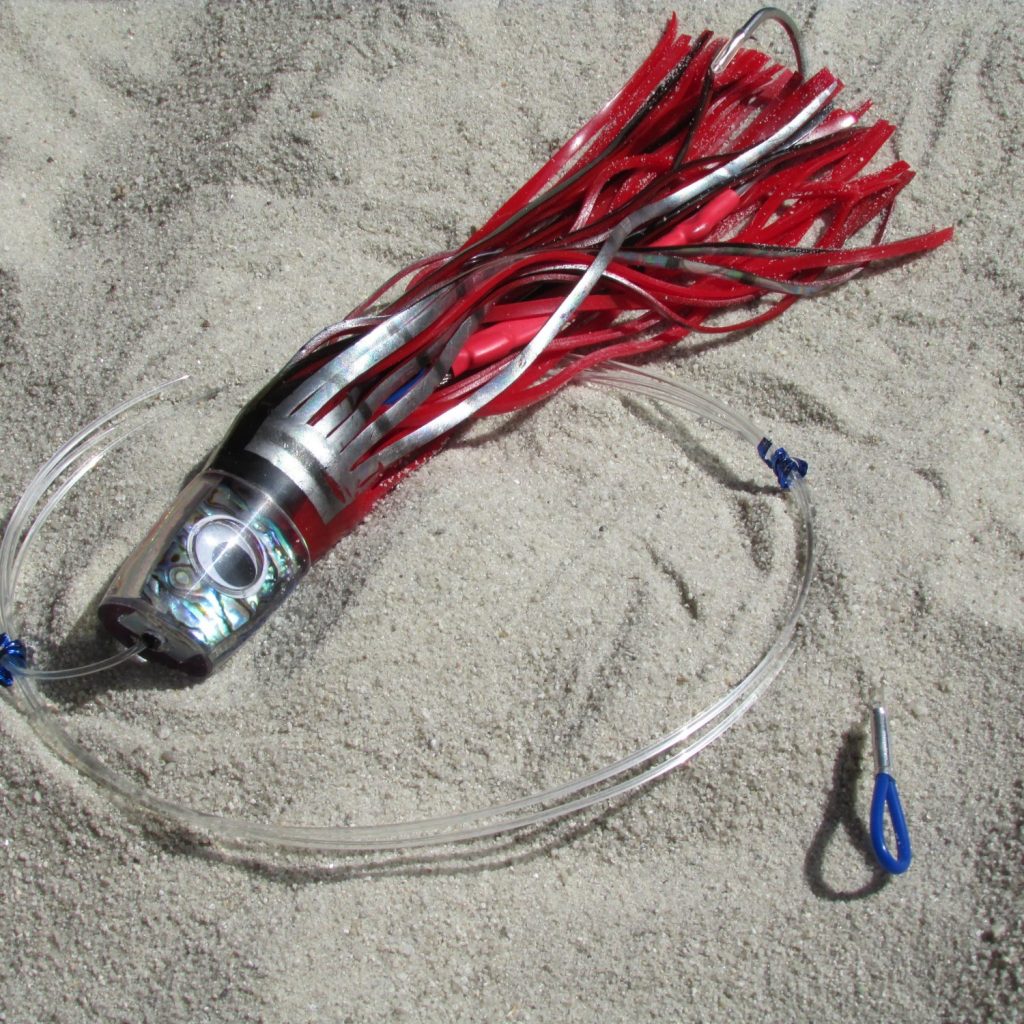
Building a tuna trolling spread that actually produces takes more than clipping five random lures to your outrigger lines and hoping for the best. We’ve spent years running spreads for yellowfin, bluefin, and bigeye across the Gulf of Mexico, the canyons off the Mid-Atlantic, and bluewater fisheries from the Bahamas to New England. The difference between a boat that consistently hooks up and one that drags lures around all day almost always comes down to how the spread is built — which lures, in which positions, at which speeds, and in which combinations.
This roundup covers the five tuna trolling lures we run most often and trust most completely. We break down what each lure does well, where it belongs in your spread, how to rig it, and what species it targets most effectively. Whether you’re a first-timer building your initial spread or an experienced offshore angler looking to refine your game, this guide will help you put together a trolling presentation that mimics a fleeing baitfish school and triggers aggressive strikes. For more on getting started in bluewater fishing, check our offshore fishing hub and our beginner’s guide to offshore fishing.
Quick Picks
- Best All-Around Trolling Plug: Yo-Zuri Bonita — A workhorse subsurface swimmer that catches everything from school yellowfin to wahoo. Belongs in every offshore tackle bag.
- Best Deep-Diving Plug: Rapala Magnum — Proven big-game diver that reaches the thermocline and draws strikes when fish won’t come to the surface.
- Best Skirted Lure: Black Bart 1656 Breakfast — Tournament-grade head design with a smoke trail and action that big tuna simply cannot ignore.
- Best Spreader Bar / Chain Lure: Moldcraft Wide Range — Versatile skirted bait that excels in daisy chains, spreader bars, and as a standalone trolling lure across a huge speed range.
- Best Budget Trolling Lure: Cedar Plug (generic) — The simplest, cheapest, and most time-tested tuna lure in existence. No serious spread is complete without one.
Building a Tuna Trolling Spread
Before we get into individual lures, it helps to understand how a trolling spread works as a system. A well-built spread simulates a school of baitfish being chased to the surface by predators — and tuna are conditioned to crash into exactly that kind of chaos. The goal is to create a staggered, multi-depth presentation behind the boat that covers as much water as possible while looking natural and chaotic enough to trigger a competitive feeding response.
Spread Positions
A standard tuna trolling spread runs five to seven lines from a combination of outriggers, flat lines, and a shotgun (center rigger) line. Here is how we typically set ours:
- Short Rigger (left and right): These are your closest lines to the boat, clipped to the outrigger about 50 to 75 feet back. They fish in the propwash and white water directly behind the transom. Skirted lures like the Black Bart 1656 Breakfast or Moldcraft Wide Range work beautifully here because they thrive in turbulent water and the bubble trail created by the boat wake gives them additional visual appeal.
- Long Rigger (left and right): Set 100 to 150 feet back, these lines fish outside and behind the short riggers. Diving plugs like the Rapala Magnum or subsurface swimmers like the Yo-Zuri Bonita are strong choices here. The added distance gives diving lures time to reach their running depth, and the cleaner water beyond the propwash lets their action shine.
- Flat Lines (left and right): Run straight off the transom rod holders, typically 75 to 125 feet back. These lines sit closer to the surface and inside the rigger lines. Cedar plugs and smaller skirted lures are classic flat-line choices.
- Shotgun / Center Rigger: The longest line in the spread, run 175 to 250 feet or more straight back from a center rigger or high rod holder. This position is perfect for a deep-diving Rapala Magnum or a cedar plug — anything that runs true at distance without constant attention.
Distance and Depth
The spread should create a V-shape or staggered pattern behind the boat when viewed from above. No two lures should run at the same distance or the same depth. Varying your setbacks prevents tangles during turns and ensures that when a tuna approaches the spread from any angle, it encounters lures at multiple points in the water column.
As a general rule, run your skirted lures shorter (they need the propwash) and your diving plugs and cedar plugs longer (they need clean water and distance to reach depth). Surface lures and skirted heads run in the top two feet. Subsurface swimmers like the Yo-Zuri Bonita typically run three to eight feet down. Deep divers like the Rapala Magnum can reach 20 to 30 feet depending on line length and trolling speed.
Trolling Speed
Most tuna trolling spreads run between 6 and 9 knots. The sweet spot depends on your lure selection and target species. Yellowfin and blackfin tuna respond well to faster presentations in the 7.5 to 9 knot range. Bluefin, particularly the larger class fish, often prefer a slightly slower spread in the 5.5 to 7 knot range. Bigeye tuna, which tend to feed deeper, respond best when you slow down to 5 to 7 knots and run deeper-diving lures.
The critical thing is that every lure in your spread must work correctly at your chosen trolling speed. A lure that spins, rolls on its side, or jumps out of the water at your target speed needs to come out of the spread — it’s doing more harm than good. This is why we emphasize testing each lure at various speeds before committing to a spread configuration for the day.
Yo-Zuri Bonita
Best for: Versatile subsurface trolling across a wide range of offshore species and conditions.
The Yo-Zuri Bonita is one of those lures that earns a permanent spot in the tackle locker because it simply catches fish — consistently, across species, across conditions, across years of hard offshore use. It is a bibbed, jointed trolling plug that dives to a moderate depth and produces a tight, aggressive swimming action that mimics a panicked baitfish trying to escape the surface chaos behind the boat. We have caught yellowfin tuna, blackfin tuna, dolphin (mahi-mahi), wahoo, and king mackerel on the Bonita, sometimes all in the same trip.
The jointed body gives the Bonita a side-to-side wobble that separates it from rigid-body trolling plugs. That wobble creates flash and vibration in the water column — two things that tuna key in on when they’re deciding whether to commit to a strike. The lure runs subsurface at roughly three to eight feet depending on trolling speed and line setback, which puts it in that productive zone just below the surface chaos where tuna often stage before blasting into a bait school from below.
We typically run the Bonita on a long rigger or flat line, 100 to 150 feet back. It trolls cleanly between 5 and 9 knots without rolling or spinning, which is a wider effective speed range than most plugs in this category. At the lower end of that range, it produces a wider, lazier wobble that appeals to bluefin and bigeye. Push it up toward 8 or 9 knots and the action tightens up into a fast shimmy that yellowfin and wahoo find irresistible.
Rigging is straightforward. We run the Bonita on 80- to 130-pound fluorocarbon leader connected to the factory split ring. For wahoo-prone waters, a short section of single-strand wire or a wire-through-the-body rig prevents cutoffs. The factory treble hooks are adequate for school-size fish, but we swap them out for stronger inline singles or Owner ST-66 trebles when targeting trophy-class yellowfin or bluefin. The lure comes in several color patterns, and we’ll cover color selection in detail below.
For anglers building their first tuna spread, the Yo-Zuri Bonita is the lure we recommend buying first. It is versatile enough to fish in multiple spread positions, durable enough to survive season after season of offshore abuse, and effective enough to produce when nothing else seems to be working. If we could only troll one plug for tuna, this would be it. For pairing recommendations with reels, see our best offshore trolling reels roundup.
Rapala Magnum
Best for: Deep-diving presentations that reach tuna holding below the surface, particularly bigeye and bluefin in warm-water thermocline zones.
The Rapala Magnum is the lure you reach for when fish are not showing on the surface and your sonar is marking activity 15 to 30 feet down. This is a large, heavy-duty diving plug built specifically for big-game trolling, and it has been catching tuna, marlin, wahoo, and dolphin for decades. The oversized diving lip drives the lure deep on the troll, and the tight wobbling action at depth is remarkably lifelike — it genuinely looks like a large herring, sardine, or bonito struggling to dive away from danger.
We run the Rapala Magnum in the 9-inch and 11-inch sizes most often for tuna. The 9-inch is our go-to for school yellowfin and blackfin. The 11-inch gets the nod when we are specifically targeting bluefin or bigeye, or when the bite has been favoring larger presentations. Both sizes reach their maximum diving depth at around 6 to 7 knots with a long setback — typically 150 to 250 feet of line out. At 8 knots and above, the lure rises in the water column and loses some of its depth advantage, so the Magnum is best suited for the lower half of typical tuna trolling speeds.
The ideal spread position for the Rapala Magnum is the shotgun line or the long rigger. The long setback lets the lure dig to its maximum depth, and the distance from the boat means it is fishing in clean, undisturbed water. We have had excellent results running a Magnum deep on the shotgun while the rest of the spread fishes the surface and mid-column with skirted lures and subsurface swimmers — that depth separation is often the difference between a one-fish day and a limit.
Rigging the Rapala Magnum requires some care. The lure’s action is sensitive to leader weight and attachment method. We use a loop knot or a quality ball-bearing snap swivel tied directly to the tow point. Avoid heavy crimped leaders attached directly to the split ring, as the added weight and rigidity can kill the wobble. A 60- to 100-pound fluorocarbon leader works well. For wahoo protection, a short wire bite leader ahead of the lure is acceptable, but keep it as light as possible to preserve the swimming action.
The Rapala Magnum is a specialist tool. It does not replace the versatility of the Yo-Zuri Bonita or the surface appeal of a skirted lure. But when conditions call for a deep presentation — overcast skies, warm surface temps pushing bait and gamefish below the thermocline, or fish marking deep on the sounder — nothing in the trolling plug category reaches tuna at depth more effectively than the Magnum.
Black Bart 1656 Breakfast
Best for: Surface and near-surface skirted trolling for yellowfin, bluefin, and marlin in propwash and clean blue water.
The Black Bart 1656 Breakfast is a tournament-grade skirted trolling lure with a resume that speaks for itself. This lure has won or contributed to winning more offshore tournaments than we can count, and it remains one of the most popular big-game trolling heads produced anywhere in the world. The reason is simple: the concave-face head design creates an erratic, smoking, bubble-trailing action on the surface that large pelagics find absolutely irresistible.
The 1656 head is a medium-sized jet head that displaces water aggressively as it tracks through the propwash. It dives below the surface, pushes out a plume of bubbles, pops back up, dives again — creating a frantic, unpredictable presentation that mimics a baitfish in full panic mode. That smoke trail is critical for tuna fishing. Yellowfin in particular are visually oriented predators, and a bubble trail visible from 50 feet away acts as a long-range attractor that draws fish into striking range. Once the tuna is close enough to see the skirted profile and flashing movement, the deal is usually sealed.
We run the Black Bart 1656 Breakfast on the short rigger positions, 50 to 75 feet behind the boat, directly in the propwash. This is where the lure performs at its absolute best — the turbulence and white water amplify the bubble trail and erratic action. It trolls effectively from 6.5 to 9.5 knots, making it compatible with the full range of typical tuna trolling speeds. At the higher end, the action becomes more violent and the smoke trail intensifies, which is exactly what you want when targeting aggressive yellowfin in warm water.
Rigging a skirted lure like the 1656 requires a trolling hook set — typically a double-hook rig with 9/0 or 10/0 offset hooks crimped to 200- to 400-pound monofilament or fluorocarbon leader. The hooks sit inside the skirt with the points facing up and back. We rig ours with a chafe tube protecting the leader where it exits the lure head, and we use a length of 300-pound mono as our standard leader material. The lead head is designed to accept the leader through a center bore, and the skirt slides over the head to complete the assembly.
Color selection on skirted lures matters enormously, and we address that in the color guide below. But the classic Black Bart color combinations — particularly the blue/white, black/purple, and green/yellow patterns — have decades of proven performance behind them. This lure belongs in every serious tuna angler’s spread. If you are building a spread around skirted lures for the first time, start with two 1656 Breakfast heads in different color combinations and fish them on the short riggers. You will not be disappointed.
Moldcraft Wide Range
Best for: Daisy chains, spreader bar teasers, and standalone trolling across an exceptionally wide speed range.
The Moldcraft Wide Range is one of the most underappreciated workhorses in offshore trolling. It is a soft-bodied, skirted trolling lure with a simple but devastatingly effective design — a cupped face that pushes water and creates a smoking, darting action across a speed range that few other lures can match. We run Wide Range lures from 4.5 knots all the way up to 12 knots without the lure blowing out, rolling, or losing its action. That versatility alone makes it indispensable.
Where the Moldcraft Wide Range truly earns its keep is in multi-lure configurations. We use it as the primary bait in daisy chains (a series of teasers followed by a hooked lure on a single leader) and as the trailing bait behind spreader bars. The compact size and consistent action mean you can run three, five, or seven Wide Range lures on a single daisy chain rig and every one of them will track correctly and swim with identical action. That uniformity is critical — a daisy chain where one lure is swimming differently than the others looks unnatural and reduces the effectiveness of the entire rig.
As a standalone trolling lure, the Wide Range fishes well on flat lines and short rigger positions. Its smaller profile makes it a natural match for school-size yellowfin and blackfin tuna that are feeding on small baitfish like sardines, pilchards, or juvenile flying fish. We have also taken plenty of dolphin and skipjack on the Wide Range, and it is a legitimate sleeper pick for wahoo when rigged with a wire leader.
Rigging follows the same double-hook convention as other skirted lures — a 7/0 to 9/0 hook set on 200- to 300-pound leader, with hooks seated inside the soft body. For daisy chain use, the teaser lures are rigged hookless on dropper loops spaced 18 to 24 inches apart, with only the trailing lure carrying hooks. Spreader bar configurations use the Wide Range on the individual arms of the bar (again hookless) with a single hooked Wide Range or similar lure trailing behind the center of the bar.
The Moldcraft Wide Range is the kind of lure that rarely gets hero worship in magazine articles, but it is the lure that charter captains and tournament teams rely on day in and day out. Its wide effective speed range means you never have to pull it from the spread when you adjust trolling speed for conditions or target species. Buy them by the dozen, rig a handful for your daisy chains and spreader bars, and keep extras rigged and ready. They will produce fish quietly and consistently all season long.
Cedar Plug (Generic)
Best for: Budget-friendly, dead-simple trolling for yellowfin, bluefin, blackfin, and albacore — the lure that has caught more tuna than anything else ever made.
The cedar plug is the oldest, simplest, and most universally effective tuna lure in the history of offshore fishing. It is nothing more than a turned piece of cedar wood with a lead head, a hole bored through the center, and a hook rig threaded through the body. There is no skirt, no lip, no jointed segments, no holographic finish. And yet this unadorned piece of wood has accounted for more tuna landings worldwide than any other artificial lure. If that does not earn it a place in your spread, nothing will.
The cedar plug works because it perfectly mimics the size, shape, and erratic tumbling action of a small baitfish like a squid or a ballyhoo that has been stunned or injured in the wake of the boat. When trolled, the cedar plug darts, wobbles, and rolls in a way that is nearly impossible to replicate with plastic or resin. The natural buoyancy of cedar wood gives the lure a subtle action that heavier synthetic materials simply cannot match. Tuna — particularly yellowfin and bluefin — have been eating cedar plugs since commercial fishermen first started trolling for them, and the lure’s effectiveness has not diminished one bit with the advent of modern materials and manufacturing.
We run cedar plugs on the flat lines or the shotgun position, anywhere from 75 to 200 feet back. The lure runs just below the surface at typical trolling speeds of 5 to 8 knots. It does not dive deep, and it does not create a dramatic surface disturbance. What it does is swim with a natural, organic action that tuna recognize as food. On days when fish are being picky or the bite has slowed, the cedar plug often produces the first strike of the day because its subtlety stands out against the more aggressive action of skirted lures and diving plugs in the rest of the spread.
Rigging a cedar plug is about as simple as it gets. Thread a length of 80- to 130-pound monofilament or fluorocarbon leader through the body from head to tail. Crimp a 7/0 to 9/0 hook to the tag end so it sits just behind the tail of the plug. Add a small egg sinker or the factory lead head at the nose to keep the lure tracking correctly. That is the entire rig. Some anglers add a small skirt or a strip of colored tape to the tail for additional attraction, but the plain cedar plug has been doing just fine without accessories for over a century.
The best advice we can give about cedar plugs is to always have several rigged and ready. They are inexpensive — typically five to fifteen dollars each — and they are expendable. If you lose one to a cutoff or a wahoo, you clip another one on and keep trolling. Buy a dozen at the start of the season and consider them consumables. No matter how sophisticated the rest of your spread becomes, the cedar plug earns its position through sheer effectiveness. We have never once regretted having one in the water.
Color Selection Guide
Choosing the right lure colors is one of those topics that can consume an entire afternoon of dock talk, and anglers will argue about it endlessly. We will keep this practical. Color selection for tuna trolling is driven by three variables: water clarity, light conditions, and the dominant bait in the area.
Blue Water, Bright Sun
This is the classic offshore scenario — deep blue water, clear skies, high sun angle. In these conditions, natural baitfish patterns with blue, green, and silver tones work best. The Yo-Zuri Bonita in sardine or bonito color patterns is deadly here. For skirted lures, blue and white combinations (like the Black Bart in Blue/White) are the standard for good reason — they match the contrast profile of most baitfish when viewed from below against a bright sky. Cedar plugs in their natural wood finish are always appropriate in clean blue water.
Overcast or Low Light
When cloud cover reduces light penetration, switch to darker, higher-contrast colors. Black and purple skirted lures become dominant producers. The Black Bart in Black/Purple or Black/Red is our go-to under overcast skies and during early morning or late afternoon trolling. Dark colors create a stronger silhouette against a dimmer sky, making the lure more visible from depth. The Rapala Magnum in darker color patterns (black/gold, purple) also shines in these conditions.
Green or Dirty Water
Offshore water is not always gin-clear. Current edges, temperature breaks, and upwellings can create green, murky zones that concentrate bait and gamefish. In dirtier water, switch to brighter, more visible colors. Chartreuse, pink, orange, and bright green get noticed when visibility is limited. The Moldcraft Wide Range in hot pink or chartreuse is a proven choice for these conditions. Bright-colored skirts on the Black Bart also produce well — think green/yellow or pink/white combinations.
Matching the Bait
When you can identify what the tuna are eating — whether it is flying fish, squid, ballyhoo, or small bonito — matching your lure colors to the dominant forage is always a smart move. If flying fish are in the air, run blue and silver patterns. If you are seeing squid on the surface at dawn, switch to pink and white. If the fish are keyed on small skipjack or bonito, the Yo-Zuri Bonita in a bonito color pattern is about as close to cheating as trolling gets.
The bottom line on color is this: carry a range, change colors when the bite slows, and pay attention to what is working on a given day. There is no single magic color. But the ability to adapt your spread’s color palette to conditions is what separates consistent boats from lucky ones.
Spreader Bars and Daisy Chains
Spreader bars and daisy chains deserve their own section because they are not individual lures — they are multi-bait rigs that simulate an entire school of baitfish, and they are devastatingly effective for tuna.
Daisy Chains
A daisy chain is a series of teasers (hookless lures) rigged on a single leader at regular intervals, with a hooked lure trailing at the end. A typical tuna daisy chain runs three to seven teasers followed by one hooked bait. The Moldcraft Wide Range is our preferred lure for building daisy chains because its consistent action and compact profile look natural in a multi-lure configuration.
Run your daisy chain on a flat line or short rigger, 50 to 100 feet back. The chain of teasers splashing and swimming on the surface creates the illusion of a small bait school being pushed to the surface — exactly the kind of commotion that triggers a tuna blitz. When a yellowfin crashes the chain, it almost always takes the trailing hooked lure. The teaser lures serve purely as attractors.
Spreader Bars
A spreader bar takes the daisy chain concept and expands it laterally. A metal or composite bar with multiple arms holds a grid of teasers — typically nine to twenty individual lures — that swim in formation behind the boat. A single hooked lure, called the stinger, trails behind the center of the bar.
The visual effect of a spreader bar is dramatic. From below, it looks like a dense school of baitfish swimming in tight formation. Tuna that might ignore a single lure will absolutely demolish a well-built spreader bar. We run spreader bars on the long rigger or shotgun position, 100 to 200 feet back, at 5 to 7 knots. They require heavier tackle to manage — typically 50- or 80-wide trolling reels on stand-up rods, which is where having the right offshore trolling reels becomes essential.
Building a spreader bar is a project, but a rewarding one. You can buy pre-rigged bars from companies like Moldcraft, Squidnation, or Captain Mack’s, or build your own using the Moldcraft Wide Range on each arm. Either way, spreader bars are a proven tournament weapon that belongs in any serious tuna trolling arsenal.
Frequently Asked Questions
What is the single best lure for tuna trolling?
If we had to pick one lure for tuna and only one, it would be the cedar plug. It costs almost nothing, catches every tuna species, works at any trolling speed, and requires zero maintenance or adjustment. That said, a cedar plug alone is not a spread. The best approach is always a combination of lure types covering different depths, actions, and positions behind the boat. Our full testing methodology for evaluating lures and gear is outlined on our methodology page.
How fast should I troll for tuna?
The productive range for most tuna species is 5.5 to 9 knots. Yellowfin and blackfin respond well to faster speeds in the 7 to 9 knot range. Bluefin often prefer 5.5 to 7 knots. Bigeye, which typically feed deeper, are best targeted at 5 to 7 knots with deeper-diving lures like the Rapala Magnum. Always adjust speed so that every lure in your spread is swimming correctly — one poorly tracking lure can spook fish away from the entire spread.
How far back should I run my trolling lures?
Distances vary by lure type and spread position. Short rigger lures run 50 to 75 feet back. Long rigger lures run 100 to 150 feet. Flat lines sit at 75 to 125 feet. The shotgun line runs 175 to 250 feet or more. The key principle is staggering — no two lures should run at the same distance. This prevents tangles, covers more water, and creates a more natural-looking presentation. Experience in your local fishery will help you dial in the exact distances that work best.
Do I need to use wire leader for tuna?
Tuna do not require wire leader. Fluorocarbon in the 80- to 130-pound range is standard for most tuna trolling applications and is far less visible underwater than wire. However, if wahoo are present in your fishing area — and they often are in the same waters where you target tuna — a short wire bite leader on your most vulnerable lines (particularly the long rigger and shotgun positions) is cheap insurance against cutoffs. Many anglers run wire on the outer lines and fluorocarbon on the short rigger and flat lines as a compromise.
Can I use these lures for species other than tuna?
Absolutely. Every lure in this roundup catches a range of offshore pelagic species. The Yo-Zuri Bonita is a wahoo and dolphin magnet. The Rapala Magnum is legendary for marlin and sailfish in addition to tuna. The Black Bart 1656 Breakfast has caught blue marlin at the highest levels of competitive offshore fishing. Cedar plugs catch dolphin, bonito, and king mackerel routinely. Building a diverse trolling spread means you are always in the game no matter what species shows up behind the boat. For a broader look at getting started in bluewater fishing, our offshore fishing beginner’s guide covers the fundamentals.
Building a tuna trolling spread is equal parts science and experience. Start with these five lures, learn how each one behaves at different speeds and positions, and pay attention to what the fish tell you on every trip. Swap colors when the bite stalls, experiment with daisy chains and spreader bars as your confidence grows, and keep detailed notes on what worked and what did not. The spread that produces consistently is the one that has been refined through seasons of time on the water — and these lures will give you a rock-solid foundation to build from. Tight lines, and we will see you at the dock.