Your fly line is the engine of every cast you make. Pick the wrong head style, weight, or taper and you’ll spend the day fighting your equipment instead of fishing. We’ve spent entire seasons swinging flies on steelhead rivers from the Skagit to the Deschutes, running these four lines through every condition the Pacific Northwest throws at two-hand and switch rod anglers — heavy rain, upstream wind, tight banks, big open tailouts, and everything in between.
This roundup covers the four steelhead fly lines that earned their place through our Benchmark Score system, not through marketing hype or pro-staff endorsements. Whether you’re throwing heavy sink tips and intruders on a dedicated spey rod or swinging unweighted flies on a compact switch setup, we’ve identified the right line for your water, your rod, and your casting style. For more of our fly fishing coverage, visit our fly fishing hub. If you’re still choosing a rod, start with our best fly rods for steelhead roundup — rod and line pairing is everything in this game.
Quick Picks
- Best Overall Skagit Head: RIO Skagit Max GameChanger — The most versatile and forgiving Skagit head we’ve cast. Effortless sink-tip turnover, clean sustained anchors, and a taper that works across a wide range of rod actions.
- Best Compact Skagit Head: Airflo Skagit Compact G2 — A shorter, denser head built for tight casting quarters and switch rods. Loads fast and punches through wind with authority.
- Best Scandi Head: Scientific Anglers Scandi Extreme — A true touch-and-go head with a long front taper that delivers presentation quality Skagit lines can’t match. Purpose-built for unweighted and lightly weighted flies.
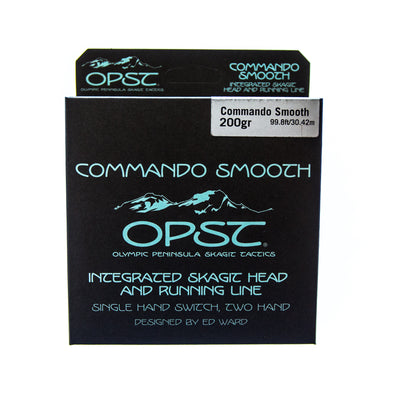
- Best Integrated Line for Switch Rods: OPST Commando Smooth — The line that redefined switch-rod steelhead fishing. Ultra-short head, effortless casting, and a smooth coating that shoots like nothing else in its class.
Skagit vs. Scandi vs. Integrated: Which Head Style?
Before we get into individual lines, we need to talk about the decision that shapes your entire steelhead fly-fishing experience: head style. The line you choose dictates what flies you can throw, how you present them, what water you can effectively cover, and what casting mechanics you’ll use. There is no universally correct answer — each system has genuine strengths and real limitations, and the best steelhead anglers we know carry more than one.
Skagit Heads
Skagit heads are short, heavy, and designed to do one thing exceptionally well: turn over sink tips and big flies with minimal backcast space. They were born on the Skagit River for a reason — the tight, brushy banks and heavy winter flows of PNW steelhead rivers demanded a casting system that could launch an intruder on a Type 6 tip without 80 feet of open gravel behind you. If you primarily swing flies with sink tips, fish weighted patterns, or wade rivers where trees and canyon walls crowd your backcast, a Skagit head is the foundation of your system.
The mechanics are straightforward: a sustained-anchor cast (snap-T, double spey, perry poke) uses the water’s surface tension to load the rod against the short, dense head. The rod does most of the work, and even intermediate casters can throw respectable distances with good technique. Skagit heads are forgiving of timing errors, they handle wind reasonably well, and they give you the raw power to deliver heavy payloads consistently throughout a long day.
The tradeoff is presentation refinement. A Skagit head landing on the water is not a delicate event. The short, aggressive taper creates a more pronounced water disturbance on the delivery, and the system is not designed for fishing unweighted flies on floating tips with any kind of subtlety. When steelhead are in soft water and responding to lightly dressed flies swung near the surface, a Skagit head is the wrong tool.
Scandi Heads
Scandi (Scandinavian) heads occupy the opposite end of the spectrum. They’re longer, lighter relative to their grain weight, and designed for touch-and-go casting with minimal or no sink tips. The long front taper delivers flies with genuine delicacy, and the casting stroke is a fluid, continuous motion that many anglers find more aesthetically satisfying than the anchor-dependent mechanics of Skagit casting.
Scandi heads excel when you’re fishing unweighted or lightly weighted flies — soft hackles, small marabou patterns, waking flies — on floating or intermediate tips. The presentation quality is meaningfully better than what a Skagit head can achieve, and on rivers where steelhead are holding in shallower runs and responding to flies swung near the surface, that refinement can be the difference between a grab and a refusal.
The limitation is payload capacity. Ask a Scandi head to turn over a heavily weighted fly on a long sink tip and the system falls apart. The light, long taper doesn’t generate the turnover energy that heavy payloads demand, and the touch-and-go anchor doesn’t load the rod deeply enough to launch that kind of weight. Scandi heads also suffer in tight quarters — you need more room to execute the longer casting stroke, and brushy banks become a real problem.
Integrated Lines
Integrated lines combine the head and running line into a single, seamless unit — no loop-to-loop connections, no separate components to manage. The OPST Commando system popularized this approach for switch rods and shorter two-hand rods, and the concept has evolved considerably since its introduction. Modern integrated lines offer ultra-short heads that load compact rods efficiently, smooth shooting characteristics, and simplified rigging that appeals to anglers who want to spend less time fiddling with components and more time fishing.
The strength of an integrated line is its simplicity and its castability on shorter rods. If you fish a 10.5- to 11.5-foot switch rod as your primary steelhead tool, an integrated line designed for that rod length is going to cast more naturally than a Skagit or Scandi head that was designed for a 13-foot spey rod. The seamless head-to-running-line transition also eliminates the hinge effect that loop-to-loop connections can create, resulting in smoother casts and more consistent loops.
The tradeoff is versatility. With a Skagit system, you can swap sink tips to adjust your depth profile in seconds. An integrated line locks you into a single configuration unless you change the entire line. For anglers who fish varied water types in a single outing — a deep tailout followed by a shallow riffle followed by a slot along a clay bank — that inflexibility can be limiting.
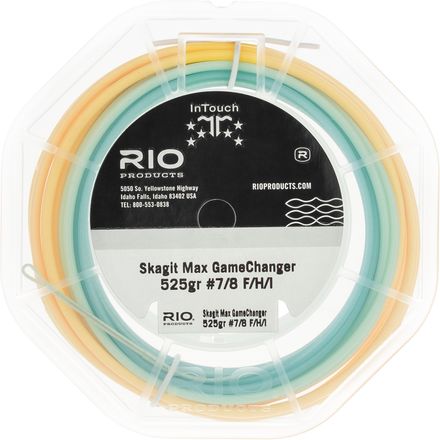
RIO Skagit Max GameChanger
Best for: The all-around steelhead swinger who needs a Skagit head that handles every sink-tip combination and rod action without complaint.
The RIO Skagit Max GameChanger is the Skagit head we keep coming back to, season after season, rod after rod. RIO redesigned this line around their MaxCast and MaxFloat technologies, and the result is a head that loads with less effort, sustains anchor with more consistency, and turns over sink tips with more authority than anything else in its weight class. If we had to pick one Skagit head to fish for the rest of our lives, this is the one.
What sets the GameChanger apart is how it handles the sustained anchor. The short, aggressive rear taper grips the water cleanly during the setup, and the energy transfer from the anchor through the cast is remarkably smooth. Sloppy anchors that would blow up a lesser head — placed too far upstream, set too aggressively, slightly misaligned — still produce fishable casts with the GameChanger. That forgiveness matters enormously on a long day when your casting mechanics start to deteriorate in the rain and the cold.
Turnover is where this head truly earns its reputation. We fished it with everything from 10-foot MOW tips and heavy intruders to 5-foot polyleaders and sparse marabou flies, and the GameChanger delivered consistent loop shape and clean turnover across the entire range. The front taper is designed to transfer energy progressively rather than dumping it all at once, which means your fly arrives at the target zone with the leader straightened and the tip extended — not piled in a heap. On the Hoh and the Sol Duc, where every cast needs to fish immediately because you might only get one swing through a particular slot, that reliability is non-negotiable.
The MaxFloat coating deserves specific mention. It genuinely floats higher and longer than previous RIO Skagit lines, which means cleaner pickups and easier repositioning between casts. Over a full day of fishing — call it 500 to 800 casts — the reduced effort on each pickup compounds into significantly less fatigue. We noticed the difference most on high-water days when line management becomes more demanding and waterlogged heads make every cast feel like you’re lifting a garden hose off the surface.
Casting distance is competitive with any Skagit head on the market. We consistently hit 70- to 85-foot casts with a 13-foot rod and moderate effort, and experienced casters in our group were touching 95 feet when they opened up the stroke. More importantly, the head maintains loop integrity at those longer distances. A lot of Skagit heads throw beautiful 60-foot casts and then fall apart when you ask for more — the GameChanger scales linearly with effort, rewarding a committed stroke without punishing a casual one.
One note on weight selection: RIO’s grain-weight recommendations are accurate for most rods, but we found that going 25 to 50 grains heavier than recommended improved casting performance on stiffer, faster-action rods. If your rod has a true fast action and you feel like the line isn’t loading the lower section, size up one increment. The head is short enough that the extra weight doesn’t create timing problems.
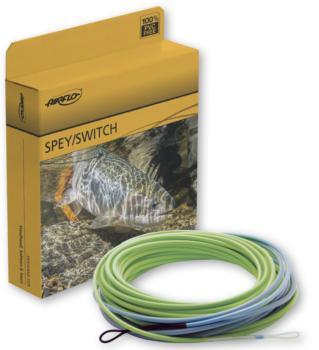
Airflo Skagit Compact G2
Best for: Anglers fishing tight, brushy rivers or shorter switch rods who need a Skagit head that loads fast in confined casting quarters.
The Airflo Skagit Compact G2 solves a problem that a lot of steelhead anglers face but don’t always articulate: there’s no room to cast. If your home water is a tight coastal creek where alders crowd both banks, a canyon river where rock walls eat your backcast, or any stretch where 40 feet of open space behind you is a luxury, the Compact G2 was designed specifically for your reality.
Airflo condensed the mass of a full Skagit head into a shorter package — roughly 17 to 20 feet depending on the grain weight — without sacrificing the turnover energy you need to deliver sink tips and weighted flies. The result is a head that loads the rod faster, requires less line outside the tip to execute a cast, and generates surprising power from a compact stroke. On the Wilson River and the Siletz, where many of the best steelhead runs are tucked under overhanging cedars, the Compact G2 let us fish water that was effectively unfishable with a standard-length Skagit head.
The casting feel is distinctly different from the GameChanger. Where the RIO head loads progressively and rewards a smooth, patient stroke, the Airflo Compact G2 loads abruptly and wants a more aggressive, punchy casting motion. It’s not unpleasant — just different — and anglers who come from a single-hand background often adapt to the Compact G2 faster because the timing feels closer to an overhead cast. The snap-T in particular feels explosive with this head: a clean anchor placement, a committed forward stroke, and the line launches with a gratifying burst of speed.
Sink-tip turnover is excellent for the head length. We fished it with MOW tips up to 12 feet and heavy tube flies without issue. The short, dense taper generates concentrated energy at the loop front, and that energy punches through wind in a way that longer, more gradual tapers cannot. On breezy days — which, in the PNW, means most days — the Compact G2 maintained casting quality when other lines were getting blown apart.
The G2’s coating is Airflo’s second-generation polyurethane formula, and it handles cold water well. We didn’t experience the stiffness or memory coiling that some lines develop below 40 degrees, which matters on January and February steelhead outings when your guides are icing and your fingers stopped working an hour ago. The line stayed supple and manageable through the worst of our winter testing on the Olympic Peninsula.
Where the Compact G2 gives up ground is at longer distances. The short head simply doesn’t carry the momentum that a longer Skagit head sustains through an extended casting stroke, and we noticed the line running out of steam beyond about 70 feet. For the water this head is designed to fish — close-to-moderate range in tight quarters — that limitation rarely matters. But if your primary water is big and open, and you regularly need to cover 80-plus feet, the GameChanger is the better tool.
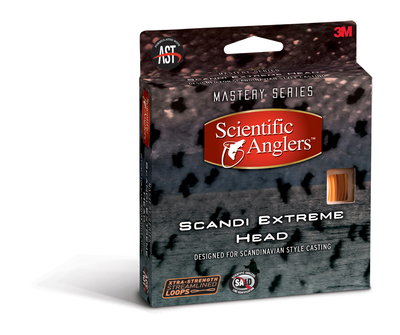
Scientific Anglers Scandi Extreme
Best for: Anglers who prioritize presentation quality and fish unweighted or lightly weighted flies on floating and intermediate tips.
The Scientific Anglers Scandi Extreme exists for the moments when subtlety matters — when steelhead are holding in soft tailouts and glassy buckets, when the fly needs to arrive with a whisper instead of a crash, and when the swing itself is an act of precision rather than brute-force coverage. This is a dedicated touch-and-go head designed for anglers who understand the Scandinavian casting stroke and want the best possible presentation from a two-hand or switch rod setup.
The long front taper is the defining characteristic. Where a Skagit head concentrates its mass in a short, punchy profile, the Scandi Extreme distributes it across a longer, more gradual taper that unrolls smoothly and delivers the fly with minimal surface disturbance. Watching this line turn over on a clean cast is genuinely beautiful — the loop unfurls in a controlled, progressive extension that lays the fly, leader, and tip down in a straight line with almost no splash. On rivers like the North Umpqua and the upper Rogue, where steelhead can be leader-shy and presentation matters as much as fly choice, the Scandi Extreme is a legitimate competitive advantage.
The casting stroke is a touch-and-go motion that feels fundamentally different from Skagit casting. Instead of a sustained anchor with a definitive pause, you’re executing a continuous, fluid motion where the line briefly touches the water surface and immediately lifts into the forward cast. It’s elegant, efficient, and when your timing is dialed, it produces effortless distance with minimal physical effort. We found the Scandi Extreme particularly rewarding on long days — the reduced physical demand of the touch-and-go stroke versus sustained-anchor casting is measurable, and we consistently fished deeper into the afternoon with less fatigue.
Scientific Anglers built the Extreme variant of their Scandi line specifically to handle slightly heavier payloads than a traditional Scandi head. The stiffer butt section and moderately aggressive rear taper give it enough backbone to turn over lightly weighted flies and short polyleaders — something traditional Scandi heads struggle with. We fished it effectively with 5-foot polyleaders in intermediate and slow-sink densities, along with unweighted and lightly dressed steelhead flies in the size 2 to 6 range. It’s not a sink-tip line and it never will be, but it extends the Scandi system’s range into territory that was previously Skagit-only.
The coating uses SA’s proprietary AST Plus slickness additive, and it genuinely shoots better than the previous generation. Running line management is a critical part of Scandi casting — the line needs to slide cleanly through the guides during the shoot — and the Extreme’s coating reduces friction noticeably. Cold-weather performance is adequate but not exceptional; below about 38 degrees, we noticed some memory coiling in the running line that required periodic stretching. That’s a minor inconvenience, not a dealbreaker, and it’s common across Scandi lines regardless of manufacturer.
One honest note: the Scandi Extreme has a narrower effective range than a Skagit head. It excels in a specific set of conditions — moderate flows, softer water, unweighted to lightly weighted flies, adequate backcast space — and it doesn’t pretend otherwise. If you’re primarily fishing heavy winter flows with big intruders and Type 8 tips, this is not your line. But for the summer and fall steelhead swing game, and for spring-run fish in lower, clearer water, the Scandi Extreme delivers a quality of presentation that no Skagit head can approach.
OPST Commando Smooth
Best for: Switch-rod anglers who want the simplest, most intuitive steelhead line system with effortless casting and minimal rigging complexity.
The OPST Commando Smooth changed the way a generation of steelhead anglers thinks about fly lines. Ed Ward and the OPST team built this system around a radical premise: what if you made the head so short and the casting so easy that virtually anyone could swing flies for steelhead on day one? The result is an integrated line with an ultra-short head — roughly 12 to 15 feet depending on the weight — that loads switch rods with almost no line outside the tip and casts with a simplicity that borders on unfair.
We don’t use the word “effortless” lightly in casting descriptions because every line requires effort. But the Commando Smooth comes closer to that word than anything else we’ve tested. The short head loads the rod immediately, the integrated running line shoots without friction through the guides, and the casting stroke is a compact, intuitive motion that produces fishable presentations with surprisingly little technique. We’ve put this line in the hands of anglers who had never touched a two-hand rod and watched them make 50-foot casts within an hour. That accessibility is the Commando system’s greatest strength — it removes the months-long learning curve that traditional Skagit and Scandi systems demand and gets people fishing.
The “Smooth” designation refers to OPST’s updated coating, and it’s a meaningful improvement over the original Commando. The line slides through guides with noticeably less friction, which translates to longer shoots and less effort on every cast. Cold-water performance is genuinely excellent — we fished the Commando Smooth through January on the Quillayute system and experienced none of the stiffness or cracking that plagued the original coating. The smooth finish also picks up less debris, which matters on the leaf-choked rivers of fall and early winter.
For sink tips, the Commando Smooth works best with OPST’s own Commando Tips in the 5- to 10-foot range, or with short polyleaders. The ultra-short head doesn’t generate the same turnover energy as a full-length Skagit head, so heavy, long tips will overwhelm the system. We found the sweet spot to be 7-foot tips in intermediate to Type 3 densities — enough to get the fly down into the mid-column where winter steelhead hold without overloading the head. Paired with compact, moderately weighted flies in the size 2 to 1/0 range, the system delivers clean presentations at 40 to 65 feet with minimal effort.
The limitation is at the edges of performance. If you need to deliver heavy payloads at long range — think Type 8 tips and 4-inch intruders at 80-plus feet — the Commando Smooth simply doesn’t have the mass to do it. The ultra-short head runs out of energy before a full Skagit head would, and the integrated design means you can’t just swap to a heavier head when conditions demand it. For the water and presentations this line was designed for, those limitations don’t matter. But anglers who fish big, heavy water as their primary game should pair the Commando Smooth with a dedicated Skagit setup rather than relying on it as a sole line.
The value proposition is compelling. The integrated design means you buy one line and you’re rigged — no separate running line, no loop-to-loop connections to manage, no grain-weight math to figure out. Add a wallet of OPST tips, a few leaders, and you have a complete steelhead system that fits in a jacket pocket. For traveling anglers, for anglers who fish multiple rods, and for anglers who simply want less complexity in their rigging, the Commando Smooth is hard to beat.
Matching Your Line to Your Rod
Getting the line-to-rod match right is the single most impactful thing you can do for your steelhead casting. A perfectly designed fly line on the wrong rod — or the right rod with an incorrectly weighted line — produces frustrating, inconsistent results that no amount of casting practice will fix.
The foundational principle is simple: the line’s grain weight must load the rod’s blank during the casting stroke you intend to use. But “grain weight” alone doesn’t tell the whole story because head length and head style change the loading characteristics dramatically.
For Skagit heads on full spey rods (12.5 to 14 feet), follow the rod manufacturer’s recommended Skagit grain weight as a starting point. Most modern steelhead spey rods are designed with Skagit weights in mind, and the recommendations are usually accurate within 25 grains. If the rod feels sluggish and underloaded, go up one increment (typically 50 grains). If it feels harsh and overloaded — you’ll notice a jarring stop at the end of the forward cast — go down.
For Skagit heads on switch rods (10.5 to 11.5 feet), you’ll generally want a shorter, lighter Skagit head than a full spey rod of the same line weight. A 7-weight switch rod, for example, fishes best with a head in the 425- to 475-grain range rather than the 550-plus grains you’d use on a 7-weight spey rod. This is where the Airflo Compact G2 shines — its shorter length is inherently better suited to the flex profile of switch rods.
For Scandi heads, grain weight should be roughly 80 to 100 grains lighter than your Skagit weight for the same rod. Scandi heads are longer and load the rod differently — the sustained loading through the touch-and-go stroke builds energy over a longer time frame, and over-weighting a Scandi head produces a collapsed, unfishable cast. The SA Scandi Extreme runs slightly heavier than traditional Scandi weights, so account for that when sizing.
For integrated lines like the OPST Commando Smooth, follow the manufacturer’s rod-weight recommendations closely. These lines are designed as systems, and the grain-weight-to-rod-length ratio has been specifically calibrated. Deviating significantly from the recommended pairing undermines the casting characteristics the line was designed to deliver.
If you’re building a system around a new rod, read our steelhead rod roundup for specific rod-and-line pairing recommendations based on our testing.
Sink Tips and Leader Setup
Your sink tip is the most important variable in your presentation — more important than fly pattern, more important than casting distance, and arguably more important than the line itself. The tip determines the depth at which your fly swings, the speed at which it tracks through the water column, and how it behaves relative to the current. Getting the tip wrong means your fly is swimming over the fish, dragging along the bottom, or swinging at a speed that steelhead ignore.
MOW tips (named for their creators: McCune, O’Donnell, and Ward) are the standard system for Skagit heads. They come in various sink-rate combinations — a common setup is a floating or intermediate back section paired with a fast-sinking front section — that let you control depth precisely. We carry a wallet with at least four MOW configurations: light (intermediate/intermediate), medium (intermediate/T-8), heavy (T-8/T-11), and extra-heavy (T-11/T-14). Between those four, we can fish effectively from just below the surface down to the bottom of a 10-foot-deep run.
Polyleaders are the right choice for Scandi heads and lighter integrated lines. These are tapered leaders with a sinking core that add depth control without the weight and bulk that would overwhelm a Scandi or Commando cast. We fish them in 5- to 7-foot lengths for steelhead, with intermediate and slow-sink being the most versatile options. The SA Scandi Extreme handles polyleaders up to fast-sink density; beyond that, switch to a Skagit setup.
Leader construction for swinging flies is straightforward. We use a simple two-piece leader: 3 to 4 feet of 20-pound Maxima Ultragreen as a butt section, connected to 3 to 4 feet of 10- to 12-pound fluorocarbon tippet. Total leader length of 6 to 8 feet provides enough separation between the tip and the fly without creating hinge points that kill the swing. For clearer water or pressured fish, we’ll extend the tippet section to 5 feet and drop to 8-pound fluorocarbon — but we rarely go lighter than that for steelhead.
PNW River Conditions and Line Selection
The Pacific Northwest is not one river — it’s dozens of dramatically different watersheds with their own personalities, and the line that dominates on the Deschutes might be completely wrong for the Hoh. Here’s how we approach line selection based on the conditions we actually encounter.
High, colored water (winter steelhead, November through March): This is Skagit territory. The fish are holding deep, the flows are pushing, and you need to get a fly down fast and keep it in the zone throughout the swing. The RIO Skagit Max GameChanger paired with heavy MOW tips (T-11 or T-14 front sections) is our default setup. We’re throwing big, heavily dressed flies — intruders, string leeches, egg-sucking leeches — that push water and give steelhead something to track in low-visibility conditions. The GameChanger’s turnover power handles these heavy payloads without breaking a sweat.
Moderate flows, decent visibility (fall and spring transitions): This is where versatility matters and where carrying two setups pays off. We’ll fish a Skagit head with medium MOW tips through the deeper runs and slots, then switch to the SA Scandi Extreme with a slow-sink polyleader for shallower tailouts and soft-water seams. These transitional conditions often produce the most dynamic fishing because steelhead may respond to either a deep or a shallow presentation depending on the specific piece of water.
Low, clear water (summer steelhead, late spring): Pull out the Scandi head or the OPST Commando Smooth. Steelhead in clear, low conditions are more aware of surface disturbance and heavy presentations. A touch-and-go cast with a Scandi head, a floating or intermediate polyleader, and an unweighted or lightly weighted fly swung near the surface is often the most effective approach. The Scandi Extreme’s delicate delivery shines in these conditions.
Tight, brushy rivers (coastal streams, canyon water): Regardless of flow, the Airflo Skagit Compact G2 or the OPST Commando Smooth are the right choices. You’re choosing between them based on payload requirements: if you need to throw heavy tips and big flies, the Compact G2 has the power. If you’re fishing lighter tips and compact flies, the Commando Smooth’s simplicity and ease of casting give it the edge.
Windy conditions: The Airflo Compact G2 cuts through wind better than any line in this roundup. Its dense, compact mass punches a tight loop that resists deformation by crosswinds and headwinds. If you fish a river that funnels wind — the Deschutes canyon, the Columbia Gorge — the Compact G2 deserves a place in your bag specifically for those days.
Frequently Asked Questions
What grain weight Skagit head should I use for a 7-weight spey rod?
Most 7-weight spey rods in the 13- to 13.5-foot range cast best with a Skagit head in the 525- to 575-grain range. Start with the rod manufacturer’s recommendation, make ten to fifteen casts, and assess whether the rod feels loaded through the bottom third of the blank during the forward cast. If it feels tip-heavy and under-loaded, go up 50 grains. If the stop feels abrupt and the rod kicks back at you, go down. Your casting stroke matters here too — if you have a slow, smooth stroke, you may prefer a slightly heavier head that loads easily. Faster, more aggressive casters often prefer lighter heads that respond to their timing.
Can I use a Skagit head for summer steelhead?
You can, but it’s often not the best choice. Summer steelhead are typically found in lower, clearer water where a heavy Skagit head landing on the surface sends a shockwave that can spook fish. A Scandi head or an integrated line like the OPST Commando Smooth delivers a quieter, more refined presentation that summer conditions usually demand. That said, if your summer water is off-color from glacial melt or rain, or if the runs are deep enough to require heavy tips, a Skagit head fished with a lighter MOW configuration still works. We have caught plenty of summer steelhead on Skagit setups — we just prefer Scandi or integrated lines when conditions allow.
How often should I replace my steelhead fly line?
With heavy use — fishing three to five days per week through a steelhead season — a quality fly line typically lasts one to two full seasons before the coating degrades enough to affect performance. The signs of a worn line are obvious: it stops floating as high, it picks up more debris, the running line develops persistent memory coils, and shooting distance decreases noticeably. Lines that spend a lot of time in contact with sand, gravel, and dirty water wear faster than those fished primarily on clean runs. You can extend line life by cleaning it every few trips with a line-specific cleaner and storing it loosely coiled off the reel during the off-season. If you fish fewer than 40 days a year, a well-maintained premium line can last three seasons.
Do I need different lines for nymphing and swinging?
Yes, and trying to do both with one line is a recipe for mediocre performance at both. Swinging flies with a Skagit, Scandi, or integrated head requires a line designed to deliver and control a fly that’s sweeping cross-current under tension. Nymphing — whether indicator nymphing, euro nymphing, or tight-line techniques — requires a fundamentally different line design with a long, thin profile that allows precise drift control and strike detection. If you nymph and swing in the same outing (and many steelhead anglers do), carry a second spool loaded with a nymphing-specific line. The casting characteristics, the presentation mechanics, and the line-to-rod interaction are different enough that a single line cannot serve both purposes well.
Is it worth carrying both a Skagit and a Scandi head?
Absolutely — and we’d argue it’s one of the best investments a steelhead angler can make. A spare spool loaded with a Scandi head and running line weighs almost nothing and takes up minimal space in your vest or pack. Having both systems available means you can adapt to whatever the river gives you that day without compromising your presentation. Fish the Skagit through the deep, heavy runs in the morning, then switch to the Scandi when you hit that glassy tailout in the afternoon where a delicate swing is what the water demands. The ability to match your line to the specific piece of water you’re standing in — rather than forcing one system to do everything — is what separates consistently successful steelhead anglers from anglers who cover water without converting grabs.
Quick Buy — Products in This Article