Pros
- Gore-Tex Pro delivers best-in-class breathability and waterproofing
- Bombproof seam construction — no leaks after a full PNW season
- Anatomical fit with articulated knees for river mobility
- Handwarmer pockets actually work in cold water
- Excellent gravel guard and neoprene stocking design
Cons
- Price is at the top of the market
- Sizing runs slightly large in the torso for shorter anglers
- Gore-Tex Pro fabric is stiffer than lighter alternatives when new
- Limited color options
There’s a reason the Simms G3 Guide shows up in every serious wader conversation — and a reason it sits at the top of our best waders for fly fishing roundup. It’s the wader that working guides on the Deschutes, Skagit, and Olympic Peninsula rivers strap on 200-plus days a year and expect to survive. We wanted to find out whether that reputation holds up for the rest of us — anglers who fish hard but aren’t guiding every day — so we put the G3 Guide Stockingfoot through a full Pacific Northwest season of steelhead, trout, and coastal fishing. Every evaluation in this review follows our standardized testing methodology.
Who This Wader Is For
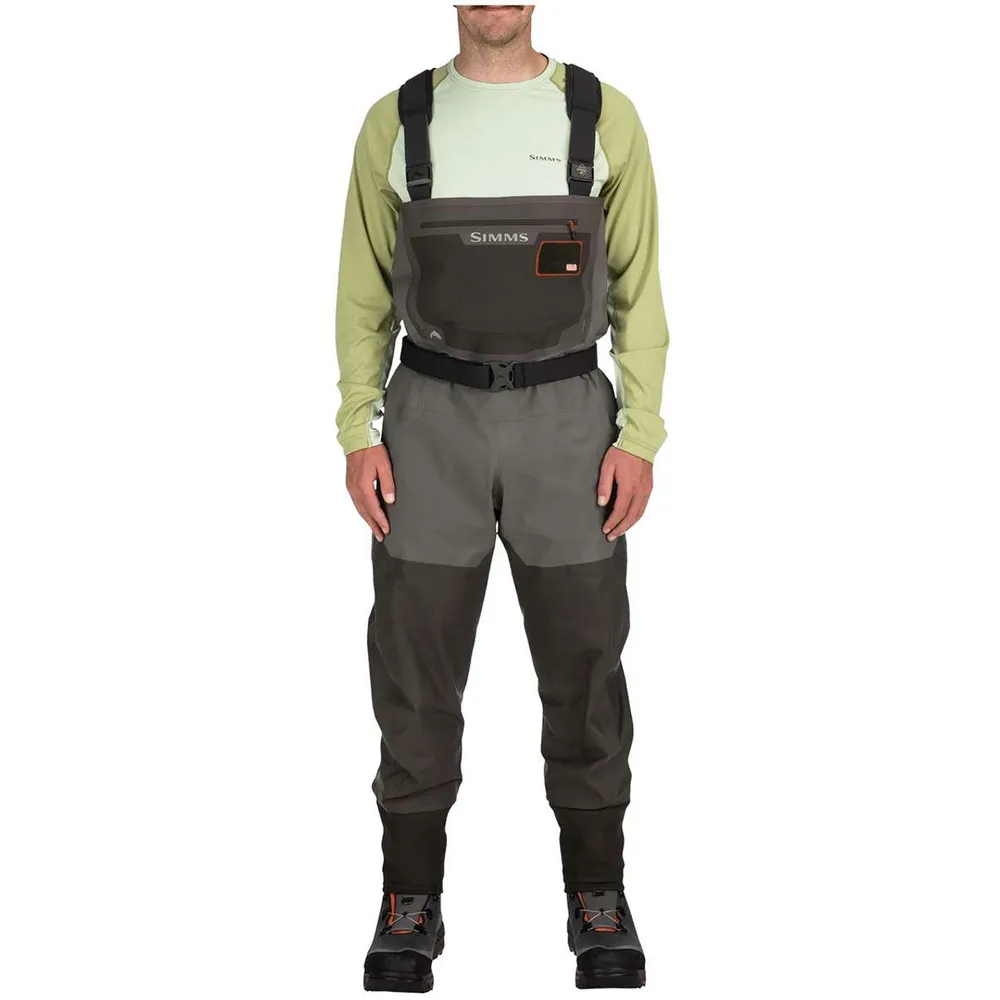
The Simms G3 Guide Stockingfoot is built for the committed fly angler who fishes frequently in demanding conditions and needs waders that won’t fail when the water is cold, the terrain is punishing, and the day is long. If you’re a steelheader wading the Sandy at first light in January, a trout angler grinding miles of the Deschutes canyon in August, or someone who fishes 30 to 60 days a year across all four seasons, the G3 Guide is designed specifically for you.
These are also the right waders for anglers who have burned through cheaper options and are tired of dealing with leaks, blown seams, and waders that feel like wearing a garbage bag after two hours of active wading. The G3 Guide’s Gore-Tex Pro membrane and premium construction solve those problems decisively.
Skip these if: You fish fewer than 15 days a year in mild conditions (the Orvis Encounter or Redington Palix River will serve you well at a fraction of the cost), you need an ultra-packable travel wader (the G3 Guide’s three-layer construction doesn’t compress as small as lighter alternatives), or you’re a shorter angler who’s had sizing issues with Simms in the past (the torso runs slightly long — more on that below). For other options, see our full wader roundup.
Key Specifications
| Spec | Detail |
|---|---|
| Membrane | Gore-Tex Pro (3-layer) |
| Upper Shell | 3-layer Gore-Tex Pro |
| Lower Legs | 4-layer abrasion-resistant Gore-Tex Pro |
| Stocking Foot | 3.5mm anatomically engineered neoprene |
| Zipper | YKK AquaGuard waterproof front zip |
| Seam Construction | Fully taped and sealed |
| Gravel Guards | Built-in with boot hook |
| Pockets | Zippered chest, two fleece-lined handwarmer, reach-through |
| Sizes Available | S–XXL in Short, Regular, Long, and King |
| Weight (size L) | ~46 oz |
| MSRP | ~$699 |
Waterproofing and Breathability
This is the performance axis where the G3 Guide earns its premium, and it’s where we’ll start because nothing else matters if your waders can’t keep water out and let moisture escape.
The Gore-Tex Pro membrane is the highest-tier waterproof-breathable technology Gore puts in waders, and the difference between it and standard Gore-Tex is not marketing — it’s measurable and perceptible on the water. The Pro membrane uses a more open molecular structure that allows substantially more moisture vapor transmission while maintaining the same waterproof rating. In practical terms, this means less condensation buildup inside the waders during active wading, which translates directly into comfort and warmth.
We tested this aggressively. On a late-August Deschutes trip — air temps pushing into the upper 80s, miles of canyon hiking between runs, wading upstream through fast riffles — the G3 Guides managed internal moisture better than any wader we’ve tested. Where budget and mid-range waders leave you feeling damp and clammy within the first hour of hard exertion, the G3 Guide kept pace with our output. By the end of an eight-hour day, the interior was noticeably drier than our experience with the Patagonia Swiftcurrent under the same conditions.
The waterproofing side of the equation is equally strong. After a full season that included submerging these waders chest-deep in January steelhead water on the Sol Duc, wading through knee-deep current for hours on the Yakima, and scrambling down rain-soaked banks on the Kalama, we logged zero leaks through the membrane. Not a single drip. The YKK AquaGuard front zipper — a common failure point on lesser waders — remained completely sealed throughout testing.
One note worth mentioning: Gore-Tex Pro fabric is noticeably stiffer than lighter membranes when the waders are brand new. The first three or four outings, the shell feels rigid compared to something like the Redington Palix River. It breaks in after that initial period and softens meaningfully, but if you’re trying them on in a shop and they feel stiff, know that it’s temporary.
Durability and Construction
The G3 Guide’s construction is where Simms’ decades of wader-building experience shows most clearly, and it’s the primary reason these waders outlast competitors by a wide margin.
The lower legs and seat use a four-layer abrasion-resistant Gore-Tex Pro shell that’s meaningfully tougher than the three-layer upper. This is a deliberate engineering choice: the high-wear zones where waders contact rock, gravel, and brush get heavier armor, while the upper body stays lighter for breathability and range of motion. We dragged these waders across the volcanic basalt shelves on the lower Deschutes — rock that will puncture lesser shells on contact — and across barnacle-crusted coastal boulders on Oregon’s north coast. The four-layer lower shell showed minimal wear even in areas where we could see visible scuff marks on the outer face fabric.
Seam construction is meticulous. Every seam on the G3 Guide is fully taped and sealed, and Simms uses a proprietary seam-sealing process that we’ve found to be the most durable in the industry. After a full season of hard use — including dozens of flexion cycles from climbing banks, kneeling on gravel bars, and crouching through brush — not a single seam showed any sign of delamination or leak. This is the area where premium waders justify their cost most clearly. Seam failure is the number-one killer of waders at every price point, and the G3 Guide’s seam integrity is in a class by itself.
The YKK AquaGuard zipper deserves specific mention. Waterproof front zippers are a convenience feature that can become a liability if the zipper quality is poor — you’re adding a potential leak path right across the front of your chest. The AquaGuard on the G3 Guide operates smoothly, seals reliably, and has shown no degradation through our testing. The convenience of a front zip for getting in and out of waders streamside is substantial, especially when you’re layering heavily for cold-weather steelhead.
The neoprene stockingfeet are 3.5mm anatomically shaped neoprene with a reinforced sole plate. They’re comfortable inside wading boots, durable against the abrasion of gravel and sand that inevitably gets between stocking and boot, and shaped to reduce bunching and hot spots. After a full season, ours show almost no wear on the sole area — a common failure point on thinner stocking designs.
Fit and Mobility
Simms offers the G3 Guide in one of the broadest size ranges in the wader market — Small through XXL, each available in Short, Regular, Long, and King variations. That granularity matters because wader fit isn’t just about comfort; it’s about safety and performance on the water.
The G3 Guide uses an anatomical cut with articulated knees that allows a genuinely full range of motion. High-stepping over logs, kneeling on a gravel bar to release a fish, climbing steep banks, and crossing fast current with deliberate footwork all felt natural and unrestricted. The articulation at the knees is particularly noticeable — the knees flex without pulling the wader shell tight across the joint, which means no restriction and no premature wear from repeated flexion.
The chest and torso area provides adequate room for cold-weather layering without excess material that catches current when you’re wading deep. We ran the G3 Guide with everything from a single lightweight base layer on summer evenings to a heavyweight merino base plus fleece pants for January steelhead, and the fit accommodated both ends of that range comfortably.
There is one fit issue we need to flag honestly: the torso runs slightly long for shorter anglers. If you’re under 5’8” and proportionally shorter in the torso, even the Short inseam may leave you with more chest material than you’d like. This isn’t a dealbreaker — the adjustable suspender system and wading belt manage the excess effectively — but it’s worth noting because it affects a meaningful number of anglers. If you’re in this size range, we strongly recommend trying the G3 Guide on with your intended layering before buying, or ordering from a retailer with a good return policy.
The built-in gravel guards are robust, well-attached, and include a boot hook that locks them securely to your wading boot laces. The guards stayed in place throughout our testing without riding up or detaching — a seemingly minor detail that becomes important when you’re wading through gravel runs all day. A blown gravel guard means rocks in your boots for the rest of the outing, and the G3 Guide’s design prevents that convincingly.
Features and Pockets
The G3 Guide’s feature set is refined rather than flashy, and every element earns its place through practical utility on the water.
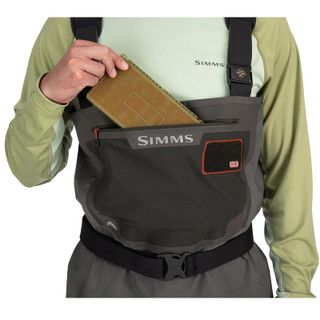
The zippered chest pocket is large enough for a fly box, tippet spools, and a multi-tool. The water-resistant zipper keeps contents dry even when you’re wading deep. Inside the chest pocket, a smaller mesh organizer pocket holds leaders or other small items you need quick access to without digging through the main compartment.
The two fleece-lined handwarmer pockets positioned at the waist are a feature we didn’t expect to care about as much as we do. On a 38-degree morning on the Sandy River, standing in 42-degree water, plunging your hands into fleece-lined pockets between casts makes a meaningful difference in your ability to stay on the water and maintain dexterity. The pockets drain effectively so they don’t hold water if you wade deep, and the fleece lining is durable enough to maintain its insulating value after repeated use and washing.
A reach-through pocket on the interior allows you to access layers underneath without opening the front of your waders — useful for grabbing a phone, snack, or anything else stowed in a base layer pocket.
The suspender system is fully adjustable with quick-release buckles that make getting in and out of the waders straightforward, even with cold hands. The suspenders distribute the weight of the waders comfortably across your shoulders without digging or slipping. They’re simple, functional, and don’t try to be more than they need to be.
The integrated belt loops accept the included wading belt, which should always — without exception — be worn snug while wading. On PNW rivers running in the 38 to 48 degree range through winter, a cinched wading belt buys you critical seconds if you take a fall by slowing water entry into the wader. For more on wading safety and the gear decisions that support it, see our steelhead rod guide where we cover the same river conditions.
Cold Water Performance
The Pacific Northwest is a cold-water fishery. Our steelhead rivers run between 38 and 48 degrees through the prime winter months, and even summer flows on glacier-fed systems like the Skagit rarely break the mid-50s. Cold-water performance isn’t a bonus feature here — it’s a fundamental requirement.
The G3 Guide performs exceptionally in cold water for a breathable wader. The Gore-Tex Pro membrane maintains its waterproof integrity at near-freezing water temperatures without the stiffening and performance degradation we’ve observed in some proprietary membranes. The three-layer upper and four-layer lower construction provide a meaningful insulation buffer between your body and the water — not as much as neoprene, but enough that layering a midweight base layer and fleece pants underneath keeps you genuinely warm through multi-hour winter sessions.
We wore the G3 Guide for a full day on the Hoh River in late January. Water temperature was 39 degrees, air temperature at launch was 31 with a light rain that turned to sleet by midmorning. We layered a heavyweight merino base, fleece pants, and a lightweight insulated vest under the waders. After six hours of wading, including extended periods standing waist-deep in the river swinging flies through steelhead runs, we were cold but functional — never miserable, never shivering, and critically, completely dry inside the waders. The breathability kept condensation from building up underneath the insulation layers, which is the failure mode that makes lesser waders miserable in cold conditions. When moisture from your body gets trapped between your skin and a mediocre membrane, it chills rapidly against cold water and destroys any insulating value your layers provide. The G3 Guide’s Gore-Tex Pro prevents that cycle.
The handwarmer pockets pull additional duty in cold conditions. Between casts, burying your hands in the fleece-lined pockets helps maintain finger dexterity for knot-tying and fly changes. It’s a small feature that makes an outsized difference when you’re trying to tie a size 2 intruder onto 12-pound tippet with numb fingers.
The Benchmark Score Breakdown
We evaluate every piece of gear against our standardized scoring methodology. Here’s how the G3 Guide Stockingfoot breaks down:
- Waterproofing: 9.5/10 — Zero leaks after a full PNW season. Gore-Tex Pro and AquaGuard zipper are best in class.
- Breathability: 9.5/10 — Gore-Tex Pro is the benchmark. Measurably superior to proprietary membranes in high-exertion conditions.
- Durability: 9/10 — Four-layer lower shell handles the most punishing terrain we test on. Seam construction is industry-leading.
- Fit & Mobility: 8.5/10 — Anatomical cut with articulated knees is excellent. Half-point deduction for slightly long torso on shorter anglers.
- Features: 8.5/10 — Everything is functional and well-executed. Handwarmer pockets and front zip are genuine assets.
- Cold Water Performance: 9/10 — Outstanding breathable wader performance in near-freezing water. Not neoprene warm, but manages moisture better than anything else we’ve tested.
- Value: 7.5/10 — The premium is real, but per-season cost is competitive when you factor in the lifespan. Tough score for anglers who fish fewer than 25 days per year.
Overall: 8.7/10
How the G3 Guide Compares
The G3 Guide doesn’t exist in a vacuum. Two waders consistently come up as cross-shop alternatives, and both deserve a direct comparison. For the full breakdown of all four waders we tested, see our best waders for fly fishing roundup.
vs. Patagonia Swiftcurrent Expedition
The Swiftcurrent Expedition is the G3 Guide’s closest competitor and the wader we’d recommend as the primary alternative for cold-water anglers. Patagonia’s H2No membrane sits slightly behind Gore-Tex Pro in raw breathability — we noticed this gap during high-exertion summer wading — but in cold-weather use, which is the Swiftcurrent’s design target, the practical difference is marginal. The Swiftcurrent runs roomier through the chest and hips, which is an advantage for heavy winter layering but a disadvantage if you prefer a streamlined fit with minimal excess material in current. Patagonia’s recycled-polyester shell and Fair Trade manufacturing appeal to environmentally conscious anglers, and their Ironclad Guarantee is among the strongest in the industry.
Choose the Swiftcurrent if: Winter steelhead is your primary season, you layer heavily, or sustainability is a deciding factor. Choose the G3 Guide if: You fish across all four seasons, prioritize breathability during warm-weather wading, or prefer a more anatomical fit.
vs. Orvis PRO Waders
The Orvis PRO sits in the same premium tier as the G3 Guide, with a price tag to match. Orvis uses their own proprietary four-layer membrane that performs well in waterproofing and reasonably in breathability, though it doesn’t match Gore-Tex Pro in vapor transmission under high exertion. Where the Orvis PRO shines is in its fit — Orvis cuts their waders with a slightly more generous hip and thigh that some anglers find more comfortable, particularly during all-day sessions. The pocket layout is different, with Orvis favoring larger exterior storage over the G3 Guide’s fleece-lined handwarmer design.
Durability is competitive between the two, though we give a slight edge to the G3 Guide’s seam construction and the proven track record of the AquaGuard zipper. The Orvis PRO is an excellent wader — genuinely premium — and the choice between it and the G3 Guide often comes down to fit preference and brand loyalty. We give the overall nod to the G3 Guide for its superior breathability and the Gore-Tex Guaranteed to Keep You Dry warranty, but the Orvis PRO is a wader you can trust.
Frequently Asked Questions
How long do Simms G3 Guide waders last?
With proper care, the G3 Guide consistently delivers three to five seasons of heavy use — and we define heavy use as 30 to 60 days per year on the water in demanding conditions. Guides who fish 200-plus days a year typically get two to three seasons, which is still exceptional given the abuse level. The most important maintenance actions are rinsing after every outing, restoring the DWR coating once or twice per season, and patching pinhole leaks promptly with Aquaseal rather than letting them grow. Proper storage — hanging in a cool, dry space out of direct UV — also extends lifespan significantly. The seams and zipper are the components most likely to need attention over time, and both are repairable through Simms’ warranty service.
Are the G3 Guide waders worth it over the Simms Freestone?
The Freestone is an excellent mid-range wader, and for anglers fishing 15 to 25 days a year in moderate conditions, it’s arguably the smarter buy. The G3 Guide pulls ahead in three specific areas: Gore-Tex Pro breathability (the Freestone uses standard Gore-Tex), four-layer lower leg durability (the Freestone is three-layer throughout), and the AquaGuard front zipper (the Freestone uses a simpler closure). If you fish frequently in harsh conditions — winter steelhead, rocky canyon rivers, full-season PNW use — the G3 Guide’s advantages compound over time and justify the price premium. If your fishing is primarily three-season trout on moderate rivers, the Freestone delivers excellent performance without the top-tier cost.
How should I size the G3 Guide if I’m between sizes?
Go up. Waders that are slightly roomy accommodate layering changes across seasons and avoid the stress points that cause premature wear. A wader that’s too tight across the hips restricts movement and creates pressure on seams during active wading — both of which shorten lifespan and compromise performance. Simms offers Short, Regular, Long, and King inseams at each chest size, so take advantage of that granularity. Measure yourself with your heaviest intended layering, compare against Simms’ published size chart, and if you’re on the boundary, choose the larger size. The adjustable suspenders and wading belt will take up any slack in the torso.
Can I use the G3 Guide for warm-weather fishing or are they overkill?
The G3 Guide is genuinely a four-season wader, and the Gore-Tex Pro membrane’s breathability makes it more comfortable in warm weather than you might expect from a three-layer shell. We fished these waders comfortably through summer evenings on the Yakima and hot August days on the Deschutes without overheating. That said, if you exclusively fish warm-weather trout in gentle conditions and never touch steelhead water or winter fishing, the G3 Guide’s durability and cold-weather features are overkill. A lighter, less expensive wader like the Redington Palix River or Simms Tributary would serve that use case at a lower price. The G3 Guide’s value proposition is built on versatility across conditions and longevity under hard use — if your fishing doesn’t demand those qualities, your money is better allocated elsewhere.
Does the Gore-Tex warranty cover everything?
Gore-Tex’s Guaranteed to Keep You Dry promise covers membrane failure — if water passes through the Gore-Tex membrane itself (not through a puncture, seam failure caused by wear, or user damage), Gore-Tex will repair or replace the waders. This is separate from Simms’ own warranty, which covers defects in materials and workmanship. Between the two warranties, you’re well covered for manufacturing defects and membrane failure. What’s not covered is normal wear and tear, physical damage from abrasion or puncture, and seam degradation from improper care. The practical takeaway: if your waders leak and you can’t find an obvious puncture or worn seam, contact Simms and invoke the warranty process. We’ve heard consistently positive reports from anglers who’ve gone through Simms’ warranty service, including fast turnaround times and fair assessments. For more on how we factor warranty and long-term value into our gear evaluations, see our methodology.