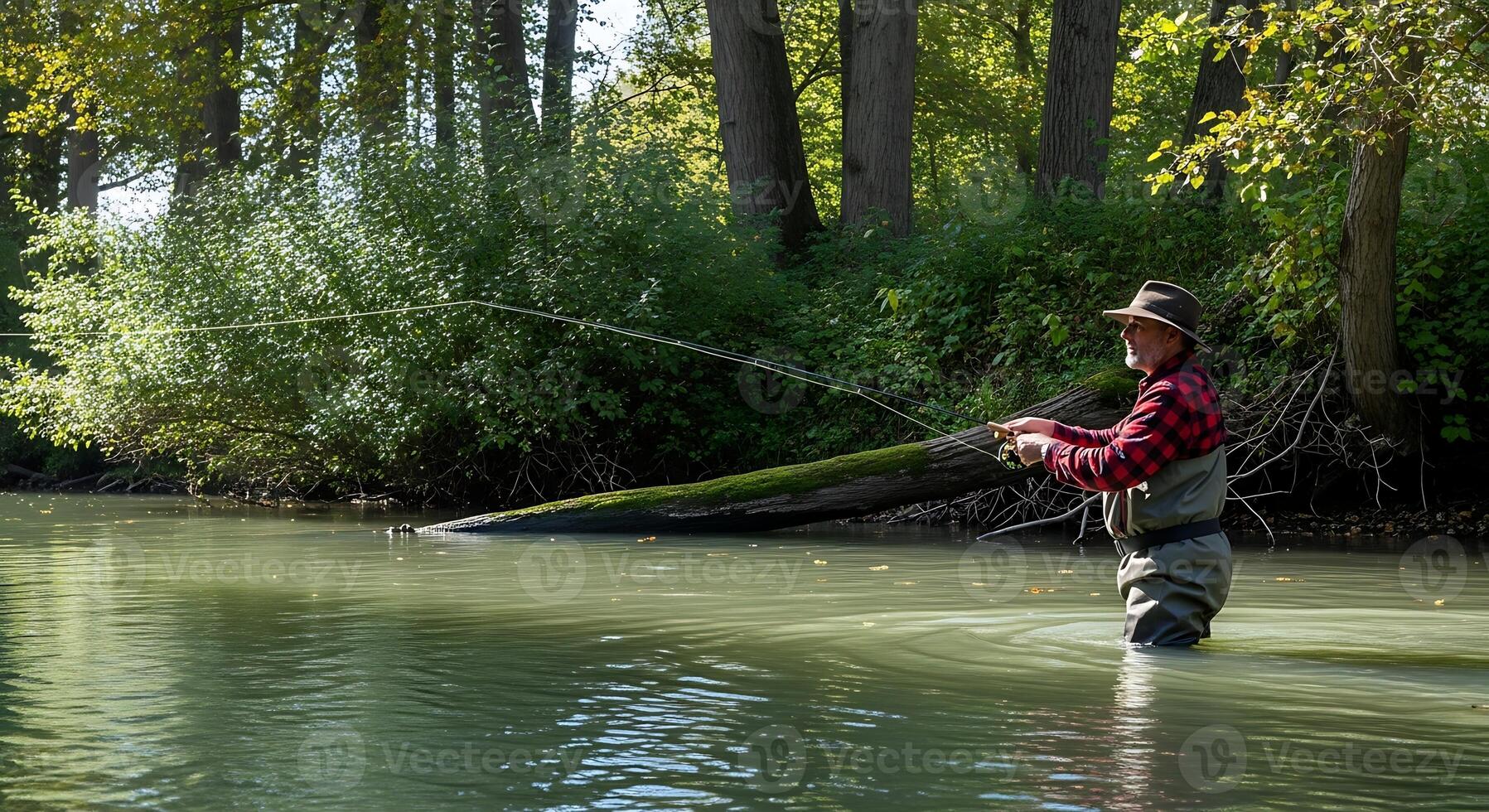
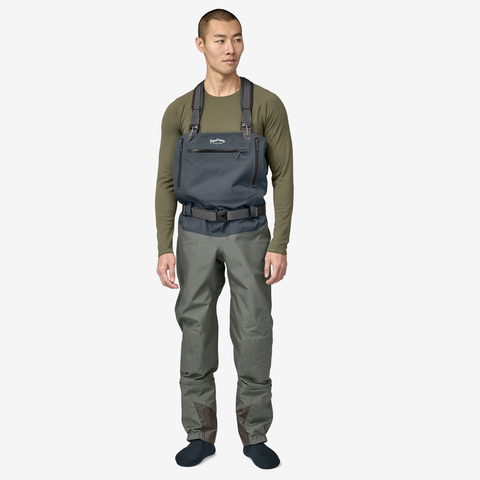
If you’re shopping for premium fly fishing waders, the decision almost always narrows to two brands: Simms and Patagonia. Specifically, the Simms G3 Guide Stockingfoot and the Patagonia Swiftcurrent Expedition — the flagship breathable waders from two companies that approach fly fishing gear from fundamentally different philosophies but arrive at remarkably similar price points.
We’ve fished both waders through full Pacific Northwest seasons. Steelhead on the Sol Duc and Hoh in January. Trout on the Deschutes in August. Coastal cutthroat on the Olympic Peninsula in the rain. Every evaluation in this comparison follows our standardized testing methodology, and every claim is backed by field hours across the rivers where wader performance actually matters. If you want the broader picture of how these two stack up against the full market, check our best waders for fly fishing roundup. For a deep dive on the Simms side alone, read our Simms G3 Guide waders review.
This is a fair fight between two excellent waders. Let’s break it down.
Quick Verdict
Buy the Simms G3 Guide if you fish across all four seasons, prioritize breathability during high-exertion wading, and want the most proven Gore-Tex Pro membrane on the market. The G3 Guide is the more versatile wader that performs equally well on a blazing August afternoon on the Deschutes and a freezing January morning on the Sandy. It’s the wader we reach for when the day could throw anything at us.
Buy the Patagonia Swiftcurrent Expedition if winter steelhead is your primary season, you layer heavily under your waders, environmental responsibility matters in your purchasing decisions, and you value Patagonia’s Ironclad Guarantee and repair-first philosophy. The Swiftcurrent is purpose-built for the coldest, hardest conditions and does that job exceptionally well.
The bottom line: The Simms G3 Guide earns the overall nod as our pick for the broadest range of fly anglers. Its superior breathability and four-season versatility give it the edge when we’re recommending a single pair of waders to someone we’ve never met. But the Patagonia Swiftcurrent Expedition is not a lesser wader — it’s a differently optimized one, and for dedicated cold-water anglers, it may genuinely be the better choice.
Specifications Comparison
| Spec | Simms G3 Guide Stockingfoot | Patagonia Swiftcurrent Expedition |
|---|---|---|
| Membrane | Gore-Tex Pro (3-layer upper, 4-layer lower) | H2No Performance Standard (4-layer) |
| Upper Shell | 3-layer Gore-Tex Pro | 4-layer recycled polyester |
| Lower Legs | 4-layer abrasion-resistant Gore-Tex Pro | 4-layer reinforced recycled polyester |
| Stocking Foot | 3.5mm anatomically engineered neoprene | 4mm neoprene with gravel guard |
| Front Zipper | YKK AquaGuard waterproof | YKK waterproof |
| Seam Construction | Fully taped and sealed | Fully taped and sealed |
| Pockets | Zippered chest, 2 fleece-lined handwarmer, reach-through | Zippered chest, 2 handwarmer, internal reach-through |
| Sizes | S–XXL (Short, Regular, Long, King) | XS–XXL (Short, Regular, Long) |
| Weight (size L) | ~46 oz | ~49 oz |
| MSRP | ~$699 | ~$649 |
| Warranty | Simms warranty + Gore-Tex Guaranteed to Keep You Dry | Patagonia Ironclad Guarantee |
| Sustainability | Standard materials | Recycled polyester, Fair Trade Certified sewing |
The specs tell part of the story. Both are premium, four-figure-adjacent stockingfoot waders with front zippers, fleece-lined pockets, and reinforced lower legs. The meaningful differences — Gore-Tex Pro versus H2No, recycled versus standard materials, anatomical versus roomy fit — only reveal themselves on the water. That’s where the rest of this comparison lives.
Head-to-Head: Material and Waterproofing
The waterproof membrane is the heart of any breathable wader, and these two waders use fundamentally different approaches to the same engineering problem: keeping river water out while letting body moisture escape.
The Simms G3 Guide uses Gore-Tex Pro, the highest-tier waterproof-breathable membrane Gore makes for waders. Gore-Tex Pro uses a more open molecular structure than standard Gore-Tex, which allows greater moisture vapor transmission without compromising the waterproof barrier. The G3 Guide pairs this membrane with a three-layer construction in the upper body and a heavier four-layer abrasion-resistant shell in the lower legs and seat. The result is a wader where the waterproofing feels effortless — you never think about it because it never fails.
The Patagonia Swiftcurrent Expedition uses Patagonia’s proprietary H2No Performance Standard membrane inside a four-layer recycled-polyester shell throughout the entire wader. Patagonia’s approach is a uniformly heavy construction that prioritizes waterproof integrity and durability over weight savings. The H2No membrane has improved substantially over multiple generations and now delivers waterproofing that is genuinely competitive with Gore-Tex.
In our testing, both waders maintained complete waterproof integrity through a full PNW season. We logged zero leaks through either membrane — not through chest-deep steelhead wading on the Sol Duc, not through hours of rain-soaked bank scrambling on the Kalama, and not through the grinding abuse of volcanic basalt on the Deschutes. Both zippers held their seals. Both seam systems remained watertight.
Winner: Draw. Neither wader leaked. Both membranes performed flawlessly in the conditions that matter most to PNW fly anglers. The waterproofing battle between modern Gore-Tex Pro and refined H2No is effectively settled at parity.
Head-to-Head: Breathability
This is the category where the gap between these two waders is most measurable, and it favors the Simms G3 Guide clearly.
Gore-Tex Pro’s more open molecular structure translates to meaningfully higher moisture vapor transmission during active wading. We noticed this most acutely during warm-weather fishing — a late-August Deschutes trip with air temps in the upper 80s, miles of canyon hiking, and aggressive wading upstream through fast riffles. After an eight-hour day in the G3 Guide, the interior of the waders was noticeably drier than what we experienced in the Swiftcurrent under identical conditions earlier in the season. The G3 Guide kept pace with high-output exertion in a way that fewer internal moisture problems meant fewer stops to vent and less of that clammy, damp feeling that saps energy on long days.
The Swiftcurrent Expedition’s H2No membrane breathes adequately for most conditions but falls behind Gore-Tex Pro during sustained high exertion. On warm days with heavy hiking, we could feel condensation building inside the Swiftcurrent sooner than in the G3 Guide. The four-layer construction throughout — while beneficial for durability — adds an incremental barrier to vapor transmission compared to the G3 Guide’s three-layer upper.
However, context matters here. The Swiftcurrent is designed for cold-water use, and Patagonia has optimized the H2No membrane for the stop-and-go exertion patterns of winter fly fishing: hike hard to the run, wade and swing for an hour, move to the next spot. In these conditions — sub-45-degree water, heavy layering, moderate exertion — the breathability gap narrows substantially. During our winter steelhead testing, the practical difference between the two waders in cold conditions was marginal enough that it didn’t affect our fishing.
Winner: Simms G3 Guide. Gore-Tex Pro delivers the best breathability in the wader market. The advantage is most pronounced in warm weather and high-exertion scenarios. In cold-weather use, the gap narrows but doesn’t disappear.
Head-to-Head: Durability and Construction
Both waders are built to survive seasons of hard use on PNW rivers — the kind of terrain that destroys budget waders in weeks. The construction philosophies differ in interesting ways.
The Simms G3 Guide uses a dual-layer approach: a lighter three-layer Gore-Tex Pro shell in the upper body where breathability matters most, and a heavier four-layer abrasion-resistant shell in the lower legs, knees, and seat where durability matters most. This targeted construction means the high-wear zones get heavier armor without penalizing the entire wader with extra weight and reduced breathability. After a full season of dragging the lower legs across basalt shelves on the Deschutes and barnacle-encrusted coastal boulders, the four-layer shell showed minimal wear — visible scuff marks on the face fabric but no compromise to the membrane beneath.
Simms’ seam construction is meticulous and represents decades of refinement. Every seam is fully taped and sealed using a proprietary process that we’ve found to be the most durable in the industry. The YKK AquaGuard front zipper is a known quantity — reliable, smooth, and proven over years of heavy use by fishing guides who depend on it daily.
The Patagonia Swiftcurrent Expedition uses a uniformly heavy four-layer construction from top to bottom. Where Simms optimizes by zone, Patagonia takes the approach that every part of the wader should be built to the same heavy-duty standard. The recycled-polyester face fabric is a heavier denier than most competitors in this class, and the knees and seat receive an additional abrasion layer on top of the four-layer base. This uniform construction makes the Swiftcurrent marginally heavier overall but ensures there’s no weak point anywhere on the shell.
Patagonia’s seam sealing is excellent — fully taped throughout with no weak spots or failures in our testing. The Swiftcurrent survived a full winter steelhead season on the Hoh, Sol Duc, and Bogachiel with zero leaks and minimal visible wear, which speaks volumes given how those coastal rainforest rivers punish gear with cobble bottoms, woody debris, and relentless rain.
The neoprene stockingfeet differ slightly. The G3 Guide uses a 3.5mm anatomically shaped neoprene with a reinforced sole plate — thinner but precision-shaped for comfort in wading boots. The Swiftcurrent uses a 4mm neoprene bootie that provides marginally more insulation, a welcome feature in 38-degree steelhead water.
Winner: Draw. Different construction philosophies, equivalent results. The G3 Guide’s zoned approach is more engineering-elegant, and its AquaGuard zipper has a longer proven track record. The Swiftcurrent’s uniform heavy construction is simpler and arguably more resistant to unexpected punctures in the upper body. Both survived a full season of punishing PNW conditions without failure.
Head-to-Head: Fit and Sizing
Fit is where these two waders diverge most noticeably, and the right choice depends entirely on your body type and how you layer.
The Simms G3 Guide has an anatomical, semi-athletic cut with articulated knees that allows a genuinely full range of motion. High-stepping over logs, kneeling on gravel bars, climbing steep banks, and crossing fast current all feel natural without the wader restricting your movement. The chest and torso area provides adequate room for layering without excess material that catches current during deep wading. Simms offers the G3 Guide in one of the broadest size ranges in the market — Small through XXL, each in Short, Regular, Long, and King inseams — which means most anglers can find an accurate fit.
There’s one honest fit issue we need to flag: the G3 Guide’s torso runs slightly long for shorter anglers. If you’re under 5’8” with a proportionally shorter torso, even the Short inseam may leave excess chest material. The adjustable suspenders manage it, but it’s worth noting.
The Patagonia Swiftcurrent Expedition has a roomier, more generous cut through the chest and hips. This is a deliberate design decision, not a fit flaw. The Swiftcurrent is built for heavy winter layering — heavyweight merino base, fleece pants, sometimes an insulated vest underneath — and that layering needs space. If you’re a winter steelheader who dresses for 32-degree mornings, the Swiftcurrent’s extra room is a genuine functional advantage. The articulated legs provide good mobility, and the overall silhouette avoids excessive material bulk in the legs that would create drag in current.
The tradeoff is that the Swiftcurrent can feel slightly baggy on anglers who layer lightly. During warm-season fishing with just a base layer underneath, we noticed more material than we wanted around the midsection. For three-season anglers who vary their layering significantly, the G3 Guide’s tighter cut adapts more gracefully across that range.
Size availability favors Simms. The G3 Guide’s four inseam options at each chest size (Short, Regular, Long, King) provide more granularity than the Swiftcurrent’s three options (Short, Regular, Long). For anglers with unusual proportions, that extra option can make the difference between a good fit and a great one.
Winner: Split decision. The G3 Guide wins for anglers who fish across all seasons and prefer a streamlined fit. The Swiftcurrent wins for dedicated cold-water anglers who layer heavily and need room. If you can, try both on with your intended layering before committing.
Head-to-Head: Features and Pockets
Both waders share a similar feature philosophy — functional, refined, and designed for anglers who spend full days on the water. The differences are in the details.
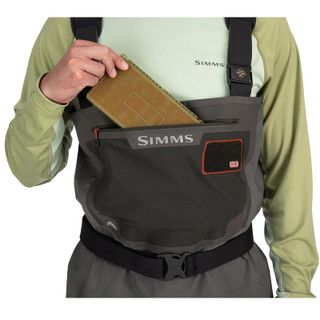
The Simms G3 Guide’s fleece-lined handwarmer pockets are a standout feature that we’ve come to consider essential for PNW winter fishing. On a 38-degree morning standing in 42-degree water, plunging your hands into fleece between casts makes a measurable difference in your ability to maintain finger dexterity for knot-tying and fly changes. The pockets drain effectively so they don’t hold water if you wade deep, and the fleece lining is durable enough to maintain its insulating value after repeated use and washing. The zippered chest pocket holds a fly box and tippet spools, with an internal mesh organizer for small items. The reach-through pocket provides access to base layer pockets without opening the waders.
The Patagonia Swiftcurrent Expedition offers a similar pocket layout with handwarmer pockets and a zippered chest pocket. The handwarmer pockets are functional but lack the plush fleece lining of the G3 Guide — a minor detail that becomes noticeable during cold-weather fishing when you’re reaching for them constantly. The chest pocket is well-sized and water-resistant, and Patagonia includes an interior reach-through pocket as well.
Both waders feature front waterproof zippers for easy entry and exit, adjustable suspender systems with quick-release buckles, integrated belt loops for the included wading belt, and robust built-in gravel guards with boot hooks. The mechanical execution of these features is excellent on both waders — zippers operate smoothly, suspenders stay adjusted, and gravel guards don’t ride up or detach during long days of wading.
Winner: Simms G3 Guide, narrowly. The fleece-lined handwarmer pockets are a genuine comfort advantage in cold conditions, and small differences in feature execution add up over a full season of use. The Swiftcurrent’s features are well-designed, but the G3 Guide’s pocket details feel like they were refined by someone who fishes 200 days a year — because they were.
Head-to-Head: Environmental Commitment
This is Patagonia’s strongest category and a factor that increasingly matters to anglers who care about the rivers they fish in.
The Patagonia Swiftcurrent Expedition is built with a recycled-polyester shell and assembled in a Fair Trade Certified facility. Patagonia’s environmental commitment isn’t marketing — it’s woven into every aspect of their supply chain and product design. The recycled materials reduce the virgin petroleum feedstock required to produce the waders. The Fair Trade certification means the factory workers who sew the waders earn a premium that goes into a community fund they control. Patagonia’s commitment to environmental activism through their 1% for the Planet pledge and their direct support for wild fish conservation through organizations like the Wild Salmon Center and Trout Unlimited adds further substance to the brand’s environmental credibility.
Patagonia also designs the Swiftcurrent for repairability, not disposability. Their Ironclad Guarantee explicitly encourages repair over replacement, and Patagonia’s Worn Wear program facilitates repairs that extend the lifespan of your gear — which is ultimately the most environmentally responsible outcome for any product.
Simms uses standard materials in the G3 Guide without the recycled-content or Fair Trade certifications that Patagonia leads with. Simms is not an environmentally irresponsible company — they support conservation causes and build waders designed to last — but they haven’t made sustainability a central pillar of their product design or marketing the way Patagonia has. The Gore-Tex Pro membrane itself is a petroleum-derived product, and while Gore has made strides in reducing their environmental footprint, the material supply chain doesn’t carry the same sustainability credentials as Patagonia’s recycled-polyester approach.
Winner: Patagonia Swiftcurrent Expedition, decisively. If the environmental impact of your gear matters to you — and for anglers who depend on healthy rivers, it should — Patagonia’s commitment to recycled materials, Fair Trade manufacturing, and conservation activism is genuine and unmatched in the wader market.
Head-to-Head: Warranty and Repair
Both companies stand behind their flagship waders, but the warranty structures differ in meaningful ways.
The Simms G3 Guide is covered by Simms’ standard warranty against defects in materials and workmanship, plus the Gore-Tex Guaranteed to Keep You Dry promise. The Gore-Tex guarantee specifically covers membrane failure — if water passes through the membrane itself (not through a puncture or user-caused damage), Gore-Tex will repair or replace the waders. This dual warranty layer means you have both the manufacturer and the membrane supplier backing the product. Simms’ repair service is well-regarded, with reasonable turnaround times and fair assessments. However, the warranty does not cover user-caused damage like punctures, tears, or wear-and-tear degradation.
The Patagonia Ironclad Guarantee is one of the strongest warranties in the outdoor industry. Patagonia guarantees the Swiftcurrent Expedition against defects in materials and workmanship and goes further by actively encouraging repair. If your waders can be fixed, Patagonia will fix them — often at low or no cost for warranty-covered issues. Their Worn Wear repair program is a structured, accessible system for getting gear repaired rather than replaced. Patagonia’s warranty philosophy prioritizes keeping products in service as long as possible, which aligns with their environmental commitment and benefits the customer.
Neither warranty is truly unconditional in the way that, say, Vortex’s VIP warranty covers optics. Both require that the failure be a manufacturing defect rather than user-caused damage. But Patagonia’s repair-first philosophy and accessible repair infrastructure give them a slight practical edge for anglers who want to maximize the lifespan of their investment.
Winner: Patagonia Swiftcurrent Expedition, narrowly. The Ironclad Guarantee combined with the Worn Wear repair program creates a stronger total support ecosystem. The G3 Guide’s dual warranty with Gore-Tex is excellent and the added membrane-specific guarantee is a genuine asset, but Patagonia’s repair culture provides a more complete safety net over the life of the product.
Head-to-Head: Value
Both waders sit in the premium tier of the wader market, and both command prices that require justification. The value question isn’t about which costs less — it’s about which delivers more for your specific fishing life.
The Simms G3 Guide retails at approximately $699 and delivers the best breathability in the wader market, a proven four-season platform, industry-leading seam construction, and the Gore-Tex Pro membrane that has been the benchmark for decades. The G3 Guide’s versatility is its core value proposition — it’s one wader that handles everything from summer trout to winter steelhead without compromise. For anglers who fish 30 or more days a year across multiple seasons, the per-outing cost over a three-to-five-season lifespan is genuinely reasonable. Factor in the seam durability and Gore-Tex Guaranteed to Keep You Dry warranty, and the total cost of ownership is competitive with cheaper waders that need replacing sooner.
The Patagonia Swiftcurrent Expedition retails at approximately $649 — roughly $50 less than the G3 Guide — and delivers exceptional cold-water performance, superior environmental credentials, a roomier fit for heavy layering, and Patagonia’s Ironclad Guarantee with the Worn Wear repair infrastructure. The Swiftcurrent’s value proposition is strongest for dedicated cold-water anglers who fish a primary season rather than all four. If winter steelhead is your life and you layer accordingly, the Swiftcurrent’s design optimization for exactly that use case delivers outstanding value.
For the broadest range of anglers, the G3 Guide’s four-season versatility and superior breathability represent better value per dollar because you never need a second pair. For specialized cold-water anglers who also value sustainability, the Swiftcurrent’s lower price point, environmental commitment, and purpose-built cold-weather performance offer compelling value that the G3 Guide can’t match on those specific axes.
Winner: Simms G3 Guide, narrowly. The superior breathability and four-season versatility mean more anglers will get more use out of the G3 Guide across more conditions. But the Swiftcurrent’s lower price and targeted cold-water excellence make it the better value for its intended audience.
Who Should Buy Which
Choose the Simms G3 Guide Stockingfoot if you:
- Fish across all four seasons and need a wader that handles July trout and January steelhead equally well
- Prioritize breathability for warm-weather wading or high-exertion days
- Prefer an anatomical, streamlined fit that adapts to varying layering levels
- Want the proven Gore-Tex Pro membrane with the Guaranteed to Keep You Dry warranty
- Need the widest range of sizing options including King inseams
- Are a shorter angler willing to work with the slightly long torso cut
Choose the Patagonia Swiftcurrent Expedition if you:
- Fish primarily in cold water — winter steelhead, spring runoff, late-season trout
- Layer heavily and need room in the chest and hips for bulky insulating layers
- Value recycled materials, Fair Trade manufacturing, and environmental responsibility in your gear purchases
- Want Patagonia’s Ironclad Guarantee and access to the Worn Wear repair program
- Prefer a slightly lower price point without sacrificing premium construction
- Support Patagonia’s conservation work through organizations like Wild Salmon Center and Trout Unlimited
Final Verdict
The Simms G3 Guide Stockingfoot is our overall pick in this head-to-head. It wins on breathability, four-season versatility, fit adaptability, and feature refinement — the qualities that matter most to the broadest range of fly anglers. The Gore-Tex Pro membrane remains the benchmark for waterproof-breathable performance, and the G3 Guide’s proven track record across thousands of guide days on rivers across the Pacific Northwest gives us confidence recommending it to any serious fly angler. When you need one pair of waders to handle everything your fishing life throws at them, the G3 Guide is the answer.
The Patagonia Swiftcurrent Expedition is not the runner-up — it’s the specialist. It wins on environmental responsibility, warranty infrastructure, cold-water optimization, and layering capacity. For the winter steelheader who fishes October through March in the hardest conditions the PNW delivers, the Swiftcurrent may genuinely be the better wader. Its recycled materials and Fair Trade manufacturing mean your purchase supports the kind of supply chain that helps protect the rivers you fish.
We respect both companies and both waders. Simms has built the most refined wader on the market through decades of guide feedback and relentless engineering. Patagonia has built a wader that performs at the highest level while proving that premium gear and environmental responsibility aren’t mutually exclusive. Either choice puts you in a wader that will last seasons, protect you in the coldest water, and let you focus on what matters — the fishing.
For more on how we evaluate waders and the specific conditions we test in, visit our methodology page. To explore the full range of wader options including budget and mid-range picks, check our best waders for fly fishing roundup. And for more of our fly fishing coverage — from rods and lines to technique guides — visit the fly fishing hub.
Frequently Asked Questions
Can I use either wader for warm-weather fishing, or are they both overkill for summer trout?
The Simms G3 Guide is genuinely a four-season wader thanks to the Gore-Tex Pro membrane’s superior breathability. We fished it comfortably through August days on the Deschutes with air temps in the upper 80s — the membrane managed moisture well enough that we never felt overheated or clammy. The Patagonia Swiftcurrent, with its heavier four-layer construction and roomier fit designed for layering, is less ideal for warm-weather use. You’ll notice more internal condensation during high-exertion summer wading compared to the G3 Guide. If you primarily fish summer trout in mild conditions, neither premium wader is necessary — a lighter, less expensive option like the Redington Palix River will serve you well at a lower price. But if you need one wader for all seasons, the G3 Guide handles warm weather materially better than the Swiftcurrent.
How do the two waders compare in sizing for women or shorter anglers?
Both brands offer extended size ranges, but Simms provides more granularity with Short, Regular, Long, and King inseams at each chest size compared to Patagonia’s Short, Regular, and Long options. That said, the G3 Guide’s torso runs slightly long for shorter anglers even in the Short inseam — if you’re under 5’8”, you may have excess chest material that the suspenders need to manage. The Swiftcurrent’s roomier cut can actually work in favor of shorter anglers who layer heavily, as the extra chest room accommodates bulk without the torso length being as pronounced an issue. For women anglers, both brands offer dedicated women’s versions of their flagship waders with proportionally adjusted cuts. We’d strongly recommend trying on both with your intended layering before buying, or ordering from retailers with generous return policies.
Is the Gore-Tex Pro membrane worth the premium over Patagonia’s H2No?
In raw breathability, yes — Gore-Tex Pro delivers measurably higher moisture vapor transmission, and the difference is perceptible during warm-weather and high-exertion fishing. In waterproofing, no — both membranes kept water out completely through a full PNW season of hard use. The practical answer depends on when you fish. If you’re a year-round angler who fishes hot summer days and cold winter mornings, the Gore-Tex Pro advantage in breathability will improve your comfort across the widest range of conditions. If you’re primarily a cold-water angler who layers heavily and fishes at moderate exertion levels, the breathability gap between Gore-Tex Pro and H2No narrows to the point where it shouldn’t drive your decision. The $50 price difference between the two waders is small enough that the membrane choice should be based on your fishing conditions, not the price delta.
How long will each wader last with proper care?
Both waders are built to deliver three to five seasons of heavy use — which we define as 30 to 60 days per year on the water in demanding PNW conditions. Fishing guides who wear these waders 200-plus days a year typically get two to three seasons, which is still exceptional. The longevity of both depends heavily on maintenance: rinsing after every outing, restoring the DWR coating once or twice per season, patching pinhole leaks promptly with Aquaseal rather than ignoring them, and storing the waders hanging in a cool, dry space out of direct UV. The Swiftcurrent’s uniform four-layer construction may provide marginally more resilience against unexpected punctures in the upper body, while the G3 Guide’s targeted four-layer lower shell is optimized for the areas that take the most abuse. Over a multi-year lifespan, the durability performance is effectively equivalent.
If I already own one of these waders, is the other worth buying as a backup?
Owning both is a legitimate strategy for anglers who fish frequently across all conditions — but only if your fishing volume justifies the investment. The ideal two-wader quiver would use the Simms G3 Guide as the primary three-season wader for its breathability and versatility, and the Patagonia Swiftcurrent Expedition as the dedicated cold-water wader for winter steelhead when you’re layering heavyweight merino and fleece underneath. The Swiftcurrent’s roomier fit accommodates that heavy layering better, while the G3 Guide’s streamlined cut and Gore-Tex Pro breathability shine from spring through fall. If you fish 50-plus days a year across multiple seasons, rotating between two waders also extends the lifespan of both by reducing wear accumulation. For most anglers who fish 25 to 40 days a year, one premium wader is sufficient — and in that case, the G3 Guide’s four-season versatility makes it the single wader we’d choose.
Quick Buy — Products in This Article