
Winter steelhead fly fishing is the most demanding, humbling, and rewarding pursuit in freshwater fly fishing. Nothing else comes close. You are standing waist-deep in a Pacific Northwest river in January, rain hammering your hood, fingers numb inside neoprene gloves, swinging a fly through green water that may or may not hold a fish — and you are doing this because somewhere in that current, a chrome-bright steelhead the size of your forearm is holding behind a boulder, and if your fly crosses its face at exactly the right depth and speed, everything changes in an instant.
We chase winter steelhead because the grab is the single greatest moment in fly fishing. Not the fight, though a fresh winter fish on a spey rod will test every piece of gear you own. Not the landing, though cradling a wild 15-pound hen in the shallows is a privilege that never gets old. The grab — that sudden, violent stop mid-swing when a steelhead commits — is why we drive three hours in the dark, rig up in the rain, and fish all day for one or two chances. Sometimes zero.
This guide covers everything you need to pursue winter steelhead with a fly rod in the Pacific Northwest: gear, flies, technique, river selection, timing, and the mental framework that separates anglers who stick with it from those who quit after two fishless weekends. For steelhead-specific gear recommendations, check our best fly rods for steelhead and best fly lines for steelhead roundups. For broader coverage of the discipline, visit our fly fishing hub.
Winter Steelhead vs. Summer Steelhead
Before we get into tactics, we need to clarify what makes winter steelhead a distinct pursuit. The Pacific Northwest has two genetically distinct steelhead runs, and they demand different approaches.
Summer steelhead enter freshwater from May through October, though the term is loose — some “summer” fish don’t arrive until November. They’ve been in the river for weeks or months by the time you fish for them, and their metabolism is active in warmer water temperatures. Summer fish are often aggressive, willing to move laterally and vertically to intercept a fly, and they’ll chase waking dries and unweighted flies on the surface in the right conditions. Summer steelhead fishing, while still challenging, offers a broader window of fly presentation options and generally more forgiving conditions.
Winter steelhead enter freshwater from late November through April, with the heaviest runs typically pushing between January and March. These fish are larger on average — a typical winter fish in the Skagit or Hoh system runs 8 to 15 pounds, with fish over 20 pounds landed every season. They are migrating through cold water, often between 35 and 45 degrees Fahrenheit, and their metabolism is correspondingly slower. Winter steelhead hold tight to the bottom in the softer seams and tailouts of a run. They do not chase flies. They will not rise through the water column to eat a fly suspended above them. Your presentation must put the fly in their face, at their depth, at the right speed — or they will ignore it entirely.
This behavioral difference is the defining challenge of winter steelhead fly fishing. You are not trying to trigger aggression. You are trying to intersect a slow-moving, bottom-hugging fish with a fly that drifts through its narrow reaction zone. Everything about your gear setup, fly selection, and technique is oriented around achieving that intersection.
Gear Setup for Winter Steelhead
Winter steelhead gear is purpose-built for one job: delivering a fly to the bottom third of the water column across a wide range of river conditions. Every component in the system matters, and getting any one of them wrong compromises the entire presentation.
The Rod: Two-Hand Spey, 7 or 8 Weight
A two-hand spey rod in the 12.5- to 14-foot range is the standard tool for winter steelhead. We fish 7- and 8-weight rods almost exclusively. A 7-weight handles smaller coastal rivers and lower flows, while an 8-weight is the workhorse for big water like the Skagit, Hoh, and Queets. If you’re buying one rod for winter steelhead, buy an 8-weight in the 13- to 13.5-foot range. It covers the widest range of conditions without being unwieldy on medium-sized water.
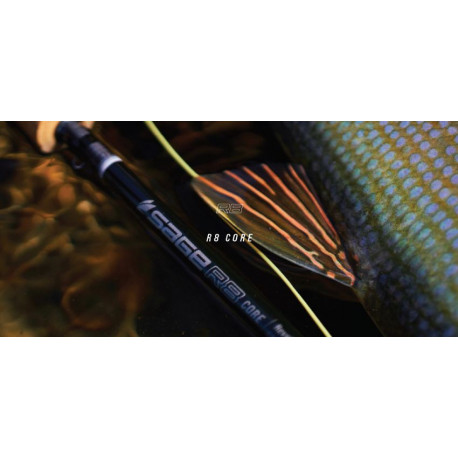
The rod needs to load Skagit-style heads and turn over heavy sink tips and large flies without collapsing. Look for a progressive action that loads deeply in the lower third of the blank during the casting stroke — this is what generates the slow, powerful turnover that Skagit casting demands. Tip-fast rods designed for Scandi-style casting are the wrong tool here. You need a rod that wants to throw heavy payloads, not light ones. Our Sage R8 Core review covers one of the best options on the market for exactly this application.
The Reel: Sealed Drag, Large Arbor
Your reel needs to do two things: hold a Skagit head, sink tip, and 100 yards of backing without stacking; and stop a 15-pound fish running downstream in heavy current. A sealed drag system is non-negotiable for winter fishing. You will be wading in rain, dunking your reel, and fishing in near-freezing temperatures. Any reel with an exposed drag system will seize, corrode, or fail when you need it most.
Large-arbor designs retrieve line faster and reduce line memory coils — both matter when you’re stripping in running line between casts hundreds of times a day. Match the reel to your rod weight, and load it with enough backing to handle a 100-foot run plus your full line system.
The Line System: Skagit Head, Sink Tips, and Running Line
The Skagit line system is the engine of winter steelhead fly fishing, and understanding it is essential. The system has three components that connect in sequence.
Running line is the thin, level line that sits on your reel and shoots through the guides during the cast. It connects to the back of your Skagit head. Choose running line in the 25- to 35-pound range. Monofilament running line offers the best shooting performance but tangles in cold weather. Coated running lines handle better in winter conditions and are what we recommend for most anglers. For a detailed breakdown of line options, see our best fly lines for steelhead guide.
The Skagit head is a short, heavy, weight-forward shooting head — typically 20 to 25 feet long — designed to load a spey rod quickly and turn over heavy sink tips. Match your Skagit head grain weight to your rod’s recommended range. Most 8-weight spey rods fish best with heads in the 525- to 600-grain range. The Skagit head connects to the sink tip at the front.
Sink tips are interchangeable sections of sinking line — usually 10 to 15 feet long — that connect to the front of the Skagit head via a loop-to-loop connection. The sink tip is what gets your fly down to the fish. We carry a wallet of tips in different densities and swap them throughout the day as water depth and speed change. More on sink tip selection below.
Fly Selection: What Winter Steelhead Eat and Why
Winter steelhead flies are not imitative in the way trout flies are. You’re not matching a hatch. You’re provoking a response — a territorial or instinctual reaction — from a fish that isn’t actively feeding. Fly selection for winter steelhead is about profile, movement, and depth more than exact imitation.
That said, there are patterns and principles that produce consistently, and carrying the right selection matters.
Intruders
The intruder is the quintessential winter steelhead fly. Originating on the Skagit River, intruders are large, articulated flies tied on shanks or tubes with trailing hooks. They push water, move with life-like undulation in the current, and present a big profile that winter fish can detect in off-color water. We tie intruders in sizes from 2.5 to 4 inches, with the largest profiles reserved for high or turbid water.
Color selection follows a general rule: dark water, dark flies; clear water, bright flies. Black and blue intruders are the standard for stained water. Pink and orange combinations work well as water clears. Chartreuse and white produce in gin-clear low water. Carry a range and adjust based on visibility.
String Leeches
The string leech is a simpler, more compact pattern that fishes beautifully on the swing. Tied with marabou or rabbit strip on a long-shank hook, string leeches have a seductive breathing action in the current that triggers strikes even from lethargic winter fish. Black, purple, and cerise are the go-to colors. String leeches are our first choice on smaller rivers and in lower, clearer water where a full-sized intruder may be too much.
Egg-Sucking Leeches
Egg-sucking leeches combine a dark body (typically black or purple chenille or rabbit) with a bright egg head in fluorescent orange, pink, or chartreuse. The contrast between the dark body and bright head creates a visual trigger point that steelhead key on. These are versatile flies that work across a wide range of conditions and are particularly effective when salmon eggs are drifting in the system alongside spawning activity.
Marabou Spiders
Marabou spiders are sparse, soft-hackle-style flies with marabou collars that pulse and breathe in the current. They’re lower-profile than intruders but move water in a way that hard-bodied flies cannot. We fish marabou spiders in black, purple, and olive, and they’re devastating in the slower tailouts and soft inside seams where winter fish rest.
General Practitioner Variations
The GP — a classic steelhead pattern with a swept-wing profile — has been reinvented dozens of times, and modern GP variations remain deadly on winter fish. Tied with orange or hot-pink body materials and partridge or pheasant rump hackle, GP-style flies swim with a lively action and present a natural, prawn-like silhouette. We carry GP variations in sizes 2 through 1/0, and they’re a confidence fly for late-season fish in clearing water.
When to Fish What
As a general framework: fish big, dark patterns early in the season (December through January) when water is typically high and stained. Transition to medium-profile flies in mixed colors (February through early March) as flows moderate. Downsize to smaller, brighter patterns (late March through April) as water drops and clears. This isn’t a rigid rule — river conditions can shift overnight with a single rainstorm — but it’s a reliable starting point.
Sink Tips and Leader Setup
Getting the fly to the right depth is the most critical variable in winter steelhead fly fishing. A perfectly chosen fly presented two feet above a steelhead’s holding depth will be ignored. The sink tip is your depth control mechanism, and understanding how to match tip density to water conditions separates productive anglers from those casting into empty water.
Sink Tip Density: T-11 Through T-17
Sink tips are rated by their weight in grains per foot. The “T” designation (T-11, T-14, T-17) tells you how fast the tip sinks. Higher numbers sink faster.
T-11 (approximately 7-8 inches per second sink rate): Use T-11 tips in shallow runs, tailouts under 4 feet deep, and slower-moving water. This is your light tip for low-water conditions and smaller rivers where getting too deep hangs you on the bottom every cast.
T-14 (approximately 8-10 inches per second): T-14 is the workhorse tip for most winter steelhead fishing. It gets you down into the 4- to 7-foot zone that holds fish in the majority of classic steelhead runs. If you’re carrying one tip, this is it.
T-17 (approximately 10-12 inches per second): T-17 tips are your heavy artillery for deep, fast runs where T-14 can’t reach bottom. Big mainstem runs on the Skagit, deep slots on the Hoh, and any water over 6 feet deep with significant current velocity demand T-17 to get your fly into the zone. The tradeoff is more bottom snags and a heavier, less elegant casting feel.
Tip Length
Standard tip lengths run 10 to 15 feet. Shorter tips (10 feet) fish better in shallower, faster water where you want the fly to swing quickly through the strike zone. Longer tips (12.5 to 15 feet) provide more time at depth in deeper, slower water. We carry tips in 10- and 12.5-foot lengths in each density, which gives us enough combinations to handle virtually any water we encounter.
Leader and Tippet
Keep your leader simple. Attach 3 to 5 feet of 12- to 15-pound fluorocarbon or stiff monofilament directly to the end of your sink tip using a loop-to-loop or nail knot connection. Winter steelhead are not leader-shy. A short, stout leader turns over big flies cleanly and maintains direct contact between the tip and the fly. Lengthening the leader beyond 5 feet introduces slack that dulls your ability to feel the grab and control the fly’s depth.
The Swing Technique
The swing is the soul of winter steelhead fly fishing. It’s deceptively simple in concept — cast, mend, let the fly sweep across the current, step downstream, repeat — and endlessly nuanced in execution. Mastering the swing means learning to read water, control your fly’s speed and depth, and maintain focus through hundreds of fishless casts.
Reading the Water
Winter steelhead hold in specific types of water, and learning to identify these lies is the single most important skill you can develop. Look for water that is 3 to 8 feet deep with a moderate, walking-speed current. Classic holding water includes the inside seams where fast current meets slower water along the bank, tailouts where runs shallow and spread, slots behind large boulders or ledges that break the current, and soft buckets in the middle of a run where the bottom contour creates a depression.
Avoid the fastest, whitest water — steelhead won’t hold in rapids. Avoid dead-slow pools with no current definition — fish pass through these but don’t rest in them during migration. The sweet spot is that band of moderate current where a steelhead can hold position without exhausting itself. Learn to see it, and you’ll spend your time fishing productive water instead of casting into empty runs.
The Cast and Mend
With a spey rod and Skagit system, you’ll be making sustained-anchor casts — snap-T, double spey, or Perry Poke depending on wind direction and bank orientation. Cast at a roughly 45-degree angle downstream. As the line lands, execute an upstream mend to create a belly of slack that slows the fly’s initial swing. The depth of this mend controls how deep your fly sinks before it begins to swing across the current.
In deeper, faster water, throw a larger upstream mend — or multiple mends — to give your sink tip time to pull the fly down before the current catches the belly of line and accelerates the swing. In shallower, slower water, a smaller mend or no mend at all keeps the fly moving and prevents it from dragging the bottom.
The Swing and Hang Down
Once your line is positioned, the current does the work. The fly swings from upstream to directly below you in an arc, covering the water from the far bank toward your position. Your job is to manage line tension with your rod tip — keeping it low to the water, pointing roughly at the fly’s position, and maintaining a tight connection. Any slack in the system means you’ll miss the grab.
As the fly completes its swing and hangs directly downstream, hold it there. This moment — the hang down — is when a disproportionate number of winter steelhead eat. The fly is hanging in the current, pulsing and breathing, at the end of its arc. A following fish that has tracked the fly through the swing will often commit at the hang down. Hold your position for 5 to 10 seconds, letting the fly work. Then slowly strip in a few feet of line before recasting.
Step and Repeat
After the hang down, take one or two steps downstream and repeat the entire sequence. This methodical coverage — cast, mend, swing, hang down, step — is how you systematically work through a steelhead run. Each cast covers a new strip of water approximately 2 to 3 feet wide. A 200-yard run might take 45 minutes to an hour to fish thoroughly. Rushing means you skip water. Skipping water means you miss fish.
The discipline of step-and-repeat is one of the hardest things for new steelhead anglers to internalize. Every cast matters. Every step matters. The fish could be in the next strip of water, or it could be 300 casts away. Your job is to present the fly correctly, every single time, and trust the process.
Where to Fish: PNW Winter Steelhead Rivers
The Pacific Northwest holds the finest winter steelhead rivers in the world. Here are the systems and water types that define the pursuit. For a comprehensive look at Washington’s fly fishing rivers, including summer steelhead and trout water, see our Washington state river guide.
Olympic Peninsula Rivers
The Olympic Peninsula is the beating heart of winter steelhead fly fishing. The Hoh, Bogachiel, Sol Duc, and Quillayute system offer wild, rain-forest rivers loaded with native winter fish. The Hoh is the crown jewel — a powerful glacier- and rain-fed river with classic swing water and a legendary run of wild steelhead that peaks in March and April. The Sol Duc fishes smaller and is more accessible for wading anglers, with clearly defined runs and excellent bank access through public land.
Olympic Peninsula rivers are rain-dependent, which means they blow out fast and drop fast. Timing your trips around weather windows is critical. A day of heavy rain can push the Hoh to 15,000 cfs and unfishable visibility, but 48 hours of dry weather often brings it back into shape. Monitor USGS gauges obsessively and be ready to move when conditions align.
The Skagit System
The Skagit River and its tributaries — the Sauk and Cascade — are the historic home of modern spey fishing for winter steelhead. This is where Skagit-style casting was developed, where the intruder pattern was born, and where the ethos of swinging flies for wild winter fish was forged into a culture. The Skagit’s winter run enters in December and pushes through April, with peak fishing typically in February and March.
The mainstem Skagit is big water that demands a drift boat for effective coverage, though walk-in runs exist from Rockport downstream. The Sauk River, entering the Skagit near Rockport, offers smaller and more intimate wading water with its own robust winter run. The Skagit system is managed under strict catch-and-release, wild-steelhead-only regulations — check current WDFW rules before fishing, as seasonal closures and regulation changes are common.
Coastal Rivers
Washington and Oregon’s coastal rivers — the Queets, Quinault, Chehalis, Wilson, and many smaller creeks — provide a diverse menu of winter steelhead water ranging from large mainstem rivers to tiny creeks you can cast across. Coastal rivers tend to be rain-driven, spate systems that fish best on the drop after storms. They often have shorter, punchier runs and more wood structure than interior rivers, which makes them exciting to fish and demanding to navigate.
Many coastal streams hold both hatchery and wild steelhead, giving you the option of keeping a hatchery fish for the table while releasing wild fish. This mixed-run dynamic is less common on the elite wild-fish rivers like the Hoh and Skagit, where only catch-and-release for wild fish is permitted.
Timing Your Trips: December Through April
Winter steelhead fishing is a game of timing, and the anglers who catch the most fish are the ones who understand run timing and river conditions well enough to be in the right place at the right moment.
December: The earliest winter fish push into lower river reaches. Fishing is often spotty, with fresh fish mixed among late-fall holdover coho in some systems. Water is typically high and cold. This is the month for dedicated anglers willing to grind for the first chrome fish of the season.
January: The run builds. Fish push further upriver and begin staging in classic mid-river holding water. January offers some of the best fishing of the season on the Olympic Peninsula, particularly the Hoh and Bogachiel when rain cycles cooperate. The Skagit system starts producing consistent fish by mid-January.
February: Peak time on many systems. The heaviest push of fish is in the river, flows often stabilize as the rain pattern shifts, and water temperatures begin their slow climb toward the upper 30s. February is when we plan our most committed trips — multiple consecutive days on the water to maximize our chances of intercepting peak migration.
March: Late-season fishing that can be outstanding. Fish are often concentrated in upper river reaches and tributary mouths. The Hoh and Skagit both fish well into March, and late-run fish are some of the largest of the season. Water conditions are generally more stable than midwinter, and longer days mean more fishing time.
April: The tail end of the run on most rivers. Fish are present but in lower numbers, and some are beginning to show spawning coloration. April fishing is best on later-timed rivers like the Skagit and upper Olympic Peninsula tributaries. Conditions are typically friendlier — warmer air, lower water, longer days — which makes April a reasonable entry point for anglers new to the winter game.
Cold Weather Gear: Staying Safe and Functional
Winter steelhead fishing puts your body in cold water in cold air for long hours. Hypothermia, frostbite, and general misery are real risks that require deliberate preparation. The best fly in your box means nothing if you can’t feel your hands well enough to tie it on.
Layering System
Build your layering system around moisture management, insulation, and wind/rain protection. A merino wool or synthetic base layer against your skin wicks sweat. A midweight fleece or insulated jacket provides warmth. A waterproof, breathable shell — the best you can afford — keeps rain and spray out. Avoid cotton at every layer. Wet cotton in 35-degree air is a fast track to hypothermia.
Under your waders, wear fleece-lined wading pants or heavyweight merino leggings. Your legs are submerged in cold water for hours, and insulation below the waist matters as much as above it. Neoprene wading socks add warmth around your feet inside wading boots. For wader recommendations that handle winter conditions, see our best waders for fly fishing guide.
Gloves: Carry Two Pairs
Your hands are the first thing to fail in winter conditions, and losing dexterity means losing the ability to tie knots, manage line, and feel the grab. We carry two pairs of gloves: neoprene fishing gloves (fingerless or with fold-back fingertips) for active fishing, and heavyweight insulated gloves for warming up between runs. When your fishing gloves get soaked and cold, switching to dry insulated gloves while you walk to the next run can restore enough feeling to keep you fishing productively.
Hand warmers in your wader pocket are a simple addition that pays enormous dividends. Stuff your hands in your pocket between casts to maintain circulation.
Wading Safety
Winter rivers are colder, higher, and faster than their summer counterparts. Wade conservatively. A wading belt cinched tight at the top of your waders is mandatory — it traps air in your waders and buys you critical time if you go in. Use a wading staff in any water where the bottom is uneven or the current pushes against your legs. Studded wading boots provide traction on the algae-slick boulders that cover most PNW river bottoms.
Never wade alone in winter conditions. A fishing partner means someone who can extend a hand, throw a rope, or call for help if something goes wrong. The risk-reward calculation changes when the water is 38 degrees.
The Mental Game: Steelhead Are a Commitment
We need to be honest about something: winter steelhead fly fishing is hard. Not hard in the way that learning to cast is hard, where practice leads to steady improvement. Hard in the way that the feedback loop between effort and reward is stretched to its breaking point.
You will have fishless days. You will have fishless weekends. Some seasons, you might fish 10 or 15 full days before your first grab. The commonly cited ratio — one fish for every thousand casts — is not exaggeration. It’s a reasonable approximation for most winter steelhead rivers in most conditions. The fish are present in lower densities than summer steelhead, they’re holding in a narrow band of the water column, and they’re less willing to move to a fly. Every variable has to align.
This reality filters the steelhead community into a particular type of angler. The ones who stay are the ones who find meaning in the process — in the casting, the water-reading, the rhythm of step-and-repeat, the wild rivers, and the raw beauty of being on PNW water in the dead of winter. The grab, when it comes, is transcendent precisely because of the effort that preceded it. A steelhead earned through two days of fishless swinging carries a weight that a fish caught on the third cast of the morning never will.
Our advice: commit to the process for a full season before you decide whether winter steelhead fly fishing is for you. Give yourself 8 to 10 days on the water, spread across the December-through-March window, fishing good water with proper gear and technique. By the end of that investment, you’ll either be hooked for life or you’ll know with certainty that this particular brand of obsession isn’t yours. Either answer is valid. But quitting after two trips doesn’t give the experience enough runway to reveal what it actually is.
Approach each day with the expectation that you’re going to fish well, enjoy the river, and probably not catch a steelhead — and if you do, it will be one of the great moments of your fishing life. That framing keeps you present, keeps your casting sharp, and prevents the corrosive disappointment that drives people away from the sport.
Frequently Asked Questions
Can you catch winter steelhead on a single-hand fly rod?
Yes, but with significant limitations. A 7- or 8-weight single-hand rod in the 9- to 10-foot range can fish winter steelhead on smaller rivers where casting distances under 50 feet are sufficient. The challenge is covering water. Winter fishing demands systematic coverage of large runs, and a spey rod lets you cast further with less effort over a full day. If you’re committed to single-hand fishing, focus on smaller coastal streams and tighter water where the distance disadvantage is minimized. Most dedicated winter steelhead anglers eventually transition to a two-hand rod because the efficiency gain is substantial.
What water temperature is too cold for winter steelhead?
Steelhead will take a fly in water temperatures as low as 33-34 degrees Fahrenheit, though their willingness to move decreases dramatically below 38 degrees. In water under 36 degrees, fish are lethargic and holding extremely tight to the bottom. Slow your swing, fish heavier sink tips, and use smaller, darker flies that pass close to the bottom. The prime temperature window for winter steelhead activity is 38-44 degrees. If you’re fishing a river with a gauge that reports water temperature, prioritize days when temps are in or approaching that range.
How do you know if a river is in fishable condition?
Monitor USGS river gauges for flow rate (cfs) and gauge height. Every river has an optimal fishing range — the Hoh, for example, fishes best between 3,000 and 7,000 cfs on the gauge at the USGS station near Forks. Above that, visibility drops below the 2-foot minimum most fly anglers need to fish effectively. Below 2,000 cfs, the river may be too low to hold migrating fish in the usual runs. Learn the fishable range for your target rivers by tracking gauge data alongside your on-water observations. River condition reports from local fly shops are also invaluable — shops on the Olympic Peninsula and in the Skagit Valley post conditions regularly.
Do you need a boat for winter steelhead fly fishing?
A drift boat dramatically increases the amount of water you can cover in a day, and on big rivers like the Skagit or lower Hoh, it’s the most effective way to fish. However, many of the best steelhead runs on PNW rivers are fishable from the bank. Walk-in access on the Sol Duc, Bogachiel, North Fork Stillaguamish, and many coastal rivers puts you on productive water without a boat. If you’re starting out, focus on bank-accessible water and invest in a good pair of wading boots and a wading staff. Hire a guide with a drift boat for a day or two to learn a river’s holding water, then return to fish it on foot with that knowledge.
What is the best fly for winter steelhead?
There is no single best fly, but if we had to fish one pattern for an entire winter season, it would be a black and blue intruder in the 3-inch range. This combination of color, profile, and movement covers the widest range of water conditions you’ll encounter from December through April. In stained water, the dark silhouette is visible without being garish. In clearer water, the blue flash provides enough contrast to draw attention. The articulated body and trailing hook design give the fly a lifelike swimming action that triggers grabs from fish holding in a range of current speeds. That said, carrying a selection of patterns — intruders, string leeches, egg-sucking leeches, and GP variations — in multiple colors gives you the ability to adapt to conditions. Versatility beats any single fly over the course of a season.
Winter steelhead fly fishing is not for everyone, and it doesn’t pretend to be. It’s a pursuit that asks more of you than almost any other form of angling — more patience, more skill, more willingness to suffer uncomfortable conditions for uncertain reward. But for those of us who have felt the grab, who have watched a wild winter steelhead cartwheeling through the mist of a January morning on the Hoh, the math makes perfect sense. The investment is enormous. The return is beyond measure. We’ll see you on the water. For more on our testing process and how we evaluate gear, visit our methodology page.