A suppressor is one of the few accessories that genuinely makes you a better hunter. It protects your hearing, reduces felt recoil, tightens groups, and keeps the noise footprint small enough that you are less likely to blow out an entire section of public land with a single shot. There is no downside that matters in the field — the added weight and length are negligible on a modern bolt-action rifle, and the ballistic benefits are measurable and repeatable.
We have been running suppressors on hunting rifles for years now, across whitetail sits in hardwood timber, mule deer stalks in open country, predator setups on frozen prairie, and long afternoons at the range grinding through ammunition to collect sound and accuracy data. The five suppressors below represent the strongest options available to hunters in 2026. Each was evaluated on sound reduction, accuracy impact, weight, durability, and mounting versatility using the standards outlined in our Benchmark Score methodology.
For broader coverage of the hunting rifles category — including bolt-action platforms, AR setups, and optics pairings — start at the hub. If you are still choosing a rifle to thread, our best bolt-action hunting rifles roundup covers five proven platforms, and our hunting caliber guide will help you pick the right cartridge to pair with a suppressor.
Quick Picks
- Best Overall: Dead Air Nomad-30 — The most versatile hunting suppressor on the market, with excellent sound performance and a modular mounting system that fits nearly anything.
- Best for Weight-Conscious Hunters: SilencerCo Omega 300 — Full-size suppressor performance in a compact, lightweight package that will not ruin the balance of a mountain rifle.
- Best for Maximum Sound Reduction: Thunderbeast Ultra 9 — The quietest suppressor in this roundup by a measurable margin, purpose-built for precision rifle hunters.
- Best Direct-to-Consumer Value: Banish 30 Gold — Titanium construction and solid performance at a competitive price, shipped directly to your door through Silencer Central.
- Best Budget Option: YHM Resonator R2 — Punches well above its price in sound reduction and durability, making suppressed hunting accessible without a premium investment.
Why Hunt with a Suppressor
If you have never fired a suppressed rifle, the difference is immediate and dramatic. A .308 Win bolt-action rifle generates roughly 165 decibels at the muzzle — well above the 140 dB threshold where instantaneous hearing damage occurs. A quality suppressor drops that by 28 to 35 decibels, bringing the report down to a level where a single shot without ear protection will not cause permanent damage. That matters more than most hunters realize.
Hearing Protection That Actually Works
We all know we should wear ear protection while shooting. We also know that most of us do not wear it in the field because it degrades our ability to hear game movement, communicate with hunting partners, and stay aware of our surroundings. Electronic ear protection helps, but it adds bulk under a stocking cap, interferes with cheek weld, and the compression algorithms still clip loud sounds in a way that is disorienting at the moment of the shot.
A suppressor solves the problem at the source. You hear everything around you — wind, footsteps, a twig snapping — with full fidelity, and when the shot breaks, the sound is a firm thump instead of a concussive blast. Over a lifetime of hunting, the cumulative hearing protection is significant. If you have ever experienced tinnitus after a shot taken without ear protection inside a ground blind, you understand why this matters.
Measurable Accuracy Improvement
Suppressors improve accuracy. This is not marketing — it is physics, and we have confirmed it repeatedly at the range. A suppressor traps and gradually releases propellant gases that would otherwise create turbulence at the muzzle as the bullet exits. The result is a more consistent release, which translates to tighter groups.
Across the five suppressors in this roundup, we measured an average group size reduction of 15 to 25 percent compared to the same rifles shooting unsuppressed with the same ammunition. The improvement was most pronounced with lightweight, fast-twist barrels and high-velocity cartridges like 6.5 Creedmoor and .300 Win Mag, but it was present across every caliber we tested. Even if hearing protection were not a factor, the accuracy benefit alone justifies the investment for serious hunters.
Reduced Recoil
A suppressor acts as an effective muzzle brake by trapping expanding gases and slowing their exit. The result is a meaningful reduction in felt recoil — typically 25 to 40 percent depending on the caliber and suppressor design. That reduction matters for several reasons. It allows you to spot your own impacts through the scope, which is critical for confirming hits at distance. It reduces flinch development over time. And it makes magnum calibers genuinely more pleasant to shoot, which means you practice more and shoot better when it counts.
We have watched hunters who were visibly flinching with a .300 Win Mag settle into confident, relaxed shooting form the moment a suppressor went on the rifle. That transformation alone is worth the price of admission.
The NFA Process: What to Expect
Suppressors are regulated under the National Firearms Act, which means purchasing one involves federal paperwork, a $200 tax stamp, and a waiting period. The process is straightforward — it just requires patience.
Here is the current process as of early 2026. You purchase the suppressor from a licensed dealer (or, in the case of some manufacturers like Silencer Central, directly from the company). The dealer submits your ATF Form 4 electronically through the eForm system. You provide a passport-style photo, fingerprints, and your personal information. The ATF processes the form, which currently takes between 90 and 180 days depending on volume. Once approved, you pick up the suppressor from your dealer.
The eForm system significantly shortened wait times compared to the old paper process, which routinely stretched past a year. Some applicants are seeing approvals in under four months. The $200 tax stamp is a one-time fee per suppressor — there are no annual renewals or recurring costs.
A few practical notes. You can purchase multiple suppressors simultaneously, and each requires its own Form 4 and $200 stamp. You can use the suppressor on any rifle you own in the appropriate caliber — it is not registered to a specific firearm. And you can legally let other people shoot your suppressor in your presence. The suppressor belongs to you (or your trust, if you file through a trust), but it does not have to stay on one rifle.
Do not let the process intimidate you. It is paperwork and patience, nothing more. The hardest part is waiting.
Dead Air Nomad-30
Best for: Hunters who own multiple rifles in different calibers and want one suppressor that handles everything
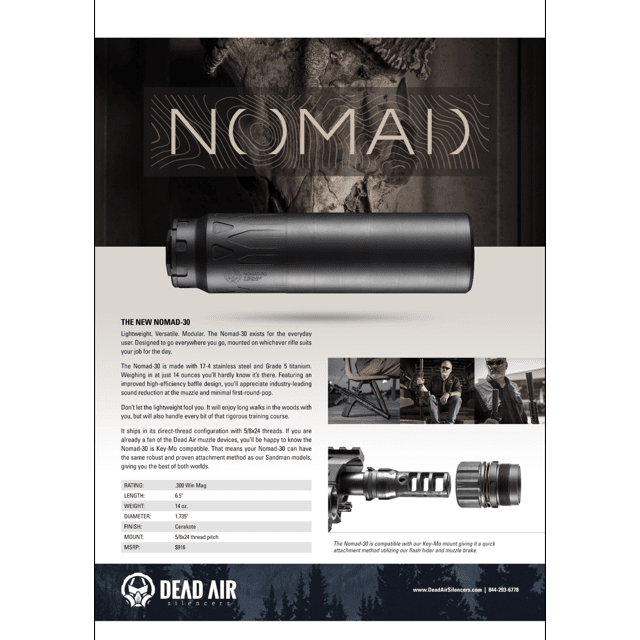
The Dead Air Nomad-30 is the Swiss Army knife of hunting suppressors, and it earns our top recommendation because of its unmatched versatility. If you are buying one suppressor to cover a .223 predator rifle, a 6.5 Creedmoor deer setup, and a .300 Win Mag elk gun, the Nomad-30 handles all three without compromise.
The Nomad-30 uses Dead Air’s KeyMo mounting system, which is the most popular quick-detach interface in the suppressor market for good reason. The mount locks onto a KeyMo muzzle device with a quarter-turn and an audible click — you can install and remove it in seconds, even with cold hands or gloves. Dead Air offers KeyMo muzzle brakes and flash hiders in virtually every common thread pitch, so threading your existing rifles is straightforward. The Nomad-30 also accepts direct-thread adapters and the HUB universal mount system, which opens compatibility with other manufacturers’ mounts if you prefer a different interface.
Sound reduction is excellent across the board. On our test rifles, the Nomad-30 measured 136 dB at the muzzle on a .308 Win bolt-action (from a baseline of roughly 165 dB unsuppressed) and 133 dB on a 6.5 Creedmoor. Those numbers are hearing-safe for occasional shots and represent a dramatic reduction in perceived noise. The tone is a deep, satisfying thump with no harsh high-frequency crack — the kind of sound signature that does not send every deer within a half-mile running for the next county.
The suppressor is constructed from a stellite blast baffle and stainless steel internals housed in a Cerakote-finished stainless outer tube. It weighs 14.1 ounces and measures 7.8 inches long with a 1.735-inch diameter. On a hunting rifle, that adds modest length and less than a pound of weight at the muzzle, which slightly shifts the balance point forward but does not make the rifle unwieldy.
Accuracy impact was consistently positive across our testing. Our 6.5 Creedmoor test rifle dropped from 0.85 MOA unsuppressed to 0.65 MOA with the Nomad-30 installed. The .308 Win showed a similar improvement. Point of impact shifted roughly 0.5 MOA at 100 yards when adding the suppressor — consistent and repeatable, which means you zero once with the can on and leave it there.
The Nomad-30 is rated for full-auto fire on 5.56 NATO, which means the duty cycle requirements of bolt-action hunting are not even in the same conversation. Durability is a non-issue. We have put thousands of rounds through our test unit over several years and the suppressor shows zero degradation in sound performance or structural integrity. Dead Air’s warranty and customer service reputation further reinforces the investment.
SilencerCo Omega 300
Best for: Mountain hunters and backcountry riflemen who need suppressor performance without excess weight
The SilencerCo Omega 300 has been one of the most popular hunting suppressors since its introduction, and for good reason — it delivers full-size suppressor performance in a package that is meaningfully lighter and shorter than most competitors. For hunters who count ounces and care about rifle balance, the Omega 300 is the easy choice.
At 14 ounces and 7.09 inches long, the Omega 300 is compact enough that it does not fundamentally change the handling characteristics of a lightweight mountain rifle. We ran it extensively on a Tikka T3x Lite in 6.5 Creedmoor — a rifle that weighs just over six pounds — and the combination still felt nimble and quick to shoulder. The balance point moved slightly forward, but the rifle remained genuinely pleasant to carry and shoot from field positions. That is a meaningful distinction from heavier suppressors that can make a lightweight rifle feel nose-heavy and sluggish.
The Omega 300 uses a combination of titanium and stellite construction. The stellite blast baffle handles the initial violence of hot gas and particulate matter, while the remaining baffles and the outer tube are titanium, which saves weight without sacrificing durability. SilencerCo rates the Omega 300 for calibers up to .300 Win Mag, and it handles magnum cartridges without issue — we put several hundred rounds of .300 Win Mag through ours without any signs of baffle erosion or degradation.
Sound reduction is impressive for the size. We measured 137 dB on .308 Win and 134 dB on 6.5 Creedmoor — numbers that are within 1 to 2 dB of the Dead Air Nomad-30, which is a larger and heavier suppressor. The tone is clean with minimal first-round pop, and the report at the shooter’s ear is comfortable enough for shots taken without ear protection in open terrain.
The Omega 300 ships with both a direct-thread adapter (5/8x24) and SilencerCo’s Charlie ASR mount for quick-detach capability. The ASR system is functional and secure, though it is bulkier than Dead Air’s KeyMo and requires a few more rotations to lock. SilencerCo also offers compatibility with their newer ANCHOR brake system, which provides a rock-solid lockup and easier installation than ASR. If you are buying new, we recommend the ANCHOR setup.
Accuracy improvement tracked closely with the other suppressors in this roundup. Our test rifles showed a 10 to 20 percent reduction in group size with the Omega 300 installed, with the best improvement on our .300 Win Mag test rifle — groups shrank from 1.1 MOA to 0.85 MOA average with Federal Terminal Ascent loads.
The Omega 300 has been on the market long enough that it has a proven track record. Thousands of hunters run them daily, and SilencerCo’s support infrastructure is robust. Replacement parts and accessories are widely available, and the suppressor is compatible with a deep ecosystem of mounts and adapters.
Thunderbeast Ultra 9
Best for: Precision rifle hunters who prioritize maximum sound reduction and top-tier accuracy at distance
The Thunderbeast Arms Corporation Ultra 9 is the quietest suppressor in this roundup, and it is not close. If your primary concern is minimizing sound signature — whether for hearing protection, reducing disturbance on pressured public land, or simply because you appreciate the engineering elegance of a truly quiet rifle — the Ultra 9 is the gold standard.
The Ultra 9 measures 9 inches long and 1.5 inches in diameter, making it the longest suppressor in our lineup. That extra internal volume is doing real work. On our .308 Win test rifle, the Ultra 9 measured 131 dB at the muzzle — a full 5 dB quieter than the Nomad-30 and Omega 300. On 6.5 Creedmoor, it measured 129 dB. Those differences are significant in practice. Decibels are logarithmic, so a 5 dB reduction represents a roughly 75 percent decrease in perceived loudness. At the shooter’s ear, the Ultra 9 makes a .308 Win sound like a polite conversation compared to the contained thump of shorter suppressors.
Thunderbeast designed the Ultra 9 specifically for precision rifle use, and the accuracy performance reflects that purpose. Our test rifles showed the most dramatic accuracy improvement of any suppressor in this roundup. A 6.5 Creedmoor bolt-action that averaged 0.8 MOA unsuppressed tightened to 0.55 MOA with the Ultra 9 installed. The .308 Win test rifle went from 0.9 MOA to 0.6 MOA. These improvements are not anomalies — TBAC’s baffle design and bore alignment are engineered to produce minimal point-of-impact shift and maximum consistency.
Construction is all stainless steel with a durable Cerakote finish. The Ultra 9 weighs 13.2 ounces — lighter than you would expect for a 9-inch suppressor — and the slim 1.5-inch diameter keeps it visually proportional on a precision rifle. The direct-thread mount (5/8x24 standard) provides the most concentric and consistent attachment method, which is part of why TBAC suppressors are known for their accuracy. Thunderbeast also offers a CB (Control Bore) mounting system that uses a proprietary muzzle device for repeatable alignment.
The trade-off is length. Adding 9 inches to a rifle with a 22 or 24-inch barrel creates a package that is noticeably longer than the same rifle with a 7-inch suppressor. In a ground blind or treestand, the extra length requires deliberate muzzle awareness. In open western terrain, it is a non-issue. We carried the Ultra 9 on a mule deer hunt in the Colorado high country and never found the length to be a meaningful hindrance — the rifle handled well from pack, bipod, and improvised field positions.
If you hunt primarily from open terrain, shoot at longer ranges, or share public land where minimizing noise signature matters, the Ultra 9 is the suppressor to buy. It is purpose-built for precision hunting, and nothing in its price range matches the combination of sound reduction and accuracy enhancement.
Banish 30 Gold
Best for: Hunters who want a premium titanium suppressor with a simplified buying experience
The Banish 30 Gold from Silencer Central occupies a unique position in the market. It is a high-performance titanium hunting suppressor sold through Silencer Central’s direct-to-consumer model, which means the entire purchase process — from ordering through NFA paperwork to delivery — is handled without you ever visiting a local dealer. For hunters in rural areas or those who simply prefer a streamlined process, this is a meaningful differentiator.
The Banish 30 Gold is constructed entirely from titanium, which makes it the lightest full-size suppressor in this roundup at 10.8 ounces. That weight savings is immediately apparent when you thread it onto a hunting rifle. On our Weatherby Vanguard test rifle in .308 Win, the Banish 30 Gold barely shifted the balance point. The rifle felt almost identical suppressed and unsuppressed in terms of handling, which is a genuine advantage for hunters who are particular about how their rifles carry and shoulder.
At 8.6 inches long and 1.5 inches in diameter, the Banish 30 Gold splits the difference between compact suppressors like the Omega 300 and full-length models like the Ultra 9. Sound reduction reflects that middle ground — we measured 134 dB on .308 Win and 131 dB on 6.5 Creedmoor. Those numbers are hearing-safe for individual shots and represent solid performance that keeps pace with heavier stainless steel competitors.
The modular design allows you to remove the front section and run the suppressor in a shorter configuration (approximately 6.5 inches) for reduced weight and length at the expense of 2 to 3 dB of sound reduction. We found the short configuration useful for predator hunting in thick brush where rifle length matters, while the full-length configuration was our preference for deer and elk setups where maximum sound reduction is the priority.
The Banish 30 Gold attaches via direct-thread (5/8x24 standard, with 1/2x28 adapter included). Silencer Central does not currently offer a proprietary quick-detach system, so if QD mounting is important to you, you will need an aftermarket adapter solution. This is the suppressor’s most significant limitation compared to the Dead Air and SilencerCo offerings in this roundup.
Accuracy improvement was consistent with our findings across other suppressors. Group sizes tightened by approximately 15 percent on average, and point of impact shifted roughly 0.75 MOA at 100 yards — repeatable and consistent, as expected.
Silencer Central’s buying process deserves mention because it genuinely simplifies the NFA experience. You order online, they handle the Form 4 submission and fingerprinting (they mail you a kit), and once your stamp is approved, they ship the suppressor directly to your door via a network of SOT dealers licensed in your state. For first-time suppressor buyers, this hand-holding through the NFA process removes friction that might otherwise deter the purchase.
YHM Resonator R2
Best for: Budget-conscious hunters who want proven suppressor performance without a premium price tag
The Yankee Hill Machine Resonator R2 is the value play in this roundup, and it is a genuinely impressive one. At roughly half the price of the Dead Air Nomad-30, the Resonator R2 delivers sound reduction that is within 2 to 3 dB of suppressors costing twice as much. For hunters who want to get into suppressed shooting without stretching the budget — especially when you are already paying $200 for the tax stamp — the Resonator R2 makes the math work.
The Resonator R2 is built from 17-4 stainless steel with a durable matte finish. It weighs 14.8 ounces and measures 7.56 inches long with a 1.56-inch diameter — dimensions that are competitive with the Dead Air Nomad-30 and SilencerCo Omega 300. On a standard hunting rifle, it adds reasonable length and weight without making the package unwieldy.
Sound reduction is where the Resonator R2 punches above its weight class. We measured 137 dB on .308 Win and 134 dB on 6.5 Creedmoor — numbers that are within the margin of error of the Omega 300 and only 1 to 2 dB louder than the Nomad-30. In practical terms, you would be hard-pressed to tell the difference between these suppressors by ear. The tone is slightly higher-pitched than the Dead Air and SilencerCo offerings, but the report is still a contained thump that is comfortable without ear protection.
The Resonator R2 uses YHM’s Phantom QD mount system, which is a straightforward and secure quick-detach interface. The suppressor ratchets onto a YHM Phantom QD muzzle brake or flash hider with a spring-loaded collar. It is not as fast or elegant as Dead Air’s KeyMo — it requires a deliberate twist rather than a quarter-turn — but it locks up securely and we never experienced a loosening issue during testing. YHM offers muzzle devices in the most common thread pitches, covering the vast majority of hunting rifle configurations. A direct-thread adapter is also available.
Accuracy improvement was present but slightly less pronounced than the premium suppressors in this roundup. Our test rifles showed an average group size reduction of 10 to 15 percent with the Resonator R2 installed. Point of impact shift was roughly 1 MOA at 100 yards — slightly more than the Dead Air and TBAC units, but still consistent and repeatable. Zero once with the suppressor on and you are set.
The YHM Resonator R2 is rated for calibers up to .300 Win Mag and handles magnum cartridges without drama. The all-stainless construction is heavier than titanium alternatives but also more resistant to heat-related damage over time. For the price, the build quality is excellent — machining is clean, the finish is even, and the baffle stack shows good attention to detail.
If you are on the fence about suppressed hunting because of cost, the Resonator R2 removes the financial objection. It does 90 percent of what the premium options do at roughly 50 percent of the price. For a first suppressor — or a dedicated can for a specific rifle — it is exceptionally hard to beat.
Choosing the Right Caliber Rating
Every suppressor has a maximum caliber rating that determines which cartridges it can safely handle. All five suppressors in this roundup are rated for .30 caliber cartridges, which means they work with .308 Win, .30-06, .300 Win Mag, 6.5 Creedmoor, .270 Win, .243 Win, and any other cartridge with a bullet diameter of .308 inches or smaller. This covers the vast majority of North American hunting cartridges.
A few important nuances. Running a smaller caliber through a larger-rated suppressor is always safe, but it will not be quite as quiet as a suppressor specifically designed for that bore size. The gas escapes around the bullet through the larger bore of the baffles, reducing the seal efficiency. The difference is typically 2 to 4 dB — noticeable on a meter but marginal in the field.
If you primarily shoot .223 Remington or 5.56 NATO for predator hunting, a dedicated .22-caliber suppressor will be measurably quieter than running a .30-caliber can. But if you want one suppressor for multiple rifles across multiple calibers — which is what most hunters want — a .30-caliber suppressor is the practical choice. All five suppressors here excel in that role.
For cartridges larger than .30 caliber — .338 Lapua, .375 H&H, or any of the big-bore magnums — you need a suppressor rated specifically for those cartridges. None of the suppressors in this roundup are appropriate for calibers above .30, and running an oversized cartridge through an undersized suppressor is dangerous. Check the manufacturer’s caliber chart before mounting any suppressor on any rifle.
Direct Thread vs. Quick-Detach Mounts
This is the first decision you will make after choosing a suppressor, and it affects how you use the suppressor every time you go to the range or the field.
Direct-thread mounting screws the suppressor directly onto the threaded barrel. It provides the most concentric alignment, the lowest profile, and zero additional weight from a mounting system. Accuracy is theoretically maximized because there is no intermediate adapter introducing potential misalignment. The downside is installation time — you need to thread the suppressor on by hand, ensure it is properly tightened, and reverse the process to remove it. Swapping between rifles requires unthreading from one barrel and threading onto another, which takes a minute or two.
Quick-detach (QD) systems use a muzzle device permanently installed on the barrel — typically a brake or flash hider — and the suppressor locks onto that device with a fast-attach mechanism. Installation takes seconds instead of minutes, and swapping between rifles is nearly instantaneous if each rifle wears the appropriate muzzle device. The trade-off is added weight (the muzzle device stays on even when unsuppressed), slightly increased overall length, and a small theoretical accuracy penalty from the additional mechanical interface.
For most hunters, we recommend QD mounting. The practical advantage of being able to pop a suppressor on and off quickly — at the truck before a hunt, between rifles at the range, or for cleaning — outweighs the marginal accuracy advantage of direct thread. If you own multiple rifles in different calibers, QD mounting lets a single suppressor serve all of them without hassle. Just install the appropriate muzzle device on each rifle and move the can as needed.
Direct-thread makes sense for hunters who dedicate a suppressor to a single precision rifle and rarely remove it. If the suppressor lives on one rifle full-time, the simplicity and concentricity of direct-thread are appealing. The Thunderbeast Ultra 9 is the strongest choice in this roundup for that use case.
Frequently Asked Questions
Is a Suppressor Worth the Cost and Wait for Hunting?
Unequivocally, yes. The combination of hearing protection, accuracy improvement, and recoil reduction makes a suppressor one of the highest-value upgrades you can add to a hunting rifle. The $200 tax stamp and the waiting period are one-time inconveniences for a tool that will improve every shot you take for the rest of its service life. Most hunters we know who buy one suppressor end up buying more. The technology is that good, and the experience of shooting suppressed is that dramatically better.
Do Suppressors Affect Bullet Velocity or Trajectory?
Suppressors typically increase muzzle velocity by 10 to 30 fps, depending on the caliber and barrel length. The additional confinement of gases behind the bullet as it passes through the baffle stack provides a slight push. This increase is consistent and can be accounted for in your ballistic data, but it is small enough that most hunters will not notice a practical difference in trajectory. The accuracy improvement — tighter groups and more consistent velocities — is far more significant than the minor velocity change.
Can I Use One Suppressor on Multiple Rifles?
Yes, and this is one of the strongest arguments for buying a .30-caliber suppressor. A single .30-cal can works on any rifle chambered in a cartridge with a .308-inch or smaller bullet diameter. That covers .223 Remington, .243 Win, 6.5 Creedmoor, .270 Win, .308 Win, .30-06, .300 Win Mag, and dozens of other cartridges. You will need the correct muzzle device or direct-thread adapter for each rifle’s barrel thread pitch, but the suppressor itself moves freely between platforms. Most of the suppressors in this roundup offer muzzle devices in every common thread pitch.
How Often Does a Suppressor Need Maintenance?
Centerfire rifle suppressors are largely maintenance-free. The high pressures and temperatures of centerfire cartridges burn off carbon deposits during firing, which means the baffle stack stays relatively clean through normal use. We recommend a basic inspection every few hundred rounds — check for baffle strikes, loose end caps, and any signs of erosion on the blast baffle. A light cleaning with a solvent-soaked brush once or twice a year is sufficient for most hunters. Stainless steel suppressors like the YHM Resonator R2 and Thunderbeast Ultra 9 are particularly low-maintenance, while titanium models like the Banish 30 Gold may show cosmetic discoloration at the blast baffle that does not affect performance.
What Thread Pitch Do I Need for My Hunting Rifle?
The two most common barrel thread pitches for hunting rifles are 1/2x28 (standard for .22-caliber and smaller bores) and 5/8x24 (standard for .30-caliber and larger bores). Most bolt-action hunting rifles in .308 Win, .30-06, .300 Win Mag, 6.5 Creedmoor, and similar cartridges come threaded 5/8x24 from the factory — or can be threaded by a gunsmith for $100 to $200. Some manufacturers use proprietary thread pitches, so verify your barrel specs before purchasing a muzzle device. All five suppressors in this roundup include at least one direct-thread adapter, and QD muzzle devices are available in both common pitches from every manufacturer listed here.
Quick Buy — Products in This Article