Drilling holes is the first thing you do on the ice and the last thing you want fighting you. We’ve run gas augers that wouldn’t start at negative twenty, hand augers that left us gassed after the sixth hole, and electric augers that died mid-cut in the worst possible moment. After three seasons of dragging every major auger platform across frozen lakes in Minnesota, Wisconsin, and the UP, we know what actually performs when the wind is howling and the ice is two feet thick.
This roundup covers the four ice fishing augers that earned a place on our recommendation list through our Benchmark Score system. We evaluate cutting speed, battery life or fuel efficiency, weight, build quality, hole diameter consistency, and cold-weather reliability. Whether you’re a run-and-gun panfish angler drilling thirty holes before sunrise or a walleye hunter who parks on a spot and fishes it all day, one of these augers fits your game. For more hardwater coverage, check out our ice fishing hub.
Quick Picks
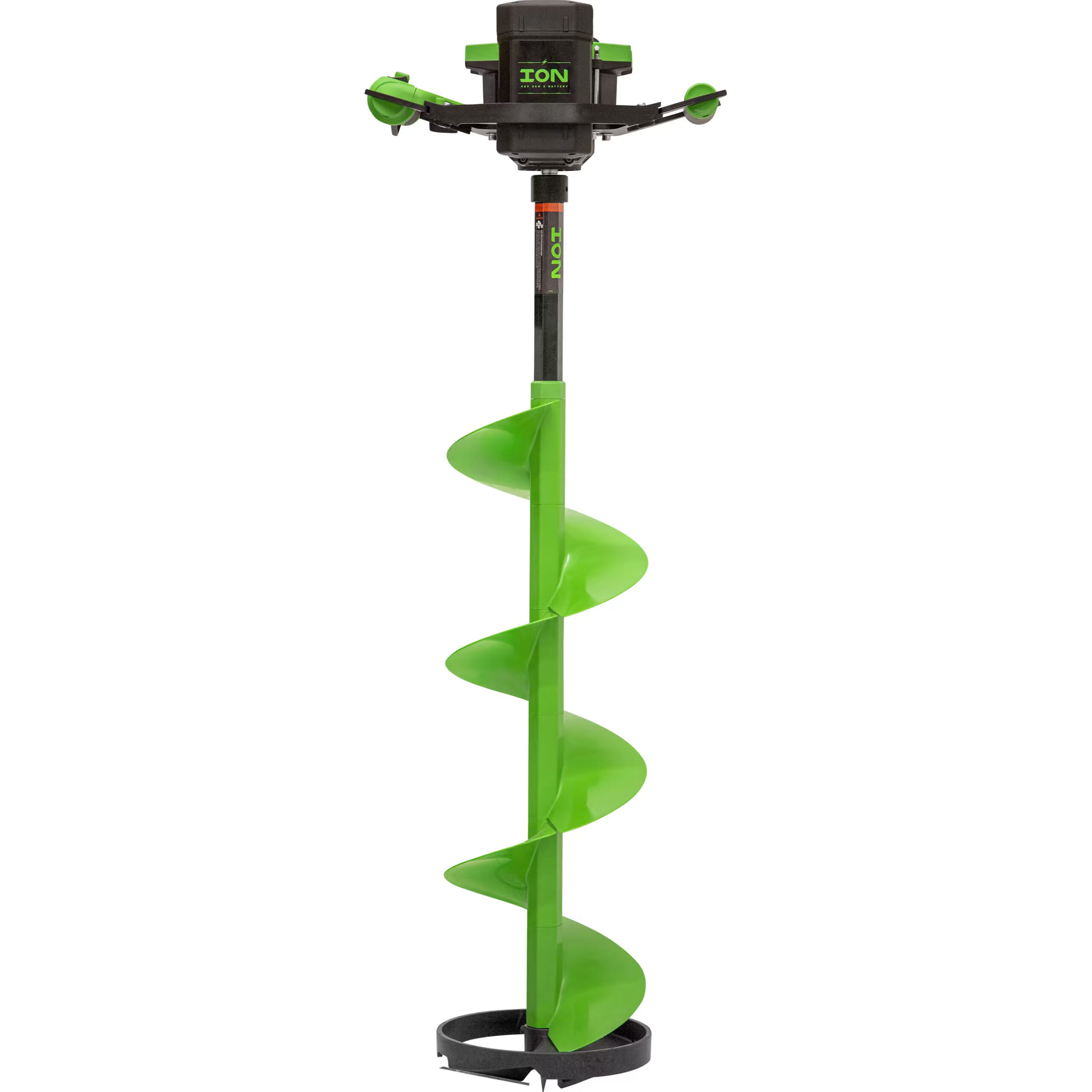
- Best Overall Electric: ION G2 — The most complete electric auger package on the market. Fast cuts, reliable battery, reverse feature for clearing slush, and a weight that won’t wreck your back on the walk out.
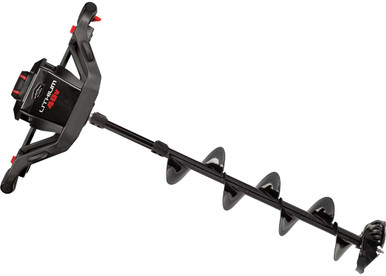
- Best Power Electric: StrikeMaster Lithium 40v — When you need gas-auger cutting speed without gas-auger headaches. The 40-volt platform chews through thick ice like nothing else in the electric category.
- Best Value Electric: Jiffy E6 Lightning — Jiffy’s proven reliability in a lighter, cleaner electric package. A smart pick for anglers transitioning from gas who don’t want to sacrifice cutting performance.
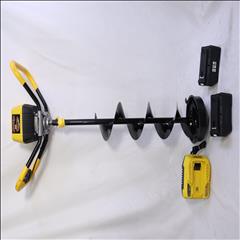
- Best Hand Auger: K-Drill Electric Ice Auger — A hybrid that bridges the gap between hand and power augers. Pair it with any 18-volt drill and you’ve got a surprisingly capable cutting system at a fraction of the weight.
Electric vs Gas vs Hand Augers: Which Type Do You Need?
This is the decision that shapes everything else about your ice fishing mobility setup, and we think the market has shifted dramatically in the last few years. Here’s where each type stands in 2026.
Electric Augers
Electric augers have taken over the hardwater world for good reason. Modern lithium-ion battery platforms deliver cutting performance that matches or exceeds most consumer-grade gas augers, and they do it without the fumes, the pull-starting, the fuel mixing, or the winterization headaches. You press a button, the auger cuts, and you move to the next hole. That simplicity is worth more than most anglers realize until they’ve spent twenty minutes yanking a pull cord in a negative-ten wind chill.
Advantages: One-button start in any temperature. No fuel mixing, no exhaust fumes inside your shelter. Dramatically quieter than gas — a genuine advantage on pressured lakes where noise spooks fish in shallow water. Lighter than comparable gas augers. Reverse functionality on most models for clearing slush from holes. Minimal maintenance beyond blade care.
Disadvantages: Battery life is finite. On a hard day of run-and-gun fishing where you’re drilling 40-plus holes through 20-plus inches of ice, you’ll want a spare battery. Upfront cost is higher than gas for equivalent cutting diameter. Extreme cold — we’re talking sustained temps below negative fifteen — can reduce battery performance, though modern lithium platforms handle this far better than they did even three years ago. Charging requires planning; you can’t just pour in more fuel on the ice.
Our take: Electric is the right choice for the majority of ice anglers in 2026. The technology has matured to the point where the old complaints about battery life and cutting power simply don’t hold up with current-generation units.
Gas Augers
Gas augers still have a place, but that place is narrower than it used to be. The core advantage of gas is unlimited runtime — as long as you have fuel, you have holes. For guides drilling 100-plus holes a day across multiple groups of clients, or for anglers consistently working through ice that exceeds 30 inches, a quality gas auger still makes practical sense. The raw power of a gas engine also cuts through refrozen holes and layered ice with less bogging than some electric platforms.
Advantages: Unlimited runtime with extra fuel. Peak cutting power still exceeds most electric augers, especially on thick or layered ice. Lower upfront cost on some models. No battery degradation over years of ownership.
Disadvantages: Pull-starting in extreme cold is genuinely miserable and sometimes impossible. Two-stroke engines require fuel mixing and winterization. Exhaust fumes are a real problem inside portable shelters — we’ve seen too many close calls with carbon monoxide to treat this casually. Heavier than electric equivalents. Louder. More maintenance overall. Gas and oil can spill on gear and clothing.
Our take: Unless you’re a guide, fish extremely thick ice regularly, or need to drill a very high volume of holes in a single outing, electric has surpassed gas for the average ice angler. We’ve seen the shift firsthand — the majority of anglers at every tournament and outing we’ve attended this season were running electric.
Hand Augers
Hand augers and drill-powered adapters like the K-Drill occupy an interesting niche that’s grown considerably with the quality of modern drill-adapter systems. A traditional hand auger with sharp blades will cut through reasonable ice thickness with nothing but arm power. A drill-powered auger gives you motorized cutting with a tool you already own, at a total system weight that’s often half of a dedicated electric auger.
Advantages: Lightest option by far — critical for anglers who walk long distances to spots. No batteries to charge, no fuel to mix (unless using a drill adapter, which uses your existing drill battery). Lowest cost. Dead simple — nothing to break down or fail except the blades. Drill-powered adapters offer motorized convenience at hand-auger weight.
Disadvantages: Pure hand augers demand real physical effort, especially through thick ice. Slower cutting than any powered option. Hole diameter options are limited on most hand models. Drill-powered setups depend on your drill’s battery and power; not all drills are up to the task.
Our take: If you’re a mobile angler who walks to your spots and drills a moderate number of holes through ice under 18 inches, a drill-powered adapter like the K-Drill is a genuinely compelling option. For thick ice or high hole counts, step up to a dedicated electric or gas auger.
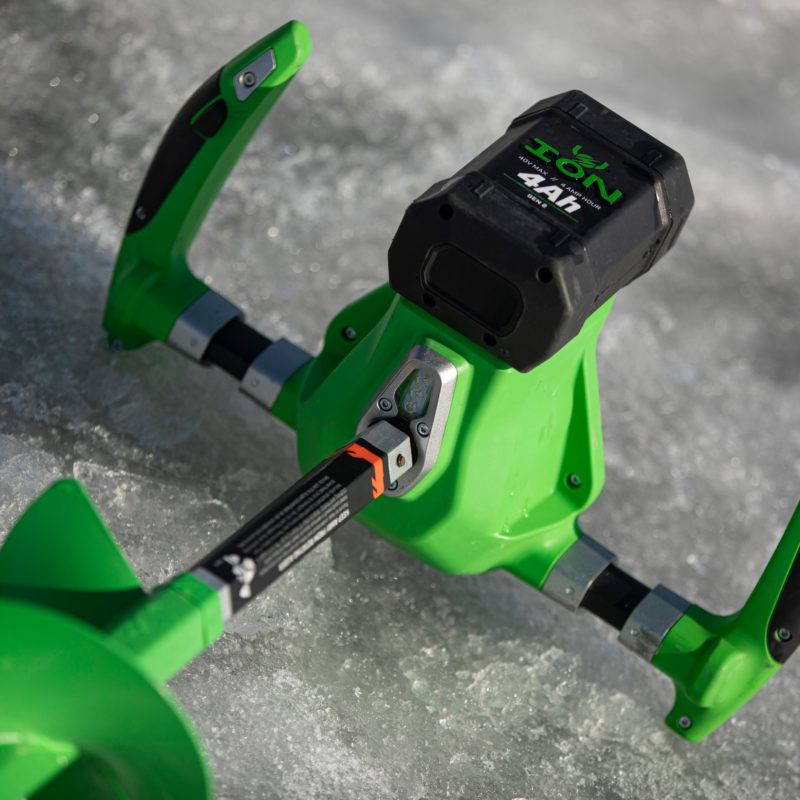
ION G2
Best for: All-around electric auger performance with the best feature set in the category
The ION G2 is the electric auger we reach for most often, and after another full season of hard use, nothing has given us a reason to change that. ION essentially built this auger around the real-world problems ice anglers face — not just cutting holes, but managing slush, working in tight shelter spaces, and getting through a full day without babysitting battery levels.
Cutting speed is excellent. The G2 cuts a clean 8-inch hole through 18 inches of solid ice in roughly 8 to 10 seconds under normal conditions. That’s fast enough that you never feel like you’re waiting, and the cuts are consistently clean with minimal chipping at the top of the hole. The reverse feature is one of those things you don’t think you need until you use it — hit the reverse button and the auger spins backward to clear slush and chips from the hole without lifting the entire unit out. On days when holes are refreezing quickly or slush is heavy, this feature alone saves time and frustration.
Battery life on the 40-volt, 6-amp-hour lithium pack is legitimately impressive. We consistently drilled 40 to 50 holes through 15 to 20 inches of ice on a single charge throughout the season. On our best day — 14-inch ice on a panfish lake in central Minnesota — we pushed past 60 holes before the battery indicator dropped to one bar. Cold performance was solid down to about negative ten. Below that, we noticed a modest reduction in per-charge hole count, but never a failure to operate. We always carry a spare battery on extreme-cold days, but honestly needed it only once.
Weight comes in around 22 pounds with the battery installed, which is manageable for most anglers. It’s not featherweight, but it’s roughly 8 to 10 pounds lighter than a comparable gas auger, and you feel that difference across a long day of hole-hopping. The overall build quality is tight — the cutting assembly, battery interface, and handle ergonomics all feel like they were designed by people who actually fish.
Hole diameter is a standard 8 inches on the model we tested, and ION offers a 10-inch option for anglers targeting pike or lake trout through larger holes. The 8-inch is the right size for the vast majority of walleye, panfish, and bass applications. If you want a deeper dive on what electronics to pair with your auger setup, our flasher and sonar roundup covers the best options for seeing what’s below those holes.
StrikeMaster Lithium 40v
Best for: Anglers who need maximum electric cutting power for thick ice and high hole counts
The StrikeMaster Lithium 40v is the auger you pick when cutting speed and raw power are the priority. StrikeMaster has long been a dominant name in the gas auger world, and their 40-volt lithium platform carries that cutting aggression into the electric category. If you’ve been hesitant to leave gas because you didn’t think electric could keep up, this is the unit that changes your mind.
Cutting speed is the StrikeMaster’s headline feature, and it delivers. Through 20 inches of solid ice, this auger completes a clean 8-inch hole in roughly 6 to 8 seconds — consistently the fastest electric cuts we recorded this season. The twin serrated stainless-steel blades bite immediately and pull through ice with authority. There’s noticeably less bogging through layered ice or refrozen holes compared to other electric augers in our testing. On a late-season trip to a northern Wisconsin lake with 28 inches of varied-density ice, the StrikeMaster punched through without hesitation while one of our other test units struggled with the transition layers.
Battery life on the 40-volt lithium pack is competitive. We averaged 35 to 45 holes through 18 to 22 inches of ice per charge, which puts it slightly behind the ION G2 in raw hole count. The tradeoff is understandable — the StrikeMaster’s motor draws more power for its faster cutting speed. A spare battery is a worthwhile investment if you’re regularly drilling more than 30 holes in a session, and StrikeMaster’s battery charges relatively quickly at around 90 minutes from empty to full. Cold-weather battery performance tracked closely with the ION — reliable down to negative ten with gradual falloff beyond that.
Weight is approximately 24 pounds with the battery, which puts it on the heavier end of the electric auger spectrum but still well under most gas augers. The extra couple of pounds over the ION are noticeable if you’re carrying the auger a long distance, but negligible when you’re drilling. The handle design is comfortable and provides solid control during cutting — an underrated detail when you’re drilling at an angle or through uneven ice.
Hole diameter is 8 inches standard, with a 10-inch configuration available. The 8-inch cuts are clean and consistent, with sharp edges that don’t require much cleanup. If you’re coming from a gas auger and want that same aggressive cutting feel in a package that starts every time, the StrikeMaster Lithium 40v is the closest thing to a direct translation. It’s earned its spot as the power choice in the electric auger category.
Jiffy E6 Lightning
Best for: Anglers who want proven Jiffy reliability in a clean, efficient electric package at a lower price point
Jiffy has been building ice augers longer than most of us have been fishing, and the E6 Lightning represents their best execution of electric auger technology to date. This is not the flashiest or most powerful electric auger in our testing, but it might be the most sensible purchase for a huge segment of ice anglers — particularly those making the jump from gas to electric and those who value long-term dependability over peak spec-sheet numbers.
Cutting speed is solid and consistent, if not class-leading. The E6 cuts an 8-inch hole through 18 inches of ice in roughly 10 to 12 seconds — a touch slower than the ION G2 and noticeably behind the StrikeMaster Lithium 40v. But here’s the thing: in practical fishing, that two-to-four-second difference per hole is nearly imperceptible across a day on the ice. What we noticed more than speed was consistency. The E6 cut with the same steady, controlled pace whether it was the first hole of the morning or the thirtieth hole after lunch. No surging, no bogging, no drama. Just reliable cuts every time.
Battery life on the Jiffy’s lithium battery pack delivered 35 to 45 holes per charge through moderate ice thickness, which is competitive with the category. Jiffy uses a standard battery mounting system that’s straightforward to swap, and their batteries have a solid reputation for longevity across multiple seasons. We tested our unit through a season and a half of heavy use without any noticeable capacity degradation. Cold-weather performance was consistent with the other lithium platforms in our testing.
Weight is approximately 23 pounds with the battery, landing it right in the middle of the electric auger pack. The E6 has a balanced feel during cutting that makes it comfortable to operate — Jiffy clearly spent time getting the weight distribution right so the auger doesn’t pull forward or twist awkwardly when the blades engage. For anglers who are new to ice fishing and want a comprehensive starting point, check out our beginner’s guide to ice fishing, which covers auger basics alongside everything else you need to get started.
Hole diameter is 6 inches standard on the E6 model, with 8-inch and 10-inch options available across the Jiffy Lightning lineup. The 6-inch is sufficient for panfish and many walleye applications, and cuts faster with less battery draw than larger diameters. If you primarily target panfish and want to maximize holes per charge, the 6-inch E6 is an efficient choice. For walleye and larger species, step up to the 8-inch version. The Jiffy name carries weight in the ice fishing community for a reason — these augers work, they last, and they don’t give you problems.
K-Drill Electric Ice Auger
Best for: Mobile anglers who want the lightest possible powered auger system by pairing with a cordless drill they already own
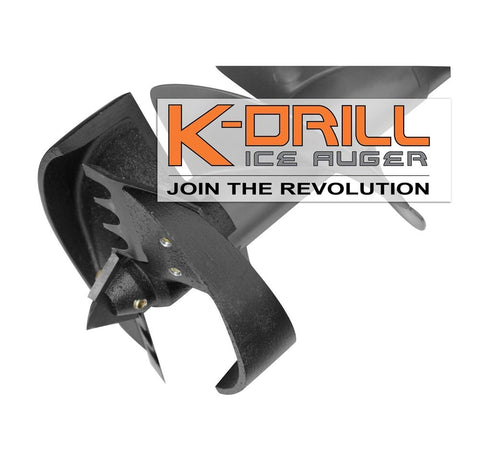
The K-Drill is a fundamentally different approach to ice auger design, and it’s one that makes remarkable sense for a specific type of angler. Instead of an integrated motor and battery system, the K-Drill is a cutting head and extension system designed to be powered by a standard 18-volt (or higher) cordless drill. You supply the drill; the K-Drill supplies the cutting. The result is a complete auger system that weighs roughly 6 to 8 pounds — a fraction of any dedicated electric or gas auger.
Cutting speed depends entirely on your drill. With a quality 18-volt brushless drill (we tested primarily with a Milwaukee M18 FUEL and a DeWalt 20V MAX), the K-Drill cuts an 8-inch hole through 15 inches of ice in approximately 15 to 20 seconds. That’s slower than any dedicated electric auger in this roundup, but it’s dramatically faster than a pure hand auger. The K-Drill’s proprietary blade design creates a self-feeding cut that doesn’t require heavy downward pressure — you guide it and let the blades do the work. The cutting action is smooth and controlled, producing a clean hole with minimal ice spray.
Battery life is your drill’s battery life, which introduces both flexibility and variability. A quality 5.0 Ah lithium drill battery gave us 15 to 25 holes through moderate ice before needing a swap, depending on ice thickness and cutting conditions. The advantage here is that most anglers who own a good cordless drill already have multiple batteries. Throw two or three in a heated pocket or an insulated bag, and you’ve got plenty of capacity for a full day. The disadvantage is that smaller or older drill batteries will deliver fewer holes and may struggle with thick ice.
Weight is the K-Drill’s killer feature. The cutting head and standard extension weigh roughly 3.5 pounds. Add a 5-pound drill and you’ve got a complete auger system under 9 pounds — less than half the weight of the lightest dedicated electric auger. For anglers who hike to remote spots, fish on foot without a sled, or simply hate hauling heavy gear, that weight savings is transformative. We used the K-Drill extensively on walk-in panfish lakes where the best spots required a half-mile trek across the ice, and the weight difference compared to a full-size auger was immediately obvious in how we felt at the end of the day.
Hole diameter is 8 inches on the model we tested, and the K-Drill also offers 6-inch and 7.5-inch cutting heads. The modular extension system lets you adjust the auger’s overall length to match ice thickness, which keeps the system compact for transport. If you already own a quality 18-volt or higher cordless drill, the K-Drill is the most cost-effective way to get a powered auger on the ice. It won’t replace a dedicated electric auger for high-volume drilling through thick ice, but for moderate use, it’s a brilliantly practical solution.
Blade Maintenance: Keep Your Auger Cutting Like New
The best auger in the world cuts like garbage if the blades are dull or damaged. Blade maintenance is the single most impactful thing you can do to preserve cutting performance, and it takes almost no time or money. Here’s what we do to keep every auger in our test fleet cutting clean.
Always use a blade guard when transporting. This sounds obvious, but it’s the number one cause of premature blade dullness we see. One contact with a rock, a concrete garage floor, or the metal bed of a truck can chip or roll a blade edge. Blade guards cost a few dollars and save you from replacing blades ten times as often.
Dry your blades after every use. When you pull the auger out of the last hole of the day, wipe the blades down with a cloth and apply a very light coat of oil — any light machine oil or even cooking spray works. This prevents rust formation, which degrades cutting edges faster than actual use on most augers. We’ve seen anglers throw wet augers in the truck and wonder why they cut poorly two weeks later. Rust is the answer.
Inspect blades before each outing. Run your thumb lightly across the flat of the blade — never along the cutting edge — and look for nicks, chips, or rolled edges. A blade with a visible chip will vibrate and cut unevenly. Most auger manufacturers sell replacement blades for $20 to $40, and swapping them takes five minutes. Don’t try to sharpen chipped auger blades yourself unless you have proper equipment; it’s almost always more cost-effective to replace them.
Carry a spare set of blades. Blades weigh almost nothing and take up zero space. If you hit a rock, a frozen stick, or a chunk of sand embedded in the ice — all of which happen more often than you’d think — having a spare set in your gear bag means your day isn’t over.
What to Look for When Buying an Ice Auger
Choosing the right auger comes down to matching the tool to your fishing style. Here are the factors that actually matter, ranked by impact on your experience.
Hole count per outing. Be honest about how many holes you drill in a typical session. If you’re a run-and-gun angler popping 30-plus holes before you settle in, you need a dedicated electric or gas auger with strong battery life or a full fuel tank. If you drill 10 to 15 holes and fish them all day, a drill-powered adapter or even a hand auger might be all you need.
Ice thickness in your area. Anglers in regions with consistently thick ice — 24 inches and up — need an auger with strong cutting power and enough battery or fuel capacity to handle the extra work per hole. Thick ice amplifies the performance differences between auger types and models.
How far you carry your gear. Weight matters exponentially the farther you walk. If you’re pulling a sled 50 yards from the truck, any auger is fine. If you’re hiking a quarter mile across a lake to a spot nobody else fishes, every pound you carry adds up. The K-Drill approach makes a lot of sense for walk-in anglers.
Hole diameter needs. Eight-inch holes cover the vast majority of freshwater ice fishing species. Six inches works well for panfish-focused anglers who want faster, more efficient cuts. Ten inches is necessary for pike, lake trout, and any species where you might need to maneuver a large fish through the hole. Larger diameters demand more power and drain batteries faster.
Noise sensitivity. If you fish pressured lakes in shallow water, auger noise is a real factor. Electric augers are dramatically quieter than gas, and hand or drill-powered options are quieter still. We’ve seen firsthand how much a loud gas auger can shut down a shallow panfish bite.
Budget. A quality electric auger runs $350 to $550 depending on brand and features. Gas augers range from $250 to $450. A K-Drill cutting head is around $150 to $200, assuming you already own a compatible drill. Factor in spare batteries or blades as ongoing costs.
Frequently Asked Questions
How many holes can an electric ice auger drill on one battery charge?
The answer depends on ice thickness, battery capacity, and auger model, but modern 40-volt electric augers consistently deliver 35 to 60 holes through 15 to 20 inches of ice on a single charge. The ION G2 led our testing in this category, regularly hitting 50 holes through moderate ice. Colder temperatures reduce battery capacity, so expect roughly 20 to 30 percent fewer holes when sustained air temps drop below negative ten. We always recommend carrying a spare battery if you’re a high-volume driller or fishing in extreme cold.
Are electric augers powerful enough to replace gas augers?
Yes, for the vast majority of ice anglers in 2026, electric augers have reached and in many cases surpassed the practical performance of consumer-grade gas augers. The StrikeMaster Lithium 40v cuts through thick ice faster than several gas augers we’ve tested over the years. The remaining edge cases for gas are extreme-volume drilling — think guides drilling 80 to 100 or more holes per day — and multi-day remote trips where recharging isn’t possible. For everyone else, electric is the better tool.
What size auger hole do I need for ice fishing?
Eight inches is the standard and the right choice for most anglers. It accommodates walleye, bass, perch, crappie, and most trout comfortably. Six-inch holes work well for dedicated panfish anglers — the smaller diameter cuts faster, uses less battery, and lets you drill more holes per charge. Go with 10 inches if you regularly target pike, lake trout, or other large species where a big fish needs room to come through the hole. Larger holes also give more room for your sonar transducer if you’re running electronics down the hole.
Can I use any cordless drill with a K-Drill or similar drill adapter auger?
Not any drill. You need a minimum of an 18-volt lithium-ion drill, and we strongly recommend a brushless motor model with at least a 4.0 Ah battery for acceptable performance. Brushed-motor drills and lower-voltage platforms lack the sustained torque needed to cut through ice efficiently and will bog down or stall in thick ice. The best performance we recorded was with Milwaukee M18 FUEL and DeWalt 20V MAX brushless drills, both of which have high sustained torque output. A 12-volt drill is not sufficient — don’t try it.
How do I keep my auger blades sharp throughout the season?
Blade longevity is almost entirely about prevention rather than repair. Use a blade guard every time the auger is in transport or storage — this is the single most important habit. Dry and lightly oil the blades after every use to prevent rust. Avoid cutting into sand, gravel, or the lake bottom, which will dull or chip blades instantly. If you fish in areas where the ice freezes around debris, go slowly and watch for dark spots in the ice that indicate foreign material. Expect to replace blades once per season under normal use, or more frequently if you drill a very high number of holes. A fresh set of blades is the cheapest and most impactful upgrade you can make to any auger.
Quick Buy — Products in This Article