
Panfish are the heartbeat of ice fishing. They’re the species that gets kids hooked, keeps veterans coming back, and fills more buckets across the ice belt than any walleye or pike ever will. Crappie and bluegill are accessible, cooperative, and when you find them — which is often — they provide some of the fastest, most addictive action available through the hardwater.
But don’t mistake “accessible” for “easy.” Ice fishing for panfish has layers of complexity that reward anglers who put in the work. Crappie suspend in the middle of the water column over deep basins, relating to structure you can’t see without electronics. Bluegill tuck into weed edges and require presentations so subtle that a heavy-handed approach will shut them down completely. Knowing where each species lives, how they behave at different times of day, and which presentation to put in front of them separates a productive day on the ice from hours of staring at a quiet hole.
We’ve spent countless seasons chasing panfish through the ice across the Midwest — from small farm ponds loaded with hand-sized bluegill to sprawling natural lakes where crappie suspend over 30 feet of water. This guide covers everything we’ve learned about finding, targeting, and catching both species consistently. If you’re new to hardwater fishing entirely, start with our ice fishing beginner’s guide for foundational gear and safety information. For our full hardwater coverage, visit the ice fishing hub.
Finding Panfish Under the Ice
The single biggest factor in ice fishing for panfish is location. You can own the best gear, tie the most refined presentations, and jig with perfect cadence — but if you’re sitting over barren water, none of it matters. Crappie and bluegill use different parts of the lake, and understanding those differences is the first step to putting fish on the ice.
Weed Edges and Green Vegetation
Bluegill are weed fish. In early and mid-winter, healthy green vegetation is the engine that drives the panfish ecosystem. Living weeds produce oxygen and harbor the invertebrates — bloodworms, scuds, small larvae — that bluegill feed on. The edges of weed beds, where vegetation meets open bottom, are the highest-percentage zones for bluegill through the ice.
Look for weed edges in 8 to 15 feet of water on most natural lakes. Cabbage (pondweed) and coontail are the two most common species that stay green longest into winter. The outside edge, where the last stalks of vegetation drop off into deeper water, concentrates fish because it provides both food and cover immediately adjacent to escape routes. Bluegill patrol this edge, moving in and out of the weeds to feed.
A key mistake anglers make is drilling holes directly on top of thick weed beds. The vegetation clogs your hole, tangles your jig, and makes it nearly impossible to fish effectively. Instead, set up right on the clean edge where the weeds thin out and transition to open bottom. This is the dinner table for bluegill, and they’ll come to you.
Basin Transitions and Deep Structure
Crappie are a different story. While bluegill hug the weeds, crappie relate to basin transitions — the spots where a flat drops off into the main lake basin. Depth contour changes of even a few feet concentrate crappie, especially where a structural feature like a point, inside turn, or sunken island creates a defined edge near deep water.
On many natural lakes, the 20- to 30-foot zone along the first major break is prime crappie territory during mid-winter. These fish use the deeper water as a staging area and move laterally along the break to feed. Understanding the basin structure through a good lake map is essential. Mark the transitions, drill over them, and let your electronics confirm whether fish are using the area.
Suspended Crappie Over Deep Water
Here’s where crappie get interesting — and where a lot of ice anglers struggle. Crappie are one of the few freshwater species that routinely suspend in open water under the ice. They’ll hang 10, 15, even 20 feet off the bottom over the deepest part of the basin, relating to nothing visible on a map. They’re following suspended plankton and baitfish, and their position in the water column can change by the hour.
Catching suspended crappie requires electronics. There’s simply no way to target them consistently without a flasher or sonar unit showing you exactly where they’re sitting in the water column. We’ll cover electronics strategy in detail below, but understand this: if you’re only fishing on the bottom for crappie, you’re missing a huge percentage of the population during mid- and late winter.
Shallow Bluegill in Early Ice
During the first two to three weeks of safe ice, bluegill can be shockingly shallow. We’ve caught limits of quality bluegill in 3 to 6 feet of water over still-green weed flats that most anglers walk right past on their way to deeper water. Early ice bluegill are aggressive, competitive, and haven’t yet been pressured by weeks of drilled holes and dropped jigs. If you can find safe ice over a shallow weed flat that produced bluegill in the fall, fish it. The fish are probably still there.
Electronics Strategy for Panfish
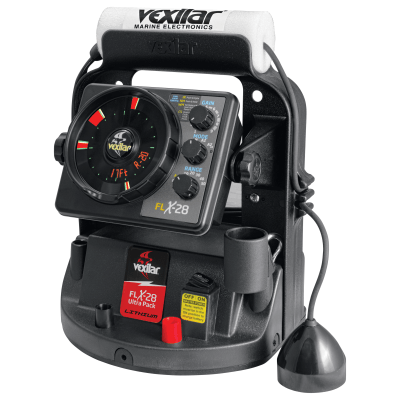
A flasher is the single most important tool for ice fishing for panfish, and it’s not even close. For crappie especially, electronics are the difference between targeting fish and guessing. Our guide to the best ice fishing flashers and sonar breaks down the full category, and our Vexilar FLX-28 review covers the unit we rely on most for panfish.
Reading Suspended Fish
When you drop your transducer down the hole, you’re looking for marks above the bottom — colored bands or arcs that indicate fish holding in the water column. Crappie often appear as a cluster of marks at a consistent depth, hovering together in a loose school. Bluegill tend to show as marks tighter to the bottom or within the weed zone.
The critical skill is matching your jig depth to the fish marks. If you see crappie suspended at 15 feet in 28 feet of water, your jig needs to be at 15 feet — not 28. This sounds obvious, but a surprising number of anglers park their jig on the bottom and wait, never realizing the fish are holding 13 feet above them.
Using the Zoom Feature
Most quality flashers offer a zoom or bottom-lock feature that magnifies a narrow section of the water column. For panfish, this is essential. Zooming in on the zone where fish are holding lets you see the subtle movements — a fish rising a few inches toward your jig, backing off, or drifting laterally out of the cone. These micro-movements tell you whether your presentation is working or whether you need to change cadence, size, or color.
When fishing bluegill in the weeds, zoom into the top of the vegetation and the few feet of water above it. You’ll see fish moving along the weed tops and be able to place your jig right in their feeding lane. For suspended crappie, zoom into the depth band where the school is holding and watch how they respond to your jigging. A fish that rises toward your bait and stalls is interested but not committed — slow down, add a subtle quiver, and give it time.
Jigging for Crappie Through the Ice
Crappie have paper-thin mouths, relatively large eyes, and a preference for small baitfish and invertebrates. Every aspect of your crappie presentation should reflect those traits: light tackle, controlled jigging, and baits that either mimic small minnows or trigger reaction strikes through flash and vibration.
Small Spoons
A 1/16- to 1/8-ounce jigging spoon is a staple crappie bait through the ice. Spoons like the Northland Buckshot Rattle Spoon, Custom Jigs and Spins Slender Spoon, and Clam Leech Flutter Spoon all produce consistently. Tip the treble hook with a small minnow head or a few spikes (maggots) to add scent and give a crappie a reason to hold the bait once it strikes.
The jigging motion for crappie spoons is a controlled lift-and-flutter. Snap the rod tip up 6 to 12 inches, then let the spoon flutter back down on a semi-slack line. The erratic falling action is what triggers strikes — crappie almost always hit on the drop or during the pause at the bottom of the fall. Watch your flasher carefully. When you see a mark rise toward your spoon, resist the urge to keep jigging aggressively. Let it hang, give it a tiny quiver, and wait for the fish to commit.
Tungsten Jigs and Plastics
Tungsten jigs have reshaped panfish ice fishing over the last decade. Because tungsten is denser than lead, a tungsten jig is significantly smaller than a lead jig of the same weight. That smaller profile matters enormously for crappie, which can be surprisingly selective about jig size. A 1/32- or 1/16-ounce tungsten jig tipped with a 1.5- to 2-inch soft plastic — a small paddle tail, curly tail grub, or minnow imitation — is one of the most versatile crappie presentations available through the ice.
Color selection varies by water clarity and light conditions, but we lean on a few proven patterns: pink and white in stained water, black and chartreuse in low-light conditions, and natural baitfish colors (silver, grey, ghost patterns) in clear water under bright skies. The key is having variety and being willing to change when bites slow.
Jigging Cadence for Crappie
Crappie respond to rhythm. A productive jigging cadence isn’t random — it’s a repeating pattern of movement and pause that gives fish time to track and commit. A good starting cadence is: two small lifts (3 to 4 inches), a controlled drop, a three-second pause. Repeat. If you’re marking fish that approach but won’t commit, extend the pause to five or even ten seconds and add the lightest possible quiver during the pause. Sometimes the tiniest vibration is what breaks a crappie’s hesitation.
The biggest mistake we see with crappie jigging is impatience. When a crappie appears on your flasher and starts rising toward your bait, the natural instinct is to jig harder to “sell” the presentation. Do the opposite. The moment a fish commits and starts moving toward your jig, stop moving or reduce your motion to an almost imperceptible shake. Let the fish close the distance on its own terms.
Jigging for Bluegill Through the Ice
Bluegill require a fundamentally different approach than crappie. Where crappie will chase a spoon through several feet of water, bluegill are grazers. They feed on tiny invertebrates — bloodworms, insect larvae, freshwater shrimp — and they inspect their food closely before eating it. Your presentation needs to match that behavior: small, slow, and subtle.
Tiny Jigs and Live Bait
The bread-and-butter bluegill presentation through the ice is a small tungsten jig — 1/64- or 1/32-ounce — tipped with one or two waxworms or a couple of spikes. The jig should be small enough that the bait is the primary visual element, not the metal. Popular jig styles include the Clam Drop Kick, Custom Jigs and Spins Chekai, and Tungsten Tubby. Glow colors (chartreuse glow, pink glow, orange glow) are effective in low-light conditions and deeper water where natural light doesn’t penetrate well.
Waxworms are the go-to live bait for bluegill for a reason — they’re the right size, they exude scent, and their soft texture encourages bluegill to hold the bait long enough for you to detect the bite and set the hook. Thread the waxworm onto the jig hook so a portion hangs free, giving it a natural profile and movement. Some anglers prefer spikes (maggots) for their durability, especially when fish are biting aggressively and tearing waxworms apart.
Slow, Subtle Presentations
Bluegill jigging is an exercise in restraint. The motion that triggers bluegill is not a lift and drop — it’s a slow, steady raise punctuated by near-motionless pauses. Lift your jig 2 to 4 inches over the course of a full second, pause for two to three seconds, then lower it back down at the same controlled speed. The goal is to mimic the slow drift of a small insect larva rising through the water column — exactly the kind of movement bluegill are wired to investigate.
When you see a bluegill approach on your flasher, hold your jig dead still or give it the faintest tremble — just enough to barely move the spring bobber if you’re using one. Bluegill will often sit inches from a jig for several seconds, studying it, before either eating or turning away. Any abrupt movement during this inspection phase will spook them. Patience at this moment is the single most important skill in bluegill ice fishing.
Best Presentations by Time of Day
Understanding when crappie and bluegill feed — and how their behavior shifts — lets you plan your day on the ice for maximum efficiency rather than blind hope.
Early Morning
Both species are active in the first hour of light, but bluegill are often the more reliable early-morning bite. Hit the weed edges first with small jigs and waxworms. Bluegill feed early, and the low-light conditions keep them less wary. Crappie can be active at dawn as well, particularly in shallow bays where they pushed up overnight to feed.
Midday
This is the toughest window for both species. Bluegill retreat deeper into weed cover and become more selective. Crappie may suspend higher in the water column under bright conditions, which sounds counterintuitive but relates to how they track plankton. Downsize your presentations across the board during midday. Use the smallest jigs in your box, slow your cadence to a near-stop, and focus on quality over quantity.
Late Afternoon and Dusk
The evening bite is the premier window for crappie through the ice. As light fades, crappie schools become active, often moving shallower and feeding more aggressively than they have all day. Switch to slightly larger spoons or jigs to increase your strike zone and take advantage of their willingness to chase. Bluegill also feed at dusk, but their bite window is typically shorter and less dramatic than crappie. Focus the last hour of light on crappie if you’re targeting both species.
After Dark
Crappie feed well into darkness on many lakes, especially under a new moon. If your state allows night ice fishing, staying an extra hour past sunset can produce some of the largest crappie of the day. Bluegill, on the other hand, largely shut down once full darkness sets in. Glow jigs and glow spoons become essential in low-light conditions — charge them periodically with a UV light or camera flash.
Deadsticking for Panfish
Deadsticking is the art of fishing a second rod with a stationary bait while you actively jig with your primary rod. In most states that allow two lines through the ice, running a deadstick alongside your jigging rod is one of the most effective panfish strategies available.
The Setup
A deadstick rod is typically an ultralight spinning rod in the 24- to 28-inch range, mounted in a rod holder next to your jigging hole. Rig it with a small hook — size 8 or 10 — a tiny split shot 6 to 8 inches above the hook, and a spring bobber on the rod tip to detect bites. A live minnow (fathead or small crappie minnow) hooked through the back or lips is the standard deadstick bait for crappie. For bluegill, a waxworm on a small jig under a spring bobber is more effective.
Why It Works
The deadstick exploits a fundamental behavior of panfish under the ice. Your active jigging rod calls fish into the area with flash and vibration. Fish that approach but won’t commit to the moving jig often slide over and eat the stationary minnow or waxworm hanging quietly nearby. We’ve had days where the deadstick rod outfished the jigging rod three to one — particularly during tough midday bites when fish were present but reluctant.
Set your deadstick bait at the depth where you’re marking fish on your flasher. Check it every few minutes to ensure the minnow is still lively and the bait is at the right depth. A spring bobber is essential for detecting the light, tentative bites that bluegill and crappie often deliver to a stationary bait. Watch for a slow pull-down or a subtle lift — both indicate a fish has the bait.
Ice Fishing Panfish Gear
Panfish through the ice demand the lightest, most sensitive tackle you can get your hands on. These are small fish with small mouths and subtle bites. The gear that works for walleye and pike is far too heavy for effective panfishing.
Ultralight Rods
A quality panfish ice rod is 24 to 30 inches long, rated for 1- to 4-pound test line, and has a fast-action tip that loads under the weight of a small panfish. The tip needs to be sensitive enough to detect a bluegill inhaling a jig at 15 feet. Several manufacturers build dedicated panfish ice rods — 13 Fishing, St. Croix, Fenwick, and Clam all produce excellent options in the $40 to $100 range. We recommend owning at least two: one for active jigging and one for deadsticking.
Line Selection
Line is the most overlooked element of panfish ice fishing. Use 1- to 2-pound test monofilament or fluorocarbon for the majority of your panfishing. Heavier line dramatically reduces bite detection and makes tiny jigs behave unnaturally in the water. Fluorocarbon’s low visibility and low stretch make it the preferred choice for clear water and pressured fish. Monofilament is slightly more forgiving and works well in stained water or for beginners.
Some anglers prefer superline (braided line) as a mainline with a short fluorocarbon leader tied via a small barrel swivel or double uni knot. This setup gives you the sensitivity and zero-stretch of braid for bite detection with the near-invisibility of fluorocarbon at the business end. It’s an excellent system, particularly in deeper water where stretch in mono can mask subtle bites.
Small Reels
A panfish ice reel doesn’t need to hold 200 yards of line or have a carbon fiber drag system. It needs a smooth drag that won’t break 2-pound test on the hookset and a spool diameter that doesn’t coil light line into unmanageable memory. Small inline reels and micro spinning reels are the two main categories. Inline reels eliminate line twist entirely, which is a genuine advantage with light line. Spinning reels are more familiar to most anglers and work perfectly well with periodic line replacement.
Hole Hopping vs. Sitting: Mobility Strategy
One of the great tactical debates in panfish ice fishing is whether to drill a grid of holes and move aggressively or set up on a known spot and wait. The answer is both — depending on conditions and which species you’re targeting.
When to Hole Hop
Hole hopping is the superior strategy early in a session when you haven’t located fish yet. Drill a grid of 10 to 15 holes across a likely area — along a weed edge, over a basin transition, or through a known panfish flat — and move through them systematically. Drop your jig, check your flasher for marks, and give each hole three to five minutes. If you’re not marking fish, move. Panfish school up under the ice, and a hole that’s dead empty is unlikely to suddenly produce fish unless a school migrates into range.
Mobility is especially important for crappie. Their schools move horizontally, and the hole that produced 20 fish an hour ago might be empty now because the school shifted 50 yards. Stay mobile, keep drilling, and follow the fish.
When to Sit
Once you’ve located an active school — consistent marks on your flasher, bites coming regularly — sit down and work that school. This is especially true for bluegill on a weed edge. A productive bluegill hole can produce fish for hours because the school is relating to a stationary feature (the weed edge) rather than roaming open water. Set up your shelter, deploy your deadstick, and settle in.
The key is reading the situation. If bites slow and marks disappear from your flasher, don’t wait 30 minutes hoping they come back. Get up, move to the next hole, and find them again. The best panfish anglers we know alternate between aggressive mobility and patient fishing — always dictated by what the electronics are telling them.
Keeping Panfish Fresh on the Ice
If you’re keeping fish for the table — and panfish are among the finest freshwater eating available — how you handle them on the ice matters. Panfish flesh is delicate and deteriorates quickly if not cared for properly.
Keep a bucket or insulated bag with a layer of snow or crushed ice on the bottom. Place harvested fish directly on the ice, belly down, and add more snow or ice on top as the bucket fills. The goal is keeping the fish cold and moist but not submerged in water, which can waterlog the flesh. On very cold days, fish frozen directly on the ice are fine, but avoid letting them repeatedly freeze and thaw if temperatures fluctuate.
Know your state’s regulations for daily bag limits and size restrictions on crappie and bluegill. Many lakes have specific slot limits designed to protect the larger breeding fish that maintain a healthy population. Selective harvest — keeping moderate-sized fish and releasing the true trophies — helps ensure panfish populations remain strong for future seasons. Count your fish as you go and stop well before you approach the limit. Responsible harvest is a core part of our testing and editorial philosophy.
Frequently Asked Questions
What Is the Best Depth for Panfish Through the Ice?
Depth depends on the species and the time of winter. Bluegill are most consistently found in 8 to 15 feet of water along weed edges during early and mid-winter, occasionally shallower during first ice. Crappie range more widely — from 15 to 30 feet or more — and often suspend well off the bottom in the deepest basins. Use a lake map to identify weed edges and basin transitions, then confirm with your electronics. The fish will tell you the right depth if you drill enough holes.
What Size Jig Should I Use for Ice Fishing Panfish?
For bluegill, start with a 1/64- or 1/32-ounce tungsten jig. For crappie, a 1/32- to 1/16-ounce jig or small spoon works in most situations. The guiding principle is to use the lightest jig that reaches your target depth in a reasonable time. Heavier jigs fall faster but look less natural. In shallow water under 10 feet, go as light as possible. In deeper water, size up slightly to maintain feel and contact with your bait.
Do I Need a Flasher to Catch Panfish Through the Ice?
You can catch panfish without a flasher, especially bluegill over shallow weed flats where the fish are predictable. But for crappie — particularly suspended crappie in deeper water — a flasher is effectively a requirement. It shows you where fish are in the water column, how they respond to your jig, and whether a spot is worth fishing. The best ice fishing flashers and sonar units range from entry-level options around $200 to full-featured units like the Vexilar FLX-28 that we use as our primary panfish tool.
What Is the Best Live Bait for Panfish Through the Ice?
Waxworms are the top choice for bluegill — they’re soft, scented, and perfectly sized for small jigs. Spikes (maggots) are a close second and last longer on the hook. For crappie, small minnows (fatheads or crappie minnows) fished on a deadstick or tipped on a jig or spoon are the go-to live bait. Many anglers carry all three and experiment to see what the fish prefer on a given day.
When Is the Best Time of Year to Ice Fish for Panfish?
First ice and late ice are the two peak windows. During early ice, panfish are still relatively shallow, aggressive, and grouped tightly near weed cover. Late ice brings a pre-spawn feeding surge where both crappie and bluegill bulk up before the spawn, often producing the largest fish of the winter. Mid-winter — the deep cold of January and February — is the toughest stretch, with reduced fish activity and more finesse required. That said, panfish can be caught throughout the entire ice season with the right approach and willingness to adapt.