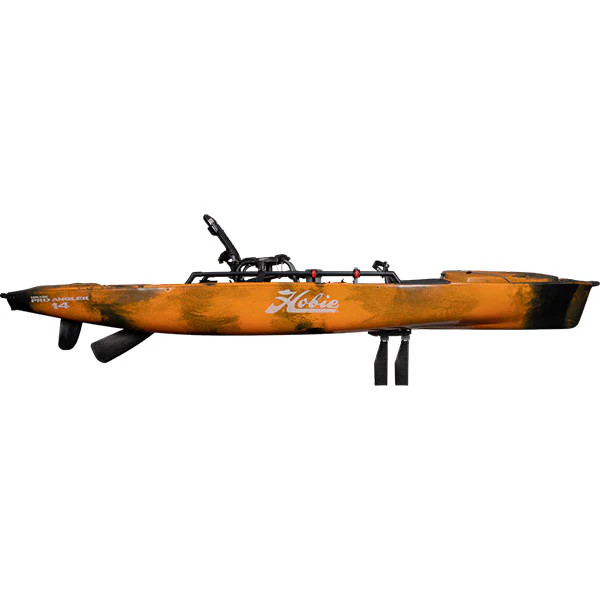
Pros
- Unmatched stability for standing and casting
- MirageDrive 360 is the best pedal system available
- Massive storage and rigging versatility
- Premium build quality and resale value
- Excellent tracking in wind and current
Cons
- Heavy at 120+ lbs — difficult to load solo
- Premium price point
- Overkill for casual anglers
- Too wide for narrow waterways
There’s a reason the Hobie Mirage Pro Angler 14 shows up in nearly every serious kayak fishing conversation. It’s been the benchmark hull in the pedal drive category for years, and every competitor that enters the market is measured against it — whether they admit it or not. We’ve spent months fishing from the Pro Angler 14 across a range of conditions, from protected coastal flats to windswept reservoirs, to find out whether this flagship kayak still deserves the throne. Here’s our full breakdown based on our testing methodology.
Who This Kayak Is For
The Pro Angler 14 is built for the dedicated kayak angler who fishes frequently, values capability over convenience, and wants the most complete fishing platform available in a kayak hull. If you’re fishing tournaments, targeting big species, spending full days on the water multiple times a month, or simply refuse to compromise on gear — this is your kayak.
It’s also the right call for anglers who prioritize standing and sight fishing. The stability on this hull is in a class of its own. We stood, cast, fought fish, and managed tackle without once feeling like the kayak was working against us. If your fishing style demands confidence on your feet, the Pro Angler 14 delivers it without hesitation.
Skip this kayak if: You fish casually a handful of times per year (the investment doesn’t justify itself), you primarily fish narrow creeks or rivers with tight turns (it’s too wide and long to maneuver comfortably), you need to load and launch solo without a cart or ramp (120+ pounds is no joke), or you’re on a budget that tops out under $3,000 (the Old Town Sportsman 120 PDL offers remarkable value at a lower price point).
Key Specifications
| Spec | Detail |
|---|---|
| Length | 13 ft 8 in |
| Width | 36 in |
| Weight (hull only) | ~120 lbs |
| Weight (rigged) | ~130 lbs |
| Max Capacity | 600 lbs |
| Drive System | MirageDrive 360 with Kick-Up Fins |
| Seat | Vantage ST |
| Hull Material | Rotomolded polyethylene |
| Rod Holders | 6 (combination of flush-mount and vertical) |
| Gear Tracks | H-Track system, multiple rails |
| Transducer Ready | Yes, Lowrance-ready scupper |
| MSRP | ~$4,799 |
Stability: Stand With Absolute Confidence
We’ll say it plainly — the Pro Angler 14 is the most stable fishing kayak we’ve tested. At 36 inches wide with a hull shape engineered specifically for a low center of gravity, this kayak feels planted. Primary stability (the initial “locked in” feeling when you sit down) is immediate and reassuring. Secondary stability (resistance to tipping when you lean to net a fish, reach for a rod, or shift your weight while standing) is equally impressive.
We spent entire sessions standing and casting without sitting down. Fighting a hard-running redfish while standing, leaning into a hookset on a jig, netting fish over the side — none of it introduced the kind of wobble or uncertainty you feel on narrower hulls. For anglers transitioning from boats or those who’ve been hesitant to stand on a kayak, the Pro Angler 14 removes that mental barrier completely.
The wide beam does come with a tradeoff. In a stiff crosswind, the 36-inch width catches more air than a narrower kayak, and you’ll notice increased drift when you stop pedaling. But the MirageDrive 360 compensates for this so effectively that it barely registers as an issue once you’re comfortable with the drive controls.
MirageDrive 360: The Best Pedal System on the Water
The MirageDrive 360 is the single biggest reason the Pro Angler 14 sits at the top of this category, and it’s not particularly close. Full 360-degree pedal propulsion means you have forward, reverse, and lateral movement all controlled from a handlebar mechanism at your seat. No other consumer pedal drive system offers this level of maneuverability.
In practice, the 360 system transforms how you fish. Approaching a brush pile, we could pedal forward, then seamlessly shift to a lateral slide to position for the perfect casting angle — all without lifting a paddle or adjusting a rudder. Holding position in current while working a shoreline was effortless. When we hooked up and a fish ran toward structure, we could instantly reverse to maintain line tension without the frantic grab-for-a-paddle moment that happens on rudder-only systems.
The kick-up fins deserve their own mention. When pedaling across a shallow oyster bar or through submerged grass, the fins deflect upward on contact and reset automatically. This means you can pedal confidently in water where a rigid propeller system would force you to pull the drive. We ran the Pro Angler 14 across flats in under 14 inches of water without damage or hang-ups. That shallow-water capability is a genuine operational advantage for inshore anglers.
The MirageDrive 360 is not without its quirks. The fin-based system has more moving parts than a propeller drive, and replacement fins are a recurring cost for heavy users. The handlebar steering mechanism takes a few outings to develop muscle memory — early on, we occasionally turned the wrong direction when our brain defaulted to rudder-pedal logic. After three or four sessions, it becomes second nature.
Tracking and Speed
For a 36-inch-wide kayak that weighs 130 pounds rigged, the Pro Angler 14 tracks remarkably well. We attribute this to the hull’s length — at nearly 14 feet, it has the waterline length to maintain a course even in quartering winds and crosscurrents. We tested it on a large reservoir with sustained 15-mph winds and were able to hold a trolling line without constant correction.
Cruising speed with moderate effort sits around 3.5 mph, which is competitive for a hull this wide. With sustained hard pedaling, we pushed it to just under 5 mph in calm conditions. It’s not the fastest pedal kayak on the market — narrower hulls from Native Watercraft and Wilderness Systems will outpace it on open water — but speed has never been the Pro Angler’s primary design objective. This is a fishing platform, and it trades top-end speed for the stability and deck space that matter more when you’re actually fishing.
Where tracking really shines is in current. We tested the Pro Angler 14 in tidal rivers with moderate flow and found that the combination of hull length and the MirageDrive 360’s precise control made holding and adjusting position against current straightforward. The lateral movement capability is especially useful here — you can slide sideways to adjust your drift line without breaking your forward momentum.
Storage and Rigging: A Tackle Shop on Water
The Pro Angler 14’s deck layout is, frankly, absurd in the best way. Hobie designed this kayak for anglers who bring everything, and it shows.
The rectangular bow hatch opens to a cavernous storage compartment with a removable liner that doubles as a functional cooler. We’ve fit full-size tackle trays, rain gear, lunch, and a bag of soft plastics in there with room to spare. The liner lifts out for easy cleaning, which matters more than you think after a long day with bait and fish.
The rear tankwell is massive, large enough for a full-size kayak crate with a battery, tackle organizers, and a catch bag stacked on top. Bungee tie-downs secure everything, and the H-Track rails on both sides of the tankwell let you mount additional rod holders, camera mounts, or whatever else your rigging demands.
Speaking of H-Track, it runs along both gunwales and around key deck areas, giving you virtually unlimited mounting options for aftermarket accessories. We ran two fish finders, a camera mount, two additional rod holders, and an anchor trolley cleat — all on the stock track system with no drilling required.
The kayak comes with six rod holders out of the box — a combination of flush-mount and vertical. For most anglers, that’s enough to run trolling rods, keep a backup rigged, and still have holders free for landing tools. The positioning is well-considered; rods don’t interfere with pedaling, casting, or the drive system.
Hobie also includes a Lowrance-ready transducer scupper that lets you install a fish finder transducer cleanly through the hull without aftermarket modifications. This is a small detail that saves time, preserves hull integrity, and produces a cleaner transducer signal than external mounting solutions.
Comfort: All-Day Seating Done Right
The Vantage ST seat that ships with the Pro Angler 14 is the most comfortable stock seat we’ve tested in a fishing kayak. The suspended mesh design keeps you cool, the aluminum frame is rigid without being harsh, and the adjustment range covers everything from a low, reclined cruising position to a high, elevated perch for sight fishing.
Lumbar support is built in and actually functional. We fished 8-hour days from this seat and stepped off the kayak without the low-back stiffness that plagues cheaper seat designs. The seat swivels — a subtle feature that makes an enormous difference when you’re fighting a fish on the opposite side of the kayak, reaching for a tackle tray, or simply trying to stretch.
Leg room is generous. Even taller anglers (we tested with a 6’3” paddler) had no complaints about knee clearance while pedaling. The foot brace positioning is adjustable and locks securely, which matters when you’re putting sustained effort into the MirageDrive on a long crossing.
The Benchmark Score Breakdown
We evaluate every kayak we test against our standardized scoring methodology. Here’s how the Pro Angler 14 breaks down:
- Stability: 10/10 — The best in class, period. No other pedal kayak matches it.
- Drive System: 9.5/10 — The MirageDrive 360 is the most capable pedal system available. Half-point deduction for parts complexity and replacement costs.
- Tracking & Speed: 8/10 — Impressive for this beam width, but narrower hulls are faster.
- Storage & Rigging: 9.5/10 — Massive capacity, thoughtful layout, extensive track system.
- Comfort: 9/10 — Vantage ST is best-in-class. All-day sessions are genuinely comfortable.
- Build Quality: 9/10 — Premium construction with excellent fit and finish. Strong resale value reflects durability.
- Portability: 6.5/10 — This is the Pro Angler’s weakness. 130 lbs rigged, 36 inches wide, and awkward for solo car-topping. A cart and a plan are mandatory.
- Value: 8/10 — Expensive, but you get a complete, premium fishing platform. The resale market confirms the investment holds.
Overall: 8.8/10
How It Compares
The Pro Angler 14 doesn’t exist in a vacuum. Two kayaks consistently come up as alternatives, and the comparison is worth addressing directly. For a deeper look at these and other pedal kayaks, see our full best pedal drive fishing kayaks roundup.
vs. Old Town Sportsman 120 PDL
The Sportsman 120 is the value play in this comparison. At roughly half the price of the Pro Angler 14, it delivers a surprisingly capable fishing experience with Old Town’s reliable PDL Drive. It’s lighter at around 100 pounds, making solo transport far more manageable. Where it falls short is in maneuverability (no 360-degree drive), standing stability (good but not Pro Angler-good), and overall storage capacity. If you’re choosing between these two, the decision often comes down to budget and commitment level. The Sportsman 120 is the smart choice for anglers who fish regularly but don’t need the absolute pinnacle of capability. The Pro Angler 14 is for anglers who refuse to compromise.
vs. Bonafide SS127
The SS127 is the closest competitor in pure standing stability, thanks to its catamaran-inspired hull design. It’s an exceptional sight fishing platform that costs significantly less than the Pro Angler 14. Where the Pro Angler pulls ahead is in the drive system (the MirageDrive 360 outclasses everything else), storage volume, and overall feature set. The SS127 sacrifices some speed and tracking efficiency for its ultra-stable deck, and it doesn’t offer the same 360-degree maneuverability. If your fishing is almost exclusively sight casting on flats, the SS127 deserves serious consideration. For everything else, the Pro Angler 14’s broader capability set makes it the more versatile investment.
Frequently Asked Questions
Is the Hobie Pro Angler 14 worth the price?
For dedicated anglers who fish frequently, yes. The Pro Angler 14 commands a premium, but it delivers a level of on-water capability, comfort, and rigging versatility that no other single kayak matches. The MirageDrive 360 alone justifies a significant portion of the price differential over competitors. Factor in the exceptional resale value — used Pro Anglers hold their value better than almost any other kayak on the market — and the total cost of ownership becomes more reasonable than the sticker price suggests. If you fish fewer than a dozen times a year, the Old Town Sportsman 120 PDL gives you 80% of the experience at half the cost.
Can one person load the Pro Angler 14 onto a vehicle?
It’s possible, but it requires planning and the right equipment. At 120+ pounds hull weight and 36 inches wide, car-topping the Pro Angler solo is a serious physical task. Most Pro Angler owners use one of three solutions: a truck bed with a bed extender or tailgate pad, a trailer (purpose-built kayak trailers or small utility trailers), or a roller-style roof rack loader paired with a quality J-cradle or saddle system. A kayak cart is essential for getting from the parking lot to the water. We strongly recommend testing your entire loading workflow before your first fishing trip — struggling with 120 pounds of kayak at a dark boat ramp at 5 AM is not how you want to start your day.
How does the MirageDrive 360 handle shallow water?
Exceptionally well for a pedal system. The kick-up fins deflect upward on contact with the bottom, structure, or vegetation, then reset automatically. We pedaled confidently across flats in 12 to 16 inches of water without hanging up. In truly skinny water under a foot deep, you’ll want to retract the drive and switch to a paddle or push pole — but that’s true of every pedal drive on the market. The MirageDrive 360 gives you more shallow-water confidence than any propeller-based system, which is a meaningful advantage for inshore anglers working tidal flats, oyster bars, and grass beds.
What electronics setup works best on the Pro Angler 14?
The Pro Angler 14 is Lowrance-ready out of the box with a dedicated transducer scupper, so a Lowrance fish finder is the path of least resistance. Most anglers run a 7- to 9-inch Lowrance unit (ActiveTarget or HDS Live are popular choices) mounted forward on the H-Track using a RAM or YakAttack mount. The bow area has enough space and track to support a second, smaller unit if you want forward-facing sonar and a traditional down/side imaging display running simultaneously. Power typically comes from a 12V lithium battery stowed in the rear tankwell crate. Run your wiring through the kayak’s internal channels to keep the deck clean and prevent snags.
How long does the MirageDrive 360 last before needing maintenance?
With proper care, the MirageDrive 360 is remarkably durable. The most important maintenance habit is rinsing the entire drive unit with fresh water after every saltwater outing. Saltwater corrosion is the number-one killer of pedal drive components, and a thorough rinse takes two minutes. Beyond that, inspect the fins for wear or cracking every 20 to 30 outings, lubricate the mast and chains per Hobie’s maintenance schedule, and check all fasteners periodically. Most anglers get two to four full seasons of heavy use before needing to replace fins or cables, depending on conditions and frequency. Hobie’s replacement parts are readily available, and the drive is designed for owner-serviceable maintenance — you don’t need a dealer for routine upkeep.