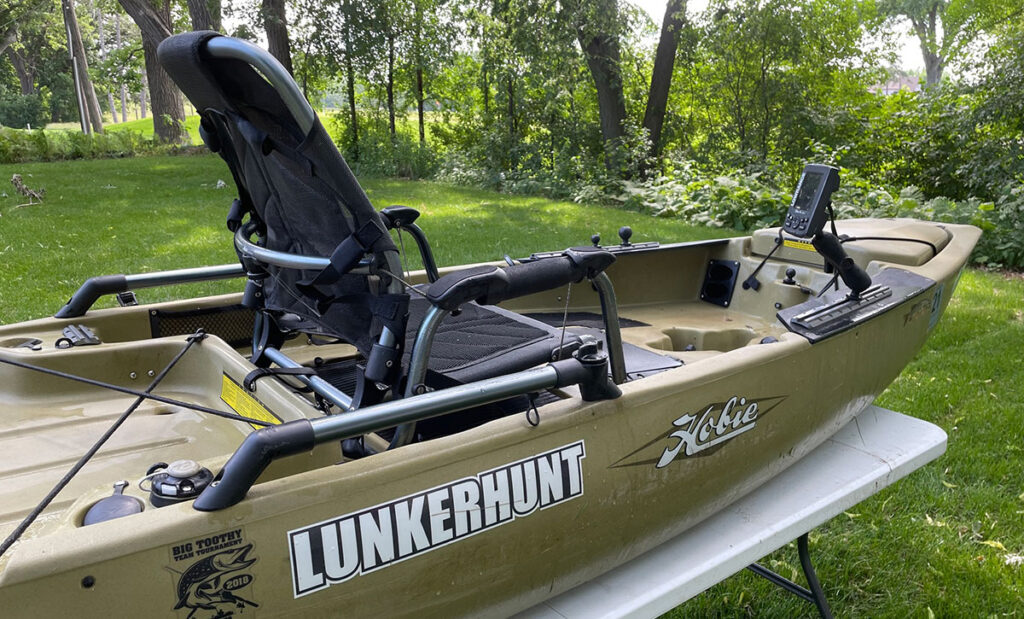
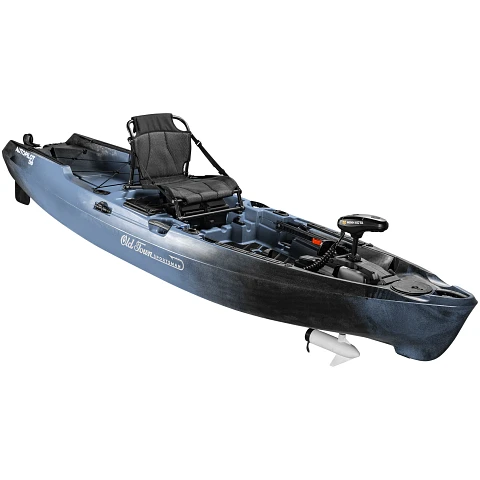
Pedal-drive fishing kayaks have fundamentally changed how anglers approach the water, and two models sit at the center of nearly every buying conversation: the Hobie Pro Angler 14 and the Old Town Sportsman 120 PDL. These aren’t just popular kayaks — they represent the flagship thinking of the two most dominant brands in the pedal-drive fishing category, each built around a different philosophy of what a fishing kayak should be and who it should serve.
We’ve logged hundreds of hours on both hulls as part of our Benchmark testing methodology — largemouth bass tournaments on Texas reservoirs, inshore redfish runs along the Gulf Coast, and flatwater crappie sessions where silence and stability matter more than speed. This isn’t a spec-sheet exercise. We’ve fished from both platforms in conditions ranging from glass-calm mornings to choppy afternoon winds, and we have clear opinions on who should buy which.
If you’re weighing these two kayaks against each other — or trying to decide whether the premium is worth the price — this is the comparison that will get you to a confident decision. For broader context on the pedal-drive market, see our kayak fishing hub and our best pedal-drive fishing kayaks roundup.
Quick Verdict: Who Should Buy Which
Buy the Hobie Pro Angler 14 if you prioritize maximum stability, need a platform that handles standing and sight-casting with total confidence, fish open water or deal with wind and chop regularly, and want the most refined pedal-drive system on the market. You’re the angler who treats kayak fishing as a primary pursuit, fishes multiple days per week, and views the kayak as a long-term investment rather than an entry point. Read our full Hobie Pro Angler 14 review for the deep dive.
Buy the Old Town Sportsman 120 PDL if you want a capable, well-featured pedal-drive kayak at a meaningfully lower price, value a lighter and more transportable hull, fish primarily calm to moderate water, and appreciate thoughtful integration with modern fish-finding electronics. It’s also the right call if you’re stepping up from a paddle kayak and want serious pedal-drive capability without the flagship price tag. See our full Old Town Sportsman 120 review for complete details.
The bottom line: The Hobie Pro Angler 14 is the better fishing kayak. The Old Town Sportsman 120 PDL is the better value. Those are two different questions, and understanding which one you’re actually asking yourself is the first step toward making the right purchase.
Specifications Comparison
| Spec | Hobie Pro Angler 14 | Old Town Sportsman 120 PDL |
|---|---|---|
| Length | 13’ 8” | 12’ 0” |
| Width | 36” | 36” |
| Weight (hull only) | ~120 lbs | ~104 lbs |
| Max Capacity | 600 lbs | 489 lbs |
| Drive System | MirageDrive 360 | PDL Drive |
| Reverse Capability | Full 360° instant | Kick-up fins + reverse |
| Standing Deck | Yes, full-length | Yes, EVA foam |
| Seat | Vantage ST (mesh, adjustable) | Adjustable aluminum-frame |
| Rod Holders | 6 (2 flush, 4 horizontal) | 4 (2 flush, 2 adjustable) |
| Gear Tracks | Multiple Hobie H-Track | Multiple accessory tracks |
| Electronics Ready | Lowrance Ghost-compatible | Integrated Universal Transducer Mount |
| Storage | Bow hatch, center hatch, stern well | Bow hatch, stern well, Exo-Ridge |
| MSRP | ~$4,999 | ~$2,499 |
The spec sheet reveals the core tradeoff immediately. The Hobie brings more length, more capacity, more storage, and a superior drive system at roughly double the price. The Old Town counters with significantly less weight, easier transport, and a surprisingly capable feature set that punches above its price class. Let’s break down what each advantage means when you’re actually on the water.
Head-to-Head: Stability
Stability is the foundation of every fishing kayak — it determines whether you can stand to cast, manage a fish at boatside without anxiety, and feel planted when conditions deteriorate. Both of these kayaks are wide at 36 inches, but they deliver stability in meaningfully different ways.
The Hobie Pro Angler 14’s 13’8” waterline length combined with its 36” beam creates one of the most stable fishing platforms in the kayak market. Period. Standing on the Pro Angler feels less like balancing on a kayak and more like standing on a small skiff. The hull’s primary stability (how steady it feels when upright) is exceptional, but what separates it from the competition is its secondary stability — the resistance to capsizing when you lean to one side to land a fish, reach for a rod, or shift your weight during a cast. We’ve stood on the gunwale to land redfish in moderate chop without a moment of genuine concern. The Pro Angler wants to stay upright, and it communicates that confidence through the hull with every movement you make.
The Old Town Sportsman 120 PDL is stable for its size class, and the EVA foam deck pad provides solid footing when standing. On calm water and light chop, standing to cast feels secure and natural. However, the shorter 12-foot waterline means the hull has less rotational resistance, and you’ll notice this the moment conditions pick up. In 15+ mph wind with a light chop, standing on the Sportsman 120 requires more active balance and core engagement than the Pro Angler demands in the same conditions. It’s not unstable — we’ve fished comfortably standing in moderate conditions many times — but there’s a noticeable gap between “stable enough” and “rock-solid.”
The capacity difference reinforces this. The Pro Angler’s 600-pound capacity means it handles a heavy angler plus a full load of gear without sitting deep in the water. The Sportsman 120’s 489-pound capacity is adequate for most anglers, but larger anglers (230+ lbs) with a full gear load will notice the waterline creeping up and stability diminishing proportionally.
Winner: Hobie Pro Angler 14, decisively. The longer hull and higher capacity translate to a stability advantage that’s immediately apparent and becomes more pronounced as conditions worsen.
Head-to-Head: Drive System
This is where the engineering philosophies diverge most dramatically, and for many anglers, the drive system alone will determine which kayak they choose.
The Hobie MirageDrive 360 is, in our assessment, the single best pedal-drive system ever put in a fishing kayak. The “360” designation isn’t marketing — the drive provides instant, intuitive propulsion in any direction. Pedal forward, backward, or pivot in place by shifting the steering handle. There is no need to stop, reach down, and physically reverse a mechanism. The transition from forward to reverse is seamless, happening at the speed of thought rather than the speed of your hands. For anglers who fish current, work structure, or need precise boat positioning while casting to specific targets, this capability is transformative.
The MirageDrive 360’s ST (Sail and Turbo) fins are efficient, quiet, and generate meaningful thrust at a comfortable cadence. Cruising speed requires moderate effort, and the system rewards a steady, rhythmic pedaling motion rather than brute force. The fins kick up on contact with shallow bottoms — a thoughtful design detail that saves hardware and prevents the jarring stop that rigid propeller drives produce when they hit an oyster bar or submerged log.
The Old Town PDL Drive is a propeller-based system, and it’s a genuinely good one. The prop generates strong forward thrust and handles well at cruising speeds. Reverse capability exists through a combination of fin positioning and prop design, but it requires a deliberate shift — you’ll need to reach down and adjust the drive unit. It works, but it’s a mechanical process rather than an instantaneous transition. In tight maneuvering situations — backing out of a mangrove pocket, holding position against current while casting to a laydown — that extra step introduces a delay that the MirageDrive 360 simply doesn’t have.
The PDL Drive’s prop-based design does have a practical advantage in raw thrust for its effort level. Props are inherently efficient at converting rotational energy into forward motion, and the Sportsman 120 moves with authority when you put power down. It also integrates cleanly with Old Town’s hull design and deploys and stows without drama.
Where the PDL Drive falls short is in shallow-water performance and stealth. A spinning prop creates more noise and turbulence than oscillating fins, and it sits lower in the water column. In skinny water — flats fishing, creek mouths, back-bay exploration — the MirageDrive 360’s kick-up fins let you pedal in water so shallow that a prop drive would be grinding bottom. For inshore anglers, this isn’t a minor detail. It’s a deciding factor.
Winner: Hobie Pro Angler 14 (MirageDrive 360), by a wide margin. The 360-degree maneuverability, shallow-water capability, and silent operation represent a generational advantage in pedal-drive technology. The PDL Drive is competent. The MirageDrive 360 is exceptional.
Head-to-Head: Speed and Tracking
Speed matters less in kayak fishing than many buyers assume — you’re not racing, you’re fishing — but efficient cruising and solid tracking reduce fatigue and let you cover more water in a session.
The Hobie Pro Angler 14’s longer waterline gives it a higher theoretical hull speed (the maximum efficient speed before you’re fighting physics). At a comfortable cruising cadence, we’ve consistently measured 3.5-4.0 mph on GPS. The hull tracks well in a straight line, and the integrated rudder system responds predictably to steering inputs. In crosswinds, the Pro Angler’s mass and waterline length help it hold course better than shorter hulls.
The Old Town Sportsman 120 PDL cruises comfortably at 3.0-3.5 mph at a similar effort level. The shorter hull reaches its efficiency ceiling sooner, meaning you’ll work harder for each additional tenth of a mile per hour above that range. Tracking is good but not exceptional — in crosswinds, the Sportsman 120 requires more rudder correction to hold a line, and the lighter hull is more susceptible to wind drift when you stop pedaling.
For lake and reservoir anglers who run from launch to a spot a mile or two away, the Pro Angler’s speed advantage translates to arriving a few minutes sooner and with less accumulated fatigue. Over a full day of repositioning between spots, that efficiency gap compounds. For anglers fishing smaller water who rarely transit more than half a mile, the difference is negligible.
Winner: Hobie Pro Angler 14, moderately. The longer hull is simply more efficient at converting pedal effort into forward progress, and it handles wind and chop better during transits. The Sportsman 120 is adequate but works harder for the same result.
Head-to-Head: Storage and Rigging
Fishing kayaks live and die by their ability to organize and secure your gear. A poorly rigged kayak creates frustration from the first cast. Both of these platforms take rigging seriously, but the approaches — and the sheer volume — differ.
The Hobie Pro Angler 14 offers six rod holders (two flush-mount, four horizontal storage), a massive bow hatch, a center-line storage area, a rear cargo well with bungee, and multiple runs of Hobie’s H-Track accessory rail system. The H-Track system accepts a wide ecosystem of compatible accessories — rod holders, camera mounts, cup holders, fish finder mounts — and lets you position them precisely where you want along the hull. The sheer amount of usable deck space is a direct benefit of the longer hull. There is room for a crate, a tackle bag, and still enough open deck to move around without stepping on gear.
The Old Town Sportsman 120 PDL provides four rod holders (two flush-mount, two adjustable), a bow hatch, a stern cargo well, and the Exo-Ridge accessory system — a series of molded channels and mounting points along the hull that serve a similar purpose to Hobie’s H-Track. The Exo-Ridge system is well-designed and supports Old Town’s growing accessory line. It’s not as extensive as the Hobie ecosystem, but it covers the essentials. Old Town also earns strong marks for the Universal Transducer Mount, which gives you a clean, built-in mounting location for your fish finder transducer. This is a detail that Hobie requires aftermarket solutions to match.
The practical difference comes down to volume. The Pro Angler 14 simply has more space. More rod storage, more deck area, more hatch volume, more track length. For tournament anglers hauling multiple rod setups, a large tackle assortment, and electronics, this capacity is essential. For recreational anglers running two rods and a small tackle box, the Sportsman 120’s storage is perfectly adequate and arguably better organized for a minimal kit.
Winner: Hobie Pro Angler 14, on volume and ecosystem breadth. The Old Town Sportsman 120 scores a notable point for the integrated transducer mount, but the Pro Angler’s raw storage capacity and rigging flexibility are hard to match on a 12-foot hull.
Head-to-Head: Comfort
Hours on the water mean hours in the seat. Comfort determines whether you fish a four-hour morning session or an all-day marathon, and both brands clearly prioritize this.
The Hobie Pro Angler 14 ships with the Vantage ST seat, a suspended mesh design that sits above the deck on an aluminum frame. This seat breathes in hot weather, supports extended sessions without pressure points, and adjusts for height and recline. We’ve fished 8-hour days in the Vantage ST without the lower-back fatigue that cheap kayak seats produce by hour three. The elevated seating position also improves your sight line for sight-casting and general water reading — a subtle but meaningful advantage for serious anglers.
The Old Town Sportsman 120 PDL comes with an adjustable aluminum-frame seat that’s comfortable and supportive. It’s a good seat — padded, adjustable, and secure. It does not, however, match the Vantage ST’s breathability in hot conditions or its all-day comfort on extended sessions. By hour five or six, we noticed more shifting and repositioning in the Old Town seat than in the Hobie. For half-day sessions, the difference is minor. For full-day or multi-day trips, the Vantage ST’s advantage becomes increasingly apparent.
Legroom and cockpit ergonomics also favor the Pro Angler. The longer hull provides more space for pedaling without feeling cramped, and the overall cockpit layout gives taller anglers (6’0”+) noticeably more room to adjust position and stay comfortable throughout the pedaling motion.
Winner: Hobie Pro Angler 14. The Vantage ST seat is one of the best in the industry, and the larger cockpit accommodates a wider range of body types more comfortably. The Sportsman 120’s seat is good, but “good” sits clearly below “best in class.”
Head-to-Head: Technology and Innovation
Modern fishing kayaks increasingly function as electronics platforms, and how well a kayak integrates with fish finders, GPS units, and other technology matters to serious anglers.
The Old Town Sportsman 120 PDL makes a strong case here with its Universal Transducer Mount (UTM). This built-in, through-hull mounting system gives you a clean transducer installation without drilling, epoxying, or running awkward external mounts. It’s compatible with major electronics brands, and it delivers cleaner sonar readings than a transom-mount or suction-cup solution. Old Town clearly designed this kayak with electronics integration as a primary consideration rather than an afterthought.
The Hobie Pro Angler 14 is Lowrance Ghost trolling motor compatible, and recent model years have improved electronics integration. However, mounting a transducer on the Pro Angler typically requires aftermarket hardware — a scupper-mount transducer arm or a through-hull installation that you’ll either DIY or pay a shop to complete. The Hobie ecosystem supports electronics, but it doesn’t offer the same plug-and-play experience that Old Town’s UTM provides.
On the innovation front, the MirageDrive 360 itself is a piece of technology that dwarfs most kayak innovations in the past decade. The engineering required to deliver intuitive 360-degree propulsion through a human-powered pedal system is genuinely impressive, and it gives the Pro Angler a technology story that the PDL Drive, while solid, cannot match.
Winner: Draw. Old Town wins on electronics integration with the UTM. Hobie wins on drive system innovation with the MirageDrive 360. Both brands are pushing the category forward in different directions, and both approaches deliver real value to anglers.
Head-to-Head: Value
Value is where this comparison gets genuinely difficult, because the price gap is substantial and the answer depends heavily on how you fish.
The Old Town Sportsman 120 PDL at roughly $2,499 delivers a pedal-drive fishing kayak with a capable prop drive, solid stability, good rigging, excellent electronics integration, and a manageable weight for solo transport. For anglers stepping into the pedal-drive category, it’s an outstanding entry point that doesn’t feel like a compromise. You get a legitimate fishing tool, not a stripped-down gateway product designed to upsell you later.
The Hobie Pro Angler 14 at roughly $4,999 costs double. It justifies that premium through a superior drive system, exceptional stability, more storage, a better seat, and the kind of on-water confidence that only comes from a hull designed without compromise. But “twice the price” is a hard sell when the Sportsman 120 covers 80% of the same ground for most fishing scenarios.
The math changes depending on your specific use case. If you fish open water, fight wind regularly, stand-cast to sight-fishing targets, need 360-degree maneuvering precision, or treat kayak fishing as your primary angling method, the Pro Angler’s advantages compound into a package that’s worth the premium. If you fish protected water, paddle-to-pedal upgrade seekers, or recreational weekend anglers, the Sportsman 120 delivers the experience you’re after at a price that doesn’t demand justification.
The weight difference also has a cost implication. The Sportsman 120 at 104 lbs is manageable for solo car-top loading with a good rack system. The Pro Angler 14 at 120 lbs practically requires a kayak trailer or cart — an additional expense and logistical consideration that doesn’t appear on the MSRP sticker.
Winner: Old Town Sportsman 120 PDL, for the majority of buyers. The Sportsman 120 delivers the core pedal-drive fishing experience at half the price, and most anglers will never encounter the scenarios where the Pro Angler’s premium capabilities become decisive.
Who Should Buy Which
The Hobie Pro Angler 14 is built for:
- Tournament and competitive kayak anglers who need every advantage
- Anglers who fish open water, bays, and conditions with wind and chop
- Sight-casting anglers who stand frequently and need a rock-solid platform
- Inshore anglers who work shallow flats where kick-up fins are essential
- Anglers who demand precise boat positioning around structure and current
- Larger anglers (230+ lbs) who need the higher weight capacity
The Old Town Sportsman 120 PDL is built for:
- Anglers upgrading from paddle kayaks to their first pedal drive
- Lake, reservoir, and calm-water anglers who rarely face rough conditions
- Anglers who prioritize solo transportability and manageable weight
- Electronics-focused anglers who want clean, built-in transducer mounting
- Budget-conscious anglers who want maximum capability per dollar
- Anglers who fish 2-3 times per month rather than multiple days per week
Final Verdict
The Hobie Pro Angler 14 is the better fishing kayak. It wins on stability, drive system, speed, storage, and comfort — the categories that define the on-water fishing experience. If we were building the ultimate pedal-drive fishing platform with no budget constraint, the Pro Angler 14 with the MirageDrive 360 is where we’d start and where we’d finish. It earned its reputation as the benchmark in the kayak fishing category.
But the best kayak isn’t always the right kayak.
The Old Town Sportsman 120 PDL is the smarter purchase for more anglers than the Pro Angler is. Most kayak fishing happens on calm to moderate water. Most anglers fish within a mile of launch. Most sessions are half-day outings rather than dawn-to-dark marathons. For those scenarios — which describe the majority of kayak fishing trips taken in this country — the Sportsman 120 delivers a genuinely excellent experience at a price that leaves room in the budget for quality electronics, premium tackle, and the gas to get to the water more often.
Our recommendation: If you fish open water, prioritize standing stability, need 360-degree maneuverability, or consider kayak fishing your primary angling pursuit — buy the Hobie Pro Angler 14. It’s the most capable pedal-drive fishing kayak we’ve tested, and its advantages become more apparent the more demanding your conditions and fishing style become.
If you fish protected water, want a capable and well-rigged pedal-drive kayak you can load solo, value clean electronics integration, or want to enter the pedal-drive market without a $5,000 commitment — buy the Old Town Sportsman 120 PDL and put the $2,500 you saved into a quality fish finder, a comfortable PFD, and more days on the water.
Both are excellent kayaks built by brands that understand what anglers need. The decision isn’t which one is better — it’s which one matches how you actually fish.
Frequently Asked Questions
Can I stand and sight-cast comfortably on the Old Town Sportsman 120?
Yes, on calm to moderate water. The 36-inch beam and EVA foam deck provide a stable standing platform, and we’ve sight-cast for bass and redfish from the Sportsman 120 without issues on protected water. The difference becomes apparent in chop and wind — the Pro Angler 14’s longer waterline provides noticeably more confidence when standing in deteriorating conditions. If standing is central to your fishing style and you regularly face choppy water, the Pro Angler is the safer choice. If you’re standing occasionally on calm lakes and bays, the Sportsman 120 handles it well.
Is the MirageDrive 360 really that much better than the PDL Drive?
In short, yes — but the magnitude of the advantage depends on how you fish. The MirageDrive 360’s instant 360-degree propulsion is most impactful when you’re working structure, fishing current, maneuvering in tight spaces, or operating in shallow water where kick-up fins prevent bottom contact. If your fishing involves pedaling to a spot and sitting there, the PDL Drive does that job effectively and the MirageDrive 360’s advantages are underutilized. If your fishing involves constant repositioning, precision boat control, and skinny-water exploration, the MirageDrive 360 is a fundamentally different and superior experience.
Can one person load the Hobie Pro Angler 14 onto a vehicle?
It’s possible but not practical for most people. At roughly 120 pounds for the hull alone — before you add the drive, seat, and gear — the Pro Angler 14 is a heavy kayak. Most Pro Angler owners use a kayak cart for launch access and either a trailer or a truck bed for transport. Solo car-topping requires a quality load-assist system (like roller bars or a side-loading rack) and significant upper-body strength. The Sportsman 120 at 104 pounds is more manageable for solo loading, though it’s still not light by any standard. If solo transportability is a priority, factor the weight difference seriously into your decision.
Which kayak is better for saltwater and inshore fishing?
The Hobie Pro Angler 14 has a meaningful edge in saltwater environments. The MirageDrive 360’s kick-up fins handle oyster bars, shallow grass flats, and sandy bottoms without damage — situations where a spinning propeller grinds, stalls, or breaks. The Pro Angler’s higher weight capacity handles the additional gear that saltwater fishing demands (a larger tackle assortment, a cast net, a landing net, a cooler for keeping fish). Its superior stability in chop and wind also matters more in open bays and coastal waters than on sheltered freshwater. The Sportsman 120 works in saltwater, but the Pro Angler was built for it.
How do the warranty and long-term reliability compare between Hobie and Old Town?
Both brands back their flagship products with solid warranties. Hobie offers a limited lifetime warranty on hull construction defects for the original owner, with varying coverage periods for components like the MirageDrive and hardware. Old Town (owned by Johnson Outdoors) provides a limited lifetime warranty on hulls and shorter coverage on accessories and drive components. In our experience and based on the broader kayak fishing community, both brands have responsive customer service departments. Hobie’s dealer network is particularly strong, with most authorized dealers stocking replacement parts for the MirageDrive system. For long-term reliability, both kayaks are built to last — we’ve seen well-maintained Pro Anglers and Sportsman models fishing hard after five-plus years of regular use without structural concerns.
Quick Buy — Products in This Article