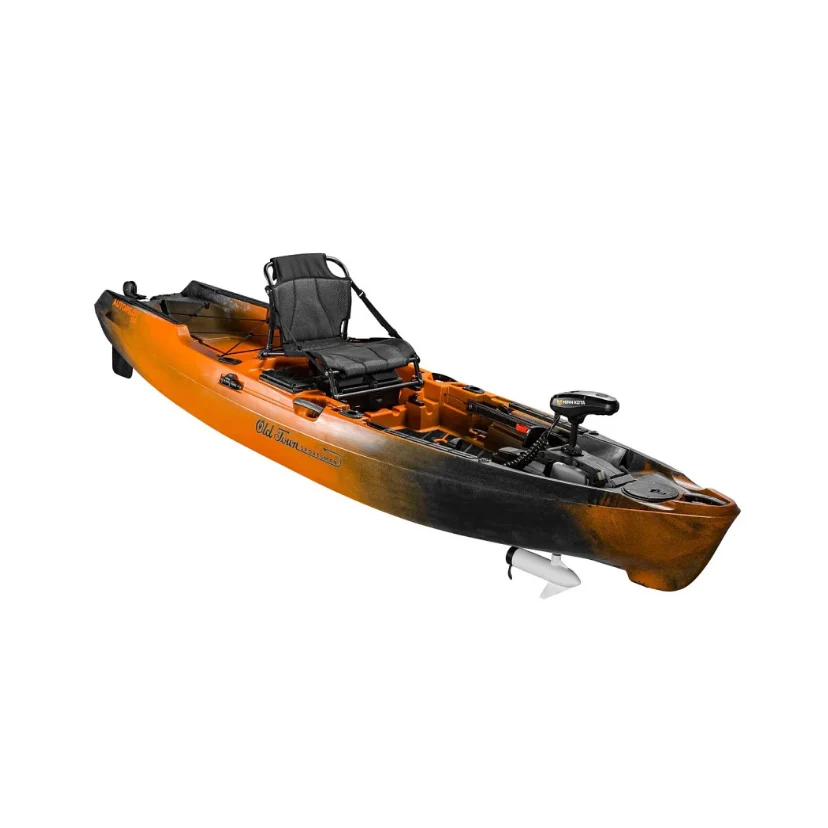
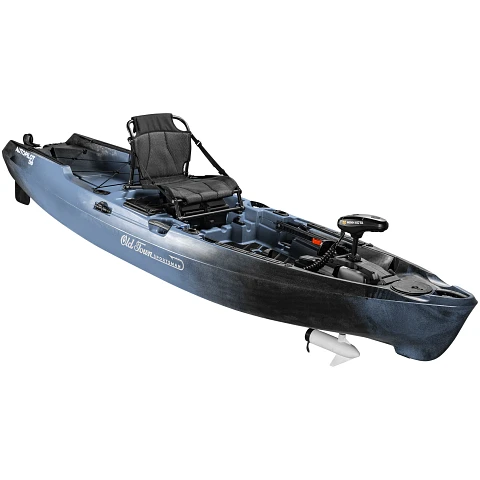
Pros
- Spot-Lock GPS anchor hold is a game-changer for kayak fishing
- PDL drive is smooth and powerful with excellent reverse
- More affordable than Hobie Pro Angler
- Minn Kota motor integration for hands-free navigation
- Stable platform with 500 lb weight capacity
Cons
- AutoPilot motor adds significant weight
- Battery not included — adds to total cost
- Less rigging versatility than Hobie Pro Angler
- 12-foot length limits storage compared to 14-foot kayaks
We’ve tested a lot of pedal drive kayaks, and the conversation usually centers on the same question: which hull, which drive system, which brand. The Old Town Sportsman 120 AutoPilot changes the conversation entirely. Instead of asking “how do I get there,” this kayak asks “where do you want to stay?” — and then holds you there with GPS precision while you fish. We’ve spent months pushing the Sportsman 120 AutoPilot across windswept reservoirs, tidal rivers, and open bays to find out whether the integrated Minn Kota motor and Spot-Lock technology live up to the promise. Here’s our full breakdown based on our testing methodology.
Who This Kayak Is For
The Sportsman 120 AutoPilot is built for the tech-forward kayak angler who wants boat-level positioning technology in a kayak hull. If you fish in wind, current, or tidal water and you’re tired of constantly correcting your drift with a paddle or pedal strokes, the Spot-Lock GPS anchor changes your fishing life overnight. Tournament anglers, structure-focused bass fishermen, and anyone who targets specific GPS waypoints will get the most out of this platform.
It’s also the right kayak for anglers who want a complete, capable fishing setup without crossing the $4,000 threshold. The Sportsman 120 AutoPilot delivers pedal drive propulsion, motorized GPS anchoring, and a solid fishing platform at a price that meaningfully undercuts the Hobie Pro Angler 14 — while offering technology the Hobie simply doesn’t have.
Skip this kayak if: You fish exclusively calm, protected water where wind and current aren’t factors (you’re paying for technology you won’t use — the standard Sportsman 120 PDL is the smarter buy), you prioritize standing and sight fishing above all else (the Hobie Mirage Pro Angler 14 offers superior standing stability), you need maximum deck space and rigging flexibility (14-foot kayaks win that fight), or you aren’t willing to manage a separate battery system (the AutoPilot motor requires a 12V battery that isn’t included).
Key Specifications
| Spec | Detail |
|---|---|
| Length | 12 ft |
| Width | 36 in |
| Weight (hull only) | ~104 lbs |
| Weight (rigged with motor) | ~130 lbs |
| Max Capacity | 500 lbs |
| Pedal Drive | PDL Drive (propeller-based) |
| Motor | Minn Kota integrated trolling motor |
| Spot-Lock GPS | Yes — i-Pilot compatible |
| Seat | ElementAir adjustable |
| Hull Material | Rotomolded polyethylene |
| Rod Holders | 4 (2 flush-mount, 2 adjustable) |
| Gear Tracks | Universal accessory tracks, multiple rails |
| Transducer Ready | Yes, built-in transducer mount |
| Battery Required | 12V marine (not included) |
| MSRP | ~$3,599 |
PDL Drive: Reliable Propeller Power
Old Town’s PDL Drive is a forward-and-reverse propeller system that has quietly become one of the most reliable pedal drives on the market. It won’t make headlines the way the MirageDrive 360 does, but it gets the job done with minimal fuss — and that counts for a lot when you’re miles from the ramp.
The propeller system produces strong, consistent thrust in both directions. Forward cruising speed sits around 3.5 to 4 mph with moderate effort, and we pushed it past 4.5 mph during sustained hard pedaling in calm conditions. Reverse is immediate and powerful, which matters more than most anglers realize until they’re backing away from structure with a fish on. Unlike fin-based systems, the prop engages instantly without the brief lag you feel with kick-up fins resetting.
Where the PDL Drive falls short of the MirageDrive 360 is in lateral movement. You don’t get the 360-degree steering that Hobie offers — the Sportsman uses a traditional rudder system for directional control. This means positioning in tight quarters requires more paddle assists and rudder adjustments. It’s perfectly functional, but if you’ve experienced the 360-degree freedom of the Hobie system, you’ll notice the difference.
The propeller does have a draft consideration. It sits lower than kick-up fins, which means you need to retract the drive in water shallower than about 18 inches to avoid damage. If you fish skinny water regularly, factor this into your decision. The drive lifts cleanly with a single pull, so transitions aren’t cumbersome — but it’s one more thing to manage compared to automatic kick-up fin systems.
Maintenance is straightforward. Rinse with fresh water after saltwater use, check the prop for fishing line wrap periodically, and inspect the drive cables seasonally. Parts are readily available through Old Town, and the entire drive unit is owner-serviceable. We experienced zero mechanical issues during our testing period.
AutoPilot and Spot-Lock: The Headline Feature
Let’s cut straight to it — the Minn Kota Spot-Lock GPS anchor is the reason this kayak exists, and it’s the reason you should consider buying it over every other pedal kayak in this price range. Nothing else in the kayak market comes close to this technology.
Spot-Lock uses GPS to hold your kayak’s position within a few feet of a marked waypoint. You pedal to your spot, press a button on the wireless remote, and the integrated trolling motor fires to hold you in place — adjusting automatically for wind, current, and drift. We tested it in 15-mph sustained winds on a reservoir and the motor held our position within roughly a 5-foot radius without any input from us. We tested it in moderate tidal current on a coastal river and got similar results. We fished for hours without touching a paddle or pedal.
The practical impact on fishing is profound. When you’re working a brush pile, a dock, or a specific depth contour, you can commit 100% of your attention to your presentation. No corrective paddle strokes breaking your cadence. No drift pulling you off the bite zone. No anchor rope tangling with your line. You simply lock in and fish. For anglers coming from paddle kayaks, this feels like cheating.
The i-Pilot wireless remote controls the motor from your seat. You can engage Spot-Lock, adjust heading, and even store waypoints. The interface is intuitive — we had it figured out within our first outing without cracking the manual. The remote is waterproof and floats, which is a smart design choice for a device you’ll inevitably fumble with wet hands.
Beyond Spot-Lock, the motor provides supplemental propulsion that pairs with the pedal drive. On long crossings into headwinds, we ran the motor at low speed while pedaling and covered water significantly faster with less effort. On calm days, we occasionally used the motor alone at low throttle for quiet approaches to spooky fish — the near-silent electric motor disturbs far less water than pedaling.
The tradeoff is battery management. The AutoPilot system requires a 12V marine battery that Old Town does not include with the kayak. A quality lithium battery (our recommendation over lead-acid for weight savings) runs $200 to $400 depending on capacity. A 50Ah lithium battery gave us a full day of intermittent Spot-Lock use with plenty of reserve. Heavier Spot-Lock use in strong current or wind will drain the battery faster — plan your power budget accordingly. The battery adds roughly 8 to 15 pounds to your rigged weight depending on your choice, and it requires a dedicated space in the rear tankwell.
Stability and Tracking
At 36 inches wide, the Sportsman 120 AutoPilot provides a stable, confidence-inspiring platform that handles the vast majority of fishing situations without drama. Primary stability is solid — you feel planted from the moment you sit down. Secondary stability is good, with enough hull resistance to handle leaning for net shots, reaching across the deck, and shifting weight during fish fights.
Standing is possible and we did it during testing, but we’ll be direct: this is not a dedicated standing kayak. The 12-foot length creates a slightly shorter waterline than 14-foot hulls, and the hull shape prioritizes all-around capability over the ultra-wide, flat standing decks you find on kayaks like the Bonafide SS127 or the Pro Angler 14. Average-sized anglers will stand and cast comfortably in calm conditions. In chop or wind, we preferred to sit. If standing is your primary fishing mode, the Pro Angler 14 is the better investment.
Tracking is solid for a 12-foot hull. The rudder system keeps the kayak on line in crosswinds, and the combination of hull shape and beam width provides enough directional stability for trolling runs and long crossings. We noticed slightly more weather-cocking in strong quartering winds compared to the 14-foot Pro Angler, which is a predictable consequence of the shorter waterline. The Spot-Lock motor mitigates this entirely when you’re stationary, which is where it matters most.
In rough water, the Sportsman 120 handles chop up to about 1.5-foot wind waves without feeling sketchy. Beyond that, we were glad for the 500-pound weight capacity and the ballast effect of the battery — the extra weight low in the hull actually helps in moderate chop. This is not an offshore kayak and we wouldn’t push it into serious swells, but for lakes, reservoirs, bays, and protected coastal water, it handles conditions with composure.
Storage and Rigging
The Sportsman 120’s 12-foot length is both its portability advantage and its storage limitation. You get a functional fishing layout with enough space for a day on the water, but you won’t be loading this kayak like a floating tackle shop.
The bow hatch opens to a dry storage compartment that fits a tackle tray, rain gear, and personal items. It’s adequate but not cavernous — if you’re used to the Pro Angler’s enormous bow compartment, you’ll notice the difference. The sealed hatch keeps everything dry, and the compartment is deep enough for bulky items like PFDs or a soft cooler.
The rear tankwell accommodates a standard kayak crate with a battery, tackle storage, and a small cooler. With the AutoPilot battery occupying tankwell space, your remaining cargo real estate shrinks compared to the standard (non-AutoPilot) Sportsman 120. We found that a well-organized crate with the battery mounted inside left enough room for a day’s worth of tackle and a catch bag, but multi-day supply runs aren’t happening back here.
Rod holders — four total, with two flush-mount and two adjustable — cover the basics. Most anglers can run two rods for trolling with a third rigged and ready. If you need more, the universal accessory tracks along the gunwales accept aftermarket rod holders without drilling. We added two YakAttack Omega holders during testing and had six total rod positions, which was plenty.
The universal accessory tracks run along both sides and provide mounting options for fish finders, camera arms, cup holders, and other accessories. The track system is compatible with most major aftermarket accessory brands. It’s not as extensive as Hobie’s H-Track layout on the Pro Angler, but it covers the critical mounting zones. The built-in transducer mount is a welcome inclusion that saves you from aftermarket transducer arm solutions.
Comfort
The ElementAir seat is adjustable, breathable, and comfortable enough for full-day sessions. The mesh back panel promotes airflow on hot days, and the seat height adjusts to give you either a low center of gravity for rough water or a higher vantage point for sight fishing. Lumbar support is present and functional, though not as refined as the Hobie Vantage ST. For sessions under six hours, we had zero complaints. On marathon 8-hour days, we noticed some stiffness in the lower back that the Vantage ST doesn’t produce — but that’s comparing against the best seat in the kayak industry.
Leg room is generous for a 12-foot kayak, and the PDL Drive pedal position felt natural for paddlers ranging from 5’8” to 6’2” during our testing. The foot brace adjusts easily and stays locked under load. The cockpit layout positions the i-Pilot remote, rudder controls, and drive engagement lever within comfortable reach without forcing you to lean or stretch.
One comfort note specific to the AutoPilot model: the integrated motor housing sits behind the seat and slightly raises the rear deck profile. It doesn’t interfere with pedaling or seating, but it does reduce the amount of open deck space immediately behind you. We adapted to it quickly, but it’s worth noting if you’re accustomed to completely open rear decks.
The Benchmark Score Breakdown
We evaluate every kayak against our standardized scoring methodology. Here’s how the Sportsman 120 AutoPilot breaks down:
- Stability: 8/10 — Confident and secure for seated fishing. Standing is possible but not its strongest suit.
- Drive System: 8/10 — PDL Drive is reliable and strong. Lacks 360-degree maneuverability, but reverse is excellent.
- AutoPilot & Spot-Lock: 10/10 — Nothing else in kayak fishing touches this technology. Category-defining feature.
- Tracking & Speed: 7.5/10 — Solid for a 12-foot hull, but shorter waterline is noticeable in strong crosswinds.
- Storage & Rigging: 7/10 — Functional but limited by 12-foot length and battery space requirements.
- Comfort: 8/10 — ElementAir seat is comfortable for full days. Not quite Vantage ST level, but close.
- Build Quality: 8.5/10 — Old Town’s rotomold construction is proven and durable. Good fit and finish throughout.
- Portability: 7.5/10 — Lighter than the Pro Angler at ~104 lbs hull weight, though rigged weight with battery approaches similar territory.
- Value: 9/10 — Spot-Lock GPS in a complete pedal fishing kayak for under $3,600 is exceptional. Budget for the battery, but the total investment still undercuts most competitors.
Overall: 8.4/10
How It Compares: Old Town Sportsman 120 AutoPilot vs. Hobie Mirage Pro Angler 14
This is the comparison everyone wants, so let’s address it head-on. These are the two most capable pedal drive fishing kayaks on the market, and they take fundamentally different approaches to solving the same problem. For a broader look at the field, see our best pedal drive fishing kayaks roundup.
Technology vs. Refinement. The Sportsman 120 AutoPilot wins on technology. Spot-Lock GPS anchoring is a feature the Pro Angler simply doesn’t offer, and for anglers who fish wind and current, that single capability changes the game. The Pro Angler wins on drive system refinement — the MirageDrive 360’s full directional control is the most capable pedal system ever built.
Standing stability. The Pro Angler 14 wins this convincingly. Its 14-foot length and purpose-designed hull give you a standing platform that feels closer to a boat deck than a kayak. The Sportsman 120 is stable enough to stand on, but it’s not in the same league for anglers who spend the majority of their time on their feet.
Storage and rigging. The Pro Angler 14 wins here too. Two extra feet of hull length and Hobie’s extensive H-Track system give you meaningfully more space and more mounting options. If you’re the angler who brings everything, the Pro Angler accommodates that lifestyle. The Sportsman 120 requires more intentional packing.
Price. The Sportsman 120 AutoPilot wins. At roughly $3,599 (plus $200-$400 for a battery), your all-in cost is still $800 to $1,000 less than the Pro Angler 14’s $4,799 MSRP. That’s real money that could go toward a quality fish finder, a lithium battery upgrade, or a season’s worth of tackle.
Portability. The Sportsman 120 wins. At 104 pounds hull weight versus the Pro Angler’s 120+ pounds, and two feet shorter, the Old Town is meaningfully easier to load, transport, and launch — especially for solo anglers. It’s still a heavy kayak by any standard, but every pound matters when you’re wrestling a kayak onto a roof rack at 5 AM.
The bottom line: If you want the most refined, complete fishing platform regardless of price and you prioritize standing stability and rigging space, the Pro Angler 14 is the answer. If you want GPS positioning technology that no other kayak offers, you value portability, and you want to keep your total investment under $4,000, the Sportsman 120 AutoPilot is the smarter buy. Neither choice is wrong — they’re built for different priorities.
Frequently Asked Questions
Is the Old Town Sportsman 120 AutoPilot worth the extra cost over the standard PDL model?
If you fish in wind or current — and most of us do more often than we’d like to admit — yes, it’s worth it. The price difference between the standard Sportsman 120 PDL and the AutoPilot model buys you Spot-Lock GPS anchoring, which is the single most impactful piece of fishing technology we’ve tested in a kayak. On calm, protected water, you won’t use it enough to justify the premium. But the moment a 10-mph wind pushes you off a productive brush pile for the third time in an hour, you’ll wish you had it. For anglers who fish diverse conditions, the AutoPilot earns its price back in productivity and sanity.
What battery should I use for the AutoPilot motor?
We recommend a 12V lithium iron phosphate (LiFePO4) battery in the 50Ah to 75Ah range. Lithium batteries weigh roughly half what equivalent lead-acid batteries weigh, which matters in a kayak where every pound affects performance and portability. A 50Ah lithium gave us a full day of intermittent Spot-Lock use in moderate wind conditions. If you fish heavy current or plan extended sessions with continuous Spot-Lock engagement, step up to 75Ah for the safety margin. Dakota Lithium and Ampere Time are popular choices in the kayak fishing community. Budget $250 to $400 for a quality lithium battery — it’s a worthwhile investment that you’ll use for years.
Can I use the Spot-Lock motor for primary propulsion instead of pedaling?
Technically yes, but we don’t recommend it as your primary propulsion strategy. The integrated Minn Kota motor is designed for positioning and holding, not sustained cruising. Running the motor at higher speeds for long distances drains the battery quickly and reduces your Spot-Lock time on the water — which is the whole reason you bought the AutoPilot model. The best approach is using the PDL Drive for all transit and relying on the motor for Spot-Lock positioning, heading adjustments, and supplemental thrust during headwind crossings. This balanced usage gives you a full day on the water without power anxiety.
How does the Sportsman 120 AutoPilot handle rough water?
The Sportsman 120 handles moderate chop and wind waves confidently. We fished it in conditions up to 1.5-foot wind-driven waves on open reservoirs without feeling unsafe. The 36-inch beam provides a stable base, and the low center of gravity from the battery placement actually improves rough-water composure. In stronger conditions, the Spot-Lock motor works harder to hold position and battery drain increases, but the system continued to function in every condition we tested. That said, this is a 12-foot sit-on-top kayak — respect the conditions, wear your PFD, and check the forecast. For our full beginner’s overview of safe kayak fishing practices, start there before pushing into challenging water.
Is the Old Town Sportsman 120 AutoPilot good for beginners?
The kayak itself is stable and user-friendly enough for a beginner, but we’d recommend the standard Sportsman 120 PDL for someone new to kayak fishing. The AutoPilot system adds complexity (battery management, motor operation, remote controls) that a beginner doesn’t need on top of learning to pedal, fish, and manage a kayak simultaneously. Start with the PDL model, learn your fishing style, and upgrade to the AutoPilot when you’ve identified that wind and current management is genuinely limiting your fishing. The money you save can go toward a fish finder, quality tackle, or a solid PFD — all of which will improve your early kayak fishing experience more than GPS anchoring will. Once you’re ready for the next level, our pedal drive kayak guide covers all the upgrade paths.