
Moose hunting is the biggest thing most North American hunters will ever do — literally. A mature bull can stand seven feet at the shoulder, weigh 1,200 to 1,600 pounds, and carry antlers that span five feet or more. The animal itself is staggering, and so is every logistical challenge that comes with pursuing one. Drawing a tag can take a decade of applying. The caliber you need hits harder than anything in your elk rifle lineup. When you finally put one down, you are looking at 600 to 800 pounds of boned-out meat that has to come off the mountain, out of the swamp, or down the river before it spoils. There is no casual moose hunt. Every aspect of this pursuit demands planning, physical preparation, and a willingness to handle an animal that dwarfs everything else in the big game world.
We have hunted moose in Alaska, applied for tags in Montana and Wyoming for years, spoken with dozens of successful moose hunters across the West and Northeast, and packed out bull moose in conditions that tested every piece of gear we own. This moose hunting guide covers everything you need — from the application grind and tag strategy to caliber selection, calling tactics, field care, and the logistics of dealing with the largest deer species on the planet.
If you are new to big game hunting, start with our big game hunting hub for foundational content. For how we test and evaluate every piece of gear we recommend, visit our methodology page. If you are also chasing elk this fall, our elk hunting gear checklist has significant overlap with moose hunting loadouts.
Drawing a Moose Tag
For most hunters in the Lower 48, the moose hunt begins years before opening day. Moose tags in states like Montana, Wyoming, Idaho, and Maine are among the most difficult draws in North American hunting, and understanding the application system is the first step toward actually standing in front of a bull.
Preference Points vs Bonus Points
States use two fundamentally different systems for allocating limited-entry tags, and knowing which one your target state uses will shape your entire application strategy.
Preference point systems — used by Montana and Wyoming for moose — guarantee that applicants with the most points draw before applicants with fewer points. This creates a strict queue. You apply, accumulate points each year you are unsuccessful, and eventually your point total reaches the threshold for the unit you want. The advantage is predictability. You can look at historical draw data and estimate with reasonable accuracy how many years of points a given unit requires. The disadvantage is that premium units in these states can require 20-plus years of points, and the wait grows longer as more applicants enter the system.
Bonus point systems — used by Colorado, Idaho, and others — weight your odds based on point totals but do not guarantee the highest-point applicants draw first. Each bonus point effectively gives you an additional entry in the draw. An applicant with 15 points has significantly better odds than one with 2, but the two-point applicant can still draw. This introduces an element of randomness that can work in your favor early or extend your wait unpredictably.
Random draw states like Maine run a pure lottery with no point system. Every applicant has the same odds each year, and you either get lucky or you do not. Maine moose permits are allocated entirely through their lottery, with roughly 2,000 to 3,000 permits issued annually from a massive applicant pool. Your odds in any given year are low, but they never improve, so there is no cost to starting late.
State-by-State Draw Odds
The draw landscape for moose in the Lower 48 is brutally competitive:
- Montana issues roughly 300 to 400 moose permits annually. Popular units require 15 to 20-plus preference points. Some less-pressured units draw in the 7 to 12 point range. Nonresident allocation is extremely limited.
- Wyoming offers approximately 250 to 350 moose licenses per year. Premium units in the Tetons and Bighorns can require over 20 points. More accessible units in central Wyoming may draw in the 10 to 15 point range for residents.
- Idaho issues moose tags through a controlled hunt draw. Odds vary significantly by zone, but most desirable units require substantial bonus points or extraordinary luck.
- Maine runs a pure lottery with no preference system. Roughly 50,000 to 60,000 applicants compete for around 2,500 permits. Your odds hover in the 3 to 5 percent range annually.
- Colorado offers an extremely limited number of moose tags — typically 200 to 300 total — in units where moose were reintroduced. This is one of the hardest moose draws in the country. Expect to wait decades in the preference point queue for premium units.
Alaska: Over-the-Counter Opportunity
Alaska is the exception that makes moose hunting accessible. Residents can purchase over-the-counter moose tags for general season hunts in many game management units, and nonresidents can hunt moose without a draw in certain areas — though a registered guide is required for nonresident moose hunters. Alaska holds the largest moose population in North America, with an estimated 175,000 to 200,000 animals statewide, and it produces the largest-bodied moose on the continent. Alaska-Yukon moose are a different animal altogether compared to their Shiras cousins in the Rockies — mature bulls regularly exceed 1,400 pounds and carry antlers over 60 inches.
The tradeoff for accessibility is logistics. Hunting moose in Alaska typically involves float planes, river float trips, or long drives on limited road systems followed by extensive hiking or boating. The costs add up quickly — bush flights, gear transport, meat hauling, and potential guide fees can push a DIY Alaska moose hunt into the $3,000 to $7,000 range even before you factor in travel from the Lower 48. Guided hunts run $12,000 to $25,000 or more. But if you want to hunt moose without waiting 20 years for a tag, Alaska is where it happens.
Application Strategy
If you are serious about hunting moose in the Lower 48, apply in every state that offers a tag. The cost of an annual application ranges from $5 to $50 depending on the state, and casting a wide net maximizes your chances of drawing somewhere within a reasonable timeframe. Apply for Montana and Wyoming to build preference points for a future guaranteed draw. Apply for Maine and Idaho as bonus or lottery opportunities that could pay off any year. Apply for Colorado if you are willing to play the very long game. And budget for an Alaska hunt as your near-term opportunity to get a bull on the ground while your Lower 48 points accumulate.
Caliber and Rifle Selection
Moose are the largest animals most North American hunters will ever shoot, and they demand a caliber that can deliver deep penetration through heavy muscle and bone at the ranges moose country presents. This is not the place for a light-recoiling mountain rifle in 6.5 Creedmoor. A moose hit marginally with an inadequate caliber can travel a long distance through terrain that may be nearly impossible to follow — thick willows, black spruce bogs, river bottoms — and recovering a wounded moose in that country is a nightmare scenario.
Minimum Caliber Class
We draw the line at the .300 class for moose hunting. The .300 Winchester Magnum is the most popular moose caliber in North America for good reason — it delivers 3,500 to 3,800 foot-pounds of energy at the muzzle, carries enough velocity to expand premium bullets reliably at distance, and is available in virtually every bolt-action rifle on the market. If you already own a .300 Win Mag that shoots well, you are set.
Beyond the .300 Win Mag, the .338 Winchester Magnum is the classic dedicated moose and big bear caliber. It hits harder, penetrates deeper, and is arguably the ideal moose cartridge if you can handle the recoil. The 225-grain and 250-grain bullets available in .338 Win Mag are purpose-built for large, heavy-bodied game and will reliably break shoulders, punch through the vitals, and exit the off side at any reasonable hunting range.
Other excellent moose calibers include the .30-06 Springfield with heavy 200 to 220 grain bullets (the minimum we would recommend for moose), the .300 WSM, the .300 PRC, the .325 WSM, the .35 Whelen, and the .375 Ruger. For a deep dive into how these cartridges compare across big game applications, see our hunting caliber guide.
Bullet Selection
Caliber gets the attention, but bullet selection is what determines terminal performance on an animal this size. For moose, you want a bonded or monolithic bullet designed for deep, controlled penetration with high weight retention. Conventional cup-and-core bullets can fragment on heavy bone and fail to reach the vitals on quartering shots through a moose’s massive shoulder assembly.
Our top bullet recommendations for moose:
- Nosler Partition — The original premium hunting bullet. Dual-core design ensures the front core expands while the rear core drives through. Proven on moose for decades.
- Swift A-Frame — Bonded construction with expansion characteristics similar to the Partition but with slightly higher weight retention. Devastatingly effective on large-bodied game.
- Barnes TTSX — All-copper monolithic construction that retains nearly 100 percent of its weight. Deep penetration with consistent expansion. Excellent choice for quartering shots on heavy game.
- Federal Trophy Bonded Tip — Bonded lead core with a polymer tip for reliable expansion. Designed specifically for large game at moderate to long range.
- Nosler AccuBond — Bonded construction with high ballistic coefficient for long-range work. A good choice for open country moose hunting where shots may stretch beyond 300 yards.
Load your rifle with the bullet you intend to hunt with well before the trip. Confirm zero, verify accuracy at the ranges you expect to shoot, and understand how the bullet performs at those distances. Moose hunting is not the time to switch to an unfamiliar load.
Optics for Moose Country
Moose habitat varies enormously — from the vast open tundra of interior Alaska to the dense boreal forest of Maine, from the willow-choked river bottoms of Montana to the alpine basins of Colorado. Your optic setup needs to match the terrain you are hunting.
Binoculars
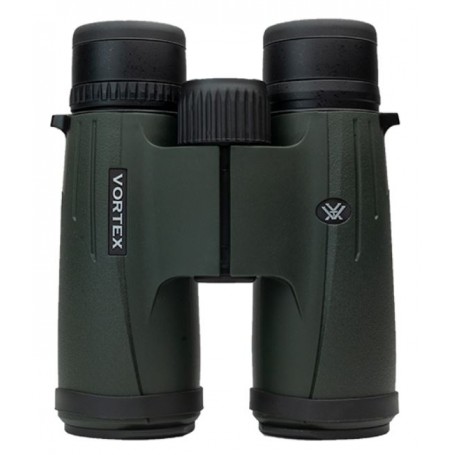
A quality pair of 10x42 binoculars is the foundation of any moose hunt regardless of terrain. You will spend far more time glassing than shooting, and binoculars are what you use to locate moose, assess bulls, and evaluate terrain for stalking approaches. We run the Vortex Viper HD 10x42 as our primary moose hunting glass. The optical clarity is excellent for the price point, edge-to-edge sharpness is strong enough for picking apart willows at distance, and the low-light performance handles the dawn and dusk hours when moose are most active.
In open tundra, river valley, or alpine terrain, 10x magnification lets you cover enormous country from a single vantage point. In thicker timber and boreal forest, you may prefer 8x42s for the wider field of view and brighter image, but 10x remains our standard recommendation for moose because so much of this hunting involves identifying bulls at 500 yards to a mile or more before committing to a stalk.
Spotting Scope
A spotting scope is indispensable for western and Alaskan moose hunting. When you glass up a dark shape in a willow flat at 1,200 yards, you need magnification to determine whether it is a bull, a cow, a dead spruce, or a large rock. A 20-60x spotting scope lets you judge antler width, count brow tines, and evaluate a bull’s maturity from distances where binoculars leave you guessing. For our recommendations on models, see our spotting scope roundup.
In dense timber environments — much of Maine, parts of Idaho, and thick boreal cover in Alaska — a spotting scope is less critical because your engagement distances are shorter and you rarely have the long sight lines that make high magnification valuable. In those situations, binoculars alone may be sufficient.
Calling Moose
Calling is arguably the most effective tactic for hunting moose during the rut, and it is one of the few situations in big game hunting where you can consistently bring a mature animal to you rather than going to it. A rutting bull moose is among the most aggressive, least cautious animals in the woods, and a well-timed calling sequence can bring a bull from a half mile away on a dead run, crashing through brush, grunting, and ready to fight.
The Rut Window
Moose rut timing varies by latitude and subspecies, but the general window is mid-September through mid-October across most of North America. In Alaska, peak rut activity for Alaska-Yukon moose typically falls in the last week of September through the first week of October. Shiras moose in the Rockies rut on a similar timeline. Eastern moose in Maine and the Northeast tend to peak slightly later, often in the first two weeks of October.
The most productive calling window is the two weeks leading up to and including peak breeding. During this period, bulls are actively searching for cows, responding aggressively to perceived rivals, and moving during daylight hours far more than at any other time of year.
Cow Calls
The cow-in-estrus call is the bread-and-butter moose calling technique. It is a long, drawn-out, nasal moan that rises in pitch and then trails off — often described as a wavering “eeerrrrrrrr-uuuuhhh” sound. You can produce it with your voice through cupped hands, a birch bark megaphone, or a commercial moose call. The natural amplifier — a birch bark cone or plastic jug with the bottom cut out — adds volume and the resonant quality that carries across moose country.
Start with a single cow call, then wait. Wait a long time. Moose do not respond like elk — there is no immediate bugling exchange. A bull may take 15 to 30 minutes to cover the distance to your position, and he may come silently. Patience is everything. Repeat the cow call every 10 to 15 minutes if you get no response, and give a location at least 45 minutes to an hour before moving on.
Bull Grunts
The bull grunt is a deep, guttural “ooh-wah” or “errr-ooh” sound that a bull makes when approaching a cow or asserting dominance. Used in combination with cow calls, bull grunts create the impression that a cow and a rival bull are together — a scenario that an aggressive rutting bull finds irresistible. Sequence a cow call, wait several minutes, then follow with two or three short bull grunts. This imitates a bull tending a cow and can provoke a territorial response from bulls that might otherwise hang up out of sight.
Raking and Thrashing
Simulating the sound of a bull raking brush and small trees with his antlers is a powerful close-range provocation tool. Use a large stick, a dried scapula bone, or even a shed antler to thrash willows and brush near your calling position. Combine the raking sound with bull grunts. This creates a full acoustic picture of a rival bull displaying dominance, and it can tip a hesitant bull into committing the last 100 yards to your setup.
Raking is most effective when you know a bull is nearby and has responded to calling but is hanging up at distance. It escalates the scenario from “there might be a cow over there” to “there is a bull with my cow over there,” and that competitive pressure is often the trigger that brings a mature bull into the open.
Calling Mistakes to Avoid
Overcalling is the most common mistake. Moose are not elk — you do not need to fill the air with sound. A single cow call followed by 15 minutes of silence is more effective than continuous calling. Moose respond to what sounds natural, and a cow does not call nonstop. If a bull is coming in silently through thick cover, excessive calling can pin down your exact position and cause him to circle downwind, where he will scent you and vanish without you ever seeing him.
The second mistake is not waiting long enough. Many hunters call for 10 minutes, hear nothing, and move to the next spot. A bull moose that was bedded 800 yards away in a willow bottom may need 30 to 45 minutes to reach your location. Commit to a calling setup for at least 45 minutes to an hour, especially in good habitat during peak rut.
Hunting Methods
Spot-and-Stalk
Spot-and-stalk is the primary method for hunting moose in open and semi-open terrain — tundra flats, alpine basins, river valleys with scattered willow, and burned-over areas with good visibility. The approach mirrors spot-and-stalk elk or mule deer hunting on a larger scale: find a vantage point with extensive visibility, glass systematically, locate a bull, plan an approach that keeps the wind in your face, and close to shooting range.
Moose are easier to spot than most big game animals simply because of their size and their preference for semi-open habitats. A bull standing in a willow flat is visible from an extraordinary distance. The challenge is not finding them — it is getting to them. Moose habitat is often wet, swampy, tangled, and miserable to move through. The 400-yard stalk that looks straightforward on a map can take two hours of wading through knee-deep muskeg, fighting through head-high willows, and crossing braided creek channels. Plan your approach carefully and add time for terrain difficulties.
Calling Setups
In areas with limited visibility — thick timber, dense willow bottoms, boreal forest — calling replaces glassing as the primary locating tactic. Set up on the edge of clearings, willow flats, lakeshores, or other openings where a responding bull will be visible as he approaches. Position yourself with the wind in your face or quartering into your setup, and have a clear shooting lane in the direction you expect a bull to approach. A responding bull may come from any direction, but they tend to follow the path of least resistance toward the sound source.
Float Trips
River float trips are the classic Alaska moose hunting method and one of the most effective ways to access remote moose country. You fly into a headwater lake or upriver airstrip, launch a raft or inflatable canoe, and float downstream over the course of 7 to 14 days, hunting the river corridor as you go. Moose concentrate along rivers — willow flats, gravel bars, oxbow lakes, and riparian corridors are prime habitat — and a float trip lets you cover miles of productive country that is inaccessible by any other means.
The logistics of a float trip are substantial. You need a packable watercraft rated for river conditions, dry bags for gear and meat, a plan for extraction at the downstream takeout, and a communication device for emergencies. You also need a plan for getting several hundred pounds of moose meat off the river and to a processor or cold storage. Many float trip hunters quarter and debone the animal on the riverbank, then load meat into the raft and continue downstream to the pickup point.
Road System Hunting in Alaska
Not all Alaska moose hunting requires a bush plane. The road-accessible areas around Fairbanks, the Matanuska-Susitna Valley, the Kenai Peninsula, and the Denali Highway corridor offer legitimate moose hunting opportunities with significantly lower logistical costs. Competition is higher on the road system, but moose densities in some of these areas are strong, and a hunter willing to hike a few miles off the road or paddle a canoe into a backcountry lake can find solitude and good bulls.
Road system hunting is an excellent option for first-time Alaska moose hunters who want to learn the game without the expense and complexity of a fly-in or float trip. It is also where most resident Alaskans fill their moose tags.
Shot Placement on Moose
A moose has the largest vital zone of any North American game animal. The heart-lung area on a broadside bull is roughly the size of a large beach ball — roughly 18 to 22 inches in diameter. In theory, this makes hitting the vitals straightforward. In practice, several factors complicate shot placement.
Broadside Shots
On a broadside moose, aim for the center of the shoulder, roughly one-third of the way up from the bottom of the chest. This puts the bullet directly through both lungs and, depending on exact placement, clips the top of the heart. A double-lung hit on a moose is devastating — the animal will typically travel 50 to 150 yards and go down. A heart shot drops them faster but requires aiming slightly lower and forward.
The shoulder bones on a moose are massive. If you are shooting a caliber in the .300 to .338 class with a premium bullet, you can break the near shoulder, drive through the vitals, and break or crack the offside shoulder, anchoring the animal or severely limiting its mobility. This is our preferred approach — we aim for the center of the near shoulder, knowing the bullet will reach the vitals even if it encounters heavy bone on the way in.
Quartering Shots
Quartering-away shots are the second-best presentation. Aim for the offside shoulder, placing your bullet behind the last rib on the near side and angling forward through the vitals. This requires a bullet with enough penetration to cross the full width of the chest cavity, which is why premium bonded or monolithic bullets are non-negotiable for moose.
Quartering-to shots are risky on an animal this large. The angle requires the bullet to penetrate the near shoulder — which on a moose can be 4 to 6 inches of bone, muscle, and connective tissue — before reaching the vitals. Unless you are shooting a heavy .338 or larger with a deep-penetrating bullet, we recommend passing on steep quartering-to angles and waiting for a better presentation.
The Follow-Up Shot
Always be prepared for a follow-up shot. Even with perfect placement, a moose may not show immediate signs of a lethal hit. They are stoic animals that do not always flinch, hunch, or mule-kick the way deer and elk do. If the animal is still on its feet after your first shot, put another one into the vitals. Moose can cover a lot of ground quickly despite their size, and a second insurance shot through the lungs can mean the difference between a 50-yard recovery and a 500-yard tracking job through a swamp.
Field Care and Pack-Out
Getting a moose from where it falls to your freezer is the most physically demanding and logistically complex aspect of moose hunting. A mature bull moose yields 500 to 800 pounds of boneless meat, and that weight has to be processed in the field and transported — often across difficult terrain and in weather conditions that threaten meat quality.
Quartering and Processing in the Field
Begin field dressing as soon as possible after the kill. Moose carry enormous body mass that retains heat, and in early fall temperatures — which can reach the 50s or 60s in many moose hunting areas — spoilage is a real and immediate threat. Your priority is getting the hide off and opening the body cavity to allow heat dissipation.
Most moose hunters quarter the animal in the field, removing the four quarters, backstraps, tenderloins, neck meat, and rib meat. If you are in Alaska, regulations in many units require that you salvage all edible meat, including rib meat and meat between the quarters. Bone-out the quarters in the field if you are packing on your back — removing the heavy leg bones can cut your carry weight by 20 to 30 percent per quarter. If you are hauling by boat, sled, or ATV, leaving the bone in is acceptable and makes hanging and aging easier later.
Keeping Meat Cool
Meat care in warm weather is the single biggest challenge of early-season moose hunting. Hang quartered meat in game bags in the shade with maximum air circulation. Cheesecloth or synthetic game bags keep flies off while allowing airflow. If nighttime temperatures drop below 40 degrees, the meat will firm up and develop a protective dry rind overnight. If temperatures stay warm around the clock, you are racing the clock.
Bring more game bags than you think you need. A full bull moose requires at least 8 to 10 large game bags. Pepper the outside of the bags with citric acid or a meat preservation spray to deter flies and slow bacterial growth on the surface. If you are on a river, submerging sealed bags of boned-out meat in cold river water is an effective emergency cooling method.
Pack-Out Logistics
The pack-out is where the real work begins. If you are within a few miles of a road or ATV trail, multiple trips with a frame pack is the standard approach. Budget 5 to 8 trips carrying 75 to 100 pounds per load to move a full bull moose. If you are on a float trip, the raft becomes your meat hauler. If you flew in, you will need a bush plane capable of carrying meat and antlers on the return trip — coordinate with your pilot before the hunt and confirm weight and cargo limits.
A quality pack frame rated for heavy loads is essential. Frames designed for hauling meat — such as those from Mystery Ranch, Stone Glacier, and Kifaru — are engineered to carry 100-plus pounds with hip-belt load transfer that keeps the weight off your shoulders. This is not the time for an ultralight daypack.
In Alaska, some hunters use pack horses, ATVs, or boat-based extraction depending on the terrain and access. Plan your extraction method before you pull the trigger. Knowing exactly how you will get the meat out should be part of your pre-hunt preparation, not a problem you solve over a dead moose.
Best States and Provinces for Moose Hunting
Alaska
The undisputed king of moose hunting. Alaska holds the continent’s largest moose population, produces the largest-bodied animals (Alaska-Yukon subspecies), and offers over-the-counter tag availability that no Lower 48 state can match. Interior Alaska — the Yukon and Kuskokwim River drainages — is the heartland of trophy bull production. The Kenai Peninsula, Matanuska Valley, and Copper River basin offer road-accessible options with strong moose densities.
Montana
Montana issues Shiras moose tags in units across the western part of the state. Unit 203 and surrounding areas in the northwest produce quality bulls in a spectacular mountain setting. The draw is extremely competitive, but a Montana moose tag is one of the most coveted permits in western big game hunting.
Wyoming
Wyoming moose hunting centers on the western ranges — the Tetons, Wind Rivers, Bighorns, and Wyoming Range. The Shiras moose in these areas are smaller-bodied than their Alaska-Yukon relatives but can carry impressive antlers for the subspecies. Draw wait times are long but predictable under the preference point system.
Maine
Maine is the moose hunting capital of the eastern United States, with the largest moose population in the Lower 48 outside of Alaska. The North Maine Woods — particularly the areas around Moosehead Lake and the Allagash Wilderness — offer a moose hunting experience unlike anything in the West. Dense boreal forest, logging roads, bogs, and thick cover define the terrain. The lottery system means anyone can draw in any given year.
Idaho
Idaho offers Shiras moose hunting in the panhandle and central mountain zones. Tags are limited and draw odds are poor, but the hunting is excellent in remote, rugged country that overlaps significantly with elk habitat.
Canadian Provinces
British Columbia, Alberta, the Yukon Territory, Ontario, and Newfoundland all offer world-class moose hunting. Canadian moose populations are generally healthy, and nonresident tag availability is better than most Lower 48 states. British Columbia and the Yukon produce massive Canada and Alaska-Yukon moose that rival anything in Alaska. Ontario and Newfoundland offer more accessible hunts in boreal and mixed forest terrain. Nonresidents in most provinces need a licensed outfitter or guide, which adds cost but also adds local knowledge and logistical support.
Gear Checklist for a Moose Hunt
This list covers the essentials for a backcountry moose hunt. Adjust based on your specific terrain, method, and duration.
Firearms and Ammunition
- Rifle in .300 Win Mag, .338 Win Mag, or equivalent
- Premium bonded or monolithic bullets (minimum 20 rounds for sighting, practice, and hunting)
- Quality rifle scope with adequate magnification (3-15x or 4-16x is ideal)
- Rifle sling, lens covers, and bore cleaning kit
Optics
- 10x42 binoculars
- Spotting scope with 20-60x magnification (for open terrain hunts)
- Compact tripod for spotting scope
- Rangefinder
Calling Gear
- Birch bark call or commercial cow call
- Practice recording or instructional reference
Meat Care and Pack-Out
- 8 to 10 large game bags
- Skinning knife (drop point) and caping knife
- Folding bone saw or Sven saw
- Pack frame rated for 100-plus pounds (Mystery Ranch, Stone Glacier, or Kifaru)
- Paracord or lightweight rope (50 feet minimum)
- Citric acid spray or meat preservation treatment
- Nitrile gloves (multiple pairs)
Clothing
- Layering system: base layers, insulating mid layer, windproof and waterproof outer shell
- Insulated jacket for glassing in cold conditions
- Waterproof boots rated for cold and wet terrain (rubber or insulated leather with Gore-Tex)
- Gaiters for swamp and brush
- Warm hat, gloves, and neck gaiter
Camp and Navigation
- GPS unit or GPS app with downloaded offline maps
- Satellite communicator (inReach or similar)
- Headlamp with extra batteries
- Fire starting kit
- First aid kit
- Water filter or purification tablets
- Camp stove, fuel, and food for trip duration plus two extra days
- Shelter appropriate to conditions (tent, tarp, or bivy)
Frequently Asked Questions
What is the best caliber for moose hunting?
The .300 Winchester Magnum is the most versatile and widely recommended moose caliber. It delivers sufficient energy for clean kills at ranges out to 400 yards with premium bullets, and it is available in nearly every rifle platform. If you want more authority, the .338 Winchester Magnum is the classic big moose cartridge and arguably the best choice for close-range timber hunting where shots may involve heavy bone at steep angles. The .30-06 with 200 to 220 grain premium bullets is the minimum we recommend. For a broader comparison, see our hunting caliber guide.
How hard is it to draw a moose tag in the Lower 48?
Extremely hard. Most states with moose hunting require a limited-entry draw, and the demand far exceeds the supply of tags. Montana and Wyoming premium units can require 15 to 25 years of preference points. Idaho and Colorado odds are similarly poor. Maine runs a lottery with roughly 3 to 5 percent annual odds. The most practical approach is to apply in every available state simultaneously while planning an Alaska hunt for near-term opportunity.
Can you hunt moose without a guide?
Yes, in most jurisdictions. Resident hunters can hunt moose without a guide in all states and most Canadian provinces. Nonresidents can hunt moose without a guide in the Lower 48 states. However, nonresident moose hunters in Alaska are required by law to use a registered guide or be accompanied by a resident relative within the second degree of kindred. Most Canadian provinces also require nonresidents to hire a licensed outfitter for moose. Check the specific regulations for your intended hunting area well in advance.
How do you pack out a moose?
You pack out a moose the same way you pack out an elk — just twice as much. Quarter the animal in the field, bone out the meat if packing on foot, load it into game bags, and haul it out on a frame pack, raft, ATV, horse, or bush plane depending on your access. A full bull moose requires 5 to 8 pack trips for a solo hunter carrying 75 to 100 pounds per load, or 3 to 5 trips for a two-person team. Start immediately after the kill, prioritize getting the hide off to begin cooling, and have your extraction method planned before you pull the trigger. Meat spoilage is the primary risk, especially in early-season warm weather.
When is the best time to hunt moose?
The rut — mid-September through mid-October — is the most productive period for moose hunting across nearly all of North America. Bulls are active during daylight, responsive to calling, and less cautious than at any other time of year. Early September pre-rut can also be productive, as bulls are establishing dominance and moving between feeding areas. Late October and November post-rut hunts can work in areas with late seasons, but bull activity drops significantly after breeding wraps up. In Alaska, the last week of September is widely considered the peak window for combining rut activity with cooler temperatures that aid meat preservation.