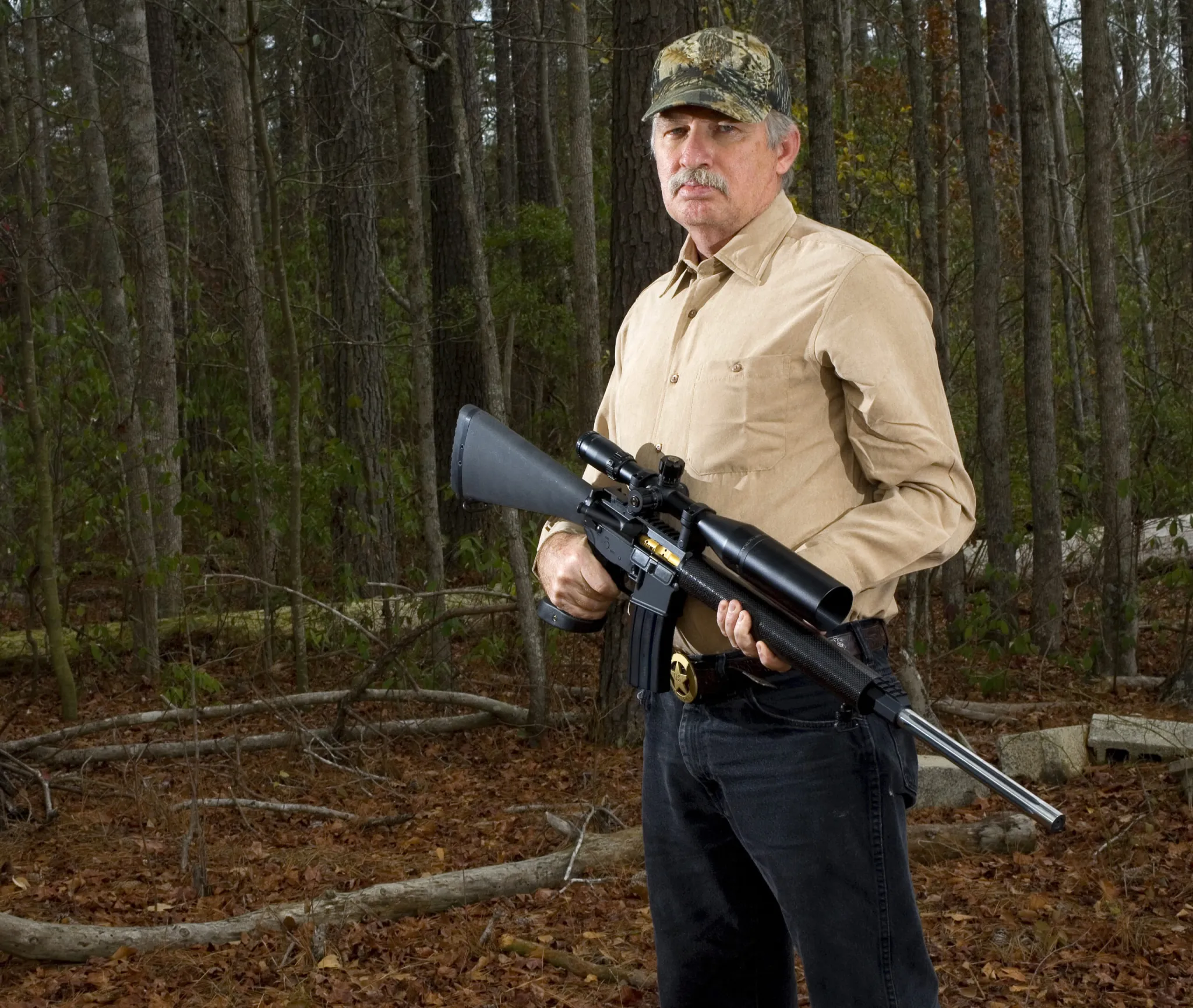
The AR platform has earned its place in the deer woods. What started as a military design and became America’s most popular sporting rifle has matured into a legitimate hunting tool — one that offers modularity, fast follow-up shots, and ergonomic advantages that bolt-action rifles simply cannot match. The stigma is fading, and for good reason. Modern AR-platform hunting rifles are accurate, reliable, and available in calibers that handle everything from coyotes to elk.
We have spent multiple seasons carrying AR-style rifles into the field — chasing whitetail from Midwestern treestands, running predator setups across open prairie, and testing accuracy at the range with more ammunition than we care to admit. The five rifles below represent the strongest options across different calibers, budgets, and hunting applications in 2026. Each was evaluated through our Benchmark Score methodology, which measures accuracy, reliability, ergonomics, build quality, and value under real-world hunting conditions.
For broader coverage of the hunting rifles category, including bolt-action platforms and optics pairings, start at the hub. If you are weighing the AR platform against traditional bolt-actions, our best bolt-action hunting rifles roundup covers five proven options on that side of the aisle.
Quick Picks
- Best Overall: Daniel Defense DD5 (.308 Win) — Premium build quality, sub-MOA accuracy, and a gas system tuned specifically for reliability in hunting conditions.
- Best for Long-Range Hunting: Wilson Combat Ranger (6.5 Creedmoor) — Match-grade barrel and hand-fitted upper deliver the precision that serious long-range hunters demand.
- Best Hybrid Design: Sig Sauer CROSS (.308 / 6.5 Creedmoor) — A bolt-action rifle with AR ergonomics that sidesteps semi-auto hunting restrictions entirely.
- Best Value: Ruger AR-556 MPR (.223/5.56 NATO) — The most capable factory AR under $1,000 for predator and varmint hunters.
- Best for Straight-Wall States: CMMG Resolute Mk4 (.350 Legend) — Purpose-built for states requiring straight-wall cartridges, with excellent terminal performance on whitetail inside 200 yards.
Why Hunt with an AR Platform?
The question used to be “why would you hunt with an AR?” Now the better question is “why wouldn’t you?” The platform offers tangible advantages that translate directly to hunting performance, and the days of ARs being too inaccurate or too unreliable for the field are long gone.
Modularity is the headline advantage. No other rifle platform lets you swap uppers in minutes to change calibers, swap stocks to adjust length of pull, add bipods and lights and lasers without gunsmithing, or configure the exact ergonomic setup that fits your body and your hunting style. A single AR lower can serve as the foundation for a predator rifle, a deer rifle, and a hog-hunting setup just by swapping upper receivers. That kind of versatility is unmatched in the bolt-action world.
Follow-up shots are faster. Semi-automatic operation means your second shot is available in a fraction of the time it takes to cycle a bolt. For predator hunters calling multiples, hog hunters dealing with sounders, or any scenario where a follow-up is needed on wounded game, the AR platform gives you a meaningful advantage. We are not advocating spray-and-pray — we are talking about the ability to make a fast, accurate second shot without breaking your cheek weld or losing your sight picture.
Ergonomics favor the platform. The inline stock design of an AR places the recoil impulse directly into your shoulder pocket instead of above it, which reduces felt muzzle rise and makes the rifle easier to stay on target with. The pistol grip provides a natural, comfortable wrist angle for sustained holds. Adjustable stocks let you dial in a perfect length of pull regardless of how many layers you are wearing. These are small things individually, but they compound into a rifle that handles well in the moments that matter.
Recoil management is superior. The buffer system and gas operation of an AR absorb and spread recoil over a longer impulse than a bolt-action. An AR-10 in .308 Win feels noticeably softer than a bolt-action .308 of similar weight. For recoil-sensitive shooters, younger hunters, or anyone who wants to spot their own impacts, the reduced felt recoil of an AR is a genuine benefit.
Accuracy has caught up. The best factory AR hunting rifles are now producing sub-MOA groups with quality ammunition. Premium barrel makers, improved gas system tuning, and tighter manufacturing tolerances have closed the accuracy gap that once existed between AR platforms and bolt-actions. The rifles in this roundup prove that point repeatedly.
Legal Considerations
Before buying an AR-platform hunting rifle, you need to understand the legal landscape. Semi-automatic rifle hunting regulations vary significantly by state, and some jurisdictions impose restrictions on magazine capacity, specific features, or semi-automatic actions entirely.
Several states prohibit semi-automatic rifles for big game hunting altogether. Others allow them but restrict magazine capacity to five or ten rounds. A handful of states — notably in the Midwest — require straight-wall cartridges for deer hunting, which is where platforms like the CMMG Resolute in .350 Legend come into play. We cover state-specific details in our hunting caliber guide, but the bottom line is this: check your state’s regulations before purchasing. The last thing you want is a rifle you cannot legally carry into the field.
For hunters in restrictive states, the Sig Sauer CROSS offers an elegant workaround — full AR ergonomics with a bolt-action mechanism that satisfies semi-auto prohibitions.
Daniel Defense DD5 (.308 Win)
Best for: Hunters who want a premium, no-compromise AR-10 platform for medium to large game out to 400+ yards
The Daniel Defense DD5 is the rifle we hand to someone who says, “I want the best AR hunting rifle money can buy.” It is an AR-10 pattern rifle built to a standard that most AR manufacturers talk about but few actually achieve, and its performance in the field matches the fit and finish you see when you pull it from the case.
The DD5 runs Daniel Defense’s proprietary four-bolt connection system between the upper and lower receivers, which creates a lockup that is noticeably tighter than standard AR-10 mil-spec tolerances. This translates directly to accuracy — our test rifle consistently produced three-shot groups between 0.7 and 0.9 MOA with Federal Gold Medal Match 168-grain and Hornady ELD-X 178-grain loads. Those numbers put the DD5 in the same accuracy conversation as bolt-action rifles costing considerably more.
The cold hammer-forged 20-inch barrel is chrome-lined for durability and finished with Daniel Defense’s proprietary S2W (Strength-to-Weight) profile that shaves weight without sacrificing stiffness in the critical first several inches ahead of the chamber. Barrel life is excellent — chrome lining adds significant longevity over stainless match barrels, which matters for a rifle you intend to shoot for years.
The gas system is where Daniel Defense’s engineering really shows. The DD5 uses an adjustable gas block that lets you tune the system for specific ammunition weights and suppressor use. Out of the box, it ran flawlessly with everything we fed it — from 147-grain FMJ range loads to 180-grain bonded hunting ammunition. Cycling was smooth and positive with no failures to feed or eject across several hundred rounds.
Weight lands at 8 pounds 9 ounces unloaded without optics, which is competitive for an AR-10 platform in .308. It is not a mountain rifle — no AR-10 is — but it is lighter than several competitors and balances well for offhand shooting. The furniture is Daniel Defense’s proprietary buttstock and pistol grip, both of which feel premium and provide excellent purchase even with gloves.
The DD5 ships with a Geissele SSA two-stage trigger that breaks at approximately 4.5 pounds total. It is a proven trigger with a tactile first stage and a crisp, predictable second stage that works well for both fast predator shots and deliberate long-range holds. Some hunters will prefer a lighter pull for precision work, but the SSA is an excellent balance of safety and shootability for field conditions.
At this price point — typically north of $2,000 — the DD5 is an investment. But it is an investment in a rifle that shoots like a precision rig, functions like a duty weapon, and will hold up to hard use for a very long time. For hunters who want the best AR-10 platform and are willing to pay for it, the DD5 is the standard.
Wilson Combat Ranger (6.5 Creedmoor)
Best for: Precision-oriented hunters who want match-grade accuracy from an AR-10 platform built to custom-rifle standards
The Wilson Combat Ranger is not a mass-produced rifle. Every Ranger is hand-assembled at Wilson Combat’s facility in Berryville, Arkansas, with individually fitted components that bring the rifle closer to a custom build than a factory production gun. That approach shows in the accuracy numbers, which are the best we recorded from any AR-platform rifle in this roundup.
Our test rifle in 6.5 Creedmoor averaged 0.55 MOA across five-shot groups with Hornady ELD Match 140-grain ammunition. With Berger 130-grain AR Hybrid loads, it tightened to 0.5 MOA average. These are numbers that compete with purpose-built precision bolt-actions, and they came from a semi-automatic platform. For hunters who take shots beyond 300 yards — whether glassing mule deer across a basin or shooting from elevated stands over agricultural fields — that level of precision creates confidence that smaller groups always provide.
The barrel is Wilson Combat’s match-grade stainless steel, hand-lapped and finished to a standard that reflects the company’s decades of barrel-making experience. Our test rifle wore an 18-inch fluted barrel that balanced weight savings against ballistic performance effectively. The 6.5 Creedmoor cartridge does not need a long barrel to perform — it reaches its velocity potential efficiently, and the 18-inch tube still pushed 140-grain bullets to roughly 2,650 fps, which is plenty for ethical big game performance past 400 yards.
Fit between the upper and lower receivers is noticeably tighter than any other AR in this roundup. There is zero play, zero rattle, and the takedown pins press in and out with a satisfying precision that tells you the machining tolerances are tight. The hand-fitting process Wilson uses means your specific rifle was assembled with attention that assembly-line production cannot replicate.
The Ranger ships with Wilson Combat’s TTU (Tactical Trigger Unit), a single-stage trigger that breaks cleanly at approximately 3.5 pounds. It is one of the better stock triggers we have tested on an AR platform — minimal creep, a clean wall, and a tactile reset that aids rapid follow-up shots. For a hunting rifle, 3.5 pounds is an ideal balance between precision and safety.
Weight comes in at approximately 8 pounds 4 ounces unloaded, which is slightly lighter than the DD5 thanks to the fluted barrel and Wilson’s attention to weight optimization. It handles well from prone, seated, and standing positions, and the M-LOK handguard provides ample real estate for bipod attachment, lights, or barricade stops.
The trade-off is lead time and price. Wilson Combat rifles are built to order, which means wait times can stretch several months during peak demand. The price is firmly in premium territory — comparable to the DD5 and sometimes exceeding it depending on configuration. But for hunters who value accuracy above all else and want a semi-automatic rifle that shoots like a custom bolt-action, the Ranger justifies every dollar and every day of the wait.
Sig Sauer CROSS (.308 Win / 6.5 Creedmoor)
Best for: Hunters who want AR-style ergonomics and modularity in a bolt-action platform that is legal everywhere
The Sig Sauer CROSS occupies its own category. It is a bolt-action rifle built on an AR-style chassis with AR ergonomic controls, AR-compatible furniture, and a folding stock that makes it absurdly packable. It does not fit neatly into either the AR or the bolt-action camp, and that is exactly its strength.
For hunters in states that prohibit semi-automatic rifles for big game, the CROSS is the answer to a question they have been asking for years: how do we get the modularity and ergonomics of the AR platform without the semi-automatic action? The CROSS delivers all of the handling benefits — adjustable stock, pistol grip, M-LOK handguard, AR-height optic mounting — with a two-lug bolt-action that satisfies even the most restrictive hunting regulations.
Accuracy is excellent. Our test rifle in 6.5 Creedmoor produced three-shot groups averaging 0.8 MOA with Hornady ELD-X 143-grain and Federal Terminal Ascent 130-grain loads. The .308 version was equally impressive at 0.85 MOA average. These are strong numbers for a factory bolt-action at any price, and they come in a package that weighs just 6 pounds 8 ounces unloaded — making the CROSS one of the lightest rifles in this entire roundup.
The folding stock is a standout feature for backcountry hunters. Folded, the CROSS drops to roughly 25 inches in overall length, which means it fits inside a pack, slides into a scabbard, or stashes behind a truck seat without the awkward profile of a full-length rifle. The stock locks solidly in the extended position with zero play, and the fold mechanism adds minimal weight.
The two-stage Matchlite Duo trigger is one of the best factory bolt-action triggers we have tested. The first stage is light and consistent at approximately 1.5 pounds, and the second stage breaks crisply at approximately 2.5 pounds total. There is no perceptible creep, and the reset is short and positive. It rivals aftermarket triggers from Timney and TriggerTech, which is significant given that those units alone cost a third to half of what a budget bolt-action rifle costs.
The barrel is a 16-inch stainless steel unit finished in Sig’s Cerakote coating. The short barrel length prioritizes packability over maximum velocity — you will lose roughly 75 to 100 fps compared to a 22-inch barrel in the same caliber. In practical terms, this means the CROSS is most effective inside 400 yards, which covers the vast majority of real-world hunting scenarios. Beyond that range, the velocity deficit starts to affect terminal ballistics with some bullet designs.
The CROSS accepts standard AICS-pattern magazines and ships with a five-round detachable box magazine. Magazine changes are fast and intuitive — identical to swapping a magazine on an AR platform. This is a small detail that adds up during cold weather when fumbling with internal magazines or rotary boxes becomes an exercise in frustration.
If there is a downside to the CROSS, it is the trigger guard area, which can feel slightly cramped with bulky winter gloves. The AR-style grip is excellent with bare hands or light gloves, but heavy insulated gloves require some adjustment. This is a minor ergonomic issue and not a dealbreaker, but it is worth noting for hunters who primarily hunt late-season cold weather.
Ruger AR-556 MPR (.223/5.56 NATO)
Best for: Predator and varmint hunters who want a capable, accurate AR-15 at a price that leaves room in the budget for optics and ammunition
The Ruger AR-556 MPR (Multi-Purpose Rifle) is the value king of this roundup, and it is not close. At a street price that typically stays well under $1,000, the MPR delivers features and accuracy that compete with rifles costing half again as much. For predator hunters, varmint shooters, and anyone whose primary AR use involves coyote hunting or prairie dog towns, the MPR is the smartest money you can spend.
The 18-inch 5R-rifled barrel is the centerpiece. Ruger uses a cold hammer-forged process and a 1:8 twist rate that stabilizes everything from 55-grain varmint loads to 77-grain match ammunition. Our test rifle produced consistent 1.0 to 1.1 MOA groups with Federal Gold Medal 77-grain and Hornady Black 75-grain loads. With bulk 55-grain FMJ, groups opened to approximately 1.5 MOA, which is still more than adequate for predator work inside 300 yards. The 5R rifling profile — with slightly angled lands opposite each other instead of directly across — reduces bullet deformation and eases cleaning, and Ruger’s implementation is well-executed.
The free-floating M-LOK handguard is generously long at 15 inches, providing a comfortable forward grip position and ample rail space for bipods, lights, and accessories. It is slim enough to grip comfortably bare-handed and rigid enough that bipod pressure does not affect point of impact. The handguard-to-barrel relationship is a critical accuracy factor on AR platforms, and Ruger got it right.
The Ruger Elite 452 trigger is a genuine surprise at this price point. It is a two-stage design that breaks at approximately 4.5 pounds total with a distinct first stage and a clean, predictable second stage. It is not in the same league as a Geissele or LaRue, but it is dramatically better than a mil-spec trigger and perfectly serviceable for hunting use. Most buyers will not feel the need to upgrade, which saves another $200 or more.
At 6 pounds 12 ounces unloaded, the MPR is light enough for all-day predator hunts where you might hit ten or more setups. The balance is slightly forward-heavy due to the longer handguard, which actually helps with stability from prone and improvised rests. It shoulders quickly and tracks smoothly between targets — useful when a pair of coyotes responds to a call and you need to transition after the first shot.
The MPR ships with a Magpul MOE grip and an adjustable Magpul MOE SL stock. Both are proven, comfortable components that many shooters prefer over more expensive alternatives. The rifle also includes a Magpul PMAG, which is the industry standard for AR-15 magazines. Be mindful of your state’s magazine capacity laws — many hunting regulations limit magazine capacity to five rounds, and five-round PMAGs are readily available.
The obvious limitation is caliber. The .223 Remington / 5.56 NATO cartridge is not legal for deer hunting in many states, and even where it is legal, we would recommend it only for experienced shooters using premium expanding ammunition at moderate ranges. Where the .223 excels — and where the MPR excels — is predator and varmint hunting. It is flat-shooting, low-recoil, and inexpensive to feed, which means you can shoot more and shoot better. For dedicated coyote and varmint work, the MPR in .223 is arguably the most practical rifle on this list.
CMMG Resolute Mk4 (.350 Legend)
Best for: Hunters in straight-wall cartridge states who want a reliable, purpose-built AR-15 for whitetail inside 200 yards
The CMMG Resolute Mk4 in .350 Legend exists to solve a specific problem: hunters in Ohio, Iowa, Indiana, Michigan, and other states that require straight-wall cartridges for deer hunting need a modern, semi-automatic option that is purpose-built for the task. The Resolute Mk4 is that option, and it handles the job with more capability than most hunters in those states have had access to.
The .350 Legend cartridge itself is worth understanding. Winchester designed it specifically for straight-wall states, optimizing it for whitetail-class game inside 200 yards. It launches a .357-caliber bullet at roughly 2,300 fps from a 16-inch barrel, generating approximately 1,760 foot-pounds of muzzle energy. That is more than enough for clean, ethical kills on whitetail and similarly sized game. Trajectory is flatter than traditional straight-wall options like .450 Bushmaster and .50 Beowulf, and recoil is substantially milder — closer to .223 than to .450. For hunters who shoot from treestands at typical Midwestern distances of 50 to 150 yards, the .350 Legend is perfectly suited to the task.
The Resolute Mk4 features CMMG’s Radial Delayed Blowback operating system, which is a significant engineering advantage over direct blowback designs that some competitors use in straight-wall AR platforms. The radial delay system uses rotating cam surfaces on the bolt to delay the bolt carrier’s rearward travel until pressure drops to safe levels. The result is smoother recoil, less bolt velocity, and a quieter, softer shooting experience compared to straight blowback. You feel the difference immediately — the Resolute cycles with a controlled, measured impulse instead of the sharp snap that direct blowback .350 Legend and .450 Bushmaster ARs produce.
Accuracy from our test rifle was solid at 1.2 MOA average with Winchester Deer Season XP 150-grain loads and 1.4 MOA with Federal Power-Shok 180-grain. Those numbers are appropriate for the cartridge and the intended use case — we are talking about a rifle designed for shots inside 200 yards, and at those distances, 1.2 MOA precision is more than enough to place rounds inside the vital zone of a whitetail with confidence.
The 16.1-inch barrel is finished in CMMG’s Cerakote and is optimized for the .350 Legend’s pressure curve. The medium taper profile balances weight and heat dissipation effectively. At 7 pounds unloaded, the Resolute Mk4 is easy to carry up a tree, walk to a ground blind, or tote through thick cover. It is one of those rifles that feels right in your hands the moment you pick it up — properly balanced, appropriately weighted, and ready to work.
The furniture is CMMG’s Ripstock adjustable buttstock and a standard A2 pistol grip, both functional and unremarkable. Most buyers will eventually upgrade the grip to a Magpul MOE or similar aftermarket option, but the stock components work fine out of the box. The M-LOK handguard is CMMG’s RML design — slim, rigid, and well-ventilated. It provides enough rail space for a bipod or light without adding unnecessary bulk.
The trigger is a standard mil-spec single-stage unit, which is the one area where the Resolute Mk4 falls behind the other rifles in this roundup. It is functional at approximately 6 to 7 pounds with noticeable creep, but it is the first component most serious hunters will want to upgrade. A quality drop-in trigger from CMC, Rise Armament, or LaRue will transform the rifle’s shootability for under $150.
Magazine compatibility is standard AR-15, and CMMG ships the rifle with a Magpul PMAG modified for the .350 Legend cartridge. Aftermarket magazines in .350 Legend are widely available. Again, check your state’s capacity restrictions — most straight-wall states that require the cartridge also limit magazine capacity.
AR-10 vs. AR-15 for Hunting
The choice between an AR-10 and AR-15 platform comes down to what you are hunting and where you are hunting it.
AR-10 platforms (.308 Win, 6.5 Creedmoor, .243 Win) are the choice for medium to large game — whitetail, mule deer, elk, and black bear. The larger cartridges provide the energy and terminal performance needed for clean, ethical kills on bigger animals at longer distances. The trade-off is weight and bulk. AR-10 rifles typically weigh 8 to 10 pounds unloaded and are longer overall. Ammunition is heavier, which matters when you are packing it into backcountry hunts. Recoil is also higher, though the AR platform’s buffer system makes it very manageable.
AR-15 platforms (.223/5.56, .224 Valkyrie, 6.5 Grendel, .350 Legend, .300 Blackout) cover predators, varmints, and — in appropriate calibers — deer-sized game. The lighter platform is easier to carry, faster to maneuver in tight spaces, and more pleasant to shoot in high volumes. Ammunition is lighter and less expensive, which translates to more practice and better marksmanship. For dedicated predator hunters or varmint shooters, the AR-15 is the obvious choice. For deer hunters in straight-wall states, the AR-15 in .350 Legend or .450 Bushmaster fills the niche perfectly.
If you could only have one AR for hunting, the answer depends on your quarry. Deer and larger — go AR-10. Predators and varmints — go AR-15. If you hunt both, the beauty of the AR platform is that you can own both uppers and swap between them on a single trip.
Caliber Options for AR Hunting
Choosing the right caliber is arguably more important than choosing the right rifle. The AR platform’s modularity means you can always upgrade components, but your caliber choice determines what you can ethically hunt and at what distances.
For large game (deer, elk, black bear): The .308 Winchester remains the gold standard for AR-10 hunting. It is widely available, effective on all North American big game inside 400 yards, and has decades of proven terminal performance data behind it. The 6.5 Creedmoor offers superior ballistic efficiency — flatter trajectory, less wind drift, and less recoil — at the cost of slightly less energy at close range. For most hunters, either cartridge is an excellent choice. Our hunting caliber guide breaks down the ballistic differences in detail.
For deer in straight-wall states: The .350 Legend is purpose-built for this role and does it better than any alternative. It is flatter-shooting and softer-recoiling than .450 Bushmaster while delivering more than enough energy for whitetail inside 200 yards. The .450 Bushmaster hits harder but kicks significantly more and drops faster, making it a less pleasant rifle to shoot for most hunters.
For predators and varmints: The .223 Remington / 5.56 NATO is the default choice, and it is hard to beat. Inexpensive, widely available, flat-shooting, and effective on coyote-sized game with proper bullet selection. The .224 Valkyrie and 6.5 Grendel offer extended range for hunters who regularly take shots beyond 400 yards, but they come with higher ammunition costs and more limited availability.
For suppressed hunting: The .300 Blackout deserves mention for hunters who use suppressors. Its subsonic loads are extremely quiet, and its supersonic loads deliver adequate energy for deer-sized game inside 150 yards. It is a niche cartridge, but it fills that niche exceptionally well.
State Legality Considerations
Navigating state hunting regulations is non-negotiable when hunting with an AR-platform rifle. The regulatory landscape is a patchwork, and assumptions can lead to legal trouble.
States that prohibit semi-auto for big game hunting include Pennsylvania, which only recently began allowing semi-automatics and still imposes restrictions. Several other states maintain partial or complete bans on semi-automatic rifles for big game. Always verify current regulations — they change more frequently than most hunters realize.
Magazine capacity restrictions are common even in states that allow semi-auto hunting. Many states limit hunting magazine capacity to five rounds, and some restrict it further. Purpose-built five-round magazines are available for virtually every AR caliber and should be considered mandatory equipment for legal hunting.
Straight-wall cartridge requirements apply in several Midwestern and Eastern states. These states typically allow rifles only if they fire a cartridge with a case that does not have a bottleneck — a regulation originally designed for shotgun zones that has been expanded to include modern straight-wall rifle cartridges. The .350 Legend, .450 Bushmaster, and .50 Beowulf all qualify, making AR-15 platforms the ideal delivery system.
Feature restrictions in states like California, New York, New Jersey, and others may affect the configuration of your AR hunting rifle. Fixed magazines, featureless builds, and other compliance modifications may be required. If you hunt in these states, consult current state-specific guides and consider whether the Sig Sauer CROSS — a bolt-action that sidesteps feature restrictions entirely — might be the simpler path.
Frequently Asked Questions
Is an AR-platform rifle accurate enough for hunting?
Absolutely. The best modern AR hunting rifles produce sub-MOA accuracy with quality ammunition, which places them on par with mid-range bolt-action rifles. The Daniel Defense DD5 and Wilson Combat Ranger in this roundup both demonstrated accuracy that would be impressive from any platform. The key is quality — a well-built AR with a quality barrel, properly torqued components, and a free-floating handguard will shoot as accurately as the shooter behind it demands. Budget ARs with loose tolerances and bargain barrels will underperform, which is why every rifle in our roundup meets a minimum accuracy standard before we consider it.
Can I use an AR-15 in .223 for deer hunting?
It depends on your state and your discipline as a marksman. Several states prohibit .223 for deer hunting due to its relatively small bullet diameter and lower energy compared to traditional deer cartridges. In states where it is legal, we recommend using only premium expanding ammunition — such as Hornady V-MAX, Barnes TSX, or Federal Fusion — and limiting shots to 150 yards or less with broadside presentations into the vitals. The .223 can kill a deer effectively, but the margin for error on shot placement is narrower than with larger calibers. If you are primarily a deer hunter, we would steer you toward .308, 6.5 Creedmoor, or .350 Legend instead. If you are primarily a predator hunter who occasionally takes a deer, the .223 can work within its limitations.
How does an AR compare to a bolt-action for reliability in cold weather?
This is where the AR platform’s reputation takes the most undeserved hits. A quality AR hunting rifle with a properly tuned gas system and appropriate lubrication is extremely reliable in cold weather. We tested every rifle in this roundup in temperatures below 20 degrees Fahrenheit without issues. The key is lubrication — switch to a cold-weather lubricant like Slip 2000 EWL or Lucas Extreme Duty when temperatures drop below freezing, and keep your bolt carrier group clean. The bolt-action still has a theoretical reliability edge because it has fewer moving parts and no gas system to foul, but in practical hunting use — where you are firing a handful of rounds, not hundreds — the difference is negligible. See our bolt-action roundup for a detailed comparison.
What optic mounting height should I use on an AR hunting rifle?
AR-platform rifles have a higher bore axis than traditional hunting rifles due to the inline stock design and receiver height. This means you need optic mounts that place the scope centerline approximately 1.5 to 1.7 inches above the top of the Picatinny rail for a comfortable, repeatable cheek weld. Standard “absolute co-witness” or “lower 1/3 co-witness” heights designed for red dots are too low for magnified optics used in hunting. Look for scope mounts specifically designed for AR platforms from manufacturers like Aero Precision, Vortex, and Badger Ordnance. If your scope rings sit too low, you will find yourself crunching your neck down to get a proper sight picture — a problem that gets worse over a long day in the field and degrades your shooting fundamentals.
Do I need a suppressor for AR hunting?
You do not need one, but a suppressor offers real advantages for hunting applications. It reduces felt recoil, eliminates muzzle flash, and drops the sound signature to hearing-safe levels in many calibers — meaning you can shoot without ear protection and maintain full situational awareness. For predator hunters calling coyotes, a suppressed AR means less disturbance to the area and faster follow-up on multiple-dog stands. For deer hunters, it means reduced flinch and better communication with hunting partners. The trade-offs are added weight, added length, and the cost plus regulatory process of acquiring one. If your state allows suppressor hunting and you plan to use your AR extensively, it is one of the most practical upgrades you can make.