Pros
- Controlled round feed is the gold standard for dangerous game reliability
- MOA trigger system is crisp and adjustable out of the box
- Legendary extraction — the claw extractor never lets go
- Available in classic walnut and modern composite configurations
- Pre-64 style action in a modern production rifle
Cons
- Heavier than modern lightweight competitors at 7.25+ lbs
- Three-position safety requires deliberate manipulation — learning curve
- Stock options are limited compared to Tikka or Browning lineup
- Price has crept up — no longer the value play it once was
There are rifles that earn their reputation through marketing, and there are rifles that earn it through decades of field performance in the hands of hunters who depend on them. The Winchester Model 70 is firmly in the second category. Jack O’Connor carried one. So did countless professional hunters across Africa. The “Rifleman’s Rifle” label wasn’t bestowed by Winchester’s ad department — it was given by the people who stake their lives on bolt-action reliability.
We’ve put the current-production Winchester Model 70 through extensive field testing across multiple seasons and environments. We wanted to know whether the modern version lives up to the legacy — and more importantly, whether it still makes sense in a market crowded with capable, lighter, and often cheaper alternatives. Here’s our full breakdown based on our testing methodology.
Who This Rifle Is For
The Winchester Model 70 is built for the traditional bolt-action hunter who values proven mechanical design over trendy features. If you grew up reading hunting magazines, if you believe a rifle should have a proper claw extractor, if you want a trigger that breaks clean without aftermarket modification, and if you plan to hand this rifle down to the next generation — the Model 70 belongs at the top of your list.
It’s the right choice for hunters pursuing big game where extraction reliability is non-negotiable. Elk in dark timber, bear in thick brush, moose in rain-soaked river bottoms — situations where a failure to feed or extract isn’t just an inconvenience but a genuine safety concern. The controlled round feed action was designed for exactly these moments, and it delivers.
The Model 70 also makes serious sense for hunters who want a do-everything bolt gun in a classic chambering. Whether you’re running .30-06, .270 Winchester, or stepping up to .300 Win Mag for longer western shots, the Model 70 platform handles the full spectrum of hunting calibers with authority.
Skip this rifle if: You prioritize weight above all else and plan to grind miles in steep backcountry terrain (look at the Tikka T3x Lite or Christensen Arms Mesa). If you want maximum modularity and aftermarket stock options, the Remington 700 footprint still dominates that space. And if budget is your primary driver, the Ruger American or Mauser M18 deliver honest accuracy for hundreds less.
Key Specifications
| Spec | Detail |
|---|---|
| Action | Bolt-action, controlled round feed (CRF) |
| Receiver | Forged steel, flat bottom |
| Barrel Length | 22-26 in (varies by chambering) |
| Overall Length | 42.75-46.75 in |
| Weight | 7.0-7.75 lbs (varies by model) |
| Trigger | MOA Trigger System, adjustable |
| Safety | Three-position wing safety |
| Extractor | Non-rotating claw extractor |
| Magazine | Internal box, hinged floorplate |
| Stock Options | Grade I walnut, composite (model dependent) |
| Available Chamberings | .243 Win, .270 Win, .30-06, .300 Win Mag, .264 Win Mag, 6.5 Creedmoor, and others |
| MSRP | ~$1,099-$1,399 (model dependent) |
Controlled Round Feed Action: The Mechanical Standard
This is the feature that separates the Model 70 from the majority of modern bolt-action hunting rifles, and it deserves a thorough explanation because it genuinely matters in the field.
A controlled round feed action captures the cartridge the moment it leaves the magazine and maintains positive control of it throughout the entire bolt stroke — from magazine to chamber. The massive non-rotating claw extractor grips the cartridge rim immediately, guiding it along a fixed path into the chamber. At no point during this process is the cartridge free-floating or loosely positioned. Compare this to a push-feed action (used in the Remington 700, Tikka T3x, Browning X-Bolt, and most modern designs), where the bolt simply pushes the cartridge forward and the extractor snaps over the rim only after the round is fully chambered.
In controlled conditions at the range, you will never notice a functional difference. Both systems chamber and extract rounds reliably when operated smoothly and deliberately. The difference emerges under stress — when you short-stroke the bolt, when you cycle the action at an odd angle while scrambling on a hillside, when adrenaline makes your hands less precise than they are on a bench.
We deliberately tested the Model 70’s action under adverse manipulation. Short-stroking, rapid cycling with the muzzle pointed upward and downward, working the bolt with the rifle canted at extreme angles — the claw extractor maintained positive control of the cartridge every single time. We ran the same abuse tests on a push-feed action from a comparable rifle, and while it handled most scenarios without issue, we were able to induce a double feed and a cartridge that popped loose from the bolt face during aggressive upward-angle cycling. The controlled round feed action simply does not allow these failure modes.
For hunters pursuing dangerous game — brown bear, grizzly, Cape buffalo — this is not an academic distinction. Professional hunters in Africa have insisted on controlled round feed actions for generations, and the Model 70 is the rifle that established that standard. Even for lower-stakes hunting, the mechanical confidence of knowing your rifle will feed and extract regardless of how you operate it under pressure is worth something.
MOA Trigger System: Clean Breaks, No Gunsmithing Required
The Model 70’s MOA trigger is one of the best factory triggers available on any production hunting rifle at any price. That is not hyperbole — it genuinely competes with aftermarket triggers that cost $150 or more to purchase and install.
Out of the box, our test rifle’s trigger broke at approximately 3.5 pounds with minimal creep and a crisp, predictable wall. There was no mushiness, no stacking, and no perceptible overtravel. We’ve tested factory triggers from Tikka, Browning, Ruger, and Savage, and while several of those are good — the Tikka T3x trigger in particular is excellent — the MOA trigger has an edge in the quality of the break itself. It feels mechanical and deliberate rather than spring-loaded.
The trigger is user-adjustable without removing the action from the stock. An external adjustment screw allows you to set pull weight anywhere from roughly 3 to 5 pounds. We settled on 3.25 pounds for our field testing, which provided a clean enough break for precise shot placement without being so light that cold, gloved fingers risked an unintentional discharge during late-season hunts.
For hunters who have spent money on aftermarket triggers for other rifles, the Model 70’s factory trigger represents genuine savings. You get the rifle with a trigger that needs no improvement. That’s increasingly rare.
Accuracy: What It Delivers on Paper and in the Field
We tested the Winchester Model 70 in .30-06 Springfield — the chambering most closely associated with this platform historically and the one most buyers will choose. All accuracy testing was conducted from a stable bench rest at 100 yards using three different factory ammunition loads.
With Federal Premium 165-grain Nosler AccuBond, our best five-shot group measured 0.78 MOA, and the average across five groups was 1.05 MOA. Hornady Precision Hunter 178-grain ELD-X averaged 1.12 MOA with a best group of 0.85 MOA. Standard Winchester Super-X 150-grain Power-Point — the kind of ammunition this rifle will realistically see most often — averaged 1.35 MOA with a best group of 1.10 MOA.
These numbers tell a clear story. The Winchester Model 70 is a consistent MOA rifle with quality ammunition, and it delivers honest 1.25-1.5 MOA performance with budget loads. That is more than adequate for any realistic hunting scenario in North America. A 1 MOA rifle at 100 yards produces a 3-inch group at 300 yards — well within the vital zone of any big game animal on this continent.
Where the Model 70 does not compete is against purpose-built precision rifles or the very best sub-MOA factory hunting rifles like the Bergara B-14 HMR or Browning X-Bolt Max Long Range. If your primary use case is shooting steel at 600+ yards, those platforms will serve you better. But for a rifle designed to be carried in the field and deliver clean kills at ethical hunting distances, the Model 70’s accuracy is exactly what it needs to be — and then some.
For context on how different chamberings perform across various game, see our hunting caliber guide.
Stock and Ergonomics: Classic Lines, Some Compromises
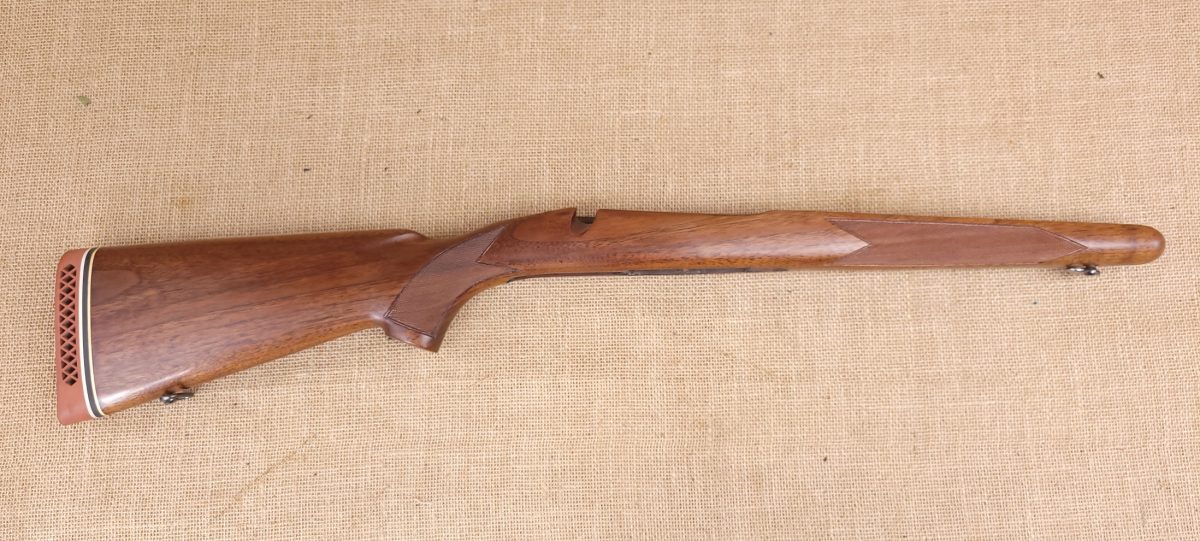
The Model 70 we tested was the Super Grade configuration with a Grade I walnut stock, and it is a handsome rifle. The wood-to-metal fit is clean, the checkering is well-executed and functional, and the overall lines are unmistakably Model 70. If rifle aesthetics matter to you — and for many traditional hunters, they absolutely do — this rifle delivers satisfaction every time you pull it from the safe.
Ergonomically, the stock geometry is traditional and will feel immediately familiar to anyone who has shouldered a classic American sporter. The comb height provides a natural cheek weld with low-mounted scopes, and the pistol grip angle positions the trigger hand comfortably. Length of pull on the standard stock is 13.5 inches, which is appropriate for average-build shooters but may feel slightly short for larger-framed hunters wearing heavy winter layering.
The composite stock options on the Featherweight and XTR models offer more weather resistance and a slightly more modern feel, though they lack the visual appeal of the walnut configurations. The composite stocks are functional and well-shaped, but they are not the textured, aggressively ergonomic designs you find on a Tikka T3x or Browning X-Bolt. They are conservative — which is consistent with the rifle’s overall design philosophy.
Here is where we have to be honest about a limitation. The Model 70’s stock options are narrower than what competitors offer. Browning’s X-Bolt lineup includes short-action composite, long-action walnut, thumbhole, adjustable comb, and chassis-style configurations. Tikka offers an entire ecosystem of interchangeable stocks through the T3x platform. The Model 70 gives you walnut or composite in a handful of configurations, and that is the extent of it. If you want to customize the ergonomics significantly, you are looking at aftermarket stocks from McMillan, Manners, or Bell & Carlson — quality options, but an additional investment.
The rifle’s weight is the other ergonomic consideration. Our test rifle in .30-06 with the walnut stock weighed 7.5 pounds bare and approximately 8.75 pounds scoped and loaded. That is not heavy by historical standards, but it is meaningfully heavier than a Tikka T3x Lite (6.3 lbs), Browning X-Bolt Mountain Pro (6.1 lbs), or Weatherby Mark V Backcountry (6.5 lbs). On a day hunt from a truck or a treestand, you will not notice. On a multi-day backcountry elk hunt with serious elevation gain, you will notice by day three. Consult our guide on the best bolt-action hunting rifles for a deeper comparison of weight across platforms.
Extraction and Reliability: The Claw That Never Lets Go
We covered the controlled round feed mechanism earlier, but the extraction side of the equation deserves its own attention because it is arguably even more important.
The Model 70’s non-rotating claw extractor is a massive, spring-steel component that engages the cartridge rim with authority. When the bolt is cycled rearward after firing, the extractor does not simply pull the spent case out of the chamber — it rips it out. There is no polite way to describe it. The mechanical advantage of this extractor design means that even cases with sticky extraction (common with hot handloads, high ambient temperatures, or slightly oversized brass) come out of the chamber without hesitation.
We tested extraction with both factory ammunition and handloads that produced noticeably firm bolt lift. In every case, the extractor held the case firmly against the bolt face, and the case ejected cleanly and consistently. We have experienced extraction failures with push-feed rifles under similar conditions — cases that required a second bolt manipulation or, in one memorable instance, a cleaning rod to dislodge. The Model 70’s claw extractor eliminates this category of failure entirely.
For hunters in cold, wet environments — late-season whitetail in freezing rain, moose hunting in the Pacific Northwest, bear hunts in coastal Alaska — this reliability matters. Moisture, condensation, and temperature swings can all contribute to sticky extraction in lesser designs. The Model 70 shrugs it off.
The three-position wing safety is the other reliability component worth discussing. Position one (full rearward) locks the bolt and blocks the trigger. Position two (middle) blocks the trigger but allows the bolt to cycle — critical for safely unloading the rifle. Position three (full forward) puts the rifle on fire. This design is mechanically simple, positive in engagement, and allows safe unloading without the trigger being live. It is a superior safety design to the two-position safeties found on most push-feed rifles.
The learning curve is real, though. If you are accustomed to a tang safety (Browning X-Bolt, Mossberg Patriot) or a simple two-position trigger guard safety (Ruger American, Savage Axis), the three-position wing will feel unfamiliar at first. It requires deliberate thumb manipulation, and the positions are not as intuitive under stress as a tang safety that simply pushes forward to fire. After a few range sessions and some dry-fire practice at home, it becomes second nature — but it is a valid criticism that the initial manipulation is less intuitive than some competitors.
Why the Model 70 Endures
In a market that chases lighter, faster, and more modular designs every year, the Winchester Model 70 continues to sell because it represents something specific: mechanical integrity over trend-chasing.
The controlled round feed action has not changed in fundamental design since the pre-64 era. It has not needed to. The extractor design that professional hunters trusted fifty years ago is the same extractor design in your new Model 70 today. The three-position safety works the same way it always has. These are not features that benefit from reinvention — they benefit from consistency.
There is also an intangible element. The Model 70 carries weight beyond its physical mass. It connects you to a lineage of hunters and a tradition of rifle craft that few other production rifles can claim. A Tikka T3x is an excellent rifle. A Browning X-Bolt is an excellent rifle. Neither one makes you feel like you are holding a piece of American hunting history. The Model 70 does, and for a certain type of hunter, that feeling matters.
We are not suggesting that sentiment should override function. But when a rifle delivers both — genuine mechanical superiority in its action design and a connection to hunting tradition — it occupies a category of one.
The Benchmark Score Breakdown
We evaluate every rifle we test against our standardized scoring methodology. Here is how the Winchester Model 70 breaks down:
- Action Reliability: 9.5/10 — Controlled round feed is the gold standard. No feeding or extraction failures under any test condition.
- Trigger Quality: 9/10 — The MOA trigger is one of the best factory triggers available. Crisp, adjustable, and needs no aftermarket replacement.
- Accuracy: 8/10 — Consistent MOA performance with quality ammunition. Not a sub-MOA precision rifle, but more than adequate for all hunting applications.
- Ergonomics & Handling: 7.5/10 — Classic stock geometry works well. Weight is above average. Stock options are limited compared to competitors.
- Build Quality: 9/10 — Forged steel receiver, excellent wood-to-metal fit, high-quality finish. Built to last generations.
- Value: 7.5/10 — The price has climbed. You are paying a premium for the name and the action design, and both are worth something — but it is no longer the value proposition it once was.
Overall: 8.4/10
How It Compares
The Winchester Model 70 competes against several well-established bolt-action hunting rifles. Here is how it stacks up against the alternatives we encounter most frequently. For a broader look at this category, see our full best bolt-action hunting rifles roundup.
vs. Browning X-Bolt
The Browning X-Bolt is the Model 70’s most direct competitor in both price and market positioning. Both are premium American-market bolt guns from established names. The X-Bolt uses a push-feed action with a rotating bolt head and a smooth, 60-degree bolt throw that is noticeably slicker than the Model 70’s 90-degree lift. The X-Bolt’s Feather Trigger is excellent — crisp and adjustable — though we give a slight edge to the MOA trigger for the quality of its break. Where the X-Bolt pulls ahead is in model variety and weight. Browning offers the X-Bolt in an enormous range of configurations, from lightweight mountain rifles under 6.5 pounds to long-range chassis builds. The Model 70 cannot match that breadth. If you prioritize action reliability and mechanical extraction above all else, the Model 70 wins. If you want a lighter, more configurable rifle with a smoother bolt throw, the X-Bolt is the better choice.
vs. Ruger Hawkeye
The Ruger Hawkeye is the most direct action-type competitor, as it also uses a controlled round feed design inspired by the original Mauser 98 — the same lineage the Model 70 draws from. The Hawkeye’s LC6 trigger is good, though not quite as refined as the MOA trigger. Build quality is solid, and Ruger offers the Hawkeye in a wide range of chamberings and configurations, including the excellent Long Range Target variant. The Hawkeye typically comes in $200-$400 less than the comparable Model 70, making it the value play within the CRF world. Where the Model 70 maintains its advantage is in overall fit and finish — the walnut on a Model 70 Super Grade is a tier above the Hawkeye’s wood, and the action feel is smoother. If controlled round feed matters to you and budget is a factor, the Hawkeye deserves serious consideration. If you want the best-executed CRF action in a production rifle, the Model 70 remains the standard.
vs. Mauser M18
The Mauser M18 represents the opposite end of the philosophy spectrum. It is a no-frills, push-feed bolt-action rifle that prioritizes accuracy and value above all else. At roughly $550-$650, it costs less than half of most Model 70 configurations. And it shoots — many M18 owners report sub-MOA accuracy with factory ammunition, which is genuinely impressive at this price point. The M18’s polymer stock is functional but uninspiring, the trigger is adjustable and adequate, and the overall build quality is honest without being luxurious. The M18 is not competing with the Model 70 on action design, extraction reliability, or heritage. It is competing on the question of “how much rifle do you actually need?” For a hunter who wants a reliable, accurate bolt gun and does not place a premium on controlled round feed or brand legacy, the M18 is arguably the most rational purchase in the category. For a hunter who values what the Model 70 specifically offers, the M18 is not a substitute — it is a different answer to a different question.
Frequently Asked Questions
Is the current Winchester Model 70 as good as the pre-64 original?
The current production Model 70 is, in our assessment, a better rifle than the pre-64 in nearly every measurable way. The MOA trigger is superior to the original trigger. Manufacturing tolerances are tighter. The barrel steel and rifling are more consistent. The action retains the controlled round feed design that defined the pre-64, including the non-rotating claw extractor and the three-position safety. What the current rifle does not have is the collector value and the specific hand-fitted feel of early production guns. If you want a rifle to hunt with, buy the current production. If you want a collectible, that is an entirely different market.
What is the best caliber for the Winchester Model 70?
That depends entirely on your intended game and geography. For an all-around North American hunting rifle, .30-06 Springfield remains the definitive choice in the Model 70 platform — it is the chambering most closely associated with this rifle historically, and it handles everything from whitetail to elk to moose with appropriate bullet selection. For dedicated western hunting at longer ranges, .300 Win Mag gives you more reach and energy at distance. For a lighter-recoiling option suited to deer-sized game, .270 Winchester is the classic Model 70 pairing that Jack O’Connor made famous. The 6.5 Creedmoor option makes sense if you want lower recoil and excellent long-range ballistics, though it feels like a modern chambering in a traditional platform. See our hunting caliber guide for a detailed breakdown of each chambering’s strengths.
How does the Model 70 handle recoil compared to lighter rifles?
The Model 70’s weight — which is a disadvantage when hiking — becomes an advantage at the moment of the shot. At 7.25-7.75 pounds bare, the rifle absorbs recoil more effectively than sub-7-pound ultralight rifles in the same chambering. Our test rifle in .30-06 was noticeably more pleasant to shoot than a 6.3-pound Tikka T3x Lite in the same caliber. The additional mass dampens felt recoil, reduces muzzle jump, and makes it easier to spot your own impacts through the scope. If you are recoil-sensitive or plan to do significant range practice, the Model 70’s weight works in your favor. This is one of those cases where “heavier” translates directly to “more shootable.”
Is controlled round feed actually necessary for hunting?
Necessary? No. The vast majority of hunting rifles sold today use push-feed actions, and they function reliably for millions of hunters every season. But “necessary” and “superior” are different questions. Controlled round feed provides a measurable mechanical advantage in extraction reliability and feeding consistency under adverse conditions — short-stroking, odd angles, extreme cold, rapid cycling under stress. For most whitetail hunters shooting from a heated blind at <200 yards, the practical difference will never manifest. For hunters pursuing dangerous game, hunting in extreme conditions, or simply wanting the maximum possible mechanical reliability in their rifle, controlled round feed offers a genuine and defensible advantage. It is insurance you may never need to collect on — but when you need it, nothing else substitutes.
How does the Winchester Model 70 compare to the best bolt-action hunting rifles overall?
The Model 70 holds a unique position in our best bolt-action hunting rifles rankings. It is not the lightest, not the cheapest, not the most accurate, and not the most modular rifle in the category. But it is the most mechanically reliable, it has one of the best factory triggers, and it carries a pedigree that no other production rifle can match. We score it at 8.4/10 overall, which reflects a rifle that excels in the areas that matter most for field hunting — action reliability, trigger quality, and build quality — while giving up ground in weight, value, and configurability. For the hunter who knows exactly what the Model 70 offers and values those specific attributes, it remains one of the finest bolt-action hunting rifles you can buy.