
Bass fishing from a kayak is one of the most effective and rewarding ways to target largemouth and smallmouth bass on any body of water. A kayak puts you in places that bass boats can’t reach — skinny backwater sloughs, timber-choked coves, shoreline pockets guarded by overhanging trees, and shallow flats where a trolling motor would spook every fish in the zip code. The low profile of a kayak means you’re sitting at the water’s surface, eye-level with laydowns and dock pilings, which changes how you see cover and how bass react to your presence.
We’ve spent hundreds of hours chasing bass from the cockpit of a kayak, from spring prespawn crawls along riprap banks to deep summer ledge fishing with electronics. This guide covers everything we’ve learned: choosing the right kayak, rigging it specifically for bass, adjusting your tackle approach, executing techniques that play to the kayak’s strengths, and reading seasonal patterns from a platform that sits six inches off the water.
If you’re newer to the sport, our kayak fishing hub covers the fundamentals. For rigging specifics, our full kayak rigging guide goes deep on installation and hardware. This article focuses on the bass-specific side of the equation.
Why Kayaks Are the Ultimate Bass Platform
Before we get into the details, it’s worth understanding what makes a kayak genuinely superior for certain bass fishing scenarios — not just a budget alternative to a bass boat.
Stealth is the kayak’s defining advantage. A 12-foot kayak displaces a fraction of the water that a fiberglass hull does. There’s no hull slap, no trolling motor hum, no livewells cycling. On pressured lakes where bass have been conditioned to associate boat noise with danger, a kayak is essentially invisible. We’ve drifted within casting distance of bass holding on shallow docks that would have bolted the moment a bass boat idled into the cove.
Access is the second advantage. Every lake has water that bass boats can’t fish — creeks too narrow to turn around in, timber so thick it would destroy a lower unit, flats so shallow a jet drive would ground out. Those are the places where bass stack up unpressured. A kayak draws four to eight inches of water. If it’s wet, you can fish it.
Cost efficiency is real but secondary. A fully rigged bass kayak runs $2,000 to $5,000 including electronics. A comparable bass boat setup starts at $25,000. But the decision to fish bass from a kayak shouldn’t be purely financial — it should be strategic. The kayak is a different tool, and for certain patterns and certain water, it’s the better tool.
Choosing a Kayak for Bass Fishing
Not every fishing kayak is built for bass fishing. Chasing bass means long days, frequent repositioning, casting hundreds of times, and occasionally wrestling a five-pounder at arm’s length. The kayak has to support all of that.
Length and Hull Design
We recommend a kayak in the 12- to 13-foot range for dedicated bass fishing. This length balances tracking (the ability to hold a straight line) with maneuverability in tight cover. Anything under 11 feet gets blown around too easily in open water and lacks the deck space for proper rigging. Anything over 14 feet becomes difficult to maneuver in the tight spots where kayaks shine for bass.
Hull width matters more than most anglers realize. A beam of 33 to 36 inches provides the stability needed to make aggressive casts, lean over the side to lip a fish, and manage tackle without feeling like you’re about to take a swim. Wider is more stable but slower — for bass fishing, stability wins.
Sit-on-Top vs. Sit-Inside
Sit-on-top is the only serious option for bass fishing. The open deck gives you access to tackle, room to manage fish, and the ability to shift your body position for different casting angles. Sit-inside kayaks trap your lower body, limit your reach, and make landing fish awkward. Every purpose-built fishing kayak on the market is a sit-on-top design, and that’s not a coincidence.
Pedal Drive vs. Paddle
A pedal drive fishing kayak is a significant advantage for bass fishing specifically because it frees your hands. When you’re working a shoreline and pitching to every piece of cover, the ability to reposition with your feet while keeping a rod in your hands is a game-changer. You can maintain a precise distance from the bank, adjust your angle to a dock, or hold position in current — all without putting the rod down.
Paddle kayaks absolutely work for bass fishing, and many tournament anglers run them successfully. The trade-off is constant rod-paddle-rod transitions that slow your pace and add fatigue over a full day. If your budget allows, a pedal drive pays for itself in efficiency on the water.
Standing Capability
Some modern fishing kayaks offer standing platforms with enough width and primary stability to cast while standing. For bass fishing, standing is a genuine tactical advantage — it lets you see into the water, spot shallow fish, and make longer pitches into cover. If standing capability is important to you, look for kayaks with a beam over 34 inches and a flat, textured deck area forward of the seat.
That said, the vast majority of kayak bass fishing happens seated. Don’t sacrifice other features chasing a standing platform you’ll use ten percent of the time.
Essential Rigging for Kayak Bass Fishing
A general fishing kayak and a kayak rigged for bass are different machines. Bass-specific rigging prioritizes casting efficiency, quick tackle changes, and fish management. Here’s the setup that works.
Rod Holders and Placement
Bass fishing from a kayak demands more accessible rod holders than trolling or general fishing. You want rods you can grab and deploy in seconds, not rods buried in flush-mount tubes behind your back.
Behind-the-seat crate holders — three to four vertical rod tubes on a crate system — carry your full arsenal for transport and serve as your rod rack while repositioning between spots. These are your storage holders.
Trackside adjustable holders on the gunwale rails beside your seat carry your active rods. Most bass anglers keep two rods deployed at all times: a casting setup for the primary pattern and a spinning setup as a follow-up. Mount one adjustable holder on each side of the cockpit at a slight forward angle for clean draws.
The Crate System
Your crate is command central. A well-organized crate for bass fishing holds three to four plano boxes of soft plastics and terminal tackle, a pair of pliers, a culling beam or scale, a lip grip tool, and backup leaders. The top of the crate serves as a flat surface for retying, rigging plastics, or setting down your phone.
We keep one Plano 3600 box dedicated to the day’s primary pattern — if we’re throwing Texas rigs, that box holds bullet weights, hooks, and the three or four soft plastic styles we’re rotating. A second box holds reaction bait components: spare treble hooks, split rings, and snap swivels. This system means we’re not digging through five boxes to find a 3/0 EWG hook while a fish boils twenty feet away.
Anchor System and Stake-Out Pole
Bass fishing demands precise boat positioning more than almost any other kayak discipline. You need to hold your kayak in an exact spot relative to a piece of cover, often in wind or light current.
A stake-out pole is the primary positioning tool for shallow water bass fishing (under six feet). It’s a fiberglass or composite pole that jams into the bottom through a dedicated port, usually near the bow or stern. It holds the kayak dead still with no anchor line angle to manage. Carry a pole that reaches at least eight feet — you’ll use it in water deeper than you expect.
An anchor trolley combined with a 1.5- to 3-pound mushroom anchor handles deeper water positioning. The trolley lets you slide the anchor point from bow to stern, controlling the kayak’s angle to the wind. For a full installation walkthrough, our kayak rigging guide covers anchor trolley setup in detail.
Fish Finder Placement
A fish finder is not optional for serious bass fishing from a kayak. Even if you’re primarily a shallow-water angler, the ability to read depth changes, find submerged cover, and identify baitfish concentrations transforms your efficiency.
Mount the transducer through the scupper hole or on a dedicated arm that keeps it in clean water below the hull. The display goes forward of your seating position — either on a RAM mount attached to the cockpit rail or on a purpose-built console. You need to see it at a glance while casting, not crane your neck over your shoulder.
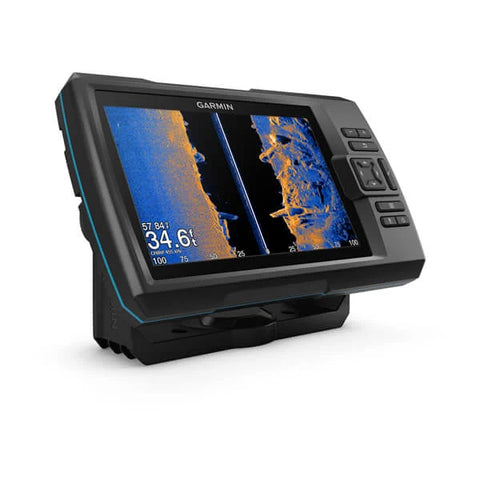
For our recommendation on the best value unit for kayak fishing, see our full fish finder guide. We also have a detailed breakdown of the Garmin Striker Vivid 7sv, which hits the sweet spot for kayak bass anglers who want side imaging without a four-figure price tag.
Tackle Adjustments for Kayak Bass Fishing
You cannot fish a kayak with the same rod and reel setups you’d run on a bass boat. The casting geometry is different, the workspace is smaller, and the consequences of a tangle are worse when you’re sitting in the middle of a lake with no trolling motor to hold you in place while you untie a backlash.
Rod Length and Action
Shorter rods are mandatory. We run 6’6” to 7’ rods for almost everything from a kayak, compared to the 7’ to 7’6” rods common on bass boats. The shorter length keeps your rod tip from catching on the water surface during hooksets, prevents the butt section from jabbing into the opposite gunwale, and makes single-hand pitches more accurate.
Medium-heavy fast action covers the broadest range of kayak bass techniques. It handles Texas rigs, jigs, spinnerbaits, and most soft plastic presentations. Pair it with a medium-power moderate-fast rod for lighter applications — drop shots, Ned rigs, and small crankbaits.
Two rods cover ninety percent of kayak bass fishing. Three covers nearly everything. Resist the urge to carry six rods — they create clutter, slow your transitions, and half of them won’t come out of the holder all day.
Reel Considerations
Low-profile baitcasters in the 7:1 to 8:1 gear ratio range are the primary reel for kayak bass fishing. The higher retrieve speed compensates for the fact that you can’t walk with the fish the way you would on a boat deck — when a bass runs toward you, you need to pick up line fast.
Braking systems matter more on a kayak because you’re often making off-balance casts or quick one-handed flips where thumbing the spool precisely is harder. A reel with a reliable centrifugal or magnetic braking system prevents the backlashes that cost you five minutes and a missed window on a piece of cover.
Tackle Management
Every piece of tackle on a kayak should be tethered, contained, or clipped down. Loose treble-hook lures rolling around the cockpit are a safety hazard when you’re sitting in a confined space with bare arms and legs exposed. Keep reaction baits in closed boxes. Rig soft plastics with weedless hooks whenever possible — not just for fishing cover, but for keeping hooks from embedding in your kayak’s foam or your skin.
Techniques That Shine from a Kayak
Certain bass fishing techniques are better from a kayak than from any other platform. The low sight angle, minimal noise, and ability to access tight spaces create opportunities that bass boat anglers simply don’t have.
Flipping Docks from a Low Profile
This is where kayak bass fishing becomes elite. Docks are the most consistent bass-holding structure on most lakes, and kayak anglers can work them better than anyone. Your low profile means you can pitch a jig under a dock walkway that a bass boat angler can only skip under. You can position your kayak between pilings and make vertical drops into shade pockets that are invisible from a higher vantage point.
Use your stake-out pole or paddle to hold position and make short, controlled pitches with a 6’6” medium-heavy rod. A 3/8-ounce jig or a Texas-rigged creature bait in green pumpkin is the standard payload. Let it fall on slack line, watch for the tick of a bite, and set the hook with a firm sweep rather than the overhead slam you’d use on a boat.
Pitching Laydowns and Timber
Fallen trees and standing timber are bass magnets, and kayaks can thread through timber fields that would terrify a bass boat owner. The key is positioning — get your kayak parallel to the laydown at a distance of one rod length, then make short pitches to each branch junction, fork, and root ball along the trunk.
Work from the shallow end of the laydown to the deep end. Bass holding on laydowns typically face shallow and retreat deeper when spooked. By starting shallow, you pick off the aggressive fish first without pushing deeper fish out of the structure.
Working Shoreline Cover Systematically
The most productive kayak bass pattern on many days is a slow, methodical crawl along a productive bank. Position yourself twenty to thirty feet off the shoreline and cast parallel to the bank or at a slight angle into the cover. A pedal drive kayak excels here — you maintain a consistent distance and speed with your feet while keeping a rod in your hands at all times.
Cover water efficiently by fan-casting: make three to five casts to each piece of visible cover (rock, stump, dock piling, grass edge), then move to the next. If a spot produces, slow down and dissect it. If it doesn’t, keep moving. Kayak anglers who park on one spot for thirty minutes without a bite are wasting their primary advantage — mobility.
Open Water Fishing with Electronics
Bass don’t always live shallow, and a kayak equipped with good electronics can find and fish offshore structure effectively. Ledges, humps, creek channel bends, and submerged roadbeds all hold bass in summer and winter patterns, and a fish finder with side imaging lets you locate this structure from a kayak just as well as from a bass boat.
The difference is positioning. In a kayak, you can’t hold over deep structure in wind as easily as a boat with a spot-lock trolling motor. Use your anchor trolley to set up directly over or upstream of the structure, and fish vertically or with short casts. Drop shots, football jigs, and deep-diving crankbaits all work well in this scenario.
Seasonal Patterns from a Kayak
Bass behavior changes with the seasons, and the kayak’s strengths shift accordingly. Understanding which kayak advantages matter in each season helps you plan your approach.
Spring: Shallow Water Dominance
Spring is the kayak’s best season for bass fishing. Prespawn and spawn bass push into the shallowest water they’ll occupy all year — back pockets, secondary points, flat shorelines with hard bottom, and creek arms. These are exactly the areas where kayaks excel and bass boats struggle.
Focus on shallow cover from February through April (timing varies by latitude). Texas rigs, jigs, and soft jerkbaits around docks, laydowns, and seawalls produce prespawn fish. During the spawn itself, a kayak’s stealth allows you to sight-fish beds that bass boat anglers blow out with their approach.
Summer: Electronics and Early Mornings
Summer bass split between early morning shallow feeds and daytime deep structure. The kayak plays both sides — launch early, fish the shallow bite for the first two hours, then transition to deeper water with your electronics once the sun gets high.
Topwater in low light is outstanding from a kayak. A walking bait or popper worked parallel to a grass line at sunrise generates explosive strikes, and the kayak’s silence means bass don’t associate your presence with danger the way they do with a boat idling through.
For the deeper daytime pattern, use your fish finder to locate brush piles, ledges, and channel swings. Mark productive spots as waypoints so you can return to them efficiently. A quality kayak fish finder with GPS charting makes this repeatable across sessions.
Fall: Transition and Baitfish Focus
Fall bass follow shad and other baitfish into the backs of creeks and onto shallow flats. This is a chase-and-react season — bass are aggressive and competitive, feeding heavily before winter. Your fish finder becomes a baitfish locator: find the shad, and the bass are within casting distance.
Reaction baits dominate fall kayak fishing. Spinnerbaits, lipless crankbaits, square-bill crankbaits, and swimbaits cover water fast and trigger the competitive strike response that fall bass are wired for. Move quickly between creek arms, checking each one for baitfish activity before committing time to it.
Winter: Slow and Vertical
Winter kayak bass fishing is the most demanding but also the least pressured. Most bass boat anglers stay home when water temperatures drop below 50 degrees. That means you have the lake largely to yourself.
Bass hold tight to deep cover in winter — standing timber, brush piles, steep bluff walls, and channel ledges. Slow presentations win: a 1/2-ounce jig crawled along the bottom, a drop shot with a finesse worm, or a small suspending jerkbait paused for ten to fifteen seconds between twitches. The kayak’s advantage here is patience and precision. You can anchor over a single brush pile and work it for thirty minutes without drifting off or burning trolling motor battery.
Fish Finder Strategy for Kayak Bass Fishing
A fish finder does more than show depth and fish arches. Used strategically, it becomes your most powerful tool for finding and patterning bass across an entire lake.
Using Side Imaging to Map Structure
Side imaging lets you scan wide swaths of water on either side of your kayak, revealing structure that would take hours to find by blind casting. On your first trip to a new lake, spend thirty minutes idling through the main creek channels and along secondary points with side imaging running. You’ll mark laydowns, rock piles, brush, and depth transitions that become your fishing spots for the rest of the season.
Marking Waypoints for Repeat Visits
Every piece of productive structure should become a waypoint in your fish finder’s GPS. Name them something descriptive — “Laydown NE Creek 12ft” is more useful than “Waypoint 047” when you’re scrolling through a list at five in the morning. Over time, you build a personal map of the lake that no one else has.
Reading Depth Transitions
Bass relate to depth changes more consistently than any other structural element. A flat that drops from four feet to eight feet over a short distance will hold bass when the surrounding flat won’t. Your fish finder shows these transitions clearly on the traditional sonar view. Train yourself to watch the depth reading constantly — when it changes sharply, slow down and fish the area thoroughly.
For a detailed look at the unit we recommend for kayak bass anglers, read our Garmin Striker Vivid 7sv review. It delivers side imaging, GPS waypoints, and ClearVu down imaging at a price point that makes sense for a kayak setup.
Landing Bass from a Kayak
Hooking a bass is one thing. Getting it into (and out of) a kayak without flipping yourself into the water is another skill entirely. The confined space and low freeboard of a kayak demand a different approach to fish handling.
Lip Grip Tools
A lip grip (like a Boga Grip or similar tool) is the single most useful landing tool on a kayak. It gives you a secure hold on the bass’s lower jaw at arm’s length, which keeps the fish away from the hull where treble hooks can snag on bungees, seat straps, and rigging. Clip it to your PFD or a D-ring within immediate reach — not buried in the crate behind you.
Rubber Mesh Nets
A short-handled rubber mesh net works for bass that are too active to lip safely or when you’re fishing treble-hook baits that make hand-landing risky. A net with a 12- to 15-inch handle is sufficient — anything longer becomes unwieldy in the cockpit. Rubber mesh is critical over nylon because it doesn’t tangle with hooks the way knotted nylon does.
Landing Fundamentals
Do not stand up to land a bass. This bears repeating because it’s the number one cause of kayak capsizes during fish fights. Keep your center of gravity low, bring the fish alongside the kayak at your hip, and lift it over the gunwale in a controlled motion. If the fish is green and still fighting, let it run. You have no reason to horse a bass to the kayak when there’s no brush to pull it into your line.
For catch-and-release, hold the fish over the water alongside the kayak for the photo, not over the cockpit. A bass that flops out of your hand falls back into the lake instead of into your lap where it thrashes hooks into your legs.
Kayak Bass Tournament Tips
Kayak bass tournaments are the fastest-growing segment of competitive fishing, and the format rewards skills that are different from traditional boat tournaments.
Pre-fish on foot and by satellite. Before a tournament, study satellite imagery of the lake to identify backwater areas, docks, laydowns, and shallow flats. Many of the best kayak tournament spots are in areas that bass boat competitors overlook because they can’t access them.
Carry a measuring board. Most kayak tournaments use a catch-photo-release format where fish are scored by length, not weight. A bump board strapped to your gunwale with a clear ruler gives you fast, accurate measurements. Practice your measure-and-photograph sequence until it takes under thirty seconds per fish.
Fish your strengths, not the field’s. Kayak tournaments reward consistency over hero casts. Five solid 14-inch fish will outscore three 16-inchers and two blanks. Stick to patterns and areas you’re confident in rather than gambling on untested spots.
Manage your energy. A kayak tournament day is physically demanding — eight hours of paddling, casting, and managing fish in the sun. Bring more water and food than you think you need. Pace yourself in the first half of the day so you can fish effectively in the afternoon, when many anglers are fading.
Log everything. After each tournament, record what worked, what didn’t, water temperature, weather, and the spots that produced. Over a season, this log becomes more valuable than any single piece of gear.
Frequently Asked Questions
What is the best kayak length for bass fishing?
A 12- to 13-foot sit-on-top kayak is the ideal length for dedicated bass fishing. This range provides enough hull speed to cover water between spots, enough stability for aggressive casting and fish handling, and enough maneuverability to work tight cover like docks and timber. Shorter kayaks lack stability and tracking; longer ones sacrifice the agility that makes kayak bass fishing effective.
Do I need a pedal drive kayak for bass fishing?
You don’t need one, but a pedal drive is a significant advantage. It frees your hands for continuous casting while you reposition along a shoreline, which is the most common bass fishing pattern from a kayak. Paddle kayaks work well — many successful tournament anglers use them — but expect more fatigue and slower coverage over a full day. Check our best pedal drive fishing kayaks roundup for current recommendations.
What rod length should I use for kayak bass fishing?
Run rods in the 6’6” to 7’ range for kayak bass fishing. This is shorter than the 7’ to 7’6” standard on bass boats, and for good reason: shorter rods keep your tip from hitting the water on hooksets, prevent the butt from catching on the opposite gunwale, and give you better control on short-range pitches and flips that dominate kayak bass fishing.
How do I keep from flipping the kayak when fighting a big bass?
Keep your center of gravity low and fight the fish with rod pressure rather than body movement. Never reach across the kayak to grab a fish on the opposite side — reel it around to your dominant side instead. If the bass surges, let it run rather than locking down the drag and pulling against the kayak’s stability. A kayak with a beam width of 33 inches or wider gives you a generous margin of primary stability for fish fights.
Is a fish finder worth it for kayak bass fishing?
Absolutely. A fish finder transforms kayak bass fishing from a cast-and-hope approach into a systematic, data-driven pattern. Even a basic unit shows depth transitions, submerged cover, and baitfish — all of which tell you where bass are likely holding. A unit with side imaging, like the Garmin Striker Vivid 7sv, lets you scan and map structure on both sides of your kayak simultaneously. For our full breakdown of options at every price point, see our best fish finders for kayak fishing guide.
Bass fishing from a kayak isn’t a compromise — it’s a specialization. The stealth, access, and precision that a kayak provides in shallow cover, pressured fisheries, and tight structure make it a legitimately superior platform for specific bass patterns. Rig it right, adjust your tackle to fit the workspace, learn the techniques that leverage the kayak’s strengths, and you’ll consistently catch bass that boat anglers drive right past. To understand how we evaluate the gear mentioned in this guide, check out our testing methodology.