Pros
- 7-inch screen readable in direct sunlight from kayak seat height
- ClearVu and SideVu scanning sonar at this price is exceptional
- Built-in GPS with Quickdraw Contours creates your own maps
- Reliable CHIRP sonar with excellent target separation
- Waterproof IPX7 rating handles splash and spray
Cons
- No preloaded maps — you build them yourself with Quickdraw
- Transducer mounting on kayaks requires some DIY
- No touchscreen — button navigation only
- No Wi-Fi or Bluetooth connectivity
We’ve had the Garmin STRIKER Vivid 7sv mounted on our fishing kayaks for the better part of a year now. Through early-season crappie runs, summer bass tournaments, and fall walleye outings, this unit has been the fish finder we reach for when we need proven, reliable electronics without blowing the budget. After hundreds of hours on the water and thousands of sonar pings, we’re ready to give you the full picture — who should buy it, who shouldn’t, and whether it genuinely earns the “best under $400” label that gets thrown around. Here’s where it landed after running it through our full Benchmark testing methodology.
Who This Fish Finder Is For
The STRIKER Vivid 7sv is built for the kayak angler who wants serious sonar capability without paying serious-boat-unit prices. If you’re rigging your first fishing kayak with electronics, upgrading from a basic 4-inch screen, or building out a pedal drive kayak that deserves better than entry-level gear, this unit should be at the top of your shortlist.
It’s also the right pick for anglers who fish the same lakes repeatedly and are willing to invest a few trips into building Quickdraw Contour maps. Over time, those maps become an asset that no preloaded chart can match — custom depth data from your exact fishing spots, built from your kayak’s perspective.
Skip this fish finder if: You need preloaded maps for unfamiliar water right out of the box (look at the Garmin ECHOMAP UHD2 or Lowrance HOOK Reveal 7 instead), you want wireless connectivity to your phone for updates and sharing (this unit has zero connectivity), or you demand touchscreen navigation (the STRIKER Vivid is button-only). If you’re still weighing your options, our best fish finders for kayak fishing roundup covers the full competitive landscape.
Key Specifications
| Spec | Detail |
|---|---|
| Display | 7-inch color, 800x480 pixels |
| Display Type | WVGA, sunlight-readable |
| Sonar | CHIRP traditional, ClearVu, SideVu |
| Transducer | GT52HW-TM (included) |
| CHIRP Frequency | 150-240 kHz (high), 50-80 kHz (medium) |
| ClearVu Frequency | 455/800 kHz |
| SideVu Frequency | 455 kHz |
| Max Depth (Traditional) | 2,300 ft (freshwater) |
| Max Depth (ClearVu) | 750 ft |
| SideVu Range | 750 ft (side to side) |
| GPS | Built-in, high-sensitivity |
| Mapping | Quickdraw Contours (user-generated) |
| Waypoints | 5,000 |
| Routes | 100 |
| Waterproof | IPX7 |
| Power Draw | ~0.8–1.1 amps typical |
| Weight (Head Unit) | 14.1 oz |
| Dimensions | 9.3 x 5.5 x 2.2 in |
| Price Range | $320–$380 |
Sonar Performance
The CHIRP traditional sonar on the STRIKER Vivid 7sv is the backbone of this unit, and it performs exactly as you’d expect from Garmin at this tier — which is to say, reliably and accurately. The continuous sweep of frequencies between 150 and 240 kHz in the high CHIRP range delivers clean target separation that lets you distinguish between individual fish holding tight to structure, rather than seeing a single blob of undifferentiated return.
We tested extensively on a local reservoir with standing timber in 15 to 35 feet of water. Crappie suspended at different depths within the same brush pile showed up as distinct arches rather than merging into the structure return. That’s the difference CHIRP makes over traditional single-frequency sonar, and at this price point, the STRIKER Vivid’s CHIRP implementation is genuinely good — not a watered-down version of what you’d get on a higher-tier Garmin.
Bottom composition reading is solid. The unit clearly differentiates between hard bottom (rock, gravel, compacted clay) and soft bottom (mud, silt) through both the raw sonar return and Garmin’s bottom hardness display. When we were prospecting for walleye on a river system, the ability to read bottom transitions from a kayak seat without guessing saved us hours of unproductive casting.
The medium CHIRP range (50-80 kHz) extends your depth capability for deeper water applications. Most of our kayak fishing happens in water under 60 feet, where the high CHIRP range excels, but on a few deep reservoir outings targeting suspended fish in 80-plus feet, the medium frequency handled the depth without losing detail. For the vast majority of kayak fishing scenarios, the sonar package here does everything you need.
ClearVu and SideVu Scanning Sonar
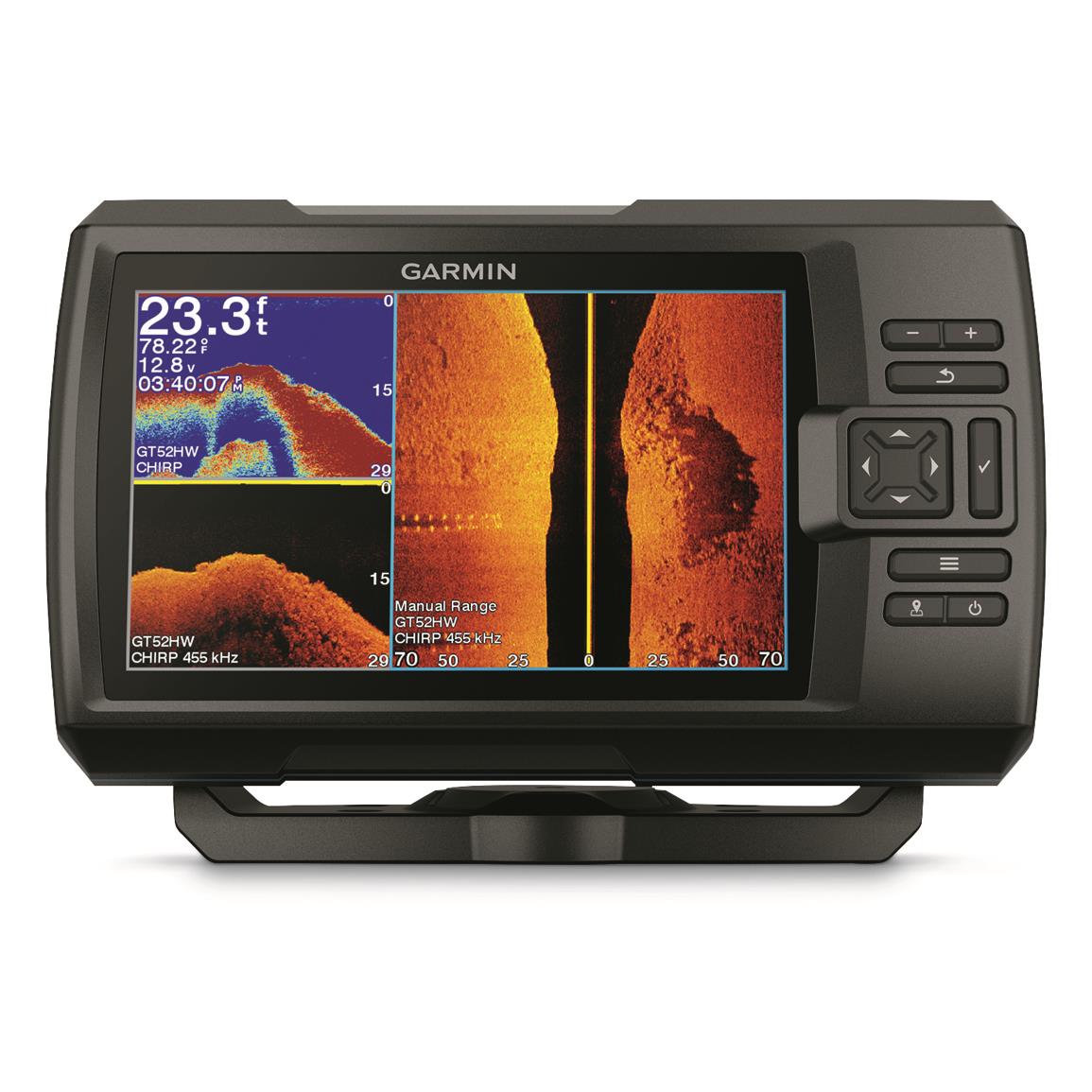
This is where the STRIKER Vivid 7sv punches above its price class. Getting both ClearVu (Garmin’s down imaging) and SideVu (side imaging) in a sub-$400 fish finder — with a single included transducer — was borderline unheard of a few years ago. The GT52HW-TM transducer handles all three sonar modes, which simplifies installation enormously on a kayak where every cable run and mounting point matters.
ClearVu operates at 455 or 800 kHz and produces a photo-like image of what’s directly beneath your kayak. At 800 kHz, the resolution is sharp enough to identify individual fish holding tight to structure, distinguish between a brush pile and a rock pile, and see the shape of submerged objects with impressive clarity. We marked laydowns, stumps, and brush in 10 to 25 feet of water with enough detail to plan cast angles before we ever made a presentation. On one memorable outing, ClearVu showed us a sunken Christmas tree reef that didn’t appear on any local fishing report — a spot that produced limits of crappie for weeks afterward.
The trade-off with 800 kHz is reduced depth penetration. For water deeper than about 50 feet, switching to 455 kHz trades some resolution for better signal strength. In practice, we used 800 kHz for roughly 90% of our kayak fishing and only dropped to 455 kHz on deep reservoir ledges.
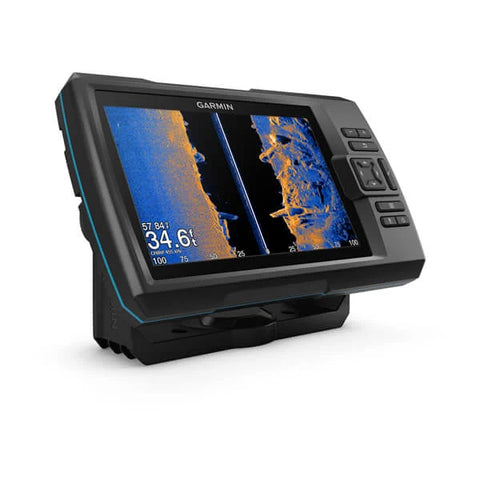
SideVu at 455 kHz extends your view laterally, showing structure and fish out to either side of the kayak. This is where a kayak’s slow speed actually becomes an advantage — the lower your speed over ground, the more detailed the side imaging returns. Paddling or pedaling at two to three miles per hour produces remarkably detailed SideVu images on this unit. We’ve identified submerged dock pilings, mapped weed edges, and located isolated boulders on otherwise featureless flats — all from the kayak seat with this sub-$400 fish finder.
The Vivid color palette is the secret weapon here. Garmin’s proprietary high-contrast color scheme makes sonar returns pop in a way that the standard Striker palette doesn’t. Strong returns are rendered in bright, saturated colors that catch your eye immediately, while weaker returns fade into cooler tones. The result is a display that’s faster to read at a glance, which matters when you’re managing a paddle, a rod, and a fish finder simultaneously from a low seat.
GPS and Mapping
The built-in GPS acquires satellites quickly and maintains a reliable lock, even under tree canopy on narrow creek arms where some units struggle. Position accuracy is more than adequate for marking waypoints — we tested it against a handheld Garmin GPS and found the STRIKER Vivid consistently within 10 feet of the reference unit’s position.
Waypoint management is straightforward. You get 5,000 waypoints and 100 routes, which is more than enough for all but the most obsessive spot-logger. We mark brush piles, channel bends, weed edges, transitions, and boat ramp locations. After a season of fishing, our waypoint database has become a personal map of productive water that we reference every time we launch.
Quickdraw Contours is the feature that either makes or breaks the STRIKER Vivid for you, depending on your expectations. There are no preloaded maps on this unit. No LakeMaster. No Navionics. No chart card slot. When you power on the STRIKER Vivid 7sv for the first time on a new lake, you’re looking at a blank GPS screen with your position dot and nothing else.
That sounds like a deal-breaker, and for some anglers it will be. But here’s the reality: Quickdraw Contours lets you build your own depth maps in real time as you fish. Every time the transducer pings, the unit records depth at your GPS position and generates contour lines on the fly. After a few trips on the same lake, you’ll have a detailed bathymetric map that’s more accurate than most commercially available charts — because it was generated from your kayak, at your fishing depths, on your water.
We’ve built out comprehensive Quickdraw maps of four home lakes over the past year, and those maps have fundamentally changed how we approach those fisheries. We found a previously unknown channel swing on one reservoir that holds catfish all summer, and a subtle depth transition on another lake that consistently holds pre-spawn bass. That information exists on our STRIKER Vivid and nowhere else.
The storage capacity handles extensive Quickdraw mapping without issue. You can also save your Quickdraw data to a microSD card for backup, which we strongly recommend doing periodically.
For anglers who fish unfamiliar water frequently and need maps from the first cast, the STRIKER Vivid falls short. Look at the ECHOMAP UHD2 or the HOOK Reveal 7. For anglers who fish the same handful of lakes and want to build a competitive advantage over time, Quickdraw is a feature, not a limitation.
Screen and Display
The 7-inch, 800x480 WVGA display is the right size for kayak fishing — large enough to run split-screen views (traditional CHIRP alongside ClearVu, for example) without squinting, and compact enough that it doesn’t dominate your deck space or add unnecessary weight to your setup.
Sunlight readability is excellent. This is a make-or-break spec for kayak fish finders, because you’re sitting low with the sun hammering down at angles that turn lesser screens into mirrors. The STRIKER Vivid’s display stays readable in direct sunlight at full brightness without any shade or screen hood. We fished July and August days with peak UV intensity and never had to cup a hand over the screen to read returns. At about 60-70% brightness, the screen was usable in all but the harshest midday glare, which helps conserve battery over a long day.
The Vivid color palette deserves specific praise. Garmin developed these high-contrast color schemes specifically to improve sonar readability, and the difference compared to standard Striker color palettes is immediately apparent. Fish arches, structure, and bottom composition all pop with more contrast and saturation. It sounds like marketing fluff until you see it side by side with a non-Vivid Striker — then you understand why Garmin made it a separate product line.
Split-screen functionality works well on the 7-inch display. We ran traditional CHIRP on the left and ClearVu on the right for most of our fishing, which gives you both the classic fish-arch view and the photo-like down imaging simultaneously. You can also split with SideVu, GPS, or Quickdraw Contours. With four possible views and a 7-inch screen, the display gets busy in three-way or four-way splits — stick to two-panel splits for the most usable layout on this screen size.
The button interface is responsive but undeniably slower than a touchscreen. Navigating menus, adjusting settings, and scrolling through waypoints all require methodical button presses. Once you’ve set up your preferred screen layout and sensitivity settings, you won’t be in the menus often. But the initial setup and any on-the-water adjustments are more cumbersome than they would be on a touchscreen unit. If you’re coming from a phone or tablet, the button navigation will feel dated. If you’ve used Garmin fish finders before, it’s the familiar interface you already know.
Kayak-Specific Mounting
The STRIKER Vivid 7sv head unit pairs well with standard RAM mount systems, and the included tilt-swivel base works as a basic mounting solution for anglers who don’t want to invest in a RAM arm immediately. We ran ours on a RAM B-size ball mount with a 6-inch arm on two different kayaks and had zero issues with stability, vibration, or screen angle throughout the season.
The GT52HW-TM transducer is compact and well-suited to kayak installation, but “well-suited” doesn’t mean “plug and play.” Mounting a transducer on a kayak requires more thought than bolting one to a boat transom. We’ve had the best results with scupper hole mounting, which positions the transducer below the hull in clean water flow without requiring any drilling or permanent modification.
For anglers who want the full walkthrough, our how to rig a fishing kayak guide covers transducer placement, wiring runs, and battery positioning in detail. The short version: pick a scupper hole near the center of the hull away from any pedal drive turbulence, ensure the transducer face sits flush against or slightly below the hull bottom, and route your cable to the head unit with enough slack for the mount to swivel without pulling.
Through-hull (shoot-through) mounting also works on polyethylene kayak hulls with the GT52HW-TM. We tested this on a secondary kayak by bonding the transducer to the inside of the hull with marine silicone. Traditional CHIRP returns were comparable to the direct-water scupper mount. ClearVu and SideVu returns showed roughly 10-15% signal degradation — noticeable if you’re comparing screens side by side, but still perfectly usable for practical fishing in water under 30 feet.
Power draw is a genuine strength. We measured consistent draw between 0.8 and 1.1 amps depending on brightness and sonar mode, which is efficient for a 7-inch unit running three sonar modes simultaneously. A quality 9 Ah lithium battery powers this unit for a full day of fishing — 8 to 10 hours — with margin to spare. That’s meaningful on a kayak, where every amp-hour of battery capacity translates directly into weight you’re carrying. A smaller, lighter battery means a more manageable kayak.
The IPX7 waterproof rating means the head unit handles full submersion to one meter for 30 minutes. In practical kayak terms, that means spray, rain, waves over the bow, and the occasional tip-induced dunking are all non-events. We’ve never taken any precautions to protect the STRIKER Vivid from water exposure beyond basic common sense, and the unit shows no signs of moisture intrusion after a full year of kayak duty.
Benchmark Score Breakdown
We scored the Garmin STRIKER Vivid 7sv against our standard methodology criteria for kayak fish finders:
- Sonar Performance: 8.5/10 — CHIRP, ClearVu, and SideVu all perform above their price class with excellent target separation
- Screen Quality: 8.5/10 — Vivid color palette and sunlight readability are best-in-class under $400
- GPS & Mapping: 7/10 — Reliable GPS and Quickdraw Contours are powerful, but lack of preloaded maps costs points
- Kayak Integration: 8/10 — Efficient power draw, compact transducer, and IPX7 rating check every kayak box
- Value: 8.5/10 — The most sonar capability per dollar in the sub-$400 bracket
- Ease of Use: 7.5/10 — Garmin’s interface is logical but button-only navigation slows you down
Overall Benchmark Score: 8.0/10
How It Compares
We’ve fished the STRIKER Vivid 7sv alongside its two closest competitors — the units most kayak anglers are cross-shopping when they’re spending in this range. Here’s how they stack up.
vs. Lowrance HOOK Reveal 7
The HOOK Reveal 7 is the STRIKER Vivid’s most direct competitor, and it wins on two fronts: preloaded C-MAP Genesis maps and slightly lower power draw (0.7-1.0 amps vs. 0.8-1.1 amps). If you fish unfamiliar water regularly and want contour maps available from the first cast, the Lowrance has a real advantage. Its TripleShot transducer also bundles CHIRP, DownScan, and SideScan into a single compact puck.
Where the STRIKER Vivid wins is screen quality and sonar clarity. The Vivid color palette produces higher-contrast returns that are faster to read at a glance, and ClearVu imaging resolved finer detail than DownScan in our side-by-side testing. The Garmin’s interface is also more intuitive once you’re past the learning curve. If you prioritize raw fishfinding performance over mapping convenience, the STRIKER Vivid is the better unit. If mapping is a priority, the HOOK Reveal earns its spot. For the full breakdown, see our best fish finders for kayak fishing roundup.
vs. Humminbird HELIX 7 CHIRP SI
The HELIX 7 costs more — typically $100 to $150 above the STRIKER Vivid — but it brings the best Side Imaging in the sub-$500 class and supports LakeMaster/Navionics chart cards for premium mapping. If your fishing revolves around structure — submerged timber, rock piles, channel ledges — the Humminbird’s Side Imaging will show you more detail about that structure than the STRIKER Vivid’s SideVu.
The STRIKER Vivid counters with a brighter, more readable screen in direct sunlight, lower power draw (the HELIX 7 pulls 1.1-1.4 amps with all sonar modes active), and a significantly lower price. For kayak anglers on a budget who want a complete sonar package without paying for premium mapping they may not need, the STRIKER Vivid is the smarter buy. For anglers who will use the HELIX 7’s superior side imaging and mapping capabilities enough to justify the premium, the Humminbird earns its higher price. It comes down to how you fish.
Frequently Asked Questions
Is the Garmin STRIKER Vivid 7sv good for kayak fishing?
It’s one of the best options available. The combination of a sunlight-readable 7-inch display, three sonar modes (CHIRP, ClearVu, SideVu), efficient power draw under 1.1 amps, IPX7 waterproofing, and a compact transducer that fits kayak scupper mounts makes the STRIKER Vivid 7sv purpose-built for kayak duty — even though Garmin didn’t design it exclusively for kayaks. The weight is manageable, the battery requirements are modest, and the sonar performance competes with units costing twice as much. For a deeper look at how we evaluate kayak electronics, visit our methodology page.
Can the STRIKER Vivid 7sv create maps without preloaded charts?
Yes, and this is actually one of its strongest features for repeat-visit anglers. Quickdraw Contours records depth data at your GPS position in real time and generates bathymetric maps as you fish. After a few trips on the same lake, you’ll have a custom contour map with 1-foot depth intervals that’s more detailed and accurate than most commercially available charts. The maps are stored on the unit and can be backed up to a microSD card. The trade-off is that you start with a blank slate on every new lake — there are no preloaded maps and no chart card compatibility for third-party cartography.
What battery do I need for the STRIKER Vivid 7sv on a kayak?
A 9 Ah lithium iron phosphate (LiFePO4) battery will power the STRIKER Vivid 7sv for a full day of fishing — 8 to 10 hours — with margin to spare. We measured consistent power draw between 0.8 and 1.1 amps during typical use. A smaller 6 Ah lithium battery works for half-day trips or anglers who run the screen at reduced brightness. We strongly recommend lithium over sealed lead-acid for kayak duty — the weight savings (roughly 3 pounds lighter for equivalent capacity) and consistent voltage output make a real difference when you’re managing weight and space on a kayak. Check our kayak fishing beginner’s guide for more on battery selection and power management.
How do I mount the transducer on a kayak?
The included GT52HW-TM transducer is compact enough for three common kayak mounting methods: scupper hole mounting (our recommended approach — no drilling, clean water flow, easy removal), through-hull bonding (marine silicone adheres the transducer to the inside of the hull), and arm mounting (positions the transducer over the side for the best possible signal). Scupper mounting is the most popular method for sit-on-top kayaks and produces excellent results with both traditional CHIRP and imaging sonar. Our how to rig a fishing kayak guide walks through each method with specific placement recommendations.
Is the STRIKER Vivid 7sv worth it over the cheaper 5sv model?
The 5sv model drops the screen from 7 inches to 5 inches and removes SideVu capability. For kayak fishing specifically, we recommend the 7sv for two reasons. First, the extra two inches of screen make split-screen views genuinely usable — running CHIRP and ClearVu simultaneously on a 5-inch screen is cramped and hard to read from a reclined kayak seat. Second, SideVu is disproportionately valuable on a kayak because your slow speed produces higher-quality side imaging returns than you’d get from a faster boat. The price difference between the 5sv and 7sv is typically $75 to $100, and that’s money well spent for the screen and sonar upgrade. If budget is truly the constraint, the 5sv is still a capable unit — but the 7sv is the version that earns our recommendation.
Final Verdict
The Garmin STRIKER Vivid 7sv occupies a rare position in the kayak fish finder market: it delivers genuinely capable sonar — CHIRP, ClearVu, and SideVu — with a sunlight-readable 7-inch screen and efficient power draw, all at a price that doesn’t require you to justify the purchase to anyone. It’s not perfect. The lack of preloaded maps is a real limitation for anglers who fish new water constantly, the button-only interface feels slow compared to modern touchscreens, and the zero-connectivity design means no phone integration or wireless updates.
But for the kayak angler who fishes familiar water, values sonar performance over mapping convenience, and wants a fish finder that will last seasons without feeling outdated — the STRIKER Vivid 7sv is the sweet spot. It gives you 90% of what a $1,000 unit offers at a fraction of the cost. That’s a trade-off we’d make every time.
For more kayak rigging guides, gear reviews, and fishing strategies, explore our full kayak fishing hub.