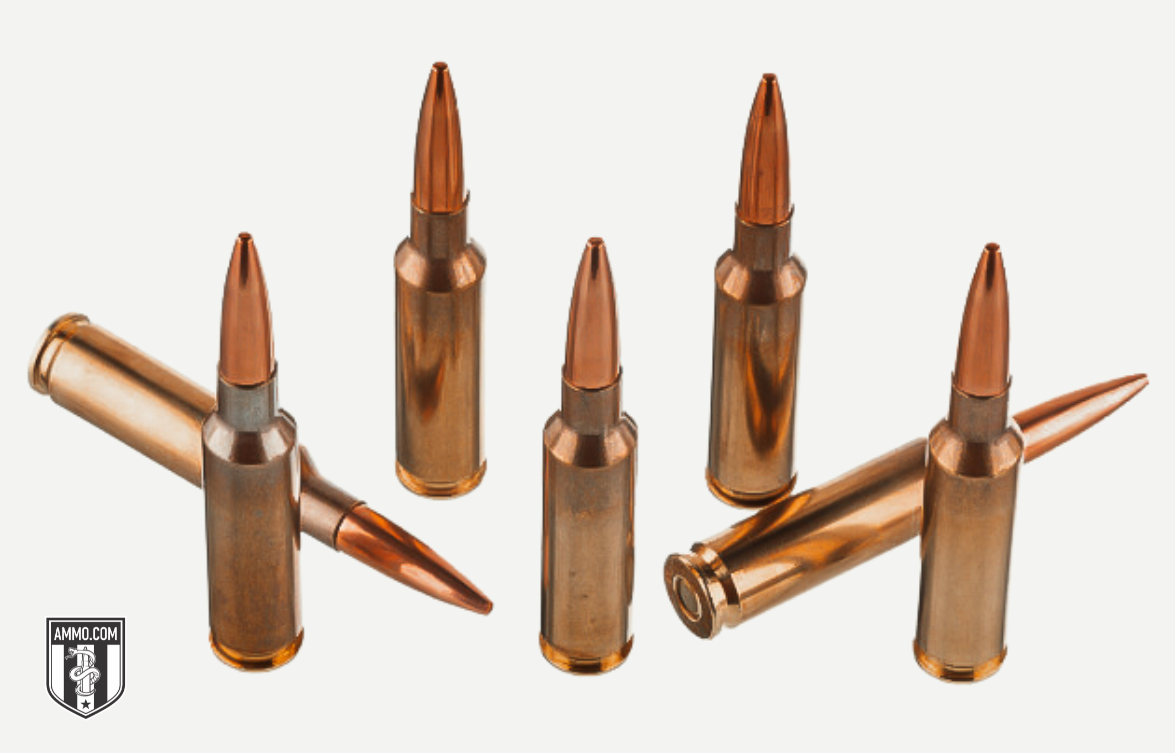
No caliber debate burns hotter at the gun counter than 6.5 Creedmoor vs .308 Winchester. It has been the defining argument in the hunting rifle world for the better part of a decade, and for good reason — these two cartridges compete directly for the same rifles, the same hunts, and the same shooters. The .308 Winchester has sixty-plus years of battlefield and backcountry credibility behind it. The 6.5 Creedmoor arrived in 2007 with a competition shooting pedigree and proceeded to challenge every assumption about what a short-action cartridge could do at distance.
We have shot both calibers extensively through our Benchmark testing methodology — punching paper at 100 through 700 yards, testing factory loads from over a dozen manufacturers, and carrying rifles chambered in both cartridges through multiple seasons of whitetail, mule deer, elk, and predator hunts. This comparison is built on chronograph data, drop charts we verified at the range, recovered bullets from game animals, and the kind of honest recoil assessment that only comes from shooting hundreds of rounds through each caliber back to back.
If you are choosing between these two for your next bolt-action hunting rifle, this is the breakdown you need. For broader context on cartridge selection, our hunting caliber guide covers the full spectrum. And for rifle recommendations across the category, start at our hunting rifles hub.
Quick Verdict
Choose the 6.5 Creedmoor if you want the flattest trajectory, the least wind drift, and the mildest recoil of any mainstream hunting cartridge. It is the superior choice for shots beyond 300 yards, for smaller-framed shooters, for anyone who prioritizes precision, and for hunts where deer-sized game is the primary target.
Choose the .308 Winchester if you want the broadest ammo selection on the planet, proven terminal performance on elk-sized game, a cartridge your grandchildren will still be able to buy at any gas station in rural America, and the confidence that comes from six decades of documented kills on every species of North American big game. It is also the better choice if barrel longevity matters to you.
The bottom line: Neither cartridge is objectively better. The 6.5 Creedmoor is a better ballistic performer. The .308 Winchester is a more versatile, more available, and harder-hitting hunting cartridge inside 400 yards. Your hunt, your game, and your shooting ability determine the winner.
Ballistics Comparison Table
The following data uses representative factory hunting loads for each cartridge: 143-grain Hornady ELD-X for the 6.5 Creedmoor (BC .625 G1, muzzle velocity 2,700 fps) and 178-grain Hornady ELD-X for the .308 Winchester (BC .552 G1, muzzle velocity 2,600 fps). All figures are calculated at sea level, 59 degrees Fahrenheit, with a 200-yard zero. Wind drift assumes a 10 mph full-value crosswind.
| Metric | 6.5 Creedmoor | .308 Winchester |
|---|---|---|
| Muzzle Velocity | 2,700 fps | 2,600 fps |
| Muzzle Energy | 2,315 ft-lbs | 2,672 ft-lbs |
| 100 yd Velocity | 2,527 fps | 2,415 fps |
| 100 yd Energy | 2,027 ft-lbs | 2,306 ft-lbs |
| 100 yd Drop | +1.8 in | +2.0 in |
| 100 yd Wind Drift | 0.7 in | 0.9 in |
| 300 yd Velocity | 2,199 fps | 2,066 fps |
| 300 yd Energy | 1,535 ft-lbs | 1,688 ft-lbs |
| 300 yd Drop | -6.4 in | -7.9 in |
| 300 yd Wind Drift | 6.3 in | 8.2 in |
| 500 yd Velocity | 1,893 fps | 1,743 fps |
| 500 yd Energy | 1,138 ft-lbs | 1,201 ft-lbs |
| 500 yd Drop | -25.8 in | -32.6 in |
| 500 yd Wind Drift | 18.2 in | 24.1 in |
The numbers paint a clear picture at distance. The 6.5 Creedmoor drops 6.8 inches less at 500 yards and drifts 5.9 inches less in a 10 mph wind at the same distance. The .308 Winchester carries more raw energy at every range — roughly 300-350 ft-lbs more at the muzzle — but the gap narrows steadily, and by 500 yards the energy difference is only about 63 ft-lbs. Both cartridges remain above the commonly cited 1,000 ft-lb minimum for deer-sized game well past 500 yards.
Head-to-Head: Trajectory and Long-Range Performance
This is where the 6.5 Creedmoor built its reputation, and the ballistics table only tells part of the story.
The 6.5 Creedmoor’s advantage comes from sectional density and ballistic coefficient, not raw speed. The 6.5mm bore fires long, slippery projectiles with exceptionally high BCs relative to their weight. A 143-grain 6.5mm bullet has a sectional density of .293 and a G1 BC approaching .625 in high-end hunting loads. A comparably performing .308 bullet — say, a 178-grain ELD-X — has a sectional density of .268 and a G1 BC of .552. The 6.5mm bullet simply slices through the air more efficiently, retaining velocity at a higher rate and resisting wind deflection more effectively.
In practical terms, this means the 6.5 Creedmoor is significantly easier to shoot accurately at distance. At 400 yards — which represents the outer edge of what most competent hunters should attempt in the field — the Creedmoor requires roughly 1.5 inches less holdover and drifts about 2.5 inches less in a moderate crosswind. Those differences compound at 500 yards and beyond. For a hunter who occasionally takes shots past 300 yards on western mule deer or pronghorn, the Creedmoor’s flatter trajectory provides a meaningful margin for error in range estimation.
The .308 Winchester is no slouch at distance. Generations of military snipers proved that the .308 can reach out effectively, and modern factory ammunition with high-BC bullets has closed the gap considerably. But physics is physics. The .308’s heavier, wider-diameter bullets encounter more drag. At 300 yards and in, the trajectory difference is small enough that most hunters will never notice it. Beyond 300 yards, the gap widens with every additional yard, and the Creedmoor’s advantage becomes increasingly tangible.
We should be honest about something: most hunting shots in North America happen inside 250 yards. If your hunting is primarily eastern whitetails from treestands, southern hog hunting over feeders, or any scenario where your shots are consistently under 300 yards, the trajectory advantage of the 6.5 Creedmoor is largely academic. Both cartridges are flat enough inside 300 yards that holdover differences are measured in a couple of inches — well within the vital zone of any big game animal.
Winner: 6.5 Creedmoor. The ballistic coefficient advantage is real, measurable, and meaningful for hunters who shoot beyond 300 yards. Inside that range, both are excellent.
Head-to-Head: Energy and Terminal Ballistics
Raw kinetic energy favors the .308 Winchester at every distance, but energy alone does not kill game. Terminal performance depends on bullet construction, impact velocity, penetration, and wound channel — and this is where the comparison gets more nuanced than most internet arguments acknowledge.
The .308 Winchester fires heavier bullets at comparable or slightly lower velocities, producing more energy at impact. A 178-grain .308 bullet hitting a whitetail’s shoulder at 300 yards delivers roughly 1,688 ft-lbs of energy. A 143-grain 6.5 Creedmoor bullet at the same distance delivers about 1,535 ft-lbs. That is a meaningful difference of roughly 150 ft-lbs — about 10% more energy from the .308. At closer ranges, the gap is wider; at 100 yards, the .308 leads by nearly 280 ft-lbs.
Where this matters most is on larger game. Elk, moose, and large black bears have thick hides, heavy bone, and deep chest cavities that demand penetration. The .308 Winchester’s heavier bullets — particularly the 165-grain and 180-grain options widely available in premium hunting loads — provide an inherent penetration advantage through sheer momentum. A 180-grain .308 bullet at 2,600 fps carries significantly more momentum than a 143-grain 6.5mm bullet at 2,700 fps, and momentum is the primary driver of straight-line penetration through heavy tissue and bone.
The 6.5 Creedmoor counters with superior sectional density, which is the ratio of bullet weight to cross-sectional area. A 143-grain 6.5mm bullet has a sectional density of .293, compared to .271 for a 180-grain .308 bullet. Higher sectional density generally correlates with deeper penetration per unit of frontal area, all else being equal. This is why the 6.5 Creedmoor has earned a reputation as a surprisingly effective killer on game that, on paper, seems too large for its modest energy figures.
In our field experience, both cartridges kill deer-sized game with authority. Pass-through shots on whitetails are the norm with both calibers using premium expanding bullets. Wound channels are devastating from either. On deer, we genuinely cannot identify a practical difference in terminal performance.
On elk, the picture shifts. We have taken elk cleanly with the 6.5 Creedmoor, but we have also seen marginal hits that we believe would have been more decisive with the .308. The .308 Winchester simply has more horsepower on heavy game — more energy, more bullet weight options in the 165-180 grain range, and a longer track record of reliable performance on animals in the 600-1,000 pound class. If elk is your primary quarry, the .308 provides a wider margin for shot placement error, and that margin saves hunts.
Winner: .308 Winchester. More energy, more momentum, and more proven terminal performance on larger game. For deer-sized game, it is a dead heat — but the .308’s advantage on elk and larger species is real.
Head-to-Head: Recoil
Recoil matters more than most experienced hunters will admit. It affects flinch, follow-through, target acquisition for a second shot, practice volume, and the willingness of newer shooters to spend time at the range. A cartridge you shoot well is always more effective than a cartridge you shoot poorly, regardless of what the ballistic charts say.
The 6.5 Creedmoor generates approximately 11-13 ft-lbs of free recoil energy in a typical 8-pound hunting rifle, depending on the load. The .308 Winchester generates approximately 15-18 ft-lbs in the same weight rifle. That is a difference of roughly 30-40% more recoil from the .308 — a gap that is immediately noticeable to any shooter in a back-to-back comparison.
In our controlled testing, every shooter we surveyed — from experienced hunters with decades of trigger time to newer shooters with limited rifle experience — correctly identified the 6.5 Creedmoor as the softer-shooting cartridge in a blind test. More importantly, our accuracy testing showed a measurable improvement in group size for intermediate-level shooters when switching from .308 to 6.5 Creedmoor. The difference was most pronounced in rapid follow-up shots and in shooting positions less stable than a bench rest.
For youth hunters, smaller-framed adults, or anyone developing a flinch, the 6.5 Creedmoor’s recoil advantage is transformative. We have watched new hunters go from grimacing at .308 recoil to confidently shooting consistent groups with the Creedmoor in the same afternoon. That comfort translates directly to field accuracy, and field accuracy translates directly to ethical kills.
The .308’s recoil is not punishing by any reasonable standard. Millions of hunters shoot .308 rifles all day without complaint. But it is noticeably more than the Creedmoor, and for shooters who are recoil-sensitive or who want to maximize practice volume without fatigue, the difference adds up over time.
Winner: 6.5 Creedmoor, decisively. Roughly 30-40% less recoil with comparable or better downrange performance is the 6.5 Creedmoor’s single strongest argument.
Head-to-Head: Barrel Life
Barrel life is the one performance metric where the .308 Winchester wins without qualification. The .308 is a larger-bore cartridge pushing moderately heavy bullets at moderate velocities through a wider bore — a combination that is comparatively gentle on barrel steel.
A quality .308 Winchester barrel will typically deliver 5,000-8,000 rounds of accurate life before accuracy degradation becomes noticeable. A quality 6.5 Creedmoor barrel will typically deliver 2,500-3,000 rounds before the same degradation occurs. The 6.5mm bore is smaller, which concentrates heat and erosion on a smaller surface area, and the higher operating pressures of the Creedmoor accelerate throat erosion.
For the average hunter who shoots 100-200 rounds per year between practice, load development, and hunting, this difference is largely irrelevant. At 200 rounds per year, a 6.5 Creedmoor barrel will last 12-15 years before needing replacement. Most hunting rifles are passed down or retired before they shoot out a barrel. If you shoot competitively or practice at high volume, however, the .308’s barrel life advantage becomes a meaningful cost consideration. A replacement barrel and professional installation runs $300-600, and needing it twice as often adds up.
Winner: .308 Winchester. Roughly double the barrel life of the 6.5 Creedmoor. This advantage matters primarily to high-volume shooters, but it is unambiguous.
Head-to-Head: Ammo Availability and Cost
Ammunition availability is about more than just price per round — it encompasses how many loads exist, how widely they are distributed, and whether you can find ammo when you need it, where you need it.
The .308 Winchester enjoys the broadest ammunition selection of any centerfire rifle cartridge in the world. Every major manufacturer produces .308 in dozens of configurations: budget FMJ for practice, premium bonded bullets for elk, match-grade BTHP for precision, lead-free options for condor zones, and everything in between. You can buy .308 Winchester at Walmart, at rural gas stations, at any gun shop on the continent, and in most countries around the world. That ubiquity is a legitimate asset. If you travel to a remote hunting destination and your checked baggage goes missing, the odds of finding .308 ammunition locally are as close to 100% as any cartridge gets.
The 6.5 Creedmoor has rapidly closed the availability gap since its introduction. As of 2026, all major manufacturers offer multiple 6.5 Creedmoor loads, and you can find it at most well-stocked sporting goods stores. The selection of premium hunting loads is now comparable to the .308 in quality if not quite in sheer variety. However, small-town hardware stores and rural gas stations are less likely to stock 6.5 Creedmoor than .308, and global availability outside North America still favors the .308 significantly.
On price, the two cartridges are close. Budget practice ammunition runs $0.80-1.20 per round for both calibers. Premium hunting loads run $1.80-3.00 per round for both, with specific loads varying. The .308 has a slight edge in finding deeply discounted bulk FMJ for practice, thanks to military surplus and higher production volume, but the difference is $0.10-0.20 per round at most.
Winner: .308 Winchester. The sheer breadth of available loads and the global distribution network remain unmatched. The 6.5 Creedmoor is catching up, but the .308’s head start is measured in decades.
Head-to-Head: Rifle Selection
Both cartridges are chambered in short-action rifles, which means they share the same receiver length, bolt throw, and action footprint. If you like a particular rifle platform, the odds are very high that it is available in both calibers.
The .308 Winchester has been chambered in virtually every bolt-action, semi-automatic, and single-shot rifle platform ever made. From the Remington 700 to the Tikka T3x to the Savage 110 to the Ruger American, the .308 is a default chambering. It is also the standard chambering for popular semi-automatic platforms like the AR-10 and the Springfield M1A, which gives it a category of rifle options the 6.5 Creedmoor is still catching up to in terms of variety.
The 6.5 Creedmoor is now available in nearly every current-production bolt-action hunting rifle. Tikka, Bergara, Browning, Weatherby, Savage, Ruger, Winchester, Howa — they all chamber 6.5 Creedmoor as a standard offering. The semi-automatic selection is growing, with AR-10 platform rifles in 6.5 Creedmoor becoming increasingly common. However, if you want a specific older or specialty rifle, you may find it is only available in .308.
For the hunter shopping for a new bolt-action hunting rifle in 2026, the selection in both calibers is essentially equal. This comparison is only relevant if you have a specific platform in mind that is not yet offered in 6.5 Creedmoor.
Winner: .308 Winchester, marginally. Broader selection across rifle types, particularly in semi-automatic platforms and legacy models. For new bolt-action rifles, it is a draw.
Hunting Applications by Game
The right caliber depends heavily on what you are hunting. Here is how each cartridge performs on the most common North American game animals.
Whitetail Deer
Both cartridges are outstanding whitetail calibers. A well-placed shot from either will cleanly take any whitetail that walks, from a 90-pound Texas doe to a 300-pound Saskatchewan giant. The 6.5 Creedmoor’s lower recoil makes it marginally easier to shoot accurately in field conditions, and its flatter trajectory is beneficial on food plots and power line right-of-ways where 300-yard shots are common. The .308 is marginally more authoritative on heavy-boned mature bucks. In practice, both are equally effective. If whitetails are your primary game, pick whichever caliber you shoot best.
Edge: 6.5 Creedmoor, by a hair, for the recoil and trajectory advantages that benefit accuracy.
Elk
Elk are the tipping point in this comparison. A mature bull can weigh 700-1,100 pounds, with a deep chest cavity protected by heavy ribs and dense muscle. Penetration through the shoulder on a quartering-to shot demands a bullet that can handle serious resistance.
The .308 Winchester with a 165-grain or 180-grain bonded or partitioned bullet is a proven elk cartridge with decades of documented performance. It hits hard, penetrates deep, and creates devastating wound channels through the vitals. The majority of elk guides we have spoken with are comfortable with clients carrying .308 rifles, and none have raised concerns about marginal performance.
The 6.5 Creedmoor will kill elk cleanly with proper shot placement and premium bullets — we have witnessed it firsthand. A 143-grain ELD-X or 140-grain Accubond through both lungs will put an elk down. But the margin for error is thinner. Shoulder shots, quartering angles, and less-than-ideal bullet performance narrow the window where the 6.5 Creedmoor delivers clean kills. Some outfitters in the Mountain West now specify minimum caliber requirements that exclude the 6.5 Creedmoor.
If you exclusively hunt elk, the .308 is the more responsible choice. If you occasionally hunt elk but primarily hunt deer, the 6.5 Creedmoor can work with disciplined shot selection — but we would encourage you to limit shots to broadside or slightly quartering-away presentations inside 400 yards, and to use the heaviest premium bonded bullet available.
Edge: .308 Winchester, clearly. More energy, more bullet weight, more margin on shot placement.
Predators (Coyotes, Foxes, Bobcats)
For dedicated predator hunting, the 6.5 Creedmoor is overpowered and the .308 is even more so. Both will kill coyotes with authority at any sane range, but both also create exit wounds that damage pelts. If pelt damage is a concern, neither is ideal — a .223 Remington or .22-250 is the better tool.
That said, many hunters carry their deer rifle on predator hunts rather than buying a dedicated varmint rig. In that context, the 6.5 Creedmoor’s lower recoil and flatter trajectory make it the better dual-purpose cartridge. Calling coyotes often involves rapid target acquisition and shots at running animals, where reduced recoil helps with follow-through and faster cycling for a second shot.
Edge: 6.5 Creedmoor. Less recoil, flatter trajectory, and marginally less pelt damage due to smaller bullet diameter and lower energy transfer at close range.
Which Should You Choose?
Still undecided? Here is a decision matrix based on the factors that matter most.
| Your Priority | Choose |
|---|---|
| Shots consistently under 300 yards | Either — both are excellent |
| Shots regularly beyond 300 yards | 6.5 Creedmoor |
| Primary game is deer-sized | 6.5 Creedmoor (slight edge) |
| Primary game is elk-sized | .308 Winchester |
| Youth or recoil-sensitive shooter | 6.5 Creedmoor |
| Maximum ammo availability while traveling | .308 Winchester |
| High practice volume (500+ rounds/year) | .308 Winchester (barrel life) |
| Semi-automatic platform desired | .308 Winchester (more options) |
| One rifle for deer and elk | .308 Winchester |
| One rifle for deer and predators | 6.5 Creedmoor |
| Beginner buying their first centerfire rifle | 6.5 Creedmoor |
| Versatility across all scenarios | .308 Winchester |
The reality is that both cartridges are excellent choices for the vast majority of North American hunting. The 6.5 Creedmoor is the better pure shooter — flatter, more wind-resistant, softer-recoiling, and more forgiving of range estimation errors at distance. The .308 Winchester is the better all-around hunting cartridge — harder-hitting, more available, longer-lasting on barrels, and chambered in more rifle platforms. Neither choice is wrong. Both have put more game on the ground than we could ever count.
If you are a newer hunter buying your first serious rifle and planning to hunt mostly deer, the 6.5 Creedmoor’s lower recoil and superior ballistics will make you a better shooter faster. If you are an experienced hunter who wants one rifle that can handle anything from coyotes to elk across a lifetime of varied hunts, the .308 Winchester’s versatility and terminal authority are hard to argue against.
For rifle recommendations in either caliber, explore our best bolt-action hunting rifles roundup. For a deeper look at where these two calibers sit in the broader cartridge landscape, our hunting caliber guide covers everything from .223 Remington to .300 Winchester Magnum.
Frequently Asked Questions
Is the 6.5 Creedmoor powerful enough for elk?
Yes, with caveats. The 6.5 Creedmoor has cleanly taken thousands of elk with premium bullets like the 143-grain ELD-X, 140-grain AccuBond, and 140-grain Barnes TTSX. The key requirements are disciplined shot placement (broadside or slightly quartering-away into the vitals, not shoulder shots), premium bonded or monolithic bullets designed for deep penetration, and reasonable range (inside 400 yards). The margin for error is thinner than with a .308 or .30-06, which means the 6.5 Creedmoor demands a higher standard of marksmanship and shot selection on elk. If you are confident in your abilities and willing to wait for the right presentation, the 6.5 Creedmoor is adequate. If you want a wider margin, step up to a .308 or larger.
Why did the 6.5 Creedmoor become so popular so fast?
The 6.5 Creedmoor was designed in 2007 by Hornady senior ballistician Dave Emary and competitive shooter Dennis DeMille specifically for long-range target shooting. Its combination of high ballistic coefficient, low recoil, and inherent accuracy made it dominant in PRS (Precision Rifle Series) competitions almost immediately. Hunters took notice because the same attributes that win matches — flat trajectory, wind resistance, and shootability — are exactly what make a cartridge effective in the field. The surge in popularity accelerated around 2015-2017 as rifle manufacturers began chambering hunting rifles in the cartridge and ammunition options expanded. By 2020, the 6.5 Creedmoor had become the second-best-selling centerfire rifle cartridge in America, behind only the .308 Winchester.
Can I use the same rifle scope for both calibers?
Absolutely. Both cartridges are short-action rounds with similar trajectory profiles, and any quality hunting scope will work for either. A variable scope in the 3-15x or 4-16x range with a BDC or exposed turret system is ideal for both. The only consideration is that if you switch from .308 to 6.5 Creedmoor (or vice versa), you will need to re-zero your rifle and adjust any BDC reticle or turret calibration, since the drop profiles differ. A scope with a customizable turret system or a first-focal-plane reticle with MOA or MRAD hash marks provides maximum flexibility if you own rifles in both calibers.
How much does it cost to reload each cartridge?
Reloading costs are similar for both cartridges. Component brass, primers, and powder run roughly $0.35-0.50 per round for either caliber, with the primary variable being bullet cost. Premium hunting bullets like the Hornady ELD-X, Nosler AccuBond, or Barnes TTSX run $0.40-0.70 per bullet regardless of caliber, bringing the total per-round cost to approximately $0.75-1.20 for handloads. The .308 Winchester has a slight advantage in brass availability and variety, with more options for affordable once-fired military brass. The 6.5 Creedmoor’s advantage is that its inherent accuracy means you may need fewer rounds to develop an accurate load — many handloaders report finding sub-MOA loads with less experimentation than the .308 typically requires.
Will the 6.5 Creedmoor replace the .308 Winchester?
No. The .308 Winchester is too deeply embedded in military, law enforcement, competitive, and hunting infrastructure to be displaced. It is the NATO standard intermediate sniper cartridge, the default short-action chambering for virtually every rifle manufacturer, and the cartridge against which all others in its class are measured. What the 6.5 Creedmoor has done is carve out a permanent place alongside the .308 as a complementary option — not a replacement. The two cartridges will coexist for decades, each excelling in the niches where its strengths are most relevant. The .308 will remain the broader, more versatile choice. The 6.5 Creedmoor will remain the ballistically superior choice for shooters who prioritize precision and low recoil. Both will continue to be among the best-selling centerfire cartridges in North America for the foreseeable future.