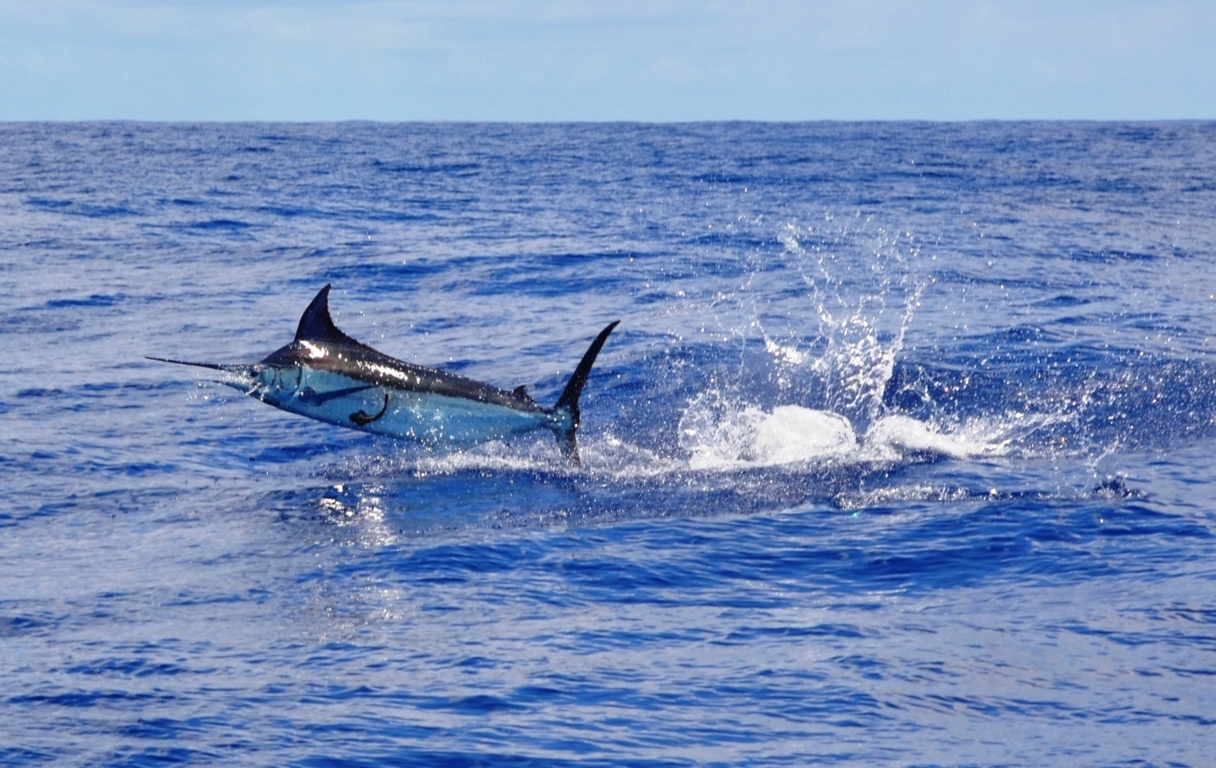
There is no moment in sportfishing that compares to a marlin strike. The outrigger clip snaps, a skirted lure disappears in a white explosion, and then — before your brain fully processes what just happened — a fish the size of a motorcycle launches ten feet out of the ocean, shaking its head with a violence that makes the reel scream and your knees buckle. Marlin are the undisputed apex of offshore angling. They are bigger, faster, meaner, and more spectacular than anything else swimming in blue water, and hooking one will permanently recalibrate your understanding of what a fish can do.
We’ve chased marlin across the Pacific, the Atlantic, and the Caribbean — from the deep ledges off Kona to the canyon edges of the Outer Banks, the banks off the Dominican Republic, and the seamounts south of Cabo San Lucas. What we’ve learned across years of serious bluewater fishing is that marlin are not random encounters. They are findable, targetable, and catchable when you understand how they think, where they live, and how to put the right presentation in front of them at the right time.
This guide covers everything we know about catching marlin — the species differences that affect your approach, the trolling spreads that raise them, the tackle required to fight them, live bait techniques for when trolling isn’t enough, how to read the water, how to fight and release them responsibly, and the destinations where your odds are highest. Whether you’re a seasoned offshore angler looking to add a marlin flag to the bridge or a motivated intermediate ready for the biggest challenge in the sport, this is the playbook. For a broader introduction to bluewater angling, start with our offshore fishing hub and our beginner’s guide to offshore fishing. If you want to understand how we evaluate and recommend gear, our methodology page explains the process.
Blue Marlin vs. White Marlin vs. Striped Marlin
Before we get into tactics, you need to understand which marlin you’re targeting because species dictates tackle class, lure size, trolling speed, and fight strategy. The three marlin species most commonly targeted by recreational anglers differ significantly in size, behavior, and geography.
Blue Marlin
Blue marlin are the undisputed heavyweight champions of the billfish world. Atlantic blues routinely exceed 400 pounds, with fish over 800 pounds caught every season in top fisheries. Pacific blues run even larger — the all-tackle world record stands at 1,376 pounds, and fish over 1,000 pounds (called “granders”) are the ultimate trophy in all of sportfishing. Blues are aggressive, powerful, and explosive. They hit trolling lures with reckless abandon, make long greyhounding runs punctuated by violent jumps, and can fight for hours. They are the primary target in most serious marlin fisheries worldwide.
Blue marlin are pelagic and highly migratory. In the Atlantic, they follow warm currents along the Gulf Stream from the Caribbean north through the Outer Banks and up to the canyons off the Mid-Atlantic. In the Pacific, they concentrate around volcanic islands, seamounts, and current convergence zones — places like Kona, Cabo, and the Great Barrier Reef. They prefer water temperatures between 76 and 82 degrees Fahrenheit and are almost always found in deep, clean, blue water.
White Marlin
White marlin are the bantamweights of the family — smaller, more acrobatic, and far more numerous in the western Atlantic than blues. Most white marlin weigh between 40 and 80 pounds, with exceptional fish pushing past 100. What they lack in raw size, they make up for in sheer aerial display. A hooked white marlin will tailwalk, cartwheel, and launch itself completely clear of the water a dozen times before it’s done. They are spectacular on lighter tackle and have developed a massive tournament following along the Mid-Atlantic coast.
White marlin respond well to smaller trolling lures, skirted ballyhoo, and naked ballyhoo pulled at moderate speeds. They are notorious short-strikers — slapping at baits with their bills rather than committing to the eat — which makes hook-up ratios a constant challenge. Circle hooks and careful rigging significantly improve your conversion rate on whites.
Striped Marlin
Striped marlin are the Pacific counterpart to white marlin in terms of size class, typically weighing between 90 and 200 pounds, with rare fish exceeding 300. They are found throughout the Pacific and Indian Oceans, with major fisheries off Baja California, New Zealand, Australia, and East Africa. Stripers are the most visually striking of the three species — they “light up” with vivid electric-blue vertical bars when agitated, creating one of the most photogenic moments in all of fishing.
Striped marlin are perhaps the most willing surface feeder of all billfish. They aggressively attack trolling lures, live baits, and even fly-fishing presentations. They are commonly found free-swimming on the surface with their dorsal fins out of the water (“tailing”), which creates sight-fishing opportunities that are unique among marlin species. Many Baja and New Zealand operations specifically target tailers with pitched live baits or cast presentations.
Trolling Spread for Marlin
Trolling is the foundational method for targeting marlin. It covers vast amounts of water, triggers the aggressive predatory instincts of billfish, and creates the visual commotion — bubble trails, splashing, smoke — that brings marlin up from depth to investigate. A properly set marlin trolling spread is a carefully orchestrated system of positions, lure sizes, running depths, and teaser patterns designed to simulate a school of fleeing baitfish.
Spread Positions
A standard marlin trolling spread runs five to seven lines from outriggers, flat lines, and a center shotgun position. Each position serves a specific purpose within the spread’s visual field.
- Short corner (left and right): These lines run closest to the boat, typically 30 to 50 feet back, right in the white water of the propwash. Short corner lures are your most visible positions and the first thing an approaching marlin sees. Run large, aggressive lures here — flat-faced plungers or chuggers that throw maximum smoke.
- Long corner (left and right): Set 60 to 90 feet back, just outside the propwash in cleaner water. These positions run medium to large skirted lures — angled-face or bullet-head designs that swim with a tight, fast action. Long corners are workhorse positions that produce a huge percentage of marlin bites.
- Short rigger (left and right): Clipped to the outrigger and set 75 to 120 feet back. These lures ride in the second or third wake wave and are often the first thing a marlin coming up from depth encounters. Skirted lures in the 10- to 14-inch range work well here.
- Long rigger (left and right): The farthest outrigger position, running 120 to 200 feet back in clean, undisturbed water. Smaller lures, diving lures, or rigged natural baits excel in this position and pick up cautious fish that follow the spread without committing closer to the boat.
- Shotgun: A single center line running 200 to 350 feet straight back. This line often produces the biggest fish of the day because it swims in completely clean water, far from engine noise and prop wash. A medium skirted lure or rigged ballyhoo is the standard choice.
Lure Selection
Marlin lure selection is a deep subject, but the fundamentals come down to head shape, size, color, and action. For blue marlin, lures in the 10- to 16-inch head range are standard, with larger lures (up to 18 inches) used in grander fisheries like Kona. For white marlin, scale down to 6- to 9-inch heads. Striped marlin fall in between.
Head shapes dictate action: flat-faced plungers push water and create a wide smoke trail with an aggressive side-to-side action. Angled-face lures swim tighter and faster, tracking well at higher speeds. Bullet heads run straight and deep with minimal surface disturbance — effective when fish are lure-shy. Cup-faced lures create a pronounced bubble trail and erratic darting action.
Color choices generate endless debate, but proven combinations include purple-and-black, blue-and-white, green-and-yellow, pink-and-white, and natural baitfish patterns. In dirty water or low-light conditions, we lean toward darker, high-contrast colors. In clear water under bright sun, lighter and more natural patterns produce. Run a variety across your spread rather than committing to a single color theory.
Teasers and Dredges
Teasers and dredges are hookless attractors designed to create visual commotion and draw marlin into your spread from a distance. They are not optional in serious marlin fishing — they are essential.
Daisy chains are strings of plastic squids or bird teasers rigged in a row, creating the illusion of a small bait school fleeing across the surface. Run one or two daisy chains from the short outrigger positions or dedicated teaser reels. They splash, bubble, and create a visual trail that marlin can see from hundreds of yards away.
Dredges are multi-armed umbrella rigs loaded with artificial or natural baits that swim subsurface, typically 5 to 15 feet below the surface. A well-built dredge loaded with mullet, ballyhoo, or silicone replicas simulates a dense bait school and is arguably the single most effective marlin attractor ever invented. The visual mass of a dredge is what turns a curious marlin into a committed one. We run at least one dredge on every serious marlin trip, typically from a dedicated dredge reel or a heavy flat-line position.
Squid chains and bird teasers serve as supplemental attractors. Birds — plastic hydroplaning devices that skip across the surface — create splash and commotion that mimics fleeing baitfish. They are especially effective when run ahead of a skirted lure or natural bait.
Tackle Requirements
Marlin tackle is the heaviest gear in recreational fishing. These fish are big, fast, and brutally strong. Under-gunning a marlin doesn’t make the fight more sporting — it makes it longer, which exhausts the fish and dramatically reduces its survival chances on release. Use tackle appropriate for the species and size class you’re targeting.
Rods
Blue marlin rods are typically rated in the 50- to 130-pound class, depending on the fishery and whether you’re fishing stand-up or from a fighting chair. A 50-wide stand-up rod in the 5.5- to 6-foot range is the standard for most blue marlin fishing. For grander-class fish or tournament fishing where maximum drag pressure is critical, 80- and 130-class chair rods with roller guides and a short, powerful action are the norm.
White marlin and striped marlin fishing calls for lighter gear — 20- to 50-pound class rods that let the fish perform while still providing enough backbone to apply meaningful pressure. Many white marlin tournament anglers fish 30-pound-class stand-up rods that balance sport with control.
Reels
Two-speed lever drag reels are the standard for marlin fishing. The two-speed mechanism lets you shift between a high gear for retrieving line during jumps and a low gear for grinding during deep runs — a feature that is genuinely critical during a multi-hour fight with a big blue. For an in-depth look at offshore reels, including models we’ve tested and trust, check our best offshore trolling reels guide.
For blue marlin, a 50-wide or 80-wide reel loaded with 80- to 130-pound braid backed by a topshot of monofilament is the working setup. Reels in this class need to hold 800 to 1,000-plus yards of line and deliver 30 to 45 pounds of strike drag with a smooth, consistent drag curve. Shimano Tiagra, Penn International, and Accurate ATD are the benchmarks.
For white and striped marlin, a 30- or 50-class two-speed loaded with 50- to 80-pound braid is appropriate. These smaller reels are lighter, faster to retrieve, and better suited to the athletic fight style of smaller marlin species.
Line and Leader
Most serious marlin operations run hollow-core braided line as the main line with a monofilament topshot. The braid provides capacity and zero stretch for hook sets, while the mono topshot (typically 100 to 200 yards of 80- to 130-pound monofilament) provides stretch and abrasion resistance near the business end. The connection between braid and mono is made with a loop-to-loop splice or a wind-on leader — a tapered section of heavy monofilament spliced directly to the main line that passes smoothly through the roller guides during the fight.
Leader material for marlin is heavy fluorocarbon or monofilament in the 200- to 400-pound range, connected to the hook with a haywire twist or crimp. Leader length varies by tournament rules and personal preference, but 15 to 30 feet is standard for recreational fishing. The leader absorbs the abrasion from the marlin’s bill, rough skin, and tail during the fight’s final phase.
Hooks
For trolling with skirted lures, stainless steel J-hooks in 9/0 to 12/0 are the standard for blue marlin. Many captains rig their lures with a single hook set to ride point-up, which significantly improves hook-up ratios and jaw-corner hooksets that facilitate safe release. For white marlin and smaller species, 7/0 to 9/0 circle hooks rigged with natural baits are increasingly required by tournament rules and dramatically improve post-release survival. Circle hooks lodge in the corner of the jaw almost every time, avoiding gut-hooking that kills fish.
Live Bait Techniques
Trolling covers water and raises fish, but when you’ve got a marlin behind the boat that won’t commit to the spread, or when you’re fishing an area where you know marlin are present, live bait is the deadliest tool in your arsenal. A swimming, panicking live baitfish triggers a predatory response that artificial lures cannot fully replicate.
Pitch Baiting
Pitch baiting is the art of deploying a live bait to a marlin that has been raised by your trolling spread but refuses to eat the lures. The technique requires a dedicated pitch rod — a medium-heavy spinning or conventional rod rigged with a live bait on a circle hook — kept ready in the rocket launcher or rod holder at all times.
When a marlin appears behind the spread, the captain or mate pulls the closest trolling lure out of the water, creating a gap. The angler immediately pitches the live bait into that gap, freespooling it back toward the marlin. The contrast between the fleeing artificial lures and the suddenly vulnerable, swimming-in-place live bait is often irresistible. The marlin transitions from following to feeding in seconds.
The key to pitch baiting is preparation. The bait must be alive, hooked properly, and ready before the marlin shows up. Scrambling to rig a bait while a 500-pound blue marlin circles your spread is a recipe for a missed opportunity. We keep two pitch rods rigged and ready at all times when trolling marlin water.
Kite Fishing
Kite fishing uses a specialized fishing kite to suspend live baits on the surface at a distance from the boat, keeping the bait splashing in the surface film while the line and leader stay out of the water. This creates the most natural presentation possible — a distressed baitfish thrashing on the surface with no visible hardware.
Kite fishing for marlin is most commonly practiced in South Florida, the Bahamas, and parts of the Caribbean. The kite keeps the bait at a fixed distance from the boat (typically 100 to 200 feet), and the angler monitors a release clip that frees the line when a fish strikes. Kite-caught marlin often eat with total commitment because they see only the bait, not the line, leader, or boat.
The downside of kite fishing is that it requires specific wind conditions (8 to 20 knots is ideal), specialized kite-fishing equipment, and a stationary or slow-drifting boat. It’s a targeted technique for known marlin areas rather than a search method.
Bridling
Bridling is a bait-rigging technique that uses a small rubber band or rigging floss passed through the bait’s eye socket and looped around the hook, keeping the hook riding alongside the bait rather than through it. This allows the bait to swim more naturally and live longer, while the hook remains in perfect position for a jaw-corner hookset.
A bridled bait paired with a circle hook is the gold standard for live-bait marlin fishing. The bait swims freely, the marlin eats it headfirst (as billfish do — they stun prey with their bill, then turn it to swallow head-first), and the circle hook slides into the corner of the jaw as the fish turns away. The result is a clean hookset with almost zero mortality on release. We bridle every live bait we deploy for marlin, no exceptions.
Reading the Water
Finding marlin is the hardest part of catching marlin. These fish roam thousands of square miles of open ocean, and even in the best fisheries, the productive water on any given day might be a narrow band a few hundred yards wide. The anglers who consistently find marlin are the ones who obsessively study the conditions and know exactly what to look for.
Temperature Breaks
Water temperature is the single most important variable in marlin fishing. Blue marlin prefer water between 76 and 82 degrees Fahrenheit. Striped marlin tolerate slightly cooler water, down to 70 degrees. White marlin are found in similar ranges to blues but push farther into temperate waters during summer migrations.
Temperature breaks — sharp edges where warm and cool water masses meet — are marlin magnets. These thermal boundaries concentrate bait, create current differentials that disorient prey, and provide the temperature contrast that pelagic predators use to navigate. A one- to two-degree temperature change over a short distance is significant. A three- to five-degree break is a flashing neon sign.
Before every trip, we study satellite-derived sea surface temperature (SST) charts to identify temperature breaks, warm eddies, and current edges. Services like Hilton’s Realtime Navigator, ROFFS, and Fish Track provide high-resolution SST data overlaid on bathymetric charts. These tools are not luxuries — they are essential navigation instruments for marlin fishing.
Current Edges and Rips
Where ocean currents collide or shear against each other, they create visible lines on the surface — color changes, debris accumulation, foam lines, and current rips. These edges are highways for pelagic predators. Marlin patrol current edges the way a bass patrols a drop-off — they use the structure created by converging water masses to ambush disoriented bait.
The Gulf Stream and its associated eddies create some of the most productive current edges in the Atlantic. Off the Outer Banks, where the Gulf Stream brushes closest to shore, the western wall of the Stream is a legendary marlin highway. In the Pacific, the equatorial currents and their associated convergence zones create similar structure on a massive scale.
Subsurface Structure
Marlin relate to underwater structure more than most anglers appreciate. Seamounts, submarine canyons, shelf edges, ridges, and humps all concentrate bait and create upwelling that brings nutrients — and the food chain that depends on them — toward the surface. Kona’s marlin fishery exists because the Big Island drops into thousands of feet of water within a mile of shore, creating a vertical wall of structure that concentrates the entire food chain into a narrow, fishable zone.
Chart your target area’s bathymetry before the trip. Identify humps, ledges, and canyon edges where depth changes rapidly. These are the locations where bait aggregates and marlin hunt.
Birds and Bait
Surface indicators remain your best real-time fish-finding tools. Frigate birds working high over the water are following large predators — often marlin or large tuna — that push bait toward the surface. Diving terns and shearwaters indicate concentrated bait schools being attacked from below. Flying fish scattering in all directions is a strong sign that something big is underneath them.
Floating debris, weed lines, and current rips that accumulate organic material create micro-ecosystems that attract the entire food chain. A single pallet, log, or tangled rope floating in blue water can hold mahi-mahi, wahoo, tuna, and — lurking beneath them all — marlin.
Fighting a Marlin
Hooking a marlin is an achievement. Landing one — or bringing it boatside for a clean release — is something else entirely. The fight is a test of tackle, technique, physical endurance, and teamwork between the angler, captain, and mate. A big blue marlin can fight for one to four hours. Some fights go longer. How you manage those hours determines whether the fish comes to the boat or whether you get spooled, broken off, or simply outlasted.
Chair vs. Stand-Up
Fighting chair techniques are the traditional method for big marlin. The angler sits in a bolted-down fighting chair with a gimbal, harness, and footrest, using body leverage and the chair’s swivel to track the fish as it moves around the boat. Chair fighting is less physically demanding than stand-up, distributes the load across the angler’s back and legs, and allows sustained pressure over extended fights. For fish over 500 pounds — and especially for granders — a fighting chair is the practical choice.
Stand-up fighting uses a gimbal belt and shoulder harness with a shorter, more responsive rod. The angler fights on their feet, gaining and losing line through a combination of short, aggressive pumps and quick reel cranks. Stand-up is more physically punishing but gives the angler greater mobility and faster response to a fish that changes direction. For white marlin, striped marlin, and blue marlin under 400 pounds, stand-up is the preferred method for experienced anglers.
Fight Technique
Regardless of whether you’re in a chair or standing up, the fundamental technique is the same: pump and reel. Lift the rod smoothly to gain line, then drop the tip while reeling to take up slack. Never reel against drag — if the fish is running and the drag is screaming, let it run. Reeling against a locked drag twists your line, overheats the reel’s drag washers, and accomplishes nothing.
The captain’s role during the fight is critical. A skilled captain uses the boat’s engines to manage angle and distance to the fish, backing down aggressively when the marlin runs to prevent getting spooled, and positioning the boat to keep pressure on the fish from the optimal angle. Communication between angler and captain must be constant — the angler calls out what the fish is doing (running, jumping, sounding, circling), and the captain adjusts the boat accordingly.
During jumps, drop the rod tip toward the water and reel fast. This “bowing” to the fish creates slack that prevents the violent head-shakes from generating enough leverage to throw the hook. It feels counterintuitive to give a jumping fish slack, but it is the single most important technique for preventing hook pulls during the aerial phase.
Wire Handling and Leadering
When the fish is within leader range — meaning the swivel connecting the main line to the leader is at the rod tip — the mate takes over for the final phase. The mate grabs the leader (wearing heavy gloves) and uses controlled hand-over-hand pulls to bring the fish alongside the boat for tagging, photography, and release.
Wire handling is dangerous. A marlin on a short leader is unpredictable, explosive, and capable of lethal force. The mate must never wrap the leader around their hands or any part of their body. One green surge from a 500-pound marlin with the leader wrapped around a wrist can amputate fingers or pull someone overboard. The leader is held with open hands so it can be released instantly if the fish surges. Safety is absolute — no photograph, no tag, and no tournament flag is worth an injury.
Catch and Release Best Practices
Marlin populations face pressure from commercial longlining, recreational harvest, and bycatch. As the apex predators of the open ocean, their reproductive rates are slow and their populations recover gradually. Responsible anglers release the vast majority of their marlin — many fisheries and tournaments now mandate it — and how you handle the release directly determines whether the fish survives.
Minimize fight time. Use tackle heavy enough to bring the fish to the boat efficiently. A four-hour fight on underweight tackle is not sporting — it’s a death sentence for the fish. Prolonged exhaustion causes lactic acid buildup, organ damage, and post-release mortality. Use appropriate gear and fight hard.
Keep the fish in the water. Marlin should never be gaffed, hauled aboard, or hung from a gin pole unless you intend to harvest the fish (where legal and ethical). All handling — tagging, hook removal, photography — should be done with the fish alongside the boat in the water. A marlin’s internal organs are not designed to support its body weight out of water; removing a large marlin from the water can cause fatal organ compression.
Revive before release. After a hard fight, a marlin may be too exhausted to swim away on its own. Hold the fish alongside the boat by the bill (using a gloved hand or bill wrap), pointing it into the current or the boat’s forward motion so water flows across its gills. Wait until the fish kicks strongly and consistently before releasing it. A premature release of an exhausted fish results in the marlin sinking and dying — a tragedy that is entirely preventable with patience.
Use circle hooks. Circle hooks jaw-hook marlin almost every time, eliminating the gut-hooking that causes internal injuries and dramatically increasing post-release survival rates. If you’re fishing live or natural baits for marlin, circle hooks are a moral and practical obligation.
Tag and report. Participate in billfish tagging programs through organizations like The Billfish Foundation (TBF) or IGFA. Tagging data provides critical population and migration information that supports conservation science. Carry tags and applicators on every marlin trip.
Top Marlin Destinations
Marlin are found in warm, deep oceans worldwide, but certain fisheries consistently produce encounters at rates that justify the travel, expense, and effort. These are the destinations we return to and recommend.
Kona, Hawaii
Kona is the most legendary marlin fishery on the planet. The Big Island’s western coast drops into thousands of feet of water within a mile of shore, creating a permanent upwelling zone that concentrates bait against the island’s volcanic shelf. Blue marlin are present year-round, with the peak season running from May through September. Kona is one of the few places in the world where a grander — a blue marlin over 1,000 pounds — is a realistic possibility on any given day. The annual Hawaiian International Billfish Tournament has been the proving ground for the world’s best marlin anglers since 1959.
Cabo San Lucas, Mexico
Cabo sits at the tip of the Baja Peninsula where the Pacific Ocean meets the Sea of Cortez, creating a convergence zone that attracts striped marlin, blue marlin, and black marlin. Striped marlin fishing from October through January is world-class — boats commonly raise 10 to 20 fish per day during peak season, with many fish tailing on the surface and eating pitched live baits. Blue marlin arrive in the warmer months, with fish over 500 pounds caught regularly from June through November. Cabo’s combination of access, infrastructure, and sheer fish numbers makes it the most popular marlin destination in the world.
Outer Banks, North Carolina
The Outer Banks is the premier blue marlin fishery on the U.S. East Coast. The Gulf Stream pushes closest to shore here — sometimes within 20 miles — bringing warm, clean, blue water and the pelagic food chain within range of a manageable boat run. Blue marlin season peaks from June through September, with the best fishing concentrated along the Gulf Stream’s western wall and around offshore structure like “The Point” and the various temperature breaks created by warm-core eddies spinning off the Stream. The Big Rock Blue Marlin Tournament out of Morehead City is one of the richest and most prestigious billfish events in the world. For more on the species you’ll encounter in these waters, see our yellowfin tuna fishing guide, as tuna and marlin often share the same water and spreads.
Dominican Republic
The Dominican Republic — specifically the north coast around Cabeza de Toro and the deep waters off Cap Cana — has emerged as one of the Atlantic’s most prolific blue marlin fisheries. The combination of warm Caribbean water, deep submarine canyons close to shore, and proximity to major migratory routes produces remarkable numbers of blue marlin from March through September. Fish in the 300- to 700-pound range are common, and grander shots are a genuine possibility. The fishery is younger and less pressured than established destinations, which means the fish are less lure-shy and the bite reports are consistently strong. Charter operations in Punta Cana and Cap Cana have invested heavily in modern fleets and experienced crews, making the DR an increasingly accessible option for visiting anglers.
Frequently Asked Questions
What size boat do you need to fish for marlin?
A center console in the 31- to 39-foot range with adequate fuel capacity, a tower for spotting fish, outriggers for spreading lines, and a reliable pair of outboard or inboard engines is the minimum for serious marlin fishing. Most dedicated marlin boats are sportfishers in the 40- to 60-foot range with enclosed cabins, fighting chairs, tuna towers, and the fuel capacity to run 50 to 100-plus miles offshore and fish all day. The boat needs to be seaworthy enough to handle open-ocean conditions, fast enough to cover ground between productive areas, and rigged with enough rod holders and outrigger positions to run a full trolling spread.
How fast do you troll for marlin?
Standard marlin trolling speed is 7 to 10 knots, with most captains settling between 8 and 9 knots as the sweet spot. At this speed, skirted lures track properly in the propwash, natural baits hold together without washing out, and the overall spread speed matches the fleeing-baitfish presentation you’re trying to create. Some captains push to 10 or 11 knots when running large, heavy lures designed for high-speed trolling, particularly in Kona-style fishing where aggressive lure action is the norm. We adjust speed constantly based on sea conditions, lure performance, and how the spread is tracking — if a lure blows out or tracks sideways, slow down until everything runs clean.
What is the best time of year to catch marlin?
Marlin timing is destination-specific. In the Atlantic, blue marlin season along the U.S. East Coast runs from June through October, peaking in July and August. White marlin peak in the Mid-Atlantic canyons from July through September. In Kona, blues are present year-round but peak May through September. Cabo’s striped marlin season peaks October through January, with blue marlin best from June through November. The Dominican Republic fishes best March through September. In general, follow the warm water — marlin migrate with temperature, and the best fishing aligns with peak water temperatures in each fishery. Studying tuna fishing lure and bait patterns can also help you dial in seasonal forage, since marlin and tuna share prey species.
How do you set the hook on a marlin?
With skirted trolling lures, the hook set is largely handled by the boat’s forward momentum. When a marlin strikes a trolling lure, the rod loads against the reel’s drag, and the fish essentially hooks itself. The angler’s job is to get to the rod, confirm the fish is hooked by feeling sustained weight and head-shakes, and settle in for the fight. With live baits and circle hooks, never set the hook with a hard strike — this pulls the bait and hook away from the fish. Instead, allow the marlin to eat the bait and turn away. As the line comes tight, engage the drag smoothly and let the circle hook rotate into the jaw corner on its own. The patience to let the fish eat and turn is one of the hardest skills in marlin fishing to develop, but it dramatically improves hookup and survival rates.
How much does a marlin fishing trip cost?
Costs vary widely by destination, boat quality, and trip length. A full-day private charter on a well-equipped sportfisher runs $2,000 to $5,000 in U.S. fisheries like the Outer Banks, $1,500 to $3,500 in Cabo, $2,500 to $6,000 in Kona, and $1,800 to $4,000 in the Dominican Republic. Multi-day trips, tournament entry fees, and premium boats push costs higher. Shared or split charters reduce the per-angler cost but limit your flexibility on targeting and technique. If you’re investing in your own tackle, a quality marlin setup — rod, reel, line, and terminal tackle — starts at around $800 for a white marlin outfit and can exceed $3,000 for a heavy blue marlin rig. For our top reel recommendations across price ranges, see our best offshore trolling reels guide.