
An offshore trolling reel is the single most consequential piece of tackle on your boat. The rod transmits force. The line connects you to the fish. But the reel is where the fight actually happens — where drag pressure is applied, where line is recovered, and where mechanical failure ends the battle before the angler gets a say. Choosing the wrong reel for offshore trolling doesn’t just cost you fish. It costs you confidence, and confidence is what keeps you in the chair grinding when a yellowfin has been pulling drag for twenty minutes and shows no sign of stopping.
We’ve trolled with lever-drag reels across every size class from 20s to 80-wides, targeting everything from school dolphin to grander marlin. The reels that performed — and the ones that didn’t — taught us exactly what matters when you’re shopping for offshore trolling tackle. This guide breaks down every variable that affects your decision: reel size, gear speed, drag system design, frame material, line capacity, rod matching, and realistic budget expectations.
If you’re looking for specific model recommendations, our best offshore trolling reels roundup covers our top picks across categories. For a broader entry point into the discipline, the offshore fishing hub ties together our full library of guides and reviews. Everything we recommend here is grounded in our hands-on testing methodology.
Reel Sizes Explained: 20, 30, 50, and 80 Class
Offshore trolling reels are categorized by size class — a numbering system that roughly corresponds to the line class the reel is designed to handle and the species it targets. Understanding these size classes is the first step in narrowing your decision, because a reel that’s too small for your target species will fail mechanically, and a reel that’s too large will be unnecessarily heavy, fatiguing, and expensive.
20 Class
A 20-class reel is the lightest conventional reel that belongs in an offshore trolling spread. These reels are designed for 20-pound line class and typically hold 400 to 500 yards of 30- to 50-pound braided line or 350 to 450 yards of 20-pound monofilament. Maximum drag sits in the 15- to 22-pound range on quality models.
We reach for 20-class reels when targeting school-size dolphin (mahi-mahi), smaller tuna in the 15- to 40-pound range, bonito, and king mackerel. They’re excellent light-tackle trolling reels for pulling small skirted lures, feathers, and rigged ballyhoo on flat lines and outrigger clips. The lighter weight — typically 18 to 24 ounces — means you can run them comfortably on lighter trolling rods and fight fish stand-up without a harness. For more on targeting dolphin specifically, our mahi trolling guide covers lure spreads and techniques tailored to this size class.
Where 20-class reels hit their ceiling is any species that can sustain long, drag-burning runs or fight deep. A 50-pound yellowfin will expose every weakness in a 20-class reel — limited line capacity, limited drag range, and a gear train that wasn’t engineered for sustained heavy loads. Use them for what they’re built for, and they’re a joy. Push them beyond their design envelope, and they become a liability.
30 Class
The 30 class is the most versatile size in offshore trolling and the one we recommend most often to anglers building their first serious trolling spread. These reels handle 30-pound line class, hold 500 to 650 yards of 50- to 65-pound braid, and deliver 25 to 35 pounds of maximum drag depending on the model. Weight ranges from 28 to 38 ounces.
A pair of quality 30-class reels covers an enormous range of offshore targets: yellowfin tuna to 80 pounds, wahoo, white marlin, sailfish, mid-size dolphin, and blackfin tuna. They have enough line capacity to survive the initial run of a hot fish, enough drag to apply meaningful pressure during the fight, and enough gear strength to grind through extended battles without overheating. If we could only own one size of offshore trolling reel, this is it.
The 30-class sweet spot is trolling medium skirted lures, rigged ballyhoo, and diving plugs. They balance well on 30- to 50-pound stand-up trolling rods, and most anglers can fight fish in this class stand-up with a gimbal belt and no harness. Our wahoo trolling tactics guide details how a 30-class setup performs against one of the fastest fish in the ocean.
50 Class
When the targets get bigger and the drag demands increase, you step up to a 50-class reel. These are designed for 50-pound line class, hold 700 to 900 yards of 80- to 100-pound braid, and produce 35 to 50 pounds of maximum drag. Weight climbs to 40 to 55 ounces, which pushes you into heavier rod territory and often a harness for stand-up fighting.
Fifty-class reels are the standard for targeting yellowfin tuna over 80 pounds, blue and white marlin on lighter tackle, big wahoo on the troll, and large amberjack on live bait. They’re the mainstay reel on many charter boats because they offer enough power for most offshore species without the weight and bulk of an 80-class. If you’re serious about yellowfin tuna fishing, a 50-class reel is the foundation of the outfit.
The two-speed feature becomes much more important at this size class. A 50-class reel without two speeds limits your ability to shift gears during a fight — and when you’re locked up with a deep yellowfin that’s pulling you into a stalemate at 200 feet, that low gear is the difference between gaining line and reaching for the knife.
80 Class
An 80-class reel is a purpose-built blue water tool designed for the largest pelagic species: blue marlin over 300 pounds, giant bluefin tuna, and any scenario where you need maximum line capacity, maximum drag, and a gear train that can survive hours of sustained punishment. Maximum drag on premium 80-class reels exceeds 100 pounds. Line capacity is measured in thousands of yards of heavy braid.
These are not reels you fish stand-up unless you’re exceptionally experienced and physically prepared. Eighty-class reels are fighting-chair reels. They weigh 55 to 80 ounces, mount on heavy trolling rods rated for 80- to 130-pound line, and require a proper fighting chair, kidney harness, and shoulder harness to fish effectively. Our marlin fishing guide covers the tackle, technique, and mindset required for this level of offshore fishing.
The cost of entry at the 80 class is significant — expect to pay $800 to $2,000 or more for a quality reel. This is not an impulse purchase. It’s a purpose-driven investment for anglers targeting the apex predators of the open ocean. If your fishing doesn’t regularly require it, the money is better spent on 30- and 50-class reels that will see more water time.
Two-Speed vs Single-Speed: When You Need Two Gears
The decision between a two-speed and a single-speed offshore trolling reel comes down to what you’re targeting and how you fight fish. This isn’t a marketing feature — it’s a mechanical capability that directly affects your ability to close out fights.
How Two-Speed Works
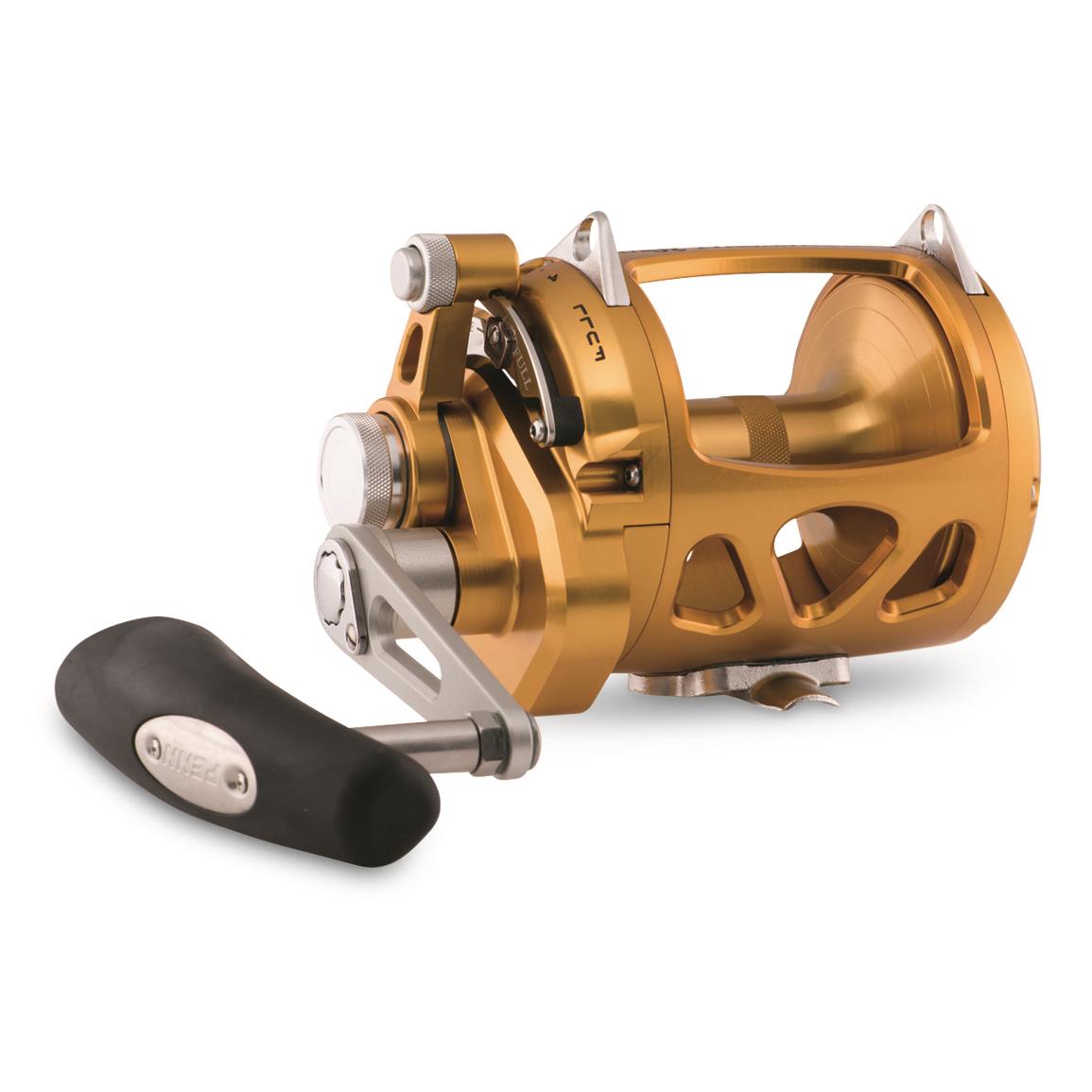
A two-speed reel contains two separate gear ratios within the same housing. You toggle between them using a button, lever, or shift mechanism — typically located on the side plate near the handle. High gear gives you a faster retrieve for recovering line quickly when a fish turns toward the boat or runs across the surface. Low gear reduces the retrieve speed but multiplies your cranking power, effectively giving you a mechanical advantage when you need to pull a fish up from depth or grind against sustained resistance.
The shift between gears is instantaneous on quality reels. You don’t lose tension, you don’t lose drag setting, and you don’t break your fighting rhythm. On cheaper two-speed designs, the shift can feel vague or hesitant — this is an area where you genuinely get what you pay for.
When Single-Speed Is Enough
For 20-class reels and lighter 30-class applications — school dolphin, bonito, king mackerel, smaller tuna — a single-speed reel in a moderate gear ratio is perfectly adequate. The fish aren’t big enough to require the low-gear grinding advantage, and the fights are short enough that high-speed line recovery isn’t critical. A single-speed 30-class reel with a 4.5:1 or 5:1 ratio covers these scenarios without the added cost, weight, and mechanical complexity of a two-speed mechanism.
When You Need Two-Speed
The moment your target species exceeds 50 pounds and fights vertically — pulling down into the water column rather than running across the surface — two-speed capability transforms from a convenience into a necessity. Yellowfin tuna are the textbook example. A big yellowfin runs hard on the initial strike, and you need high gear to recover line when it circles or turns. Then it sounds — diving deep and using its body shape to maintain depth — and suddenly every inch of line you gain comes through brute, arm-burning force. Shifting to low gear on a two-speed reel cuts that effort dramatically, letting you pump and wind with sustainable effort instead of maxing out on every crank.
We consider two-speed essential on any reel 50-class and above, and highly recommended on 30-class reels used for yellowfin, wahoo, or marlin. The cost premium is typically $50 to $150 at comparable quality levels, and it’s money well spent.
Drag Systems: Lever Drag vs Star Drag, Carbon vs Composite
The drag system is the heart of an offshore trolling reel. It’s the mechanism that applies controlled friction to the spool, letting the fish take line under resistance rather than pulling against a locked spool that would snap the line. Understanding how drag systems work — and how they differ — is essential to choosing the right reel.
Lever Drag vs Star Drag
Offshore trolling reels come in two primary drag configurations: lever drag and star drag. For trolling applications, lever drag is the correct choice in almost every scenario.
A lever drag system uses a push-forward lever — typically located on top of the reel near the rod — to control drag pressure. The lever travels through defined positions: free spool at the back, a preset strike position in the middle, and full drag at the forward end. This design lets you go from zero drag to a calibrated fighting drag in a single, repeatable motion. When a reel in the outrigger goes off, you push the lever to strike, and you know exactly how much pressure you’re applying because you pre-set it before the fish ate. That repeatability is critical in offshore trolling, where hook-sets happen fast and you can’t be fumbling with fine adjustments while a marlin is greyhounding away from the transom.
A star drag system uses a star-shaped wheel on the handle shaft to adjust drag pressure through incremental rotation. Star drags are excellent on casting and jigging reels, but they lack the rapid, repeatable adjustment that lever drags provide in a trolling context. You can’t preset a star drag to return to a specific pressure setting after going to free spool, and adjusting drag under heavy load requires fine motor control that’s difficult when you’re fighting a big fish. Star drag reels have their place in deep sea bottom fishing, but for offshore trolling, lever drag is the standard for good reason.
Carbon Fiber vs Composite Drag Washers
The material inside the drag system matters as much as the external mechanism. Drag washers are the friction surfaces that create the resistance, and they come in two primary materials for offshore reels: carbon fiber and composite (often marketed as HT-100 or similar trade names).
Carbon fiber drag washers are the premium option. They produce smooth, consistent drag pressure across a wide range of settings, generate less heat during sustained runs, and maintain their performance characteristics when wet. High-end reels from Shimano (Tiagra series) and Penn (International VI series) use carbon fiber drag stacks that deliver buttery smooth pressure without the pulsing or sticking that plagues lesser materials. A quality carbon drag stack can also handle higher maximum pressures without glazing or deteriorating.
Composite drag washers — Penn’s HT-100 being the most recognized — are the proven workhouse material. HT-100 washers have landed more tournament fish than any other drag material in history. They’re durable, they perform well when wet, and they’re easy to replace. The performance gap between premium composite washers and carbon fiber washers has narrowed significantly in recent years, and for most anglers fishing 30-class and below, a quality composite drag system is more than adequate.
Where carbon fiber genuinely separates itself is at high drag pressures sustained over long fights — the kind of scenario you encounter with large tuna and marlin on 50- and 80-class tackle. At 30-plus pounds of drag pressure applied continuously for 20 minutes, carbon fiber maintains smoother, more consistent performance with less heat buildup. If you’re fishing at this level, the carbon drag upgrade is worth the investment.
Gear Ratios: High-Speed Retrieve vs Low-Speed Power
Gear ratio describes the relationship between handle cranks and spool revolutions. A reel with a 6.2:1 ratio turns the spool 6.2 times for every full crank of the handle. A reel with a 3.1:1 ratio turns it 3.1 times. Higher ratios mean faster line retrieval. Lower ratios mean more cranking power per turn.
For offshore trolling, the gear ratio you need depends on whether you’re fishing a single-speed or two-speed reel — and what species you’re targeting.
Single-Speed Ratio Selection
On a single-speed trolling reel, you’re locked into one ratio for the entire fight. A moderate ratio in the 4.0:1 to 5.0:1 range offers the best compromise between retrieval speed and cranking power for general-purpose trolling. This range lets you recover line at a reasonable pace when a fish runs toward the boat, while still providing enough mechanical advantage to pump and wind against moderate resistance.
Avoid single-speed reels with very high ratios (6:1 and above) for trolling applications. The speed sounds appealing on paper, but the loss of cranking power becomes apparent the moment a fish loads the rod and you realize each handle turn is moving the spool against your arm strength rather than with mechanical assistance.
Two-Speed Ratio Advantages
Two-speed reels solve the ratio dilemma entirely. A typical offshore two-speed reel offers something like 6.2:1 in high and 3.1:1 in low. In high gear, you’re cranking line at roughly twice the speed of low gear — critical for recovering slack when a fish suddenly changes direction. In low gear, you’re applying roughly twice the cranking force — critical for gaining line against a deep, heavy fish that’s using every ounce of its body weight to stay down.
The ability to shift between these ratios during a fight is what makes two-speed reels so effective offshore. You start in high gear during the initial run and surface fight, shift to low when the fish sounds and the battle becomes a vertical grind, shift back to high when it rises, and repeat until the fish is at the boat. This dynamic adaptation keeps you in the most efficient gear for each phase of the fight, reducing fatigue and shortening fight times.
Frame Materials: Machined Aluminum vs Graphite
The frame of an offshore trolling reel must do two things: resist flexion under heavy drag loads and survive years of saltwater exposure. Frame material is where reel manufacturers make their most significant cost-versus-performance decisions, and it directly affects how long your reel holds up and how it performs under pressure.
Machined Aluminum
Premium offshore trolling reels — Shimano Tiagra, Penn International, Accurate Valiant — use frames machined from solid aluminum billets. Machined aluminum is lighter than cast aluminum, dramatically more rigid, and far more resistant to the microscopic flex that causes gear misalignment under heavy loads. When you’re applying 40 pounds of drag and cranking against a fish that’s pulling just as hard, the frame is absorbing enormous stress. A machined aluminum frame maintains its dimensional integrity under that stress, keeping gears meshed perfectly and drag components aligned.
The corrosion resistance of quality anodized aluminum is excellent, though not impervious. Saltwater will find its way into anodized surfaces eventually, especially around screw threads and seams. This is where maintenance discipline separates reels that last five years from reels that last twenty.
Graphite and Composite Frames
Budget and mid-range offshore reels often use graphite or composite frames to reduce cost and weight. Graphite frames are corrosion-proof — salt water cannot corrode a graphite frame the way it attacks aluminum — which is a genuine advantage for anglers who aren’t religious about post-trip reel maintenance.
The trade-off is rigidity. Graphite frames flex more under heavy drag loads than aluminum frames, and that flex can cause inconsistent drag performance, gear wear, and an overall reduction in the reel’s mechanical efficiency. For 20-class and lighter 30-class applications where drag pressures stay below 20 pounds, graphite frames perform adequately. For 50-class and above, or any scenario where you’re routinely applying high drag pressures, a machined aluminum frame is a necessary investment.
One-Piece vs Two-Piece Frames
Within the aluminum category, one-piece frames offer superior rigidity compared to two-piece (bolted) designs. A one-piece frame eliminates the potential for the side plates to shift or spread under load, which is a real concern on heavy tackle. Most premium offshore reels use one-piece or near-one-piece frame designs for this reason. It’s a detail worth checking on the spec sheet, especially for 50- and 80-class reels.
Line Capacity: Matching Capacity to Species and Technique
Line capacity isn’t just about fitting enough line on the spool. It’s about ensuring you have enough reserve after a fish has made its longest run to still fight it effectively. Running out of line means losing the fish and potentially losing terminal tackle worth significant money. Every offshore angler who’s been at this long enough has watched a spool empty and felt the sickening pop of a snapped line.
How Much Line You Actually Need
The species you’re targeting dictates your minimum line capacity requirements. Here are realistic benchmarks based on our experience:
- Dolphin, bonito, king mackerel: 300 to 400 yards of working line is sufficient. These fish make fast but relatively short runs. A 20-class reel with 400 yards of braid handles them comfortably.
- Yellowfin tuna (30 to 80 pounds): 500 to 650 yards minimum. Yellowfin make powerful initial runs and then fight vertically, but a hot fish on light drag can strip 300 yards in the first minute. You need the reserve. See our yellowfin tuna fishing guide for species-specific tackle recommendations.
- Wahoo: 400 to 550 yards. Wahoo are speed demons that make blistering initial runs — often the fastest of any offshore species — but they tire relatively quickly.
- Blue marlin: 800 to 1,200 yards depending on the size of fish you’re targeting. A 400-pound blue marlin can strip 500 yards of line in a single run. You need every yard on the spool and then some.
- Giant bluefin tuna: 1,000 yards minimum of heavy braid. These fish combine speed, stamina, and raw power in a package that will test the absolute limits of your tackle.
Braid vs Mono for Trolling
Braided line offers dramatically more capacity per spool volume than monofilament. A reel that holds 500 yards of 30-pound mono might hold 800 yards of 65-pound braid. This capacity advantage has made braid the dominant choice for offshore trolling, often fished with a monofilament or fluorocarbon topshot of 50 to 200 yards that provides stretch and abrasion resistance near the terminal end.
The braid-to-mono topshot system gives you the best of both worlds: the capacity and sensitivity of braid for the bulk of your line, and the shock absorption and invisibility of mono where the fish can see it. Most serious offshore trollers run this configuration, and reel manufacturers design their line capacity specifications around it.
Matching Reel to Rod: Why a Balanced Outfit Matters
An expensive reel on the wrong rod is a waste of money. The rod and reel need to work as a matched system — balanced in weight, compatible in power rating, and ergonomically functional as a unit. An unbalanced outfit creates leverage problems, accelerates fatigue during fights, and can actually reduce the effective performance of both components.
Weight Balance
Hold the outfit at the rod’s balance point — the spot where the rod sits level in your hand without tipping forward or backward. On a properly balanced trolling outfit, this point should be near the reel seat or slightly forward of it. If the outfit is tip-heavy, the rod will nosedive in the holder and the tip will drag in the water. If it’s butt-heavy, the rod won’t load properly when a fish pulls.
Power and Line Class Matching
Rod manufacturers rate their trolling rods by line class — 20-pound, 30-pound, 50-pound, 80-pound — and these ratings should match your reel’s intended line class. A 30-class reel belongs on a 30-pound trolling rod, not a 50-pound rod that will overpower the reel’s drag capacity, and not a 20-pound rod that will be overstressed by the reel’s maximum drag.
The rod’s power rating determines how much force it transmits to the fish through the leverage of the blank. A rod rated too heavy for the reel’s drag output wastes energy — you’re fighting the rod’s stiffness instead of applying pressure to the fish. A rod rated too light for the reel’s drag output risks catastrophic failure — a broken rod blank or pulled guides under maximum load.
Roller Guides vs Ring Guides
For offshore trolling applications, roller guides are standard on 30-class and above outfits. Roller guides use small, free-spinning rollers at each guide station instead of fixed ceramic or metal rings. These rollers reduce friction dramatically as line passes through the guides under load, which means less heat generation on the line, less wear on the guides, and more efficient transfer of drag pressure to the fish. On heavy tackle — 50-class and 80-class — roller guides are not optional. The friction generated by heavy braided line pulling through fixed ring guides under 40-plus pounds of drag will destroy the guides and compromise the line.
Budget Tiers: What to Expect at Every Price Point
Offshore trolling reels span a wide price range, and understanding what each tier offers helps you allocate your budget effectively. We’ve fished reels across all three tiers extensively, and each has a legitimate place depending on your fishing frequency, target species, and long-term plans.
Entry Level: $200 to $400
At this tier, you’re looking at reels like the Penn Squall II and Shimano TLD series. These are capable reels that handle 20- and 30-class applications well. Expect graphite or composite frames, single-speed gear trains, and composite drag systems. Build quality is solid but not refined — you’ll notice rougher finishes, less precise machining tolerances, and lighter-duty hardware compared to premium reels.
For anglers who troll occasionally, target mid-size species like dolphin and smaller tuna, or are building their first trolling spread on a budget, this tier delivers genuine performance. The Shimano TLD in particular has proven itself as a reliable workhorse on countless charter boats. These reels will handle years of service if you maintain them properly, though they won’t perform at the same level as premium options under extreme pressure.
Mid-Range: $400 to $700
This is the sweet spot for serious recreational anglers. Reels like the Penn International VISX, Shimano Tyrnos II, and Okuma Makaira offer machined aluminum frames, two-speed gear trains, and upgraded drag systems — many with carbon fiber washers. Build quality takes a significant step up from the entry tier, with tighter machining tolerances, smoother gear trains, and more refined drag curves.
A mid-range 30- or 50-class reel from any of these manufacturers will handle everything from school dolphin to large yellowfin tuna and small to medium marlin. The Penn International VISX series is a standout in this tier — it delivers performance that approaches the flagship International VI at a substantially lower price point. If we were outfitting a private boat on a realistic budget, mid-range reels would fill most of the rod holders.
Premium: $700 and Above
The premium tier is where engineering becomes art. The Shimano Tiagra, Penn International VI, and Accurate Valiant represent the pinnacle of offshore trolling reel design. One-piece machined aluminum frames, full carbon fiber drag stacks with astronomical drag capacities, silky two-speed gear trains with instant shifting, and fit and finish that inspires confidence before you even put the reel on the rod.
These reels are built for anglers who fish hard, fish often, and target the biggest species the ocean offers. A Shimano Tiagra 50W has landed more tournament tuna and marlin than probably any other single reel model in history. The Penn International VI is its primary rival, and both deliver the kind of mechanical perfection that justifies the price when your season includes blue marlin, giant tuna, or serious tournament competition.
Is a $1,200 reel four times better than a $300 reel? No. Is it meaningfully better in the scenarios it’s designed for? Absolutely. The premium tier is for anglers who need maximum performance, maximum durability, and maximum reliability — and who will use the reel hard enough and long enough to realize the return on investment.
Maintenance Essentials for Saltwater Trolling Reels
Saltwater destroys fishing tackle. This is not an exaggeration — it’s an electrochemical reality. Sodium chloride in solution is one of the most corrosive environments your reel will face, and every offshore trip exposes your equipment to it. The difference between a reel that lasts three years and a reel that lasts fifteen is not the reel itself — it’s the maintenance.
After Every Trip
Rinse every reel with fresh water immediately after returning to the dock. Use a gentle stream from a hose — not a pressure washer, which can force water past seals and into the drag stack and gear train. Pay attention to the drag lever area, the handle knob, the spool shaft, and any screw heads or seams where salt can accumulate. Let the reels air dry completely before storing them.
Monthly During the Season
Back off the drag completely on any reel in storage. Storing a reel with the drag engaged compresses the drag washers, which can cause flat spots and uneven drag performance over time. Apply a light reel oil to the handle knob bearings, the spool shaft, and the level wind (if equipped). A small drop of oil on the drag lever pivot keeps the lever action smooth.
Annual Service
Once a year — or every 40 to 50 fishing days, whichever comes first — disassemble the reel for a full service. This means removing the side plate, inspecting and cleaning the gear train, checking drag washers for wear and glazing, replacing any corroded hardware, and re-greasing all bearing surfaces with marine-grade reel grease. If you’re not comfortable doing this yourself, most tackle shops and reel repair services offer annual maintenance for $40 to $80.
The reels that show up at the repair shop with frozen drags, corroded gears, and seized bearings are not defective products. They’re neglected tools. A ten-minute rinse after every trip and a yearly service will keep a quality offshore reel performing at its best for a decade or more.
Frequently Asked Questions
What size offshore trolling reel do I need for tuna?
It depends entirely on the size of tuna you’re targeting. For blackfin tuna and small yellowfin under 30 pounds, a 20- or 30-class reel is appropriate. For yellowfin in the 30- to 80-pound range, a 30-class two-speed reel is the standard choice. Yellowfin over 80 pounds call for a 50-class reel with a two-speed gear train and carbon fiber drag. For giant bluefin tuna — fish exceeding 200 pounds — nothing less than an 80-class reel with 100-plus pounds of drag and 1,000-plus yards of line capacity is adequate. Our yellowfin tuna fishing guide covers tackle selection for that species in detail.
Is lever drag better than star drag for trolling?
For trolling specifically, yes. Lever drag is superior because it allows you to preset your strike drag, go to free spool for a bait drop or outrigger deployment, and return to your exact fighting drag in a single, repeatable motion. Star drag reels require manual readjustment every time you change the setting, which introduces inconsistency during the critical moments after a strike. Star drag reels have strengths in other applications — jigging, bottom fishing, casting — but for trolling, lever drag is the industry standard and our consistent recommendation.
How much drag do I actually need for offshore trolling?
A practical rule of thumb is to set your strike drag at roughly one-third of your line’s breaking strength. So 30-pound line gets a 10-pound strike drag, 50-pound line gets around 17 pounds, and so on. Your reel’s maximum drag capacity should comfortably exceed the maximum drag you’ll realistically apply — which means you want at least 25 to 30 pounds of maximum drag on a 30-class reel and 40 to 50 on a 50-class. You should never fish at a reel’s absolute maximum drag setting, because that leaves no headroom and puts extreme stress on the drag components.
Can I use the same reel for trolling and bottom fishing?
Technically yes, but the ideal reel for each technique differs. Trolling reels are optimized for lever drag control, line capacity, and sustained drag performance during horizontal and surface fights. Bottom fishing in deep water emphasizes cranking power and retrieval speed for hauling fish and tackle up from depth. A quality two-speed lever-drag reel in the 30- or 50-class range can handle both, but it’s a compromise in each direction. If you do a lot of both, dedicated setups outperform a shared one. Our guide on choosing a deep sea reel covers bottom fishing reel selection in detail.
How often should I service my offshore trolling reel?
At minimum, rinse with fresh water after every saltwater trip, back off the drag for storage, and perform a full disassembly and service annually or every 40 to 50 fishing days. If you fish tournaments or troll more than 50 days a year, consider servicing twice annually — once at the start of the season and once at the midpoint. Drag washers should be inspected during every service and replaced if they show glazing, uneven wear, or reduced smoothness. Most manufacturers sell drag washer kits for $15 to $40, making this one of the most affordable ways to maintain peak performance on a reel that may have cost ten or twenty times that amount.
Quick Buy — Products in This Article