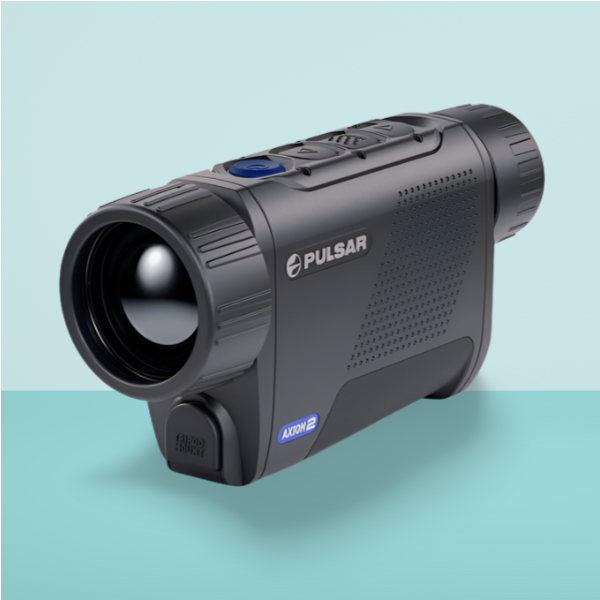
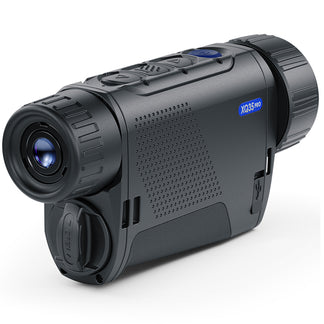
Pros
- 384x288 sensor with 1300-yard detection range in a pocket-sized package
- Stream Vision 2 app for Wi-Fi streaming and recording
- Excellent ergonomics — true one-hand operation with intuitive controls
- Built-in photo and video recording with 16GB onboard storage
- 8+ hour battery life on a single charge
Cons
- 384 resolution shows its limits beyond 500 yards for ID
- No built-in rangefinder at this price point
- Screen brightness can wash out in direct sunlight
- Lens cap design could be more secure
We have carried the Pulsar Axion 2 XQ35 Pro on every predator stand for the past season — coyote sets across open Kansas prairie, nighttime hog sits in Oklahoma cedar breaks, and dawn fox hunts on frozen Iowa pastureland. Over 80+ stands and hundreds of hours of field use, this monocular has been the first thing we reach for when we step out of the truck and the last thing we put away. After running it through our full Benchmark testing methodology, we are ready to give you the definitive answer on whether the Axion 2 XQ35 Pro deserves its reputation as the go-to thermal handheld for predator hunters.
This is not a first-look or unboxing recap. We have used, abused, and stress-tested this unit in conditions ranging from 95-degree August scouting sessions to minus-10 wind chills on January predator stands. Here is everything we found.
Who Should Buy the Pulsar Axion 2 XQ35 Pro
The Axion 2 XQ35 Pro is built for dedicated predator hunters who need a reliable, high-quality thermal scanning tool that disappears into their kit. If you run 20+ stands a season, call coyotes on open ground where pre-stand scanning separates successful hunts from blown setups, or you need a monocular that works flawlessly every single time you press the power button, this is the unit.
It is also the right choice for hunters who want one thermal monocular that does everything well without forcing compromises. The Axion 2 balances image quality, detection range, battery life, recording capability, and portability better than anything else we have tested at its price point. If you are building out a predator hunting gear list and need one thermal handheld to cover all scenarios, start here.
Skip this monocular if: You need to identify targets at 600+ yards consistently — the 384 sensor will frustrate you at extreme range, and you should look at 640-resolution units instead. If integrated rangefinding is a must-have, the AGM Fuzion LRF TM35-384 bundles a laser rangefinder that the Axion 2 lacks. And if your budget is under $1,500, check our full best thermal monoculars for predator hunting roundup for capable options at lower price points.
Key Specifications
| Spec | Detail |
|---|---|
| Sensor Resolution | 384x288 (17um pixel pitch) |
| Objective Lens | 35mm |
| Magnification | 2.5x-20x (2.5x optical, 8x digital) |
| Detection Range | 1,300 yards |
| Refresh Rate | 50Hz |
| Display | 1024x768 AMOLED |
| Battery Life | 11 hours (rated), 8+ hours (field-tested) |
| Weight | 10.6 oz |
| NETD | ≤40 mK |
| Recording | Built-in photo/video, 16GB onboard storage |
| Connectivity | Wi-Fi, Stream Vision 2 app |
| Water Resistance | IPX7 |
| Color Palettes | 8 modes |
| Charging | USB-C |
Performance: Detection Range and Image Quality
Detection range and image quality are the two specs that matter most in a predator hunting monocular, and the Axion 2 XQ35 Pro delivers on both fronts — with some honest caveats about where the 384 sensor reaches its limits.
The 384x288 sensor paired with Pulsar’s latest image processing algorithms produces a remarkably clean thermal picture for a sub-11-ounce handheld device. During testing on open grassland, we consistently picked up coyote-sized heat signatures at 800+ yards on cool, clear nights with strong thermal contrast. On one particularly still December evening in central Kansas, we detected a group of three coyotes working a fence line that we later confirmed was at 920 yards with a laser rangefinder. At that distance, we could tell by gait and movement pattern that we were looking at canines, but positive species identification — distinguishing a coyote from a farm dog — required them to close to roughly 500 yards.
That 500-yard identification threshold is the practical ceiling for the 384 sensor in real hunting conditions. On nights with strong thermal contrast (cold, dry, clear skies), we pushed positive ID to 450-500 yards on coyotes with confidence. On warm, humid evenings where background temperatures stayed elevated, effective ID range dropped to 300-350 yards. This is not a weakness unique to the Axion 2 — it is a fundamental limitation of 384-resolution sensors that applies equally to every unit in this class. If you hunt wide-open Western rangeland where you need to ID targets beyond 500 yards, a 640-resolution monocular is worth the investment. For the vast majority of predator hunting scenarios — scanning treelines, checking fence rows, glassing CRP fields, and monitoring caller setups — the Axion 2’s image quality is more than sufficient.
The 17-micron pixel pitch keeps the image tight and detailed within the identification envelope, and Pulsar’s image boost processing smooths noise without smearing fine detail. We found White Hot the most effective palette for general scanning, delivering the cleanest contrast between animal heat signatures and ambient backgrounds. Red Monochrome proved useful for picking out animals against warm backgrounds like sunlit rock faces still radiating heat after sunset. The ability to cycle between eight color palettes with a quick button press — no menu diving — is a practical advantage when conditions shift mid-stand.
The 1024x768 AMOLED display renders the thermal image beautifully. Colors are accurate across all palette modes, blacks are deep, and there is no visible pixel grid even at moderate digital zoom levels. Compared to LCD-equipped competitors, the AMOLED advantage is immediately obvious. The 50Hz refresh rate delivers smooth, real-time imagery with no perceptible lag when panning across a field, which matters when you are scanning quickly to locate a responding coyote before it reaches your caller.
Performance: Ergonomics and One-Hand Use
This is where the Axion 2 XQ35 Pro separates itself from nearly every competitor we have tested. The ergonomics are not just good — they are best-in-class.
At 10.6 ounces, the Axion 2 fits naturally in one hand and genuinely disappears into a jacket pocket. We carried it in the chest pocket of our predator hunting vest all season without noticing the weight or bulk. When other thermal monoculars occasionally got left in the truck because they added too much weight to an already loaded kit, the Axion 2 came with us on every single stand. The best thermal monocular is the one you actually carry, and the Axion 2 wins that competition decisively.
The control layout is designed for operation in complete darkness with heavy gloves. The power button, menu toggle, and zoom controls are raised, tactile, and spaced far enough apart that we never pressed the wrong button — even with insulated Mechanix winter gloves in sub-zero conditions. Boot-up time is under four seconds from a cold start, which matters when a coyote appears unexpectedly and you need eyes on it immediately. We have lost animals to slow-booting competitors. Never with the Axion 2.
The eyepiece is comfortable for extended scanning sessions. We routinely glassed for five to ten minutes at a stretch during pre-stand scans without eye fatigue. The adjustable screen brightness prevents eyepiece glow from illuminating your face in total darkness — a detail that matters on pressured ground where educated coyotes circle downwind and skyline-check your position. At minimum brightness, the Axion 2 is effectively invisible to anything watching you.
One-hand operation means your other hand stays free. Free to hold a shooting stick, free to work an electronic predator call remote, free to brace against a tree or fencepost for stability during extended scans. On team hunts where one person scans while the other stays on the rifle, the scanner can relay real-time information without ever putting down the monocular. This operational fluidity sounds minor on paper but compounds across a season of hunting into a genuine tactical advantage.
Performance: Recording and Streaming
The built-in photo and video recording capability is a feature we initially dismissed as a marketing checkbox and now consider a legitimate advantage.
The Axion 2 records video at the display’s native 1024x768 resolution directly to 16GB of onboard storage. That is enough for roughly four to five hours of continuous video recording — far more than you will ever need in a single session. The recording toggle is a quick-access function that does not require menu navigation, so you can start and stop recording without taking your eye off the thermal image.
Video quality is good enough for hunt documentation, social media content, and reviewing animal behavior after the fact. It is not cinematic — you are recording a thermal display, not an 4K camera feed — but the footage is sharp, clean, and clearly shows what the operator is seeing. We have used Axion 2 footage to review coyote approach routes, study how animals responded to different calling sequences, and settle friendly arguments about how far away that triple was. For hunters who guide clients on predator hunts, the recording capability lets you capture proof of performance without carrying a separate camera rig.
The Stream Vision 2 app connects via Wi-Fi and mirrors the monocular’s display on a smartphone or tablet in real time. We used this most often on two-person hunts where the spotter needed to see exactly what the scanner was seeing. Signal range was reliable out to about 15 feet, which covers the typical distance between a caller and a shooter on a predator stand. The app also handles firmware updates — Pulsar pushes these regularly, and we received one update during our testing window that improved image processing in high-humidity conditions.
The app’s gallery function lets you review and transfer recorded photos and videos to your phone without connecting to a computer. This is a meaningful convenience improvement over competitors that require USB cable transfers through desktop software. After a hunt, we could pull our best clips onto a phone in the truck and share them within minutes.
Performance: Battery Life and Cold Weather
Pulsar rates the Axion 2 XQ35 Pro at 11 hours of battery life, and while we never quite hit that number with active use, we consistently exceeded 8 hours — which is outstanding for a thermal monocular of this size.
During moderate-temperature hunts (nighttime temps between 35-65 degrees Fahrenheit), we routinely got 8 to 9 hours of active scanning before the low-battery indicator appeared. Active scanning means the unit was powered on, we were adjusting brightness, cycling palettes, zooming, and occasionally recording — the way you actually use a monocular in the field, not sitting idle in a drawer. For a typical predator hunting evening that spans five to six hours across multiple stands with drive time in between, the Axion 2 has battery life to spare on a single charge.
Cold weather is where every lithium-ion device takes a hit, and the Axion 2 is no exception. During our January and February hunts in Kansas with ambient temperatures between 5 and 20 degrees Fahrenheit, battery life dropped to 6 to 7 hours of active use. That is still enough for a full evening of predator hunting, and meaningfully better than several competitors that fell below five hours in the same conditions. We kept the Axion 2 in an inside jacket pocket between stands, which kept the battery warm and mitigated cold-related drain. This simple habit extended usable runtime by roughly 30 to 45 minutes on the coldest nights.
The USB-C charging port is a practical advantage. We charged the Axion 2 from a vehicle charger during the drive between hunting properties and from a 10,000mAh power bank when camping. A 30-minute charge between stands was typically enough to add an hour or more of runtime. The unit can also run continuously off USB-C power, so a compact power bank in a vest pocket provides effectively unlimited runtime for marathon hunting sessions.
Performance: Build Quality
The Axion 2 XQ35 Pro is built to handle the realities of predator hunting, and after a full season of hard use, our test unit shows it.
The magnesium alloy housing is rigid, lightweight, and shrugs off the inevitable knocks and drops that happen when you are pulling gear out of bags in the dark. We dropped the Axion 2 from waist height onto frozen ground twice — once intentionally during testing, once decidedly not — and it powered on and performed identically both times. The IPX7 waterproof rating held up through multiple hunts in steady rain and one particularly memorable snow squall that left everything in our pack coated in wet snow. No fogging, no moisture intrusion, no loss of image quality.
The lens cap is our one build quality complaint. It attaches via a friction-fit rubber tether that works fine when the unit is stored in a pocket, but we found the cap occasionally coming loose when the Axion 2 was tossed into a pack with other gear. A magnetic or threaded cap would be a welcome improvement. We eventually attached a short lanyard to prevent the cap from separating entirely — a minor field fix that Pulsar should address in the next revision.
The objective lens itself is scratch-resistant and cleaned easily with a microfiber cloth. After a full season, our lens shows no visible scratches or coating degradation despite being exposed to blowing dust, light rain, and the general abuse of living in a hunting vest.
Benchmark Score Breakdown
We scored the Pulsar Axion 2 XQ35 Pro against our standard methodology criteria for thermal monoculars:
- Image Quality: 8.5/10 — Excellent for a 384 sensor, clean processing, outstanding AMOLED display
- Detection Range: 8/10 — Strong scanning range at 1,300 yards, positive ID limited to ~500 yards by sensor resolution
- Ergonomics: 9.5/10 — Best-in-class one-hand operation, pocket-sized, glove-compatible controls
- Battery Life: 9/10 — 8+ hours in real conditions, USB-C charging, runs off external power
- Build Quality: 8.5/10 — IPX7, magnesium housing, durable construction; lens cap is the weak spot
- Features: 8/10 — Recording, Wi-Fi streaming, 8 palettes, Stream Vision 2 app
- Value: 7.5/10 — Strong performance for the price, but no rangefinder at this tier
Overall Benchmark Score: 8.4/10
How It Compares
We have tested the Axion 2 XQ35 Pro against the two monoculars hunters most often cross-shop it with. Here is the quick breakdown — for the full comparison, see our best thermal monoculars for predator hunting roundup.
vs. AGM Fuzion LRF TM35-384
The AGM Fuzion matches the Axion 2 on sensor resolution (384x288) and adds a built-in 600-yard laser rangefinder — the single feature the Pulsar lacks. If you hunt open country where precise distance matters for shot placement and you want to consolidate your kit into fewer devices, the Fuzion’s integrated rangefinding is a genuine tactical advantage. We found the Fuzion’s range readings accurate to within plus or minus two yards out to 500 yards, and having the distance displayed directly on the thermal overlay eliminates the mental context switching of juggling a separate rangefinder.
Where the Axion 2 wins is image quality, ergonomics, and battery life. Pulsar’s image processing produces a noticeably cleaner, smoother thermal picture than the Fuzion, especially at higher digital zoom levels where the AGM’s image becomes grainy. The Axion 2 is lighter (10.6 oz vs. ~14 oz), more comfortable for extended one-hand scanning, and its 8+ hour battery life outpaces the Fuzion’s 5-6 hours by a meaningful margin. The Fuzion’s rangefinder draws significant power, and heavy ranging reduces runtime further.
Our take: If you already carry a quality standalone rangefinder and prioritize image quality and all-day battery life, the Axion 2 is the better monocular. If eliminating a separate rangefinder from your kit and gaining integrated distance data is worth the trade-offs in image quality and runtime, the Fuzion earns its place.
vs. Trijicon IR-PATROL M250XR
The IR-PATROL plays in a different league on sensor resolution and build quality. Its 640x480 sensor produces a thermal image with significantly more detail at range than the Axion 2’s 384 sensor — positive coyote identification stretches past 400 yards consistently, and the 60Hz refresh rate is the smoothest in the handheld thermal market. Trijicon’s military-heritage construction is virtually indestructible, and the IR-PATROL is the monocular you buy when equipment failure is not an option.
Where the Axion 2 wins is features, battery life, portability, and value. The IR-PATROL intentionally strips away Wi-Fi, recording, app connectivity, and color palettes in favor of absolute reliability and sensor performance. Its CR123A battery provides only 4-5 hours of runtime versus the Axion 2’s 8+ hours. And the Trijicon commands a significant price premium that puts it in a different budget category entirely.
Our take: The IR-PATROL is the better thermal sensor. The Axion 2 is the better predator hunting tool for most hunters. Unless you operate in genuinely extreme conditions, need maximum identification range, or demand mil-spec durability, the Axion 2 delivers 90% of the IR-PATROL’s capability at a meaningfully lower price with better battery life and a richer feature set.
Frequently Asked Questions
Is the Pulsar Axion 2 XQ35 Pro worth it for coyote hunting specifically?
Absolutely. The Axion 2 XQ35 Pro is arguably the best-matched thermal monocular for dedicated coyote hunting. The 384 sensor provides more than enough resolution to ID coyotes at the 200-500 yard distances where most predator calling action happens. The pocket-sized form factor means you actually carry it on every stand — not just the ones where you remembered to pack it. And the 8+ hour battery life covers a full evening of multiple setups without recharging. We have called in and confirmed more coyotes with the Axion 2 than any other piece of scanning equipment we own. The pre-stand scan alone — spending two minutes glassing every quadrant before starting a calling sequence — has transformed how we set up and directly increased our success rate.
Can I use the Axion 2 XQ35 Pro during the day?
You can, but with limitations. Thermal monoculars work regardless of lighting conditions because they detect heat radiation, not reflected light. During daytime use, the Axion 2 will detect and display heat signatures as effectively as it does at night. The practical issue is that the screen can wash out in direct sunlight, making the display harder to read. We found the Axion 2 usable during overcast days and in shaded conditions, but struggled with screen visibility in bright midday sun. The adjustable eyecup helps block ambient light, and cranking display brightness to maximum improves readability. For pure daytime scanning, traditional binoculars remain superior. The Axion 2 shines during the dawn and dusk transition periods and, of course, in full darkness. For a deeper comparison of thermal technology versus traditional optics in various conditions, see our thermal vs. night vision hunting guide.
How does the Pulsar Axion 2 compare to using a thermal scope for scanning?
A dedicated thermal monocular like the Axion 2 is the safer, more effective, and more practical scanning tool compared to using a thermal rifle scope. The fundamental issue with scanning through a rifle scope is that your muzzle sweeps across everything you look at — including ranch roads, livestock, other hunters, and structures. A handheld monocular lets you glass a full 360 degrees without pointing a rifle at anything. Beyond safety, the Axion 2’s lightweight, one-hand design lets you scan while keeping your silhouette compact and motionless. A hunter swinging a scoped rifle on a bipod is visible to every coyote within 500 yards. A hunter holding a small monocular to one eye is nearly invisible. The ideal predator hunting setup runs a thermal monocular for detection and a thermal scope or clip-on for engagement — the monocular finds targets, the scope engages them. For more on building the right optics system, browse our predator hunting hub.
Does the Stream Vision 2 app actually work reliably in the field?
In our experience, yes — with the caveat that Wi-Fi streaming is a supplementary feature, not a primary one. The Stream Vision 2 app connected reliably to the Axion 2 within seconds on every attempt, and the mirrored display showed minimal latency at distances under 15 feet. We used it most often to let a hunting partner monitor the thermal feed on their phone while we scanned from a different position. The app also handles firmware updates, gallery management, and settings adjustment. Where it occasionally hiccupped was in extreme cold — below about 10 degrees Fahrenheit, the Wi-Fi connection dropped intermittently, likely due to the phone struggling more than the monocular. For critical hunting operations, never rely on the app as your primary interface. Use the monocular’s direct controls and eyepiece for all scanning and decision-making, and treat the app as a useful bonus for team coordination and content transfer.
What accessories should I buy with the Pulsar Axion 2 XQ35 Pro?
Keep it simple. A quality neck lanyard prevents drops and keeps the monocular accessible — we used a thin paracord lanyard that let the Axion 2 hang at chest level when not in use. A compact USB-C power bank (10,000mAh is plenty) provides peace of mind on extended hunts and charges the monocular during drives between stands. A microfiber lens cloth lives in the same pocket as the monocular for quick cleaning in dusty or wet conditions. Beyond that, the Axion 2 does not need much. Skip aftermarket lens caps unless you find one that fits more securely than the stock version. Skip bulky carrying cases — the whole point of this monocular is that it fits in a pocket. The money you save on unnecessary accessories is better spent on ammunition, a quality electronic predator call, or fuel to reach more hunting spots.
Final Thoughts
The Pulsar Axion 2 XQ35 Pro is not the highest-resolution thermal monocular you can buy, and it is not the one with the most features crammed into the housing. What it is, definitively, is the thermal monocular that offers the best overall package for predator hunters who need a reliable, capable, pocketable scanning tool that performs night after night without compromise.
After a full season of carrying it on every stand, we can say without reservation that the Axion 2 has earned its place as permanent kit. It found coyotes we would have missed, confirmed targets we would have guessed at, and survived conditions that would have killed lesser equipment. At an 8.4 Benchmark Score, it sits comfortably as one of the best thermal monoculars in its class — held back only by the inherent limitations of its 384 sensor at extreme range and the absence of an integrated rangefinder.
For most predator hunters running most stands in most conditions, those limitations never matter. What matters is a clean image, fast boot, all-day battery, and a form factor that guarantees you actually have it when you need it. The Axion 2 delivers on all four. Browse more predator hunting gear reviews and guides in our predator hunting hub.